
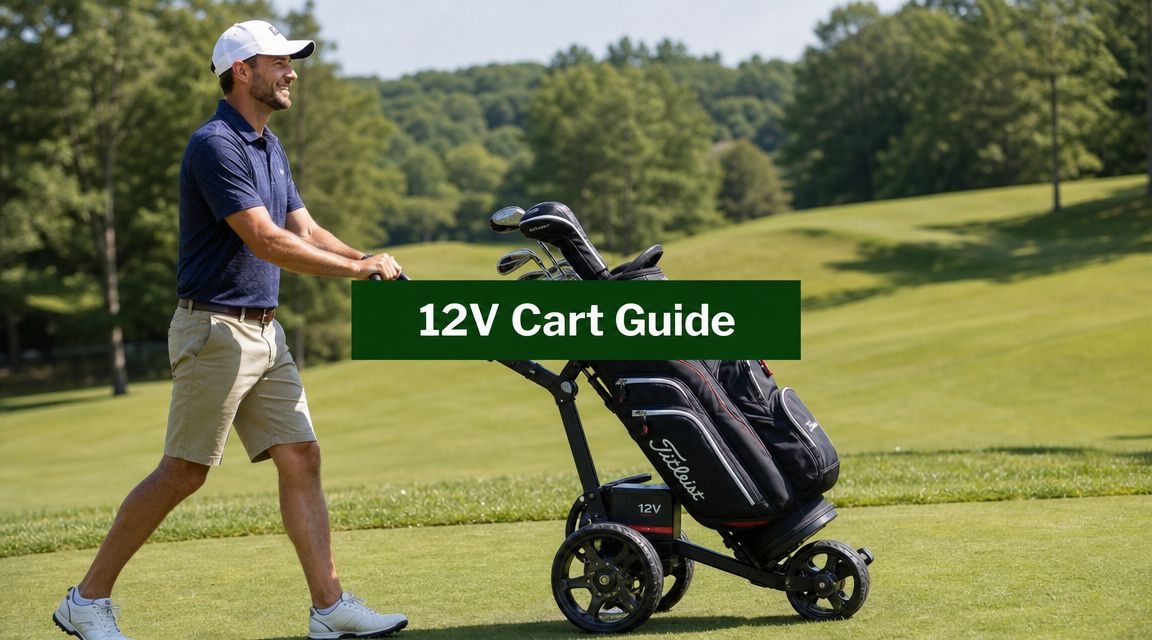
You're probably here because “12V golf cart” sounds simple, but the products behind that phrase aren't.
Maybe you're a walking golfer who loves the rhythm of the round, but your push cart starts feeling heavy by the back nine, especially on hills. Or maybe you own a traditional electric cart and you're trying to figure out whether a 12V battery is the right replacement. Those are two very different situations, and that's where most of the confusion starts.
A 12V golf cart can mean a lightweight power setup for a walking golfer, or it can mean one battery inside a much larger battery pack. If you mix those ideas up, you can buy the wrong battery, expect the wrong range, or end up with a system that won't work.
The Modern Golfer's Guide to 12V Power
Walking golfers know the tradeoff. You get exercise, better pace, and a more connected feel for the course. But pushing a loaded cart up a long incline can turn a relaxing round into a grind.
That's why 12V power has become such a useful term in golf equipment. For some golfers, it means a compact battery that helps drive a motorized push cart add-on. For others, it refers to one piece of the battery pack inside a larger electric riding cart. Same voltage label, very different job.
The history helps explain why this matters. The first golf cart is commonly dated to 1932, and one account says an early electric version needed six car batteries to complete an 18-hole course, which shows how cumbersome early designs were before more standardized battery systems became common, as noted in Cart Barn's golf cart history overview.
Early golf transport was about making movement possible. Modern battery systems are about making movement practical.
That shift is what matters to today's golfer. Battery tech got smaller, more organized, and easier to fit into real golf use. Instead of treating “12V” like a magic answer, it helps to think of it as a power building block.
Where golfers get tripped up
The most common mistake is assuming a 12V label tells you everything. It doesn't.
A walking golfer shopping for a powered wheel kit is usually thinking about:
- Weight and portability. Can you lift it in and out of the trunk?
- Simple charging. Does it fit your routine after the round?
- Enough capacity for your course. Flat and short is different from hilly and long.
A riding cart owner is thinking about something else:
- Pack compatibility. Does the battery match the cart's required system voltage?
- Deep-cycle design. Can it handle repeated use, not just quick bursts?
- Series wiring. Is it one battery or one battery among several?
If you understand that split early, the rest of the buying decision gets much easier.
What a 12V System Really Means for Golfers
When golfers say “12V golf cart,” they often mean one of two things. The cleanest way to understand it is to separate small-system use from full-cart propulsion.

One 12V battery powering a lighter device
This is the version that matters most to walking golfers.
A single 12V battery can make sense when the load is modest, such as a motorized push cart add-on, accessory layer, or smaller golf mobility device. In plain terms, the battery isn't trying to move a heavy riding cart with passengers. It's helping one golfer move one bag with much less physical effort.
A push cart assist system is a bicycle compared with a riding cart being a pickup truck. Both move golf gear, but they don't ask the battery to do the same kind of work.
Multiple 12V batteries inside a larger cart pack
Many buyers get surprised.
A single 12V battery is typically not used alone to power a standard electric cart. In a 48V system, for example, four 12V deep-cycle batteries are connected in series so the motor and controller get the operating voltage they need, as explained in Herewin Power's guide to battery voltage and capacity for golf carts.
Series wiring is easier to understand with a flashlight analogy. One battery gives a little push. Stack the right batteries in sequence, and the pushes add up. That's how a cart reaches the voltage its drivetrain expects.
Practical rule: If you're looking at a full-size electric riding cart, don't assume “12V” means one battery will run the whole vehicle.
That's also why deep-cycle matters. A golf cart battery needs to deliver usable power over time. A regular car starter battery is built for a different job. It's made to provide a quick burst, not steady golf-course duty.
The quick takeaway
If you're a walking golfer, 12V often means a realistic, portable power solution.
If you're working on a traditional electric cart, 12V usually means one module in a larger voltage system, not a standalone answer.
That distinction saves a lot of frustration.
Comparing 12V, 36V, and 48V Golf Cart Systems
Once you separate push-cart power from riding-cart power, the voltage choices start to make more sense. The question isn't “Which voltage is best?” It's “Which voltage fits the job?”

What 12V usually means in practice
For a walking golfer, a 12V setup usually points to simplicity. Smaller system. Less bulk. Less intimidation.
That makes it a natural fit for golfers who want help moving a push cart without jumping all the way to a full riding cart. You're still walking the course, but you're taking the strain out of pushing.
What 36V and 48V are built to do
Traditional electric carts need more from the battery system because they move more weight and do it for longer stretches under heavier load. That's why many 36V or 48V electric golf cart systems are built from multiple 12V batteries connected in series, making 12V a foundational building block rather than a niche format, as noted in Business Research Insights' golf cart battery market summary.
A good mental model is stairs versus an elevator. A small 12V assist setup helps you take the stairs more easily. A 36V or 48V system is the elevator. Different experience, different machinery.
Side-by-side tradeoffs
| System | Best fit | Main advantage | Main drawback |
|---|---|---|---|
| 12V | Motorized push cart add-ons, smaller golf power needs | Lighter, simpler, easier to handle | Not suitable as the sole power source for a standard riding cart |
| 36V | Some traditional electric carts | Established cart system with solid usable power | Less headroom than higher-voltage systems on tougher terrain |
| 48V | Many modern electric carts | Better suited for stronger performance and longer use on demanding routes | Heavier, more complex overall system |
How this affects your round
For a walking golfer, lighter weight can matter more than raw power. You care about folding the cart, lifting it into the car, charging it at home, and making it through the round without your shoulders and lower back doing all the work.
For a rider, the priorities shift. You want enough system voltage to move the cart reliably, especially with passengers, hills, or longer routes.
The right system doesn't start with voltage. It starts with how you actually get around the course.
That's why many golfers searching for a 12V golf cart aren't really shopping for the same thing, even when they use the same phrase.
Choosing the Right 12V Golf Cart Battery
If you're buying a battery, voltage is only part of the story. The two decisions that shape your real-world experience are battery chemistry and capacity.
For range, capacity matters most. Battery capacity is measured in amp-hours (Ah), and industry guidance notes that it matters more than voltage alone when you're trying to judge how long the system will run. Hilly terrain, heavier loads, and longer distances all raise power demand, which is why a higher-capacity option such as a 12V 100Ah battery can be important for maintaining performance, according to Atlantic Battery Systems' guide to 12-volt golf cart batteries.
Think of Ah as the size of the fuel tank
Voltage is like pressure. Amp-hours are closer to the size of the tank.
Two batteries can both be 12V, but the one with more Ah can usually support longer use before recharge. For a walking golfer, that can be the difference between finishing comfortably and watching the system fade late in the round on a hilly course.
12V Golf Cart Battery Comparison
| Feature | Lead-Acid | AGM | Lithium-ion (LiFePO4) |
|---|---|---|---|
| Weight | Heavier | Heavier than lithium, often more manageable than flooded lead-acid setups | Usually lighter |
| Maintenance | Requires more attention | Lower maintenance than traditional flooded lead-acid | Low-maintenance in normal use |
| Charging behavior | Can be slower and more sensitive to discharge habits | Generally straightforward | Often more convenient for frequent users |
| Use experience | Familiar and widely used | Cleaner ownership feel than flooded lead-acid | Strong fit for golfers who value portability and ease |
| Upfront cost | Lower entry point | Mid-range | Higher upfront cost |
| Best for | Budget-focused buyers who don't mind upkeep | Golfers who want less hassle without changing formats entirely | Walkers and frequent players who care about weight and convenience |
How to choose without overthinking it
Start with your real course conditions.
- Mostly flat course. You may get by with a more modest capacity if your load is light.
- Hilly course or long walks. Capacity becomes more important because the motor works harder.
- Heavy bag and extra gear. Every added pound asks more from the battery.
- Frequent play. Convenience starts to matter more, especially when lifting and charging become routine.
If you're a walking golfer, battery choice should support the reason you walk in the first place. You want less strain, not another heavy item to manage.
A battery that looks fine on paper can still feel wrong in the parking lot if it's awkward to carry, slow to charge, or frustrating to live with.
That's why many golfers end up preferring lithium for push-cart power, even when they started by shopping only on voltage.
Installation for Motorized Push Cart Kits
For most walking golfers, the nice surprise is that a motorized push cart upgrade usually isn't a garage project. It's closer to adding a well-designed accessory.

What installation usually looks like
A typical add-on kit uses a bracket that attaches to the cart frame or axle area, then the powered wheel or drive unit mounts onto that bracket. The goal is simple. Keep the original push cart, add powered assistance, and avoid a full replacement.
You don't need to think like an electrician. You need to think like someone attaching a cleanly designed accessory that has to sit securely, track straight, and be easy to remove for storage.
A good example is a wheel hub motor kit for golf push carts, where the setup centers on a bracket-and-drive approach rather than a complicated custom conversion.
A simple install checklist
- Check cart compatibility. Most add-on systems are built around common three-wheel and four-wheel push cart shapes.
- Secure the bracket first. The mount matters because the motor unit depends on stable alignment.
- Confirm wheel clearance. Make sure the powered component won't rub the frame or interfere with folding.
- Charge before first use. That gives you a clean starting point when testing speed and control.
After the hardware is attached, most golfers spend a little time adjusting to assisted walking. The technique is different from pushing manually. You guide more and shove less.
A product in this category is the Caddie Wheel, which adds powered assistance to a standard push cart through a drop-on motorized wheel system with remote control operation. For the right golfer, that's a way to keep walking without the effort of pushing a loaded cart the entire round.
For a closer look at how this kind of upgrade goes together in real life, this video helps:
What new users often notice first
The first benefit usually isn't speed. It's reduced tension.
Your hands stay lighter on the handle. Uphill sections feel less punishing. By the time you reach the last few holes, you've spent less energy managing the cart and more energy on the round itself.
Essential Maintenance and Safety Tips
Battery care doesn't need to be complicated. A few habits do most of the work.
Charging habits that protect battery life
Use the charger that matches your battery's chemistry and intended setup. That sounds basic, but it's where many avoidable problems begin.
For day-to-day care:
- Recharge after use. Don't leave the battery sitting severely discharged if you can avoid it.
- Watch charger behavior. If your charger doesn't have automatic shutoff or battery-management features, don't leave it connected indefinitely.
- Store thoughtfully. Off-season storage is easier on batteries when the battery is kept in a cool, dry place.
If you want a plain-language reference on charger basics, this guide to a 12-volt battery charger for golf cart use is a useful starting point.
Small checks that prevent bigger headaches
Most golf battery problems don't start as dramatic failures. They start as neglected connections.
Clean, tight terminals make a quiet difference. Corrosion and looseness make a noisy one.
Add these quick checks to your routine:
- Inspect terminals. Look for corrosion, residue, or movement at the connections.
- Keep things dry. Golf equipment sees dew, wet grass, and occasional rain, but batteries and connections still need protection from unnecessary water exposure.
- Avoid accidental short circuits. Be careful with metal tools and loose hardware around battery contacts.
- Look at cables and mounts. A battery that shifts in transport or a cable that rubs repeatedly can create trouble later.
Safety on the course and at home
A battery system should feel boring in the best way. Reliable. Predictable. Uneventful.
If something starts getting hot, smells unusual, charges strangely, or delivers abrupt performance changes, stop using it until you identify the issue. That's as true for a powered push cart kit as it is for a larger cart battery setup.
Troubleshooting Common 12V System Issues
When a 12V system acts up, the symptom usually points you in the right direction. The trick is not jumping to the most expensive conclusion first.

If range suddenly drops
Start with the obvious. Check charge level, charger behavior, and connection quality.
If you're using a push-cart assist system, a sudden drop in runtime can point to a battery that isn't reaching full charge, extra rolling resistance, or a connection problem. If the unit still runs but fades earlier than usual, don't assume the motor is the problem.
If the cart or motor won't turn on
Work through the simple items first:
- Confirm battery charge
- Check the main connections
- Inspect any fuse or inline protection
- Make sure controls are paired and functioning
- Look for loose or damaged wires
For more examples of battery-related failure patterns, this overview of golf cart battery issues can help you narrow down what you're seeing.
If a larger cart feels weak under load
Multi-battery systems often confuse people.
In a pack made of several batteries, one weak battery can drag down the whole system. One explanation notes that a multi-battery pack can fail because a single faulty 12V battery causes pack voltage to fall below the controller's minimum threshold under load, even when the other batteries still seem healthy, as discussed in this video on diagnosing low golf cart batteries in a pack.
That means the cart may seem fine at rest, then struggle or shut down when you ask it to move.
Don't judge a multi-battery pack by the strongest batteries in it. The weakest one often decides how the cart behaves.
A simple troubleshooting mindset
Use symptom-to-cause thinking.
| Symptom | Likely first check |
|---|---|
| Reduced runtime | Charge level, battery condition, rolling resistance |
| No power at all | Main connection, fuse, switch, charger follow-up |
| Sluggish movement | Loose terminals, corrosion, weak battery under load |
| Intermittent behavior | Vibration-related loose wiring or controller connection |
For walking golfers, that method keeps troubleshooting calm and practical. For riding-cart owners, it prevents the common mistake of treating the whole pack as healthy when one battery has already become the weak link.
Frequently Asked Questions About 12V Golf Carts
Can a single 12V battery run a regular electric golf cart
Usually, no. A standard electric riding cart normally needs a higher-voltage pack. A single 12V battery is more often suitable for smaller golf power applications, accessories, or certain motorized push cart systems.
Is 12V enough for a walking golfer
Often, yes. For a motorized push cart add-on, a 12V setup can be a practical match because it's helping move a lighter load than a full-size riding cart.
What matters more for range, voltage or amp-hours
For range, amp-hours matter more than voltage alone. Two batteries can both be 12V, but the one with more capacity is generally better suited for longer use before recharge.
Should I use a car battery in golf equipment
It's usually a poor fit for propulsion duty. Golf applications need deep-cycle behavior, not the short, high-current burst that starter batteries are designed to deliver.
Why does one bad battery affect the whole cart
In a multi-battery pack, the batteries work together. If one weak battery drops too far under load, the full system can perform poorly or stop working even if the others are still in decent shape.
Can I add 12V accessories to a higher-voltage cart
You can, but the setup has to match the cart's electrical system. That often means using the proper reducer or converter rather than wiring accessories carelessly into a higher-voltage pack.
Is lithium worth considering for walking golfers
For many walkers, yes. The appeal is usually less weight, easier handling, and simpler ownership. The right answer depends on how often you play, how hilly your course is, and how much battery weight you want to manage.
If you want to keep walking but cut the strain of pushing, Caddie Wheel offers a practical power-assist option for standard push carts. It's a straightforward path for golfers who want electric help without moving to a full riding cart.
Share:
Remote Control Frequency: What Golfers Need to Know
How to Conserve Battery Power on Any Device