
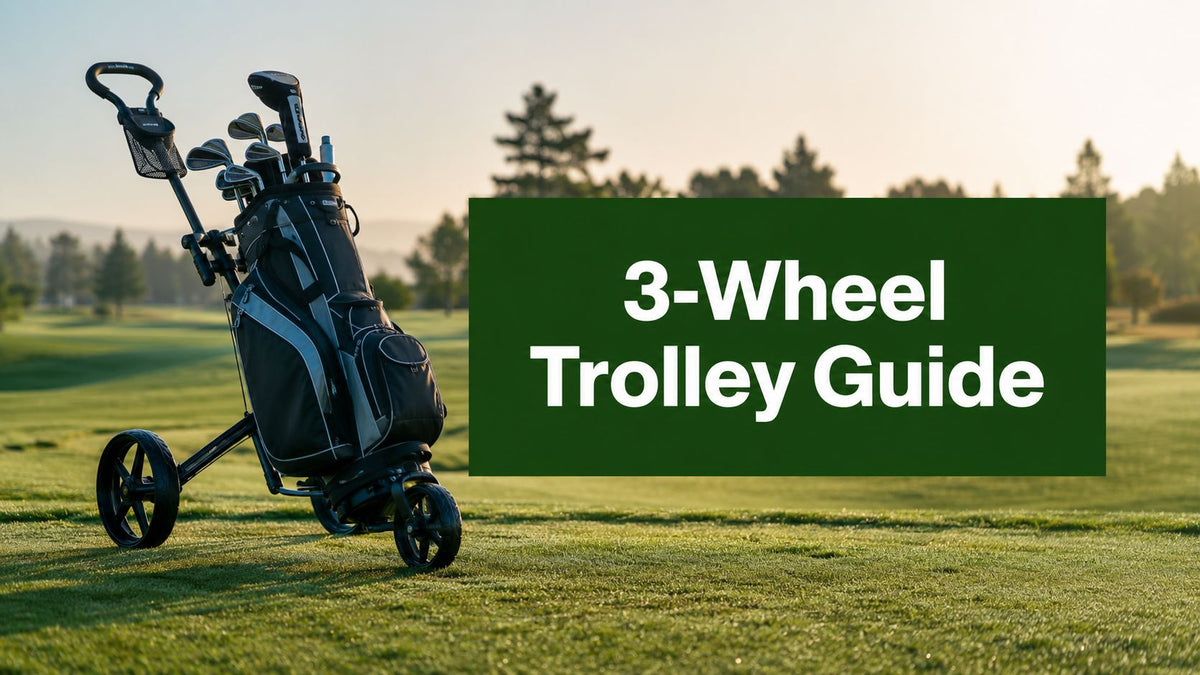
You're standing on the first tee with a bag that's heavier than it should be, a damp glove in one pocket, and a three-wheel trolley that either feels like a smart bit of kit or a mistake you'll regret by the 14th. That's the whole reason 3 wheel golf trolley reviews matter. Most of them tell you whether a cart folds small and rolls straight, but they skip the part that decides how much you'll enjoy walking, what it'll feel like on slopes, and whether the frame you buy today can take a motorized add-on later.
| Model | Best for | Main trade-off | Upgrade angle |
|---|---|---|---|
| PowaKaddy Micra | Compact storage and built-in features | Costs a bit more than the bare-bones option | Strong base if you want a tidy push-cart setup first |
| Motocaddy QB2 | Fast folding and low fuss | Fewer included extras | Good if you like a clean, simple frame |
| Clicgear 3.0+ | Tight steering and sturdy build | Heavier footprint when folded | Worth considering if you prize structure over portability |
| Sun Mountain Speed Cart GX | Easy rolling and light feel | Rear stance can feel less planted on sidehill lies | Better for golfers who want a smooth push, not max compactness |
| Big Max Blade+ | Slim folded shape | Less room for extras than bulkier carts | Useful if boot space is the main battle |

If you're the golfer loading up before work, racing the weather, and trying to keep the round enjoyable instead of exhausting, the right trolley matters every hole. That's why I'd rather talk like a playing partner than a brochure. If you want a plain-English buying guide on choosing a push cart base, the short version is worth a look in this guide on how to choose a golf push cart.
Walking Up to the First Tee With the Right Cart
The first tee is where a trolley either disappears into the background or starts annoying you immediately. You want the bag strapped down, the handle at the right height, and the front wheel tracking cleanly while you walk, not a cart that rattles, twists, or takes a wrestling match to fold after the round. That's why a three-wheel trolley is more than a convenience purchase, it's the piece of kit you touch every single hole.
The hidden part of the decision
Most buyers start with fold size and price, then stop there. That's the shallow part of the conversation, because the question is how the trolley behaves when your bag is fully loaded, the ground is wet, and you've still got nine holes to go. A trolley that feels fine in the shop can feel clumsy once you've added water, balls, waterproofs, and a full winter setup.
Practical rule: if you walk more than you ride, buy for the round, not for the showroom.
The other thing most reviews skip is future-proofing. If you already own a good push cart, the smartest upgrade path may not be replacing the whole thing. A base that accepts a future motorized add-on can save you from buying twice, especially if you're thinking about something like a drop-on wheel assist later.
What this buying guide actually settles
This is the stuff that matters. Weight, so you're not deadlifting the cart into a boot every Sunday. Fold size, so it fits the car without rearranging the whole back seat. Wheel geometry, because that's what decides whether the cart pivots cleanly or feels vague on the move. And yes, whether the frame can sensibly support a future powered assist.
The market backdrop backs up the importance of this category. The global golf push and pull cart market is projected to reach USD 0.29 billion in 2026 and USD 0.65 billion by 2035, with a projected 9.67% CAGR across the period, which tells you this isn't a niche accessory lane, it's a growing part of walking golf (Business Research Insights). That growth makes sense. Golfers want less fatigue, less hassle, and more flexibility without jumping straight to a full electric cart.
Why Three-Wheel Trolleys Still Dominate Walking Golf
A three-wheel trolley has survived because the shape just works. The triangular stance gives you the thing walkers care about most, a front wheel that turns easily and a rear base that keeps the cart planted. That's the balance point a lot of two-wheel designs never quite reach, and it's why three-wheel carts became the default manual format in the first place.
The geometry does the real work
Historical coverage shows manual three-wheeled golf trolleys became popular in the 1920s, when players wanted a practical alternative to carrying clubs, and later accounts place an early golf cart-like vehicle in 1932 when a Florida inventor built a rider-style cart for golfers (GT Golf Cart history). That long run tells you something simple. The format stuck because it solves a walking problem better than most alternatives.
The front wheel is the key. It pivots through tight doglegs, around tee boxes, and along cart paths where you'd feel every extra inch of turning radius. The rear axle spreads the load, so the trolley doesn't feel sketchy the moment the bag gets heavy. On flat and moderate parkland courses, that combination is exactly what you want.
Why weight still matters in the real world
Independent reviews consistently place good three-wheel push carts in the 6 to 8 kilogram range. That's not just a spec-sheet detail, it's the difference between an easy boot lift and a cart you start resenting before the round begins. One 2026 test also found a 13.6 lb best-value three-wheel model and an 18 lb premium three-wheel option, then judged the category lighter, more maneuverable, and smaller when folded than four-wheel designs (Cubical Golfer 2026 test).

Where four-wheel carts still win
Three-wheel trolleys usually steer better. Four-wheel carts usually sit more confidently on steep or rough ground. That's the trade-off, and it's not subtle. If your home course is mostly flat, I'd take the tighter turn and smaller folded footprint every time. If your course has ugly sidehills, broken lies, and long climbs, the wider footprint of a four-wheel chassis starts making more sense.
The cart that feels best in the pro shop isn't always the one that feels best at hole 15.
Modern wheels have narrowed the comfort gap, too. Airless and EVA-style tyres mean you're not giving up much rolling comfort just to get the maneuverability advantage. That's a big reason the three-wheel form still owns walking golf.
Comparing the Top Three-Wheel Models Worth Your Money
The glossy marketing starts to fall apart. The best three-wheel trolley for one golfer can be the wrong choice for another, because weight, folded shape, and bag interface matter in different ways. A compact fold is great until the handle feels awkward. A clever latch is great until the cart loads up like a brick.
Top Three-Wheel Golf Trolleys Compared
| Model | Weight (kg) | Folded Size | Wheel System | Frame Material | Price Band (USD) |
|---|---|---|---|---|---|
| PowaKaddy Micra | Approx. 7.5 | 535 mm x 355 mm x 380 mm | Quick-release three-wheel system with wide-diameter wheels | Not specified in verified data | Around the high-$200s equivalent |
| Motocaddy QB2 | Not specified in verified data | Over 20% smaller than the prior CUBE fold | Oversized, low-friction three-wheel setup with auto-fold front wheel | Not specified in verified data | Around the high-$200s equivalent |
| Bag Boy Quad XL three-wheel variant | Not specified in verified data | Not specified in verified data | Three-wheel variant, details vary by listing | Not specified in verified data | Not specified in verified data |
| Clicgear 3.0+ | Not specified in verified data | Not specified in verified data | Three-wheel push-cart layout | Not specified in verified data | Not specified in verified data |
| Big Max Blade+ | Not specified in verified data | Not specified in verified data | Three-wheel format with compact-fold design | Not specified in verified data | Not specified in verified data |
The verified numbers here are limited, so don't pretend they tell the whole story. What they do show is that the PowaKaddy Micra sits at about 7.5 kg and folds to 535 mm x 355 mm x 380 mm, which is the kind of compact shape that makes life easier if your boot space is tight. The Motocaddy QB2 is positioned as the cheaper, ultra-compact alternative at £179, with an auto-fold front wheel and an ultra-small folded footprint, which is exactly why it gets so much attention from walkers (The Golf Shop Online Micra vs QB2 review, QB2 review).
What the numbers mean in practice
The Micra is the better pick if you want built-in convenience and a proven compact form. The QB2 is the smarter buy if you care more about getting a neat fold and spending less upfront. Neither cart is trying to be a brute-force hill climber, and that's the point. They're made for walkers who want a manageable push, not a truck-sized frame.
The reviews also show the usual hidden split. One cart gives you more included features, while the other trims the setup to the essentials. That's why I'd ignore spec-sheet noise and ask one question instead, do you want the trolley to feel like a finished product out of the box, or are you happy adding pieces later?
See the compact push-cart comparison and accessories angle if you're weighing a manual setup against a more assistive path.
How Slope, Load, and Long Rounds Test Three-Wheel Designs
A three-wheel trolley can feel excellent on a showroom floor and still be the wrong fit for your home course. Slopes change everything. So does a loaded bag. Once you've got wet weather gear, extra balls, and a full round's worth of gear hanging off the frame, the trolley's balance point stops being theoretical.
Sidehill lies are the real test
The biggest weakness of a narrow three-wheel base is sidehill stability. On flatter ground, the design feels nimble. On a cross-slope, the center of gravity shifts and you start doing little course corrections that wear you down. That's where wheelbase width and wheel geometry matter more than brand labels. A wider rear stance buys you margin, while a narrow setup asks more from your hands and wrists.
If the course has long slopes and you feel the trolley tug sideways, you're not imagining it, the terrain is asking more of the frame.
The other issue is cumulative fatigue. Over 18 holes, a good push cart feels easy. Over 36 holes, or on a hilly parkland layout, small inefficiencies become real effort. That's why buyers who play long rounds on undulating courses should pay more attention to wheel size, stance width, and braking than to the number of accessories on the handle.
Wheel size isn't just a spec
Wheel geometry changes rolling resistance. Bigger wheels tend to roll better over soft fairways, rough patches, and damp turf, while small front wheels can feel twitchier when the ground is uneven. One retail listing shows three-wheel trolley designs using combinations like 12-inch rear wheels with 9.5-inch front wheels, while another uses 9.5-inch front wheels and 10.5-inch rear wheels. Those numbers matter because they shape how the cart crosses rough ground and how confidently it tracks when the course isn't cleanly level (Golfgear4less wheel spec listing).
When the standard three-wheel layout stops being enough
If your course is steep, wet, or loaded with awkward transitions, a wider base or a motorized assist starts looking less like luxury and more like common sense. More stable carts help with hill control, and electric assistance reduces the repeated push effort that wears you down across a full day. That's especially relevant if you already feel the round in your shoulders before the back nine.
Motorized Add-On Compatibility With Three-Wheel Trolleys
A three-wheel trolley can be a useful starting point for motorized assistance, but only if its frame and axle layout cooperate. Buyers planning to add a Caddie Wheel later should judge the trolley as a future platform, not only as a manual cart for today. That changes which models deserve attention.
What to check before you buy
Hub-style power-assist wheels suit some three-wheel frames, while others need adapter kits or awkward mounting solutions. Look for clean frame geometry, accessible attachment points, and a predictable rear axle layout. Unusual tubing, narrow wheel spacing, or a crowded rear assembly can turn an otherwise simple conversion into a frustrating compromise.
Check the axle and hub measurements before buying. A trolley may look sturdy and fold neatly yet leave too little clearance for an add-on wheel. The brake position, bag support, and folded shape also matter, because the motor and its bracket must not interfere with normal storage or transport.
Most reviews stop at folding, storage, and price. That leaves out the decision buyers face after several long or hilly rounds: whether the trolley can accept assistance without forcing a complete replacement. The electric golf push cart market is growing, which makes modular upgrade options more relevant, but market growth does not guarantee that a particular frame will fit a motor kit. Treat compatibility as a model-specific check, not a category-wide promise.
Three-Wheel Trolley Motor Compatibility at a Glance
| Trolley Model | Motor Add-On Fit | Adapter Needed | Combined Price Range |
|---|---|---|---|
| Standard three-wheel push frames with simple rear axle layouts | Usually the easiest fit for drop-on assist | Sometimes, depending on axle standard | Manual cart plus motor package pricing varies by setup |
| PowaKaddy Micra | Best treated as a compact push base first | Check compatibility before assuming fit | Manual cart plus assist package pricing varies by setup |
| Motocaddy QB2 | Good candidate if the axle and hub geometry match | Check for a model-specific bracket | Manual cart plus assist package pricing varies by setup |
| Clicgear-style frames | Often workable with the right hub format | Commonly requires fit checking | Manual cart plus assist package pricing varies by setup |
This table is a starting point, not a fit guarantee. Exact frame dimensions and hub design decide the outcome. Standard rear geometry gives you the best odds, while proprietary or cramped layouts deserve a direct compatibility check before purchase.
For a practical look at the conversion route, read the electric conversion kit approach before comparing a retrofit with a complete electric trolley. A suitable three-wheel base can preserve the handling you already like while leaving room for motorized assistance later.
The Case for Retrofitting a Motor Instead of Replacing
If you already own a solid three-wheel push cart, retrofitting makes more sense than throwing it away and starting from zero. That's especially true if your current cart folds well, fits the boot, and already suits your bag. The whole point of a retrofit is to keep the frame you like and add assist where it helps.
Why the retrofit route is the cleaner upgrade
A powered add-on gives you a middle path between manual pushing and a full electric trolley. You keep the storage pattern you know, you keep the folding routine you already trust, and you don't have to relearn a new handle layout or brake system. For a lot of golfers, that's the smarter move because it preserves the cart they already own instead of forcing a replacement.
That's also where battery logistics come in. A full electric trolley means a full electric system to manage. A retrofit keeps the footprint smaller and avoids dumping a perfectly usable push frame just because you want less effort on the hills. From an ownership point of view, that's cleaner and usually easier to justify.
Practical rule: if the frame still suits your bag and boot, upgrade the push cart before you replace it.
Where retrofit can fall short
Retrofitting isn't magic. It adds weight to the frame, needs the right mounting setup, and can ask more from the cart than a straight manual push ever did. If your home course is very steep or you've already found that the cart feels unstable on sidehill lies, a simple add-on might not fully solve the problem. You may still want a wider chassis or a purpose-built electric model.
There's also the buyer mistake nobody likes to admit. People often compare the sticker price of a motor add-on to the price of a new trolley and stop there. The comparison is total ownership, including whether the existing cart is worth keeping, whether the upgrade is easy to live with, and whether the added motor weight still leaves you happy walking the course.
When I'd stay manual
Stay with push only if your course is mostly flat, your current cart is light, and you already like how it folds and loads. A good three-wheel push cart still wins on simplicity. But if you're starting to dread the walk, or you know slope and fatigue are what spoil the back nine, a retrofit gives you the most logical step up without scrapping your current setup.

Matching Three-Wheel Trolleys to Real Golfer Profiles
The right trolley depends on who's pushing it. Seniors, fitness walkers, budget buyers, and players on hilly courses all want something different, and pretending one cart fits all is how people end up disappointed. Here's the honest match-up.
Best 3-Wheel Trolley by Golfer Profile
| Golfer Profile | Recommended Trolley | Why It Fits | Add Motor? |
|---|---|---|---|
| Seniors who want easy storage and light handling | PowaKaddy Micra | Compact fold, manageable weight, and a polished feel | Yes, if slope or fatigue is becoming a problem |
| Fitness walkers who care about balance and stride rhythm | Motocaddy QB2 | Clean fold, easy steering, and a simple setup | Maybe, if long rounds start feeling heavy late |
| Budget players who want a no-fuss cart | Motocaddy QB2 | Lower entry price and minimal setup friction | Not first choice unless you already have a retrofit plan |
| Hilly-course players | PowaKaddy Micra or a wider-base alternative | Better if you want a compact base with a bit more planted feel | Yes, but only if the course is tough enough to justify it |
For seniors, I'd lean PowaKaddy Micra because the fold is compact and the cart feels like a finished product, not a compromise. The QB2 is still good, but the Micra gives you the more complete package if you want less fiddling and a more settled everyday experience.
For fitness walkers, the Motocaddy QB2 is the cleaner pick. It's the cart I'd choose if I wanted a light, simple push that doesn't clutter the round. The auto-fold front wheel is the sort of detail that sounds small and feels useful every time you pack up.
For budget buyers, the QB2 wins again. The cheaper upfront cost matters if you're trying to get into push-cart golf without overspending, and it doesn't punish you with a clumsy fold. The Micra is better equipped, but the QB2 gets the basics right without making you pay for things you may not use.
For hilly-course players, I'd be more cautious. A standard three-wheel cart can still work, but if your course is steep enough to leave you tired halfway through, a retrofit or a wider-base option is smarter than trying to force a lightweight frame to do a hard job. That's where the motor add-on starts looking worth it.
My top pick for the average recreational walker is the PowaKaddy Micra. It beats the QB2 on real-course practicality because the more complete setup gives you less to buy later, less to think about on the course, and a more settled all-round experience when the round gets long.
If you're already using a push cart and you want less strain without replacing a frame that still works, Caddie Wheel gives you a drop-on electric assist that turns the trolley you own into a remote-controlled setup. If that's the upgrade path you're weighing, take a look at Caddie Wheel and see whether your cart is a better candidate for retrofitting than replacing.
Share:
Why Do Some Batteries Last Longer Than Others
Umbrella Holders Golf