
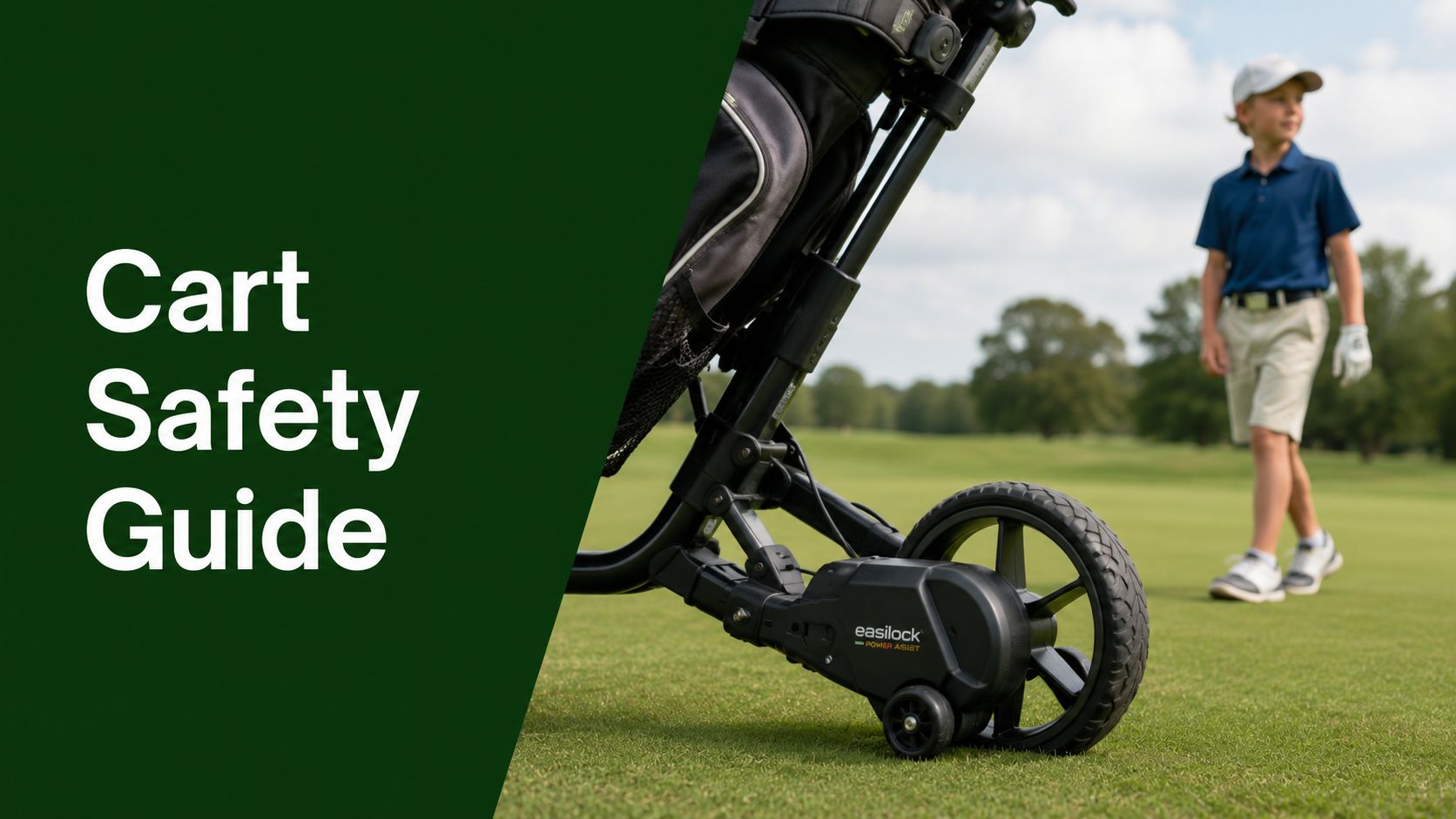
Your child starts the round full of energy. By the back nine, the bag feels heavier, the walk feels longer, and the fun starts to slip. That's usually when parents search for a child's motorized golf cart and hope there's a simple product that makes junior golf easier.
The problem is that this search term sounds more straightforward than it is. In practice, parents usually mean one of three very different things: a toy ride-on, a child riding in an adult golf cart, or some kind of powered help for carrying clubs. Those options are not equally safe, not equally practical, and not equally welcome on a golf course.
If your goal is to help a young golfer enjoy the course without turning the solution into a new risk, the smartest question isn't “What cart should I buy?” It's “What helps my child get around the course safely while still playing the game the right way?”
The Junior Golfer's Dilemma
A lot of junior golf problems don't start with swing mechanics. They start with fatigue.
A child can love golf and still wear down halfway through a round. The clubs feel awkward. The pace slows. Attention drifts. Parents can see it happening and want to help without taking away the independence that makes junior golf rewarding in the first place.
That's why the idea of a child's motorized golf cart is so appealing. On the surface, it sounds like the perfect fix. Let the child conserve energy, move their gear more easily, and stay excited about playing. For many families, that search starts from a good instinct. You're trying to remove strain, not add shortcuts.
Golf gets hard for kids long before it gets boring. Most of the time, the weight and the walk are the real issue.
The trouble is that “motorized golf cart” points people toward vehicle thinking. Once you go down that path, the choices get messy fast. Are you talking about a child driving something? Riding in something? Using a powered tool that moves the bag while they walk? Those are completely different situations.
What works for a grown golfer on a resort course usually doesn't translate well to a child. Adult carts are built around adult bodies, adult judgment, and adult rules. Toy vehicles are built for backyard fun, not golf course terrain, course policy, or junior play. That leaves parents in a confusing spot where the obvious answer often isn't the responsible one.
Here's the practical reality. If the mission is to keep a child engaged in golf, the best solution usually supports walking rather than replacing it. Kids still get the rhythm of the round, still learn to manage their clubs, and don't get exposed to the same ride-on hazards that concern pediatric safety experts.
What Is a Childs Motorized Golf Cart Anyway
The phrase child's motorized golf cart sounds like a product category. It mostly isn't.
According to Children's Hospital of Philadelphia reporting on golf cart safety, the term is frequently misinterpreted by search algorithms, which leaves a gap around the actual existence, safety certification, or market availability of purpose-built motorized carts for children under 12. That matters because parents searching for a serious junior golf solution often get mixed in with results that don't answer the core question.

The three things people usually mean
When I look at how families use this term, it usually points to one of these buckets:
| What parents picture | What it actually is | Why it falls short |
|---|---|---|
| A small golf cart for kids | A niche idea with unclear certification and limited real course presence | Hard to verify safety standards or course suitability |
| A fun electric cart a child can use | A toy ride-on vehicle | Built for play areas, not golf operations or on-course safety |
| A way to make golf easier | An adult golf cart carrying a child, or a powered aid for a push cart | These are completely different safety profiles |
Toy ride-ons are not course tools
The first trap is assuming that a battery-powered toy vehicle can stand in for golf equipment. It can't.
Toy ride-ons are designed for recreational use in controlled spaces. They aren't made for golf course traffic patterns, turf conditions, slopes, wet ground, path transitions, or the pace of play expectations that come with actual golf. Even if a child loves the idea, the fit with real golf is poor from the start.
Adult golf carts are adult vehicles
The second trap is even more common. A parent searches for a child's motorized golf cart but ends up really considering an adult cart as the transport solution.
That's where the conversation needs to slow down. Standard golf carts are designed for adults, and the junior golf use case is very different. If your real goal is less effort and more enjoyment, there are better categories to explore than putting a child on a vehicle.
One useful place to understand the broader walking alternative is this guide to motorized push carts for golfers. The key difference is simple. A walking aid supports the round. A ride-on vehicle changes the entire risk profile.
Practical rule: If the product puts the child in or on a vehicle, treat it as a transportation decision first and a golf decision second.
The Unseen Risks for Young Passengers
The biggest misunderstanding in this topic is thinking that a golf cart is a mild, low-stakes vehicle. For children, it isn't.
A pediatric review published through PubMed Central on golf cart injuries in children reported that more than 60% of children injured in golf cart incidents suffered a traumatic brain injury, and in 2019 alone, over 6,500 children were injured due to golf carts. That should change how parents evaluate the phrase child's motorized golf cart immediately.

Why golf carts are a poor fit for kids
The issue isn't just speed. It's design.
Golf carts generally lack the child-specific safety systems parents expect in passenger vehicles. The same pediatric review notes that the American Academy of Pediatrics advises against children riding in golf carts at all and specifically recommends that children under 6 should not ride in golf carts, while only children over age 6 should ride if strict safety protocols are followed. The article also notes that these vehicles lack safety features such as airbags, doors, and child-specific restraints.
That mismatch matters in real use:
- Seat fit is wrong: Adult seating doesn't secure small bodies well.
- Open sides increase fall risk: Children can shift, slide, or lean without much containment.
- Course terrain changes quickly: Curbs, paths, slopes, and uneven turf create movement that children don't brace for well.
- Kids don't read risk the way adults do: They fidget, turn, reach, and reposition.
Parents already know this principle from car seats
Most parents would never shrug off restraint fit in a family car. The same mindset should carry over here. If you want a refresher on how small setup mistakes can create big safety issues, Hiccapop's guide on avoiding common car seat mistakes is a useful reminder that child safety depends heavily on fit, positioning, and equipment designed for the child using it.
Golf carts fall short on all three.
A golf cart looks calm because it's familiar. Familiarity isn't the same as safety.
The hidden problem with “gentle” golf environments
Parents often assume the golf course itself reduces risk. Quiet setting, low speed, open space. But that environment can hide the problem.
Children get on and off repeatedly. Bags shift. Players share seats awkwardly. Cart paths slope toward drainage areas, bridges, and ponds. Even if no one is driving recklessly, the setup still exposes a child to falls and head injury risk that doesn't exist when the child is walking beside their own gear.
If you're evaluating any powered golf solution, safety should also include battery handling and storage standards for the equipment adults bring to the course. This overview of a fireproof lithium battery container for golf gear is a useful example of the kind of practical equipment thinking that belongs in modern golf, especially when families are around.
A Smarter Alternative Motorized Push Cart Assist
Once you stop treating a child's motorized golf cart as a vehicle search, the answer gets clearer. The safer category is motorized push cart assist.
That means the child still walks, still participates, and still learns how to manage a round. The motor helps with the load, not with transporting the child.

Why this solves the real problem
Most parents searching this topic aren't trying to buy a mini vehicle. They're trying to solve one of these problems:
- The bag is too much work
- The child loses energy carrying or pushing clubs
- The round feels too long
- The novelty of golf fades when effort outweighs fun
A powered assist wheel addresses those issues directly. Instead of asking a young golfer to drag or push a loaded cart for the entire round, it supplies propulsion while keeping the child on foot. That protects the core parts of junior golf that matter: walking the course, developing pace, learning responsibility, and staying engaged with each shot.
What good power assist looks like
The best systems are simple enough that adults will use them and controlled enough that they don't complicate the round. For example, the Caddie Wheel unit product details describe a drop-on design with a snap-in bracket that enables installation in minutes, without bulky external batteries or complicated remote systems, and maintains compatibility with most three- and four-wheel push carts.
That design philosophy matters more than people think. If a powered solution is awkward to mount, heavy to manage, or difficult to control, families tend to abandon it. Junior golf gear needs less friction, not more.
Here's what tends to work in practice:
- Keep the child walking: This preserves the structure of the game.
- Motorize the load, not the player: That removes the hazard that comes with ride-on thinking.
- Use familiar equipment: A standard push cart with assist is easier to integrate than a separate vehicle.
- Prioritize simple controls: Adults should be able to supervise without fuss.
On-course test: If the powered solution helps the child stay with their bag while walking naturally, you're in the right category.
It also respects how kids actually learn golf
Junior players benefit from doing more of the round themselves. They learn where to place the bag, how to move between shots, and how to stay organized. A ride-on cart cuts out much of that. A power-assist setup supports it.
That's especially relevant because guidance around young children has remained cautious on golf cart riding, while newer accessibility thinking has opened the door to non-vehicle aids. The product category is a better match for families who want support without stepping into an avoidable safety issue.
A short demo helps if you haven't seen this type of setup in action:
What doesn't work nearly as well
Some ideas sound clever but usually fail in actual golf use.
A modified cart aimed at children creates more questions than answers. A toy ride-on doesn't belong in normal course operations. Having a child depend on an adult cart for routine movement can also create friction with junior formats that expect walking, plus it weakens the independence many parents want their child to build.
Motorized push cart assist isn't flashy in the same way. It's better. It matches the problem.
Motorized Carts vs Power Assist Wheels
If you compare the two options directly, the trade-offs get easy to see. One option moves the child. The other moves the clubs.
That difference shapes everything from safety to course practicality.

Side by side on the factors parents actually care about
| Decision factor | Child on a motorized cart | Child using a power-assist wheel |
|---|---|---|
| Safety | Introduces passenger and fall risk | Removes ride-on exposure because the child walks |
| Independence | Child gets transported | Child manages their own gear with help |
| Physical benefit | Minimal walking if cart-dependent | Walking stays part of the round |
| Course fit | Can conflict with junior formats or course rules | Fits the walking model many junior golfers already use |
| Equipment burden | Separate vehicle mindset | Builds off a standard push cart setup |
Safety is the tiebreaker
Even if you ignored every other factor, this is the one that should decide it.
A child riding in a cart is exposed to the vehicle's design limitations. A child walking with a powered push cart is not. The powered wheel may still require adult supervision and common sense, but it avoids the central hazard that makes the cart option hard to justify.
The better option is often the simpler one
Power-assist wheels also win on everyday usability.
The Caddie Wheel manual overview notes that the unit supports play for up to 36 holes on a single charge, which is enough for two full 18-hole rounds or a single long day without recharging. That kind of endurance matters because family golf days and tournament environments don't always leave room for fiddly charging habits or gear failures.
The walking experience stays intact
For many families, this is the overlooked advantage. A child who walks with assistance still experiences golf as a walking game.
That means:
- Better pacing: The child moves with the hole, not apart from it.
- More ownership: Clubs, ball, and routine stay in the player's orbit.
- Less dependency: Adults don't need to shuttle the child around.
- More transferable habits: Walking golf teaches behaviors that carry into junior competition.
If you want a broader look at this category, these examples of electric golf walking carts help show where powered walking support fits into modern golf equipment.
The best junior setup usually feels less like transportation and more like light assistance.
Your Next Steps and a Junior Golfer Safety Checklist
By the time most parents search for a child's motorized golf cart, they're already solving a real problem. Their child is getting tired, frustrated, or overloaded by the physical side of golf. The mistake is assuming the answer has to be a vehicle.
Current guidance remains firm that children under 6 should not ride in golf carts due to improper seatbelt fit and lack of child-specific safety features, while newer thinking has started to recognize a shift toward modular, non-vehicle electric aids in golf accessibility, as discussed in this injury prevention overview on golf cart safety. That's the right lane for parents who want help without the ride-on risk.
Junior golfer safety checklist
Before you buy anything powered for the course, ask these questions:
- Does it remove passenger risk? If the solution puts the child in or on a vehicle, think twice.
- Does it encourage walking? Junior golfers usually benefit when walking remains part of the round.
- Is it built for golf use? Backyard ride-ons and on-course equipment are not the same thing.
- Can an adult supervise it easily? If operation is clumsy or distracting, it won't improve the day.
- Does it support independence? Good junior gear helps the child manage golf, not avoid it.
- Will your course or junior program allow it? Always check local rules and expectations before showing up with new equipment.
One more parent consideration
If a preventable injury does happen, it helps to understand how child injury claims are handled in your state. For families in Pennsylvania, this parent's guide to PA child injury law gives useful legal context without making you dig through statutes on your own.
The practical conclusion is straightforward. If you want to support a young golfer, don't look for a mini version of an adult cart. Look for a way to lighten the load while keeping the child walking, learning, and safely involved in the round.
If you want a safer way to help a junior golfer stay fresh on the course, take a look at Caddie Wheel. It's a practical power-assist option for standard push carts that supports walking golf instead of replacing it with a ride.
Share:
7 Key Tips for Golfing in the Rain
Golf World Handicap System Explained: A 2026 Guide