
Electric golf caddy prices typically run from roughly $500 to $4,500, and most mainstream remote-control models in 2026 cluster around $1,100 to $2,100. So the central question isn't whether they're expensive, it's whether you need a full caddy at all, or just the cheapest way to get electric assistance on the course.
That question shows up the moment pushing a cart starts feeling like work instead of warm-up. A lot of golfers assume the choice is simple, buy a premium electric caddy or stay manual, but the market has more levels than that, and the price gap between them is doing a lot of the decision-making.
Understanding the Electric Golf Caddy Price Range
The first time a golfer leans into a hill with a loaded cart, the math changes fast. At that point, the electric golf caddy price stops being abstract and starts feeling tied to how much strain you want to remove from every round.
Where the money actually goes
The broad market picture matters because it keeps people from overreacting to one sticker price. Electric golf caddies were estimated at $0.45 billion in 2025 and are projected to reach $0.89 billion by 2034, with a 7.8% compound annual growth rate over the 2026 to 2034 forecast period, which tells you the category is still expanding rather than settling into one fixed price point Dataintelo market report.
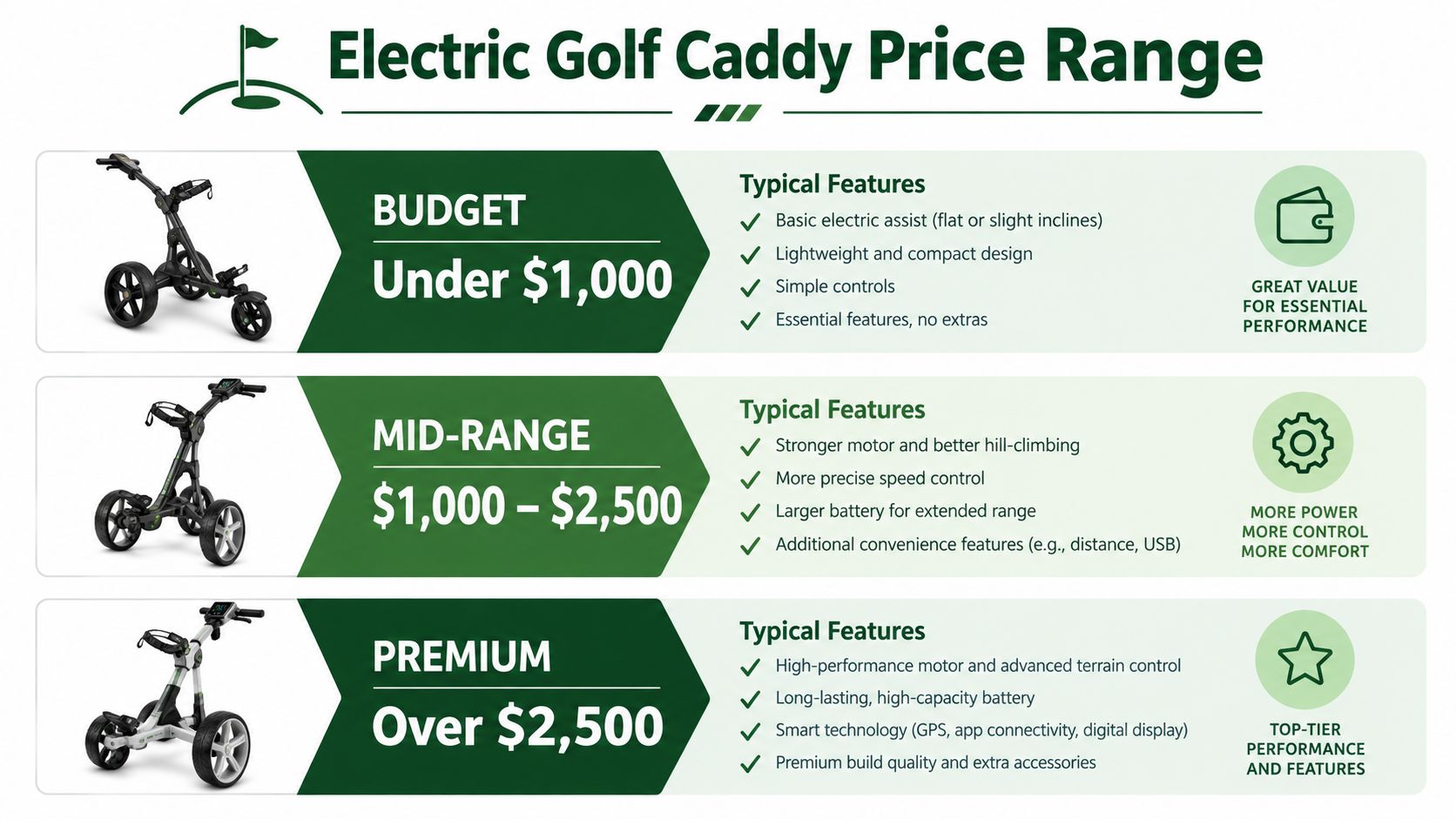
Entry-level personal electric golf caddies are commonly listed around $500 to $1,200, mid-range remote-control and lithium-battery models around $1,500 to $2,500, and premium feature-rich units around $3,000 to $4,500 Dataintelo market report. That spread isn't random. It reflects real differences in battery chemistry, control systems, and feature depth, not just the frame and wheels.
Practical rule: once a model crosses into remote operation or larger lithium capacity, the price usually starts following function, not fashion.
What that range means on the course
A golfer who only wants less pushing on flatter tracks can live in the lower tier. A player who regularly walks hilly courses, carries a heavier bag, or wants hands-free control is usually looking at the middle of the market. Premium buyers are paying for convenience features and performance margin that matter most when golf is frequent, terrain is rougher, or the cart needs to do more than just roll beside you.
The key takeaway is simple. Lower price often means fewer controls and shorter range, while higher price usually buys better batteries, stronger drive systems, and more comfort under load. That's why the market makes room for both practical buyers and golfers chasing a more polished experience.
Entry-Level Versus Mid-Range Versus Premium Caddies
The smartest way to shop is to stop asking, “What's the average price?” and start asking, “What tier do I play into?” A golfer who walks once in a while has different needs from someone who uses an electric cart every weekend.
Three pricing bands, three different use cases
Mainstream electric golf caddies in a 2026 retail snapshot sat around $1,099 to $2,599, with examples at $1,099, $1,698, $1,799, and $2,599 Golf Monthly retail snapshot. That same picture also showed 14 electric caddies priced from $739 to $2,999, which confirms that the category now stretches from lower-entry options into clearly premium territory Golf Monthly retail snapshot.
Remote-control caddies add another useful benchmark. A specialty retail collection puts them around $1,198 to $2,099, with budget options under about $1,400 and premium options above $2,000 Top Shelf Golf remote-control collection. That lines up with what buyers see when they compare shop shelves to online listings.
| Tier | Typical Price Range | Common Features | Best For |
|---|---|---|---|
| Entry-level | About $500 to $1,200 | Basic motorized help, simpler controls, lighter feature set | Flat courses, lighter bags, casual walking |
| Mid-range | About $1,500 to $2,500 | Remote control, better battery life, stronger hill performance | Regular walkers, mixed terrain, golfers who want convenience |
| Premium | About $3,000 to $4,500 | Feature-rich systems, advanced controls, top-end build quality | Frequent players, demanding courses, buyers who want the most capability |
How to think about each tier
Entry-level caddies make sense when the goal is basic relief, not luxury. Mid-range models are the sweet spot for a lot of golfers because they add the features that change the round, especially remote control and better range. Premium units are for people who know they'll use those extras often enough to justify the jump.
A retail snapshot is helpful, but the decision still comes down to usage. If you rarely play hilly courses, paying for the top tier can be overkill. If your home course punishes carts with slopes and long walks between shots, the middle or upper tier starts to look less like a splurge and more like a tool.
How Battery, Motor, and Control Systems Affect Price
The biggest mistake buyers make is assuming a higher price is just branding. On course, the cost usually comes from the parts that do the work, and from how well those parts are put together.
Where the money goes
A 2026 buyers' guide showed electric trolleys at roughly £499 for an 18-hole lithium model with a 28V 230W motor, £749 for a 36-hole lithium model with a 30V 230W motor, and £1,249 for a flagship with dual 30V 230W motors and a 36-hole lithium battery Electric trolley market guide. The same guide also listed a remote-control value model at £799 with dual 120W motors and 36-hole capacity.
That spread makes sense once you look at what is being added. More battery capacity gives you more usable range. More motor power gives you more margin on hills and with a heavier bag. More control hardware means more wiring, more electronics, and more parts that have to work together reliably.
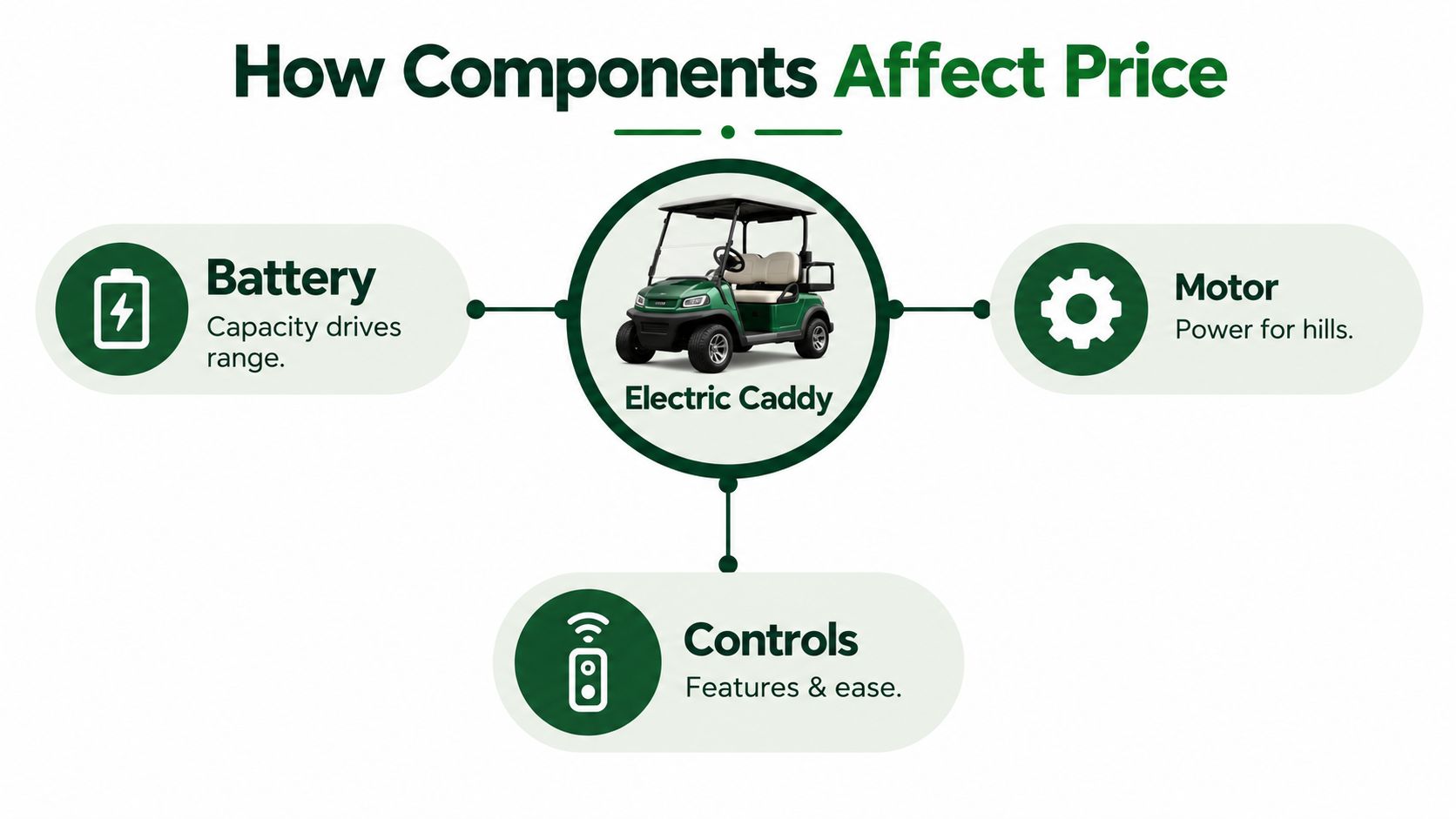
What you're paying for: longer rounds, steadier climbing, and less strain on the machine when the bag is heavy or the course gets steep.
Why remote control changes the bill
Remote control is not a small add-on. It changes the build, the electronics, and the value the manufacturer has to put into the system, so remote-capable models usually sit above simpler motorized carts even when the frame looks similar.
Battery choice matters just as much as motor size. A stronger battery and motor combination can be the difference between a cart that gets through 18 holes and one that finishes with room to spare. For a fuller look at battery trade-offs, see a breakdown of full electric caddy pricing and this electric trolley battery explainer.
The practical takeaway is simple. If two caddies look similar but one costs more, the extra money is usually buying longer usable range, better control, and more confidence on hills, bad lies, and heavy days. That is a better way to judge value than chasing brand prestige alone.
Full Electric Caddies Versus Lower-Cost Cart Assist Options
The cheapest way to get electric help is not always buying a full electric caddy. For many golfers, the main decision is whether to upgrade the push cart they already own or start over with a complete motorized setup.
The better comparison is often retrofit versus replacement
Recent retail listings show mainstream remote electric caddies in the U.S. clustered around $1,099 to $2,099, with premium models reaching $2,599 or even $2,999 Breaking Eighty coverage. At the same time, market summaries still describe electric push carts more broadly as roughly $300 to $1,800+, which leaves a wide gap for buyers who want assistance without paying for a full caddy Breaking Eighty coverage.
That gap is where conversion-style systems make sense. If you already own a solid push cart, a retrofit can give you motorized help without paying for a new frame, handle, and control platform. It is a different buying decision, and for budget-sensitive golfers, it is often the more practical one. For a closer look at full electric caddy pricing, the spread becomes clearer once you compare the full build against assist-only options.
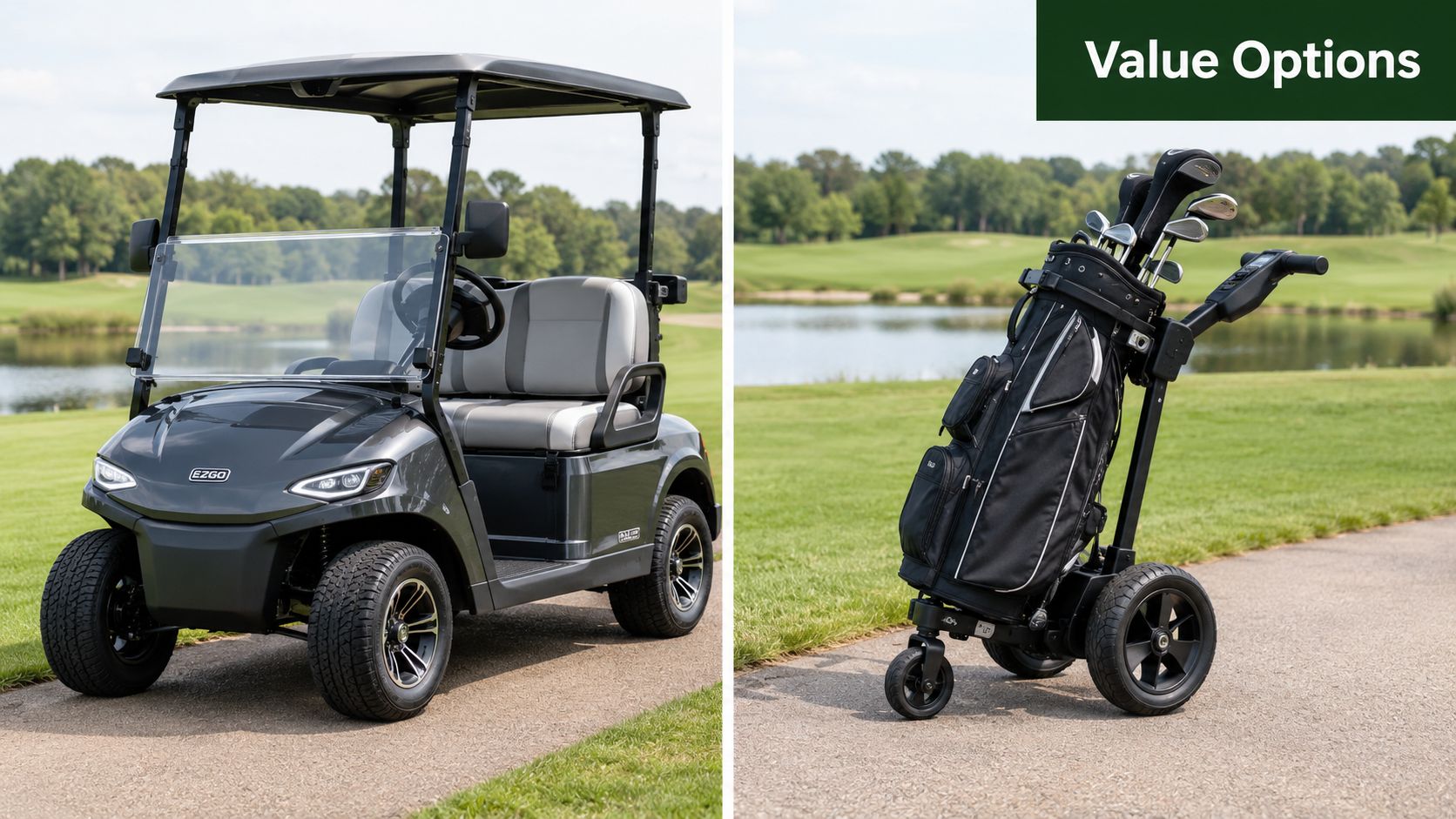
Where the lowest-cost entry really sits
The appeal of a cart-assist setup is simple. You keep the push cart you trust and add powered movement where it matters most. That often fits golfers who do not want to commit to a full remote cart but still want relief on hills, long walks, or windy days.
Some conversion kits offer this approach, turning a standard push cart into a powered assist setup instead of replacing the cart outright. Another path is to buy a full remote caddy, but that is a different spend and a different level of commitment.
The practical trade-off is straightforward. A premium electric caddy gives you more integration and usually more convenience, while a retrofit keeps costs lower and lets you hold onto equipment you already like. For many golfers, the alternative to either option is staying manual and accepting the fatigue that comes with it.
Total Cost of Ownership Beyond the Sticker Price
Sticker price gets attention, but ownership cost decides whether the purchase still feels smart a year later. Batteries age, warranties expire, and accessories can turn a fair deal into a frustrating one if you skip the details.
Warranty and battery terms change the value equation
One major manufacturer's warranty leaflet says the standard lithium battery is designed for 18 holes, the XL battery can do 36 holes under normal conditions, and registering the battery within 30 days is required for a full 5-year battery warranty, while unregistered products default to a 2-year warranty PowaKaddy warranty leaflet. Those terms matter because they affect how long the cart feels reliable, and how much protection you have if something goes wrong.
Longer warranty coverage is not just a comfort item. It can change how you think about replacement risk, battery care, and the way you budget for the machine over time. If you're keeping a cart for several seasons, those terms deserve more attention than a flashy feature list.
Hidden costs that catch buyers off guard
Battery replacement, charger compatibility, and wear parts are the expenses people forget to price in. A cart that looks cheaper at checkout can become more expensive if the battery setup is limited, the charging accessories are inconvenient, or the support path is weak.
Practical rule: a lower sticker price only wins if the battery terms and support terms are still solid.
It also helps to read maintenance guidance before buying. This maintenance guide is useful for thinking through how upkeep affects long-term value, especially if you're comparing a full electric caddy to a simpler assist setup.
The ownership lens changes the shopping conversation. You're not just buying today's round, you're buying the next few seasons of range, reliability, and support. That's where the cheapest-looking option can become the most expensive one.
How to Get the Best Value When Shopping for an Electric Caddy
Good value comes from matching the cart to your actual golf habits, not the biggest feature list on the page. The right model is the one you'll use comfortably without paying for capability you never need.
Ask the questions that expose real fit
Start with your own rounds. If you mostly play 9 holes, a big battery and top-end control system may be overkill. If you usually walk 18 holes on a hilly course, that's a different story.
Then compare specs, not adjectives. Ask how the cart handles incline, whether the battery comfortably covers your normal round, and whether the control style is something you'll use every time or only occasionally. If you already own a compatible push cart, compare the cost of a conversion against the cost of a full replacement before you assume the full cart is the smarter buy.
A simple buying filter
- Match battery to routine: buy for the round you play most often, not the rarest one.
- Pay for hills only if you have them: stronger drive systems matter most on uneven or steep terrain.
- Skip unused features: GPS, follow mode, and advanced displays make sense only if you'll use them regularly.
- Check support and parts access: a cart is easier to own when help is reachable after the sale.
One more thing matters. Test whether the controls feel natural enough that you'd use them without thinking. If a remote or assist system feels awkward, the feature won't save you much, even if the spec sheet looks impressive.
Making the Right Choice for Your Game and Budget
The best decision comes from being honest about how you play. If you're a casual walker on flatter tracks, an entry-level option can make sense. If you play often on mixed terrain and want easier course management, a mid-range remote model is usually the safer balance. If you want the most capability and expect to use it heavily, premium systems justify themselves through performance and convenience.

The bigger point is that electric golf caddy price reflects range, motor strength, control style, and long-term reliability, not just how the cart looks on the shop page. The cheapest answer is not always the right one, and the most expensive answer isn't automatically the most sensible either. The right move is the one that removes strain without wasting money.
Caddie Wheel helps golfers add motorized assistance to an existing push cart, which makes it a practical option for players who want electric help without buying a full cart. If you're comparing full caddies against a more affordable assist solution, visit Caddie Wheel and see whether a conversion setup fits your course, your budget, and the way you already walk.
Share:
Walking Golf Caddy: What It Is and How It Works