
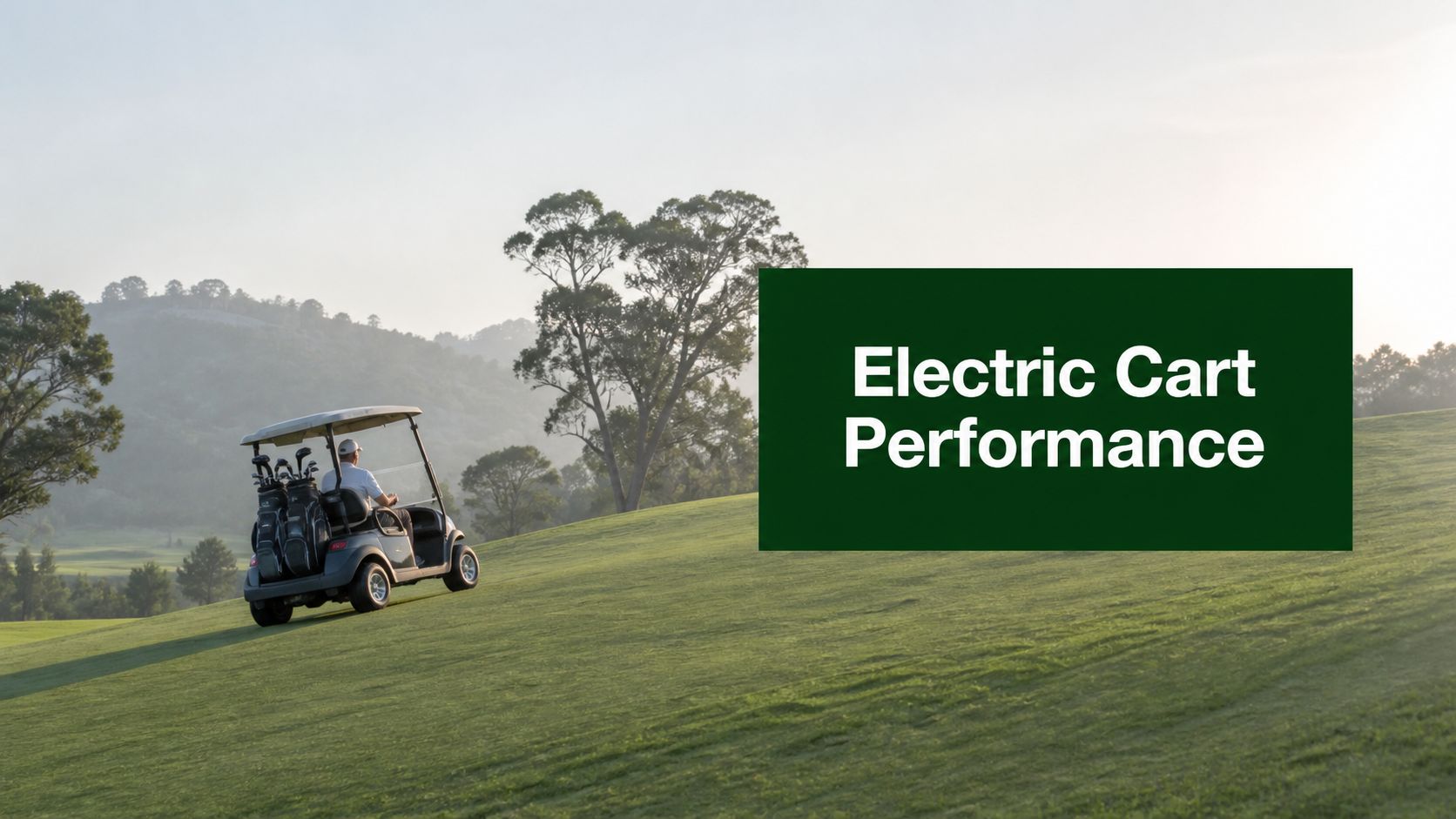
At the 14th hole, the throttle is buried on a long uphill par 5. The motor whines, the cart slows, and the battery gauge seems to fall faster than the fairway rises. Two players walking nearby pass with push carts, leaving you to wonder whether the problem is the motor, the battery, the load, or just the wrong kind of vehicle for the course.
That moment captures the essence of electric golf cart performance. Speed matters, but so do launch response, hill-climbing ability, useful range, battery behavior, and predictable control. A cart that reaches a high top speed on flat pavement may feel weak on a climb, while a slower setup can deliver a more comfortable and dependable round.
What Electric Golf Cart Performance Really Means
At the 14th hole, the cart slows on a long uphill par 5 while the battery gauge drops faster than expected. Nearby players walking with push carts pass by. The immediate question is whether the motor, battery, load, or course demands are responsible.
That moment defines electric golf cart performance. Speed is only one measure. Launch response, hill-climbing ability, usable range, battery consistency, braking, steering, traction, and stability determine whether the cart feels dependable across a full round.
Six connected factors explain the experience:
- Top speed controls travel time between shots, but reveals little about performance on a slope.
- Acceleration off the line shapes every restart, especially with passengers and golf bags aboard.
- Hill-climbing torque determines whether the cart keeps momentum or slows sharply as the route rises.
- Real-world range makes more sense in completed holes than in miles listed on a product page.
- Battery longevity across seasons affects whether performance remains consistent after repeated charging and storage.
- Predictable handling includes braking, steering, traction, and stability on changing surfaces.
Factory electric golf carts are commonly governed to about 12 to 15 mph. Many 48V systems reach 15 to 19 mph under typical conditions, while practical range can be around 30 to 35 miles, as described in this technical guidance on 48V golf-cart batteries and range. Course layout, hills, passenger weight, tire pressure, and weather can shift those results.

Electric carts have a long history. Marketeer produced an early model in Redlands, California, in 1951. The market has since expanded, reaching USD 1.55 billion in 2024 and projected to reach USD 2.58 billion by 2033, with a projected 6.1% CAGR, according to Grand View Research's electric golf cart market analysis.
A modified cart capable of 25 mph or more may appeal to enthusiasts. For a walking golfer using a lightweight power-assist system such as Caddie Wheel, that speed is unnecessary. The better question is whether the setup carries its load, handles the course, and completes the holes with controlled, usable power.
Motor Power and Torque in Plain English
Horsepower describes how much work a motor can produce over time. Torque is what you feel when the cart starts moving or climbs a hill. A motor with strong torque can turn the wheels against resistance, while horsepower becomes more relevant as speed and sustained workload rise. Golf-cart gearing links the two, favoring pulling force at lower speeds or faster travel on level ground.
Technical design guidance commonly places electric golf-cart motors in the 3 to 15 HP, or 2.2 to 11 kW, range. Geared motor speeds are around 2,500 to 6,000 RPM, with peak torque commonly around 10 to 30 Nm. The same golf-cart motor design reference describes AC motor efficiency around 85% to 95%, compared with roughly 70% to 85% for DC motors.
That efficiency difference affects how the drivetrain uses battery energy. An efficient AC system loses less energy as heat, helping it maintain wheel torque during repeated climbs or acceleration. A DC motor can suit a flatter course and straightforward utility use, though it may feel less composed when the cart works hard for long periods.
| Spec | Stock DC Motor | Upgraded AC Motor |
|---|---|---|
| Typical role | Simple course transport | Hillier routes and stronger load response |
| Efficiency range | About 70% to 85% | About 85% to 95% |
| Power range | Often toward the lower end of common cart outputs | Available across a wider high-output range |
| Driving feel | Adequate and straightforward | Smoother sustained pull under load |
| Main consideration | Lower-complexity replacement | Requires a matched controller and battery system |
Peak and continuous ratings answer different questions. Peak output describes a short burst, such as starting on a steep section. The continuous rating better reflects repeated hill starts and long inclines. A cart can feel powerful for the first few minutes, then lose speed if the controller reduces current to control motor heat.
A 2025 peer-reviewed study reported more than 60% cogging-torque reduction, a 7.3% increase in maximum output torque, and a 1.2 percentage-point efficiency gain under high-load conditions. Peak efficiency reached 95%, according to the published golf-cart motor optimization research. Lower cogging torque can smooth low-speed starts, while higher peak torque helps when passengers or gradients increase resistance.
For a practical buying framework, use this guide to choosing an electric motor for a golf cart. Match motor output to terrain and payload, not to the largest label number. A walking golfer using a lightweight Caddie Wheel power-assist system usually needs controlled torque and efficient assistance, rather than the output required to push a full cart at high speed.
Battery Capacity and the 36-Hole Promise
Voltage measures electrical pressure, amp-hours measure stored charge, and watt-hours combine both into a practical estimate of total energy. The relationship is:
watt-hours = volts × amp-hours
This calculation makes battery packs easier to compare, but it does not predict exactly how many holes you will play. Usable depth of discharge, motor efficiency, weight, hills, surface, tire pressure, and driving style all affect consumption. Lead-acid and lithium packs with comparable voltage can store noticeably different amounts of usable energy, so a matching voltage label does not mean matching range.
| Spec | Lead-Acid 48V System | Lithium 48V System |
|---|---|---|
| Voltage | Common 48V configuration | Common 48V configuration |
| Voltage behavior | Can feel weaker as charge falls | Tends to maintain a steadier output profile |
| Weight | Heavier battery installation | Lighter installation in comparable applications |
| Maintenance | Requires more attention to charging and condition | Usually simpler day-to-day ownership |
| Range interpretation | Highly dependent on usable capacity and load | Highly dependent on pack size, controller, and conditions |
A 36-hole rating is a target, not a guarantee. Electric golf push carts are often marketed around a 36-hole battery target. One 2026 independent review describes 36 holes as an ideal baseline, yet reports 31 holes on hilly terrain before the battery reached its last indicator bar. The MGI ZIP X3 listing specifies a 36-hole, 250Wh lithium battery system and says a fully charged unit can complete 36 holes, subject to playing conditions.
Range estimates become clearer when you separate stored energy from energy used. Divide usable battery energy by average consumption per hole, then test that estimate on your own course. Start with a full charge, record the weather, terrain, load, and surface, and note the battery state after 9 and 18 holes. Your personal baseline will reveal more than a generic claim because it reflects the way you play.
The same principle applies to a power-assist wheel. Its battery is smaller, but it moves a lighter load because it is not propelling a full passenger cart. Use this guide to improving electric golf cart range to reduce avoidable energy loss through charging, tire pressure, route, and load choices. A walking golfer who never needs 25 mph can direct more of the available battery energy toward steady assistance instead of high-speed transport.
Why Faster Is Not Always Better
A higher top speed sounds like a direct performance upgrade, but on a golf course it can be the wrong upgrade. Stock electric carts commonly operate around 12 to 15 mph, while upgraded versions may reach 19 to 25 mph or more, according to the electric golf-cart speed comparison. Street-legal low-speed vehicle applications are often capped near 25 mph for regulatory reasons.
Speed changes the job the battery must do. The same comparison lists a custom upgraded cart at about 28 mph with roughly 30 to 40 miles of range, while standard carts show stock-range figures around 50 to 60 miles. These are different configurations, not a laboratory head-to-head test, but they show the direction of the trade-off. More speed typically requires more energy, leaving less capacity for distance or repeated hill starts.
Course travel also includes frequent acceleration and braking. You pull away from the tee, slow near the next shot, wait beside a green, and repeat that cycle throughout the round. Finishing a par 4 slightly sooner rarely changes the quality of play, yet the battery still supplies energy for every acceleration and absorbs losses during braking.
For a walking golfer using a lightweight power-assist system, the target is different. The system does not need to move passengers at cart speed. A steady walking pace can preserve range while still reducing the effort of hills and long fairway stretches.
Practical rule: Choose the speed that lets you travel smoothly between shots. For most course use, steady low-speed transport is more valuable than a high top-speed benchmark.
The same source estimates that electric carts account for roughly 72% of the global golf cart market. Buyers therefore benefit from judging performance beyond maximum speed: stable voltage, reliable tire traction, and a motor that sustains torque uphill often matter more during an actual round.
How Terrain, Load, and Weather Change the Numbers
A cart that reaches its advertised range on level pavement may behave differently on your course. Grass, slopes, passengers, wind, turns, and repeated stops all add resistance, sometimes outweighing a small difference in motor rating.
Hills are usually the first major penalty. Climbing converts battery energy into height as well as forward motion, like carrying the cart up a ramp instead of pushing it across a floor. The IRJET golf-cart engineering paper describes commercial cart examples claiming 20% to 30% grade capability under test conditions. That figure describes the slope a specific setup can handle, not the range it will deliver there. Battery performance on a hilly route can also fall by a significant margin, depending on surface, speed, and load.
Payload changes the job. Two passengers, golf bags, drinks, and accessories increase the force required at the wheels. A motor that feels strong with one occupant may slow during a standing hill start with a full load. Check the manufacturer's payload rating, then judge performance by sustained climbing rather than a brief empty-cart test.
Weather affects the battery too. Lithium and lead-acid chemistry respond differently to temperature, and cold conditions can make either system feel less energetic. Use your actual winter route as the test, and keep capacity in reserve for the return trip instead of applying one universal adjustment.
Surface resistance matters even on flat ground. Paved paths usually demand less energy than wet grass, deep rough, or soft soil. Steering corrections and wheel slip add more work, especially when the cart is carrying weight.
| Condition | Typical Impact | Example Adjustment |
|---|---|---|
| Hilly route | Can reduce battery performance materially | Use a lower speed and reserve capacity for the final holes |
| Heavy payload | Raises torque demand | Test with the bags and passengers you actually carry |
| Cold weather | Can reduce available battery performance | Store and charge according to the battery maker's guidance |
| Rough or wet surface | Increases rolling resistance and traction demand | Avoid unnecessary rough travel and check tire condition |
A useful field formula is:
expected range = advertised range × terrain factor × load factor × weather factor × surface factor
The factors do not need to be perfect. A conservative estimate based on your recorded rounds is more useful than treating a best-case 36-hole rating as a guarantee. The same engineering paper reports an electric golf cart traveling 151 km on one charge in a specific test, while a solar-assisted cart study reports 23 miles from the battery pack plus 12 miles from solar under ideal sunlight conditions. Those results are not directly comparable. They show how strongly test design, assistance, and operating conditions shape range.
Maintenance Habits That Protect Performance
Maintenance affects what the driver feels. A tire with low pressure increases rolling resistance, a dragging brake forces the motor to work harder, and a loose battery connection can interrupt current delivery during acceleration.
Start with the tires. Check pressure before a long round and inspect for uneven wear. Don't copy a number from another cart, because tire construction and manufacturer recommendations differ. Use the pressure listed for your tires, then compare range and hill response over repeated rounds.
Battery connections deserve equal attention. Corrosion, looseness, and damaged cables create resistance between the pack and controller. Clean, secure connections help the system deliver current consistently, but disconnect power and follow the manufacturer's safety procedure before touching terminals.
Battery check: A clean connection protects acceleration and prevents a false impression that the motor has lost power.
Brake drag is easy to miss because the cart may still move normally. After a short drive, compare wheel temperature carefully and listen for rubbing. A brake that doesn't release fully turns every flat section into a low-grade climb.
Storage also shapes long-term behavior. Lithium packs generally need a manufacturer-specified partial-charge state for storage, while lead-acid batteries shouldn't be left neglected or fully discharged. Keep the cart and battery in conditions approved by the battery maker, especially where freezing temperatures are possible.
Use this golf-cart maintenance checklist as a monthly inspection routine:
- Tires: Verify pressure, tread, and sidewalls, then monitor rolling feel and range.
- Battery: Check charge behavior, connectors, cables, and visible damage.
- Brakes: Confirm the cart rolls freely when released and stops predictably.
- Drive system: Listen for unusual motor, gear, belt, or axle noise.
- Suspension: Inspect loose hardware and lubricate only where the manufacturer allows it.
Spend about 15 minutes on that inspection each month. Track one simple metric, such as top speed on a familiar flat section, holes completed, or the number of hills climbed before the gauge changes. A baseline turns vague sluggishness into a problem you can investigate.

How Lightweight Power-Assist Redefines the Category
A walking golfer doesn't need a cart capable of 25 mph. The useful performance target is different: steady assistance, controlled starts, dependable braking, and enough battery for the walk.
A drop-on power-assist system such as Caddie Wheel adds a motorized wheel to a compatible standard push cart. Its design uses a lightweight unit, described by the publisher as approximately 10 pounds, with a lithium battery, remote control, and forward, reverse, and braking functions. The device moves the push cart rather than carrying a passenger, so the motor avoids the much larger job faced by a traditional 48V golf cart.
That changes the three most important measurements:
- Range becomes walking rounds per charge, rather than passenger-cart miles.
- Top speed stays near walking pace, which is appropriate for following a shot-to-shot rhythm.
- Maintenance becomes simpler, centered on tire condition, the battery connection, charging, and the attachment hardware.
Caddie Wheel states that its battery supports up to 36 holes per charge, while actual results remain dependent on terrain, payload, surface, and usage. The remote-control function also matters because the control system determines how confidently you can manage a slope. Manuals for remote electric trolleys commonly use a sequence in which the brake button establishes communication, the plus button accelerates, holding plus reaches maximum speed, and the minus button decelerates or reverses, as shown in the remote-trolley control manual.

Traditional golf-cart ownership involves a larger vehicle, storage space, charging arrangements, and maintenance of the complete drivetrain. A power-assist wheel lets an existing push-cart owner preserve the walking format while reducing the physical effort required on inclines.
The product demonstration shows the intended setup and control approach:
For walking golfers, consistency round after round can matter more than maximum speed. The right system helps you keep your energy for the swing, not spend it pushing the equipment between shots.
Choosing the Right Performance Setup for Your Game
Start with the problem you experience. A flat-course golfer may need only a stock 36V or 48V cart, careful charging, and regular tire checks. A hill player should prioritize motor torque, controller matching, and a battery with enough usable capacity for repeated climbs.
| Golfer Profile | Recommended Setup | Top Upgrades | Metric to Monitor |
|---|---|---|---|
| Flat-course regular | Stock 36V or 48V cart | Battery care, correct tire pressure | Holes completed per charge |
| Hill player | High-torque AC motor with a suitable 6V or lithium pack | Motor-controller matching, battery capacity | Speed held on the longest climb |
| Senior or knee-limited walker | Power-assist wheel or compact 48V cart | Low-effort propulsion, dependable braking | Walking comfort late in the round |
| Budget walker | Used cart with a lithium retrofit | Battery condition, brake service | Total range after a full charge |
For a hill course, accept that additional climbing demand can reduce range, and size the battery around your real route rather than an idealized flat test. For a walking golfer, a power-assist setup may remove the need to manage a heavy passenger vehicle at all.
The diagnostic question is simple: what hurts more, distance walked or distance driven? If walking effort is the problem, prioritize assistance and control. If the cart loses speed on climbs, investigate torque, battery delivery, tires, brakes, and load before paying for a higher top-speed number.
Caddie Wheel offers a lightweight motorized power-assist wheel that attaches to compatible three- and four-wheel push carts, with variable-speed forward, reverse, and braking control and a battery rated for up to 36 holes per charge. Visit Caddie Wheel to see whether its drop-on design fits your cart and your course.
Share:
Golf Bag Cover for Golf Cart: Selection, Fit, and Care Guide
Golf Bag on Wheels: The Complete Buyer's Guide for 2026