
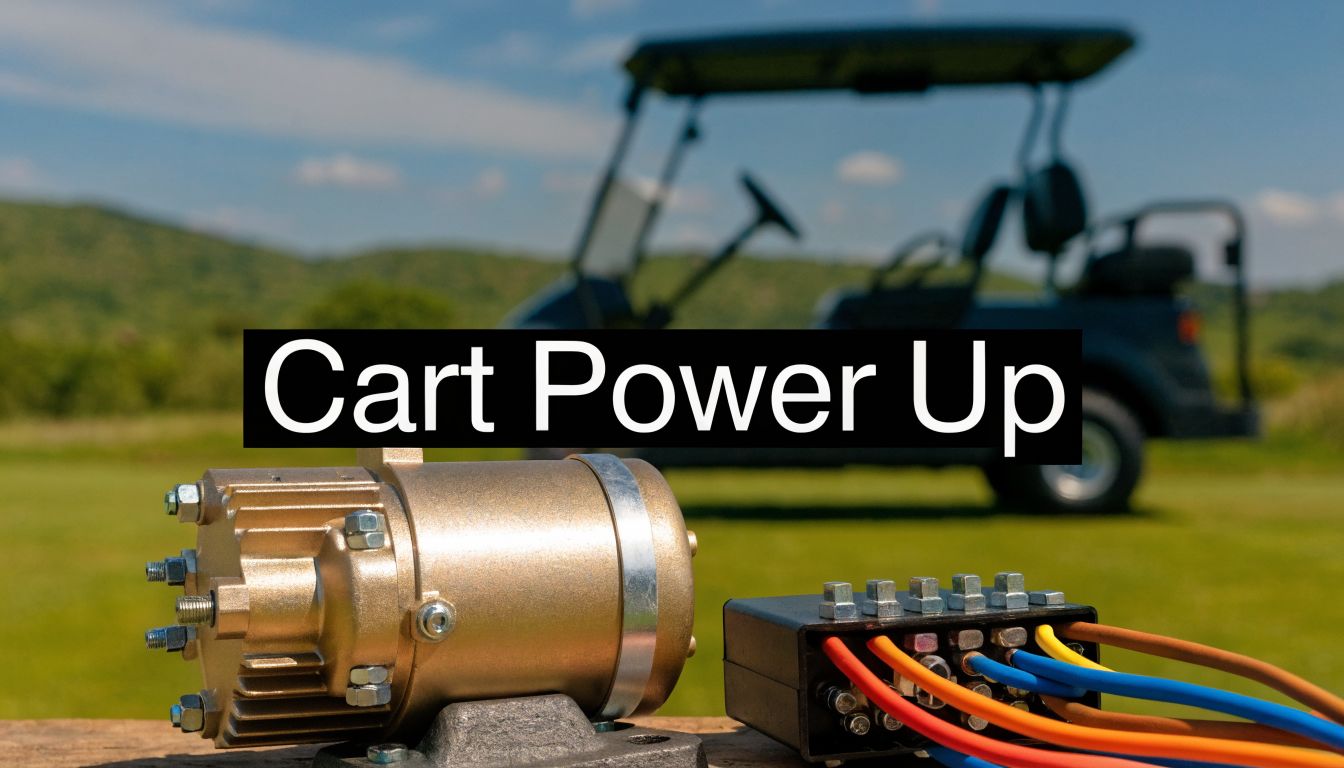
Your Club Car probably didn’t send you searching for a new motor because everything felt great. More often, the cart has gotten slow on hills, lazy off the line, or rough enough that you’re starting to wonder whether the motor is worn out or just mismatched for how you use it.
That’s where a lot of golfers get stuck. They search for golf cart motors electric club car, land on a pile of product pages, and see voltage, HP, RPM, series, Sepex, AC, IQ, regen. It starts to sound technical fast. The underlying question is simpler. What problem are you trying to solve?
Some owners need more climbing power. Some want better speed on flatter paths. Some just need a reliable replacement that works with the cart they already have. And some golfers don’t need a cart motor upgrade at all. They need less effort during the round, which is a different problem entirely.
Is It Time to Upgrade Your Club Car Motor
You finish a round, point the cart toward the parking lot, and hit the same hill it used to climb without a fuss. Now it sags, slows, and sounds like it is working harder than it should. That is usually the moment Club Car owners start asking whether the motor is tired, the setup is mismatched, or the whole cart needs a different plan.
A motor upgrade can solve the problem, but only when the problem really belongs to the motor.
That distinction saves money. A weak hill climb can come from a worn motor, but it can also come from tired batteries, a controller that cannot feed enough current, undersized cables, or a cart geared for speed instead of pulling power. Swapping motors before you sort that out is like putting bigger clubs in the bag when the actual issue is your grip. The part is stronger, but the result may not improve much.
Start with the job, not the catalog
Ask one plain question first. What do you want the cart to do better?
A cart used on flat paths and light loads may benefit from a speed-oriented setup. A cart that hauls two adults, a cooler, and gear up neighborhood grades usually needs torque first. If you own an older DS or Precedent and just want dependable service again, a stock-style replacement may be the better call than a high-output build.
Owners also mix up two different jobs. One job is faster or stronger riding. The other is getting around the course with less effort. If your real goal is effortless walking rather than more cart performance, a power-assist option may fit better than a full motor project. That is the lane where the Caddie Wheel starts to make more sense.
Signs a motor upgrade is the right move
- Hill performance keeps getting worse: The cart slows on grades it used to handle comfortably.
- Your load has changed: More passengers, cargo, towing, or rougher ground asks more from the motor.
- You want a different response: Some motors favor stronger launch, others smoother cruising, and others a balance of both.
- The existing motor shows real wear: Heat damage, failing brushes on DC systems, or repeated electrical trouble can make replacement the practical option.
There is another clue technicians watch for. The cart works, but it never feels right for how you use it. That often points to a mismatch, not just old age.
A bigger motor does not automatically create a better Club Car. The motor has to match the controller, battery pack, cables, and the terrain you drive. If you are still sorting out the basics, reading a clear guide on AC motors for golf carts and how they compare in real use can help you frame the decision before you spend money.
One more practical point. Golf carts and electric utility vehicles often overlap in how owners use them around property, paths, and light hauling. If your needs are starting to look more like work duty than golf duty, these essential electric UTV buying tips can help you decide whether to upgrade the cart you have or move to a machine built for a different job.
The best upgrade matches the machine to the work. Sometimes that means a new motor. Sometimes it means fixing the supporting parts. And sometimes it means choosing power assist for walking instead of chasing more speed from a riding cart.
The Heart of Your Cart AC vs DC Motors
Most Club Car owners hear “AC” and “DC” and assume one is old and one is new. That’s partly true, but it misses the feel of each setup.
Think of an AC motor like a modern EV. It delivers power in a smooth, controlled way and usually feels more refined across different terrain. Think of a DC motor like an old-school muscle car. It’s simpler in concept, often hits hard from a stop, and can be a great fit when you want straightforward, proven pulling power.

What DC really means on a Club Car
DC setups often split into two common behaviors for Club Car owners: series and Sepex/regen-style systems.
A series-wound DC motor is built to make strong starting torque. That’s why so many high-speed aftermarket DS upgrades use them. According to Golf Cart King’s Club Car DS 10 HP motor listing, many of these motors can deliver a 20 to 25% torque increase over stock and reach 16 to 22 mph on a 48V system, but they also require lead-acid batteries due to high power draw.
A Sepex or regen-oriented DC setup behaves differently. It’s usually more controlled and better suited to carts where efficient power delivery matters as much as raw shove.
What AC brings to the table
AC systems are popular with owners who want a broader performance envelope. They tend to feel smoother when accelerating, and they often pair well with modern controller tuning. If you want a more detailed primer on how these systems behave in real carts, this guide on AC motors for golf carts is a helpful next read.
If you’ve also been comparing carts beyond golf use, these essential electric UTV buying tips give useful context on how electric drive systems are evaluated when terrain, load, and ride feel all matter.
AC vs DC Golf Cart Motor Comparison
| Feature | AC Motor | DC Motor (Series) | DC Motor (Sepex/Regen) |
|---|---|---|---|
| Power delivery | Smooth and consistent | Hard-hitting low-end pull | Controlled and balanced |
| Best fit | Mixed terrain, refined driving feel | Speed-focused or strong launch setups | Efficiency-minded carts, hill-friendly use |
| Maintenance feel | Often perceived as more modern in operation | Simpler concept, but supporting parts matter | More system-dependent than basic series setups |
| Controller importance | Very high | Very high | Very high |
| Typical owner goal | Balance | Punch and top-end improvement | Torque with better control |
A motor never works alone. The cart only feels as good as the motor, controller, cables, battery pack, and gearing allow it to feel.
That’s why shopping by motor type alone can mislead you. The best motor on paper can be the wrong motor in your cart.
How to Choose the Right Motor for Your Needs
Don’t start with brand names. Start with the round you play and the terrain you drive.
A lot of buyers drift toward whatever motor has the loudest speed claims. That works for some carts, but it’s not the safest default. If your Club Car struggles on slopes, carries more than one rider often, or spends time on uneven ground, a speed-first setup can leave you disappointed.

Three owner profiles that make the choice easier
The flat-ground speed chaser
This owner wants the cart to feel livelier on paved paths or flatter courses. A high-speed series motor may be the answer if the rest of the system can support it. But this only works well when the batteries, controller, and cables are ready for the extra demand.
The hill-focused golfer
This owner needs the cart to pull strongly, not just run fast. For hilly courses, torque-series electric motors for Club Car Precedent models are often the better choice because they use regen braking to recapture 10 to 20% of energy, extend range, and help carts climb 20 to 30% grades according to Pete’s Golf Carts’ torque-series motor overview.
If your cart feels weak only on climbs, this kind of setup usually makes more sense than a speed motor.
The owner who wants a balanced cart
Some golfers don’t need extremes. They want decent pull, steady speed, and dependable operation. That buyer is usually better off with a well-matched replacement or a balanced upgrade, not the most aggressive thing in the catalog.
OEM versus aftermarket
There isn’t one right answer here.
- OEM-style replacement: Best when reliability, fit, and familiar behavior matter most.
- Aftermarket upgrade: Best when you have a clear goal such as stronger hill climbing or more speed, and you’re willing to support the motor with matching components.
- Mild performance build: A smart middle ground if you want improvement without turning the cart into a project.
The motor is only one piece
A strong motor can’t fix weak batteries. It also can’t outrun a controller that won’t deliver the current it needs. And if the gearing doesn’t suit the setup, the cart may still feel wrong.
Buy the setup, not just the motor. When owners chase only the motor, they often pay twice.
That’s the practical way to think about golf cart motors electric club car. Choose for the work the cart does. The best motor is the one that solves your problem without creating three new ones.
Decoding Motor Specs Voltage HP and RPM
Spec sheets scare off a lot of buyers because they look more precise than they really are. In practice, three numbers drive most of the decision: voltage, horsepower, and RPM.
Voltage decides compatibility first
Voltage tells you what electrical system the motor is built to work with. Club Car models commonly appear in 36-volt and 48-volt configurations, and serial families such as ‘AB’ for certain 36-volt DS carts and ‘AA’ for certain 48-volt DS carts help identify what you’re dealing with, as outlined in JS Golf Carts’ Club Car serial number guide.
That matters before you even think about performance. If the motor and controller don’t match the cart’s voltage, you’re not upgrading. You’re creating a problem.
For a broader look at how geared electric drive units translate power into motion, this explanation of an electric gear motor helps connect the motor’s numbers to what you feel at the wheels.
Horsepower tells you how hard the motor can work
Horsepower is easy to misunderstand. Owners often treat it like a top-speed number, but it’s really more about the motor’s ability to do work under load.
A higher-HP motor can help the cart hold speed better when climbing, carrying passengers, or accelerating. But horsepower by itself doesn’t guarantee a nicer cart. A poorly matched high-HP motor can feel worse than a properly matched lower-output motor.
RPM hints at speed potential
RPM is how fast the motor spins. More RPM can support more speed, but only when the rest of the system allows it. Tire size, gearing, controller tuning, and battery condition all shape what happens on the course.
Here’s the simple reading method:
- Voltage: “Will it fit my system?”
- Horsepower: “How hard can it work?”
- RPM: “What kind of speed potential does it have?”
When you read a motor listing, start with compatibility, then read for behavior. Most buying mistakes happen in the opposite order.
That small shift saves a lot of wasted money.
Installation Basics and Common Pitfalls to Avoid
A Club Car motor swap looks simple in a product photo. In the garage, it can get complicated fast.

The common assumption is that if the motor physically bolts up, the job is basically done. That’s one of the biggest mistakes DIY installers make. The motor may fit the cart while the controller, gear ratio, cables, solenoid, or battery setup still make the whole build unstable or disappointing.
The mismatch problem is bigger than most owners think
A significant guidance gap exists online for motor swaps. Forum data suggests 40% of motor swap failures stem from overlooked controller mismatches, and vendors also warn that aftermarket DC motors are designed for factory gear ratios only, according to Plum Quick’s Club Car motor collection notes.
That tells you something important. Many “bad motor” stories are not motor failures at all. They’re system-matching failures.
What a careful installer checks before turning a wrench
- Controller compatibility: The motor and controller have to speak the same language.
- Gear ratio reality: If the cart has been modified before, don’t assume factory gearing.
- Cable and solenoid condition: Performance motors pull harder and expose weak supporting parts.
- Model differences: DS and Precedent setups may look similar to a new buyer but still differ where it counts.
If you want to watch a general repair workflow before deciding whether the job is in your comfort zone, this overview helps frame the process:
DIY or call a shop
A hands-on owner with the right tools can handle many straightforward replacements. A full performance upgrade is different. Once controller programming, heavy-duty electrical parts, or uncertain prior modifications enter the picture, a good golf cart tech earns his money.
If you don’t know the cart’s exact voltage, controller type, and gearing, pause before ordering a performance motor.
That’s not a warning against DIY work. It’s a reminder that successful installation starts with diagnosis, not with a credit card.
A Smarter Alternative The Case for Power Assist
Not every golfer who starts researching golf cart motors electric club car needs a faster riding cart. Some just want to finish the back nine with more energy.
That distinction matters. A full motor replacement solves a riding-cart problem. It doesn’t solve the very different problem of wanting to walk, get the health benefits of walking, and stop fighting a heavy push cart on hills.

When a full cart motor is the wrong tool
If your real complaint sounds like this, the answer may be different:
- You like walking but hate pushing uphill
- Your shoulders or back get tired before your swing does
- You don’t want the cost and complexity of a full vehicle upgrade
- You already own a push cart and just want assistance
That’s a separate job-to-be-done from upgrading a Club Car.
Why power assist deserves a look
A good power-assist setup keeps you walking while removing much of the strain of pushing and controlling the cart. For golfers who care about conserving energy during the round, that can be more useful than turning a riding cart into a stronger riding cart.
If regen technology caught your attention earlier, this explanation of understanding regenerative braking systems is worth reading because it shows why controlled electric assistance can feel so natural on changing terrain.
Golfers also compare different forms of electric on-course transport now, from full-size vehicles to compact walker-friendly solutions. This look at remote golf carts is useful if you’re deciding how much powered help you want.
The practical takeaway is simple. If your goal is effortless walking, not faster riding, don’t force a Club Car motor upgrade into a problem it wasn’t meant to solve.
Frequently Asked Questions About Club Car Motors
How much does a Club Car motor upgrade cost
A motor upgrade can range from a fairly manageable repair bill to a serious project. The price changes based on what you are replacing. A stock-style motor swap usually costs less than a full performance conversion, and once you add a controller, heavier cables, battery checks, and labor, the total climbs fast.
One useful rule of thumb is to price the whole system, not just the motor. Buying the motor alone is a little like buying a stronger heart for the cart while ignoring the arteries feeding it. If your real goal is better hill climbing, more speed, or stronger acceleration, expect supporting parts to be part of the bill.
If that total starts to feel high, pause and ask a simple question. Are you trying to improve a riding cart, or are you really trying to make walking the course easier? Those are different problems, and they do not call for the same solution.
Do I really need to upgrade the controller too
Often, yes.
The controller is the cart's traffic manager. It decides how much current reaches the motor and how smoothly that power comes on. Pairing a stronger motor with a weak or mismatched controller can leave you with disappointing torque, heat buildup, or jerky throttle response.
That matters most on performance builds, but it also applies to some replacement jobs. If your old controller is already close to its limit, a new motor may expose that weakness quickly. Before you buy parts, make sure the motor, controller, battery pack, and solenoid are working as one system.
Is it legal or safe to make my Club Car faster
Speed changes affect more than top-end numbers. They also change stopping distance, cornering feel, tire load, and how stable the cart feels on rough paths or slopes. A cart that feels fine at one speed can feel nervous at a higher one.
Local rules matter too. Private communities, golf courses, and street-legal cart areas often have their own limits. Check the rules before you change the setup, and make sure the brakes, tires, suspension, and steering are in shape for the speed you want.
Should I replace the motor if my cart feels weak
Not always. A weak cart can come from aging batteries, poor cable connections, a tired controller, or dragging brakes. Replacing the motor first can fix the wrong part and leave the underlying problem untouched.
Start with the basics. Battery voltage under load, cable condition, and controller health usually tell you more than guesswork.
If you reach that point and realize you do not need a stronger riding cart, you may be better served by a different kind of electric help altogether. Caddie Wheel gives standard push carts lightweight electric power assist, so you can keep walking without fighting every hill and long fairway.
Share:
Best 12 Volt Battery Charger for Golf Cart Guide 2026
Waterproof Golf Bag Covers: The Ultimate 2026 Buying Guide