
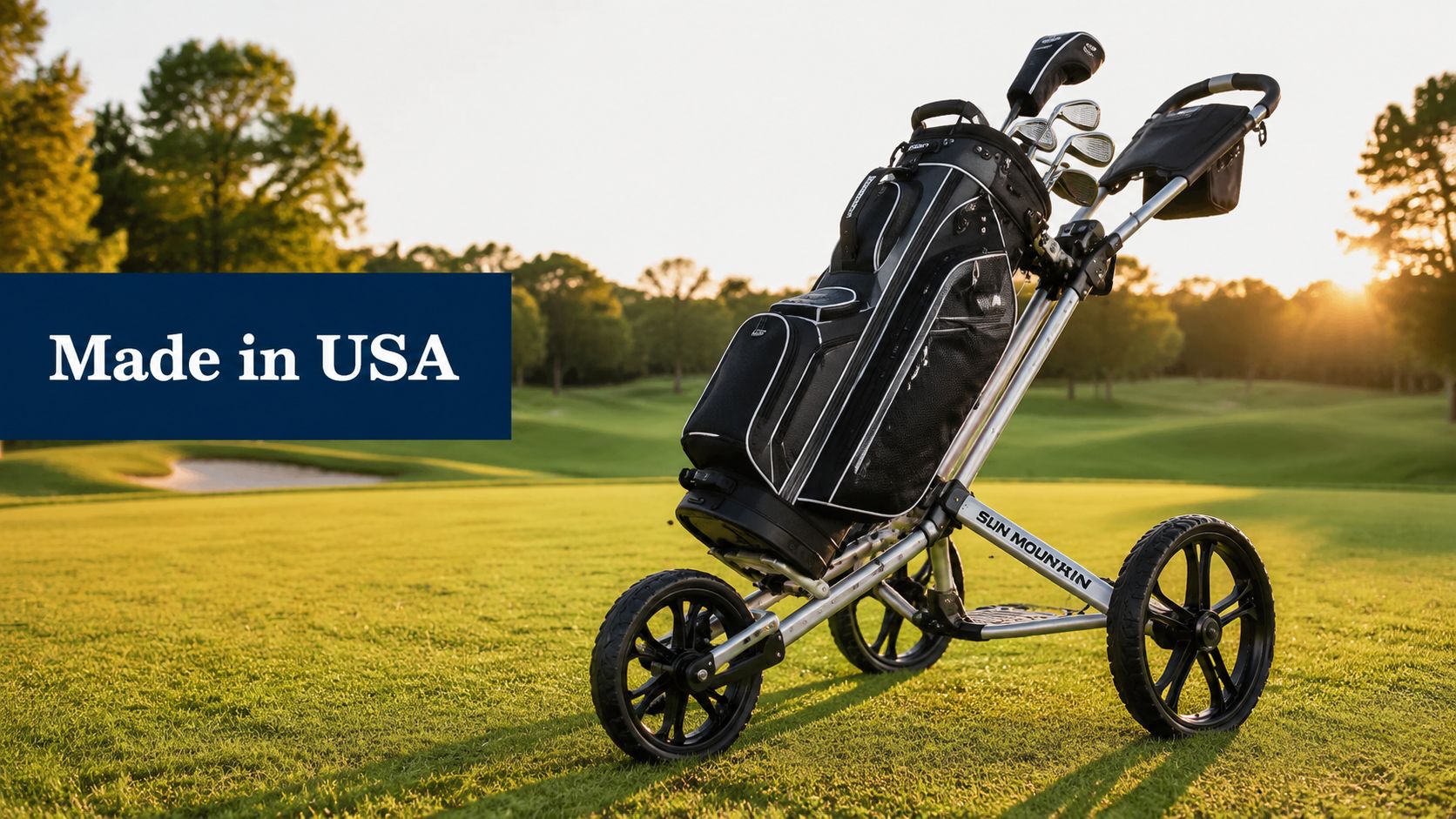
You're probably in the same spot a lot of walking golfers hit sooner or later. Your current cart works, but you want something that feels sturdier, cleaner, and worth the money. You start searching for a golf push cart made in USA, assuming that label will point you straight to the best option.
That instinct makes sense. Golfers want gear that lasts, rolls smoothly, and doesn't fold up like a lawn chair halfway through the season. A lot of players also want to support domestic manufacturing if they can. The problem is that this category isn't as simple as the sticker on the box makes it sound.
A smart buy comes down to more than patriotic branding. It comes down to what the frame is made of, how the cart handles hills, how the wheels track across rough ground, and whether upgrading what you already trust makes more sense than replacing it.
The Search for an American-Made Golf Push Cart
A walking golfer usually doesn't start with a spreadsheet. He starts with annoyance. Maybe the cart he has now rattles on cart paths. Maybe the handle feels loose. Maybe he's tired of pushing hard up the back nine and starts thinking, “I'll just buy an American-made one next time and be done with it.”
That's a reasonable first thought. In a market this large, there's no shortage of options competing for attention. The North American golf cart market is projected to reach $3.19 billion by 2034, while the push and pull cart segment is projected to reach $3.1 billion by 2034 at a 6.2% CAGR, according to Straits Research on the golf cart market. With that much demand, every brand is trying to stand out on quality, origin, features, or price.

The trouble starts when golfers assume “made in USA” tells the whole story. It usually doesn't. In this category, the label often says less about how the cart will perform on your course than golfers expect.
Practical rule: Buy for performance first, then verify where the product is actually built and assembled.
I've found that most golfers aren't really shopping for a label anyway. They're shopping for peace of mind. They want a cart they can trust for a full season of walking, one that feels planted on side slopes, folds without a fight, and doesn't become dead weight on hills.
That's why the better question isn't “Which cart has the right sticker?” It's “Which setup gives me the best mix of durability, support, and value for how I play?”
What Made in USA Really Means for Golf Carts
The phrase Made in USA carries weight. Golfers hear it and think domestic materials, domestic labor, domestic quality control, and a cleaner supply chain. Sometimes that's partly true. Often, it's only partly true.
A 2024 Golf Industry News analysis found that 78% of push carts marketed as “Made in USA” are only partially assembled domestically, with critical electronics and motors imported from Asia. That's the central problem. Buyers often picture a fully domestic cart, but the process often involves final assembly in the United States using globally sourced components.

Why the label can mislead
A push cart isn't a simple product. Even a standard non-motorized unit may involve tubing, hinges, wheel assemblies, molded plastic parts, fasteners, and bag brackets sourced from multiple countries. Add electric assist and you're dealing with motors, controllers, batteries, and charging hardware that often come from specialized overseas suppliers.
That doesn't automatically mean lower quality. It just means the label alone can't do the evaluation for you.
Here's where golfers get tripped up:
- Final assembly isn't full domestic production. A product can be assembled in the US while its most important parts come from somewhere else.
- Imported electronics aren't unusual. Motors, battery cells, and control systems often come from established global supply chains.
- Price doesn't prove origin. A higher retail price may reflect lower production scale, shipping, branding, or assembly costs, not necessarily better materials.
What the label is still good for
The label still matters to some buyers, and that's fair. It can mean closer domestic support, easier communication with the company, and more confidence in post-sale service. It may also reflect tighter oversight in final assembly.
If you care about American manufacturing, ask a sharper question: which parts are domestic, which parts are imported, and who stands behind the finished product?
That approach is a lot more useful than trusting broad marketing language. If a brand is clear about frame origin, electronics origin, assembly location, and support process, that's a good sign. If the language stays fuzzy, assume you need to dig deeper.
Better buying questions
Use these instead of relying on the label alone:
| Question | Why it matters |
|---|---|
| Where is the frame made? | Frame quality drives stability and long-term durability. |
| Where do the motors and battery come from? | Electric performance depends heavily on these parts. |
| Is the cart assembled or fully manufactured in the US? | Those are not the same thing. |
| Can the brand supply replacement parts? | Support matters more than branding once the cart is in your trunk. |
The golfers who make the best buying decisions usually stop chasing slogans early.
How to Evaluate True Quality and Craftsmanship
Once you stop treating origin as the main filter, shopping gets easier. You can judge a push cart the way seasoned walkers do. Check the structure, the rolling feel, the fit with your bag, and the quality of the moving parts. Those details tell you more than any decal.
Start with the frame and joints
Pick up the cart and fold it a few times. A good frame feels solid without feeling clumsy. Hinges should move cleanly. Locking points should engage without forcing them. If the cart flexes too much when loaded, you'll feel it on uneven ground.
Look closely at:
- Frame material. A sturdy aluminum frame is usually a better sign than a design that leans too heavily on thin plastic stress points.
- Weld quality. Clean welds and well-finished joints usually age better than hardware that looks like an afterthought.
- Bag supports. If the upper and lower bag brackets don't hold your bag securely, the cart will annoy you every round.
Wheels matter more than golfers expect
A push cart can look great in a product photo and still roll poorly. The wheels tell the truth fast. Cheap wheels wobble, drag, or lose tracking on sidehill lies. Better wheel assemblies roll straight and stay calm over rough turf and path edges.
Check the basics:
- Spin each wheel and feel for roughness.
- Look at axle fit and side-to-side play.
- Test whether the cart tracks straight with a loaded bag.
- Make sure the brake feels dependable on a slope.
A push cart that rolls poorly will feel heavy even when it isn't.
Evaluate electric benchmarks like an adult, not a brochure reader
If you're looking at electric assist or a fully electric setup, battery endurance becomes a practical buying standard. One benchmark worth taking seriously is a verified 36-hole battery range per charge, as noted by Navee's electric golf push cart specifications. That matters because range anxiety is real on a long day, especially on hilly courses.
A good electric system should also match your walking pace without jerky starts, awkward lag, or fiddly controls. Reliability on hills is more important than flashy features.
A simple quality checklist
This is the checklist I'd use before spending money:
-
Fold and unfold it yourself
Don't trust a polished demo. If the mechanism fights you in a showroom or parking lot, it won't get better later. -
Load your actual bag if possible
A cart can feel fine empty and unstable with a full cart bag. -
Look for replacement part realism
Ask whether the company supports wheels, brackets, straps, and wear items over time. - Judge accessory compatibility A cart should work with the way you play. If you use a cooler pouch, umbrella holder, or premium bag setup, compatibility matters. If you're pairing the cart with tour-quality golf gear, make sure the base and upper supports suit a structured bag profile.
-
Read a practical buying guide before you commit
A useful reference is this breakdown on how to choose a golf push cart, because it focuses on real-world fit and use instead of hype.
Warranty tells you what the brand expects
A warranty won't make a bad cart good, but it does reveal how confident the company is in its own build. Short, vague, hard-to-use warranty coverage usually tells its own story. Clear warranty terms and accessible support usually come from brands that expect their carts to stay in service.
A Smarter Alternative The Rise of Push Cart Upgrades
A lot of golfers are solving the problem differently now. Instead of replacing a push cart they already like, they're upgrading it.
That shift makes sense if you already own a cart that folds well, fits your bag properly, and feels familiar on the course. You've already done the hard part, which is finding a chassis you trust. Adding power to that setup is often a more practical move than starting over with a brand-new electric unit.

A 2025 MyGolfSpy survey found that 62% of walking golfers already own a standard push cart and would prefer upgrading it over buying a new $1,500+ electric cart, as cited in coverage tied to Golfweek's push cart discussion. That preference says a lot. Golfers don't necessarily want a whole new platform. They want less strain and more help on the course.
Why retrofitting works
The best part of an upgrade is that it preserves what already works.
- You keep your familiar cart. No relearning balance, folding sequence, or bag fit.
- You avoid overbuying. Many golfers don't need a full integrated electric caddie.
- You focus money where it matters. The value is in propulsion and reduced effort, not replacing every part of your setup.
Modular systems have become much more interesting. A well-designed retrofit can turn a standard three-wheel or four-wheel push cart into an assisted walking setup without making it bulky or awkward.
Golfers who already like their current cart should be skeptical of full replacement as the default answer.
What doesn't work
Not every upgrade idea is smart. Pieced-together aftermarket solutions can create balance problems, awkward wiring, or fit issues that make the cart worse. If the add-on feels like a garage experiment, it probably won't survive regular use on a golf course.
A proper conversion setup should be purpose-built, easy to remove, and designed around actual push cart geometry. If you want to see what that category looks like, this overview of an electric golf push cart conversion kit is a useful place to compare the concept against buying a whole new electric cart.
Transform Your Walk with a Motorized Wheel
The best motorized wheel systems solve a specific problem. They take a push cart you already trust and remove most of the effort that wears you down over the round. That matters most on hilly courses, long walks between greens and tees, and days when your body feels every incline.

The design detail that separates a practical upgrade from a headache is the mounting system. Modern motorized wheel upgrades often use a snap-in bracket compatible with most three- and four-wheel carts, allowing installation in 5 to 10 minutes without complex tools or programming, according to this guide to electric golf walking carts. That kind of installation is what makes the category viable for ordinary golfers instead of only gear tinkerers.
What the upgrade changes on the course
A good motorized wheel doesn't just push the cart for you. It changes how you spend energy during the round. Instead of leaning into the handle on every slope, you can walk in rhythm and save your legs for the swing.
That has a few practical benefits:
- Climbing hills gets less taxing. You stop fighting the cart and start walking beside it.
- Pace becomes smoother. Consistent assist helps the walk feel more relaxed between shots.
- You're more likely to keep walking rounds. The physical barrier drops for seniors, tired players, and anyone dealing with limited mobility.
Keep the setup simple
The best systems don't demand a technical mindset. You want straightforward controls, a secure bracket, and a battery routine that fits normal golf habits. Complicated programming, bulky external parts, or fiddly pairing steps are where these products lose people.
A useful benchmark in this category is battery capacity that can support a long day of golf, and earlier in the article I covered the 36-hole standard many buyers should look for. Beyond range, control feel matters just as much. The cart should respond cleanly, hold pace, and avoid jerky acceleration.
Here's a look at how these systems are used in practice:
Who benefits most
Motorized wheel upgrades make the most sense for a few groups:
| Golfer | Why it fits |
|---|---|
| Senior walkers | Less pushing strain over the full round |
| Players on hilly courses | Better control and less fatigue uphill |
| Budget-focused golfers | Keeps the existing cart instead of replacing everything |
| Fitness-minded walkers | You still walk the course without the burden of manual pushing |
If you're comparing options broadly, it helps to review different motorized push carts and think about how much of the value comes from propulsion itself versus extra built-in features you may never use.
The sweet spot for many golfers isn't a brand-new electric cart. It's a familiar cart with smart assist.
Frequently Asked Questions About Upgrading Your Cart
Will a motorized wheel fit my push cart?
Usually, compatibility depends on whether your cart uses a common three-wheel or four-wheel design and whether the frame can accept the mounting bracket cleanly. The key is to verify fit before ordering instead of assuming all carts are identical. Look closely at rear frame shape, axle area clearance, and bag placement.
If a brand offers a clear compatibility guide and install examples, that's a good sign. If fit information is vague, ask before you buy.
Is setup actually simple, or is that just marketing?
For a well-designed retrofit, setup should be simple enough that a regular golfer can handle it without tools spread all over the garage. The difference is whether the product was designed as a universal-style golf accessory or adapted from some other mobility device.
Good systems feel repeatable. You mount the bracket, attach the drive unit, confirm alignment, and you're done. Bad systems turn a push cart into a project.
Is upgrading more cost-effective than buying a new electric cart?
In many cases, yes, especially if your current push cart is already stable and in good condition. You avoid paying again for the frame, handle, bag straps, and folding system you already own. That's usually the strongest argument for upgrading.
The other savings are less obvious but still real. You don't spend time adjusting to a new cart platform, and you don't risk buying a cheaper electric unit that underwhelms on build quality.
What should I ask about support and warranty?
Ask practical questions, not vague ones.
- How are replacement parts handled if something wears out?
- What does the warranty cover on the powered unit?
- Who answers fit questions before purchase?
- How is service handled if you have an issue mid-season?
Support matters more in this category than a flashy product page. Moving parts, batteries, brackets, and controls all need a company that stands behind them.
Does upgrading take away the walking part of golf?
No. It changes the effort, not the format. You still walk the course, read lies from the ground, and stay engaged with the round. What disappears is the repetitive strain of dragging or pushing a loaded bag over every hill and long transition.
That's why many golfers find upgrades easier to stick with than riding more often. You keep the walk. You lose a lot of the grind.
If you already own a push cart you trust, adding power is often the smarter move than replacing it. Caddie Wheel is built for golfers who want lightweight electric assist without the bulk of a full electric cart, and it's worth a close look if your goal is to walk more rounds with less strain.
Share:
Surf Golf Cart: A Buyer's Guide to Power-Assist Wheels
Heated Golf Gloves: Ultimate Guide 2026