
You're probably here because you like walking the course, but you don't love pushing a loaded trolley up the last climb on the back nine. Maybe your current setup feels fine on flat holes, then suddenly heavy on a long hill. Maybe you're shopping for your first motorized push cart and every battery page seems to shout amp-hours without telling you how far the trolley will go.
That confusion is normal. Battery shopping for a golf trolley gets muddled fast because the number most golfers notice first isn't always the number that matters most on the course.
Introduction to Golf Trolley Lithium Power
A good walking round has a rhythm to it. You stroll to the tee, keep your shoulders loose, and arrive at each shot without feeling like you've been dragging a suitcase over wet turf. A poor battery choice breaks that rhythm. The trolley feels heavier than expected, range starts to nag at the back of your mind, and by the time you reach the closing stretch you're managing battery anxiety instead of club selection.
That's why golf trolley lithium has become such a big part of modern walking golf. In major markets, lithium-ion had 50.48% of the golf cart battery market in 2025, according to a 2026 golf cart battery market report summarized by Market Research Future. The same summary says the market is projected to reach USD 337.15 million by 2035 from USD 178.94 million in 2025, with a 6.54% CAGR from 2026 to 2035, while a separate study in that same summary places the broader market at USD 1.49 billion in 2024 and USD 2.21 billion by 2030 with a 6.8% CAGR. The exact totals vary by study, but the direction is clear. Battery-powered golf mobility isn't fading away.
Why golfers moved this way
Some of that shift is easy to feel the first time you lift a lithium pack. Some of it shows up later, when charging feels simpler and the trolley keeps a steadier pull through the round.
The trolley industry also has a visible history here. Stewart Golf says its F1 was the first trolley to use a 36V lithium battery as standard, and that its X7 made the company the first trolley brand in Great Britain to be 100% lithium powered. It further states that by 2011 the X7 Lithium meant the brand was exclusively supplying lithium batteries to customers. PowaKaddy also reported in 2015 that lithium batteries reached 54% of its total battery sales from January to September, overtaking lead-acid for the first time, according to an industry market summary on lithium battery golf caddies.
Golfers didn't switch just because lithium sounded newer. They switched because lighter packs, easier handling, and more dependable on-course performance solved everyday walking problems.
What actually matters when you choose
If you only remember one idea from this guide, make it this: usable watt-hours matter more than amp-hours alone.
Amp-hours by themselves can mislead you. Real range depends on the battery's voltage, how much energy you use in a round, how hilly your course is, and whether you want enough reserve for a second loop or a long practice day. That reserve matters just as much as raw capacity, especially if you sometimes play more than 18 holes.
What a Golf Trolley Lithium Battery Really Is
A golf trolley lithium battery is a stored energy pack that feeds power to the trolley motor in a controlled way. The motor doesn't care about marketing language. It cares about getting the right voltage and enough current when you ask the trolley to start rolling, climb a slope, or hold pace over uneven ground.
Think of it like a tank and pressure system
The easiest way to read battery specs is to separate three ideas:
- Voltage is like pressure in a water system. It helps determine how power is delivered.
- Amp-hours are like the size of the tank.
- Watt-hours tell you the total energy available, which is what you really use up during a round.
Two batteries can share the same amp-hour rating and still store different amounts of energy if their voltage is different. That's why comparing amp-hours alone can send buyers in the wrong direction.
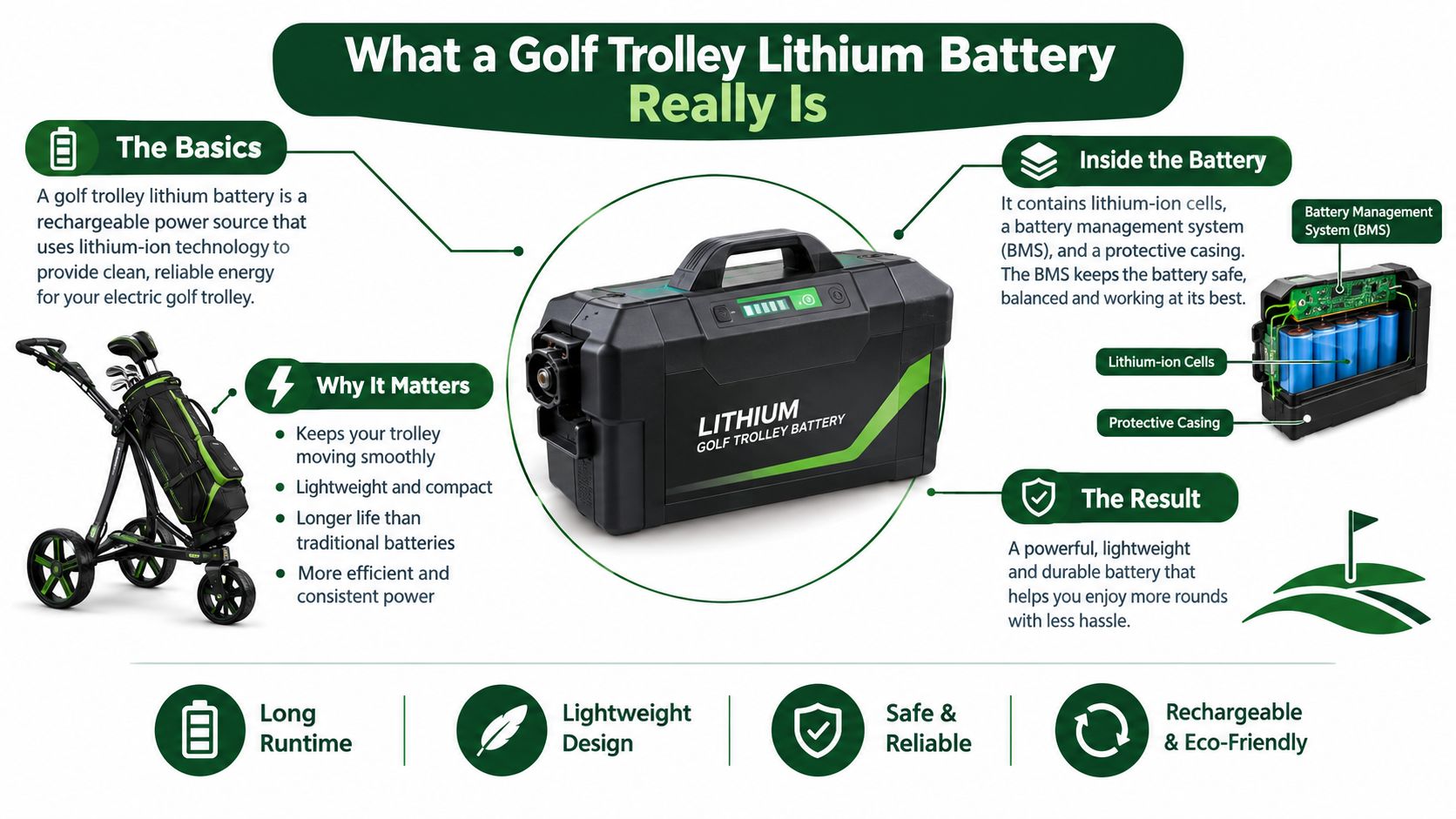
A practical example helps. A 12V LiFePO4 golf trolley battery example described by Wevolver stores 281Wh, weighs 3.3kg, has a 25A continuous discharge rating, a 30A pulse discharge for 3 seconds, and a 14.6V charging voltage, according to this LiFePO4 engineering guide. That combination is why golfers notice lithium as both light to carry and capable of delivering useful motor power.
What LiFePO4 means in plain English
LiFePO4 stands for lithium iron phosphate. For golf trolleys, you don't need to memorize the chemistry. What matters is the behavior.
LiFePO4 packs are commonly favored because they offer a strong mix of long service life, usable discharge performance, and lower carrying weight than older battery types. The same Wevolver guide says high-quality LiFePO4 packs commonly deliver 3,000 to 6,000 cycles at 80% depth of discharge, with some premium cells reaching 10,000+ cycles under lighter use, and that cycle life is typically measured to 80% remaining capacity.
Why current delivery matters on hills
A trolley doesn't draw power evenly all round. It asks for more when you start from a stop, climb a rise, or guide a loaded cart through thicker turf.
That's where golfers often get confused. They assume “bigger battery” only means “more holes.” In reality, battery quality and discharge capability also affect how calmly the trolley handles demanding moments.
Practical rule: Read the battery label in this order. Match the voltage first, compare watt-hours second, then check current capability and physical fit.
If you've ever seen a trolley feel eager on level fairways but strained on climbs, that difference isn't imaginary. It comes from how the battery and motor work together under load.
How Lithium Compares With Lead Acid for Golf Trolleys
The easiest way to understand the lithium shift is to stop thinking about batteries as chemistry and start thinking about them as experience. What do you carry from the car park? How often do you charge? How steady does the trolley feel late in the round? How much fuss comes with ownership?
The feel on and off the course
Lithium changes the everyday handling first. A lighter pack is easier to remove, easier to carry, and easier to fit without wrestling the trolley frame.
Lead-acid usually asks more from the owner. It's bulkier, less convenient to move around, and generally less appealing for golfers who walk often or store their trolley between rounds. That's why many walking golfers don't view this as a technical upgrade. They feel it as a convenience upgrade.
| Lithium vs Lead Acid for Golf Trolleys at a Glance | ||
|---|---|---|
| Feature | Lithium LiFePO4 | Lead Acid |
| Carry weight | Commonly much lighter. A documented example weighs 3.3kg for 281Wh. | Typically heavier and less convenient to lift in and out. |
| Usable energy planning | Best compared by watt-hours and reserve planning. | Often less attractive for golfers who want predictable portable range. |
| Maintenance | Generally lower day-to-day fuss. | Usually more ownership hassle over time. |
| On-course behavior | Often better suited to repeated walking rounds and hill work. | Can feel less convenient for regular walking golfers. |
| Upfront price | Usually higher. | Usually lower. |
| Best fit | Frequent walkers, hilly courses, players who value portability. | Golfers focused mostly on lower initial spend. |
Here's a useful video if you want to see the lithium-versus-lead-acid discussion in a more visual format.
The trade-off golfers actually make
Lithium's main drawback is simple. It usually costs more upfront.
But the buying decision often shifts once a golfer thinks past the first invoice. If you walk weekly, play on rolling ground, or dislike hauling a dense battery block around, lithium solves annoyances you'll notice every single round. If you play occasionally on flatter ground and care mostly about the purchase price, lead-acid may still seem acceptable.
When lead-acid becomes the wrong compromise
Lead-acid limitations show up fastest with golfers who do one or more of these:
- Play long days: Extra holes expose any weakness in usable range.
- Walk hilly courses: Repeated climbs punish heavier, less convenient setups.
- Travel with the trolley often: Lifting battery weight in and out of the car gets old quickly.
- Want simple ownership: Less messing about usually matters more after the purchase than before it.
If your trolley battery is something you carry often, not just something you charge, weight deserves a front-row place in the decision.
Capacity Runtime and Weight Expectations on the Course
You need enough usable energy to finish your normal round with a reserve you trust. Battery buying gets practical. You don't need abstract capacity.
Start with watt-hours, not just amp-hours
Independent guidance for golf trolley batteries recommends checking usable watt-hours, estimating range from watt-hours divided by expected draw, and keeping at least a 30% reserve, according to this golf trolley battery explainer from Golfstore.ie. That reserve isn't just a comfort blanket. It protects you from underestimating the day.
A flat, dry course with a light bag asks less from the motor than a wet, hilly course with a full setup. Add stop-start use, steeper paths, or a second loop, and the gap grows.
A simple way to estimate your own needs
Think about battery range in three layers:
-
Your stored energy
This is the watt-hour figure. -
Your typical draw
Motor demand changes with slope, turf resistance, trolley load, and speed habits. -
Your reserve
Don't plan to empty the pack every time. Build in at least that 30% reserve from the Golfstore.ie guidance.
That means a golfer who usually walks a gentle 18 can use a smaller pack than someone who regularly plays windy links terrain, carries extra kit, or likes 27-hole and 36-hole days.
Why bigger can be smarter, not excessive
Many golfers assume buying a larger battery is overkill if they usually play 18 holes. Sometimes it is. Sometimes it isn't.
A battery that finishes your round with healthy reserve is usually being cycled more gently than a battery that limps home near empty. That matters because depth of discharge strongly affects service life. A controlled study of lithium iron phosphate cells reported 3,221 cycles at 80% depth of discharge and 34,957 cycles at 20% depth of discharge, according to this ScienceDirect study on cycle life and depth of discharge. The lesson is straightforward. Shallower cycling can preserve battery life far longer.
A battery sized for shallow use often ages better than a small battery pushed deep every round.
Terrain changes everything
Range claims can sound absolute. They aren't. The same battery behaves differently depending on:
- Course profile: Repeated hills increase current draw.
- Ground conditions: Soft turf and wet rough add resistance.
- Cart load: Extra water, layers, and accessories all count.
- Driving style: Higher speed settings and frequent corrections use more energy.
This is also why battery weight matters twice. It matters in your hands when loading the car, and it matters in your setup when you're trying to keep the whole walking experience easy. If you want context on how much battery mass can change handling, this guide on how much a golf cart battery weighs helps frame why lighter power systems feel different in practice.
Match the pack to the day you actually play
If your normal round is 18 holes on modest terrain, your battery choice can be tighter and lighter. If you sometimes play 27 or 36 holes, size for that reality instead of the best-case day.
That's the common mistake. Golfers buy for average use, then get frustrated on their hardest day. Buy for the toughest round you realistically expect, while still keeping reserve.
Safety Charging and Storage Essentials for Lithium Packs
A lithium battery is convenient, but it still deserves careful handling. These packs are treated as hazardous goods, and improper use can create a risk of fire, explosion, and chemical burns, as stated in the TiCad user manual for lithium-powered golf trolley equipment_UserManual_TiCad%20GOLDFINGER.pdf).
Charge within the right temperature window
Golfers often charge in garages, sheds, and car boots without thinking much about temperature. That's fine until winter or a heat wave.
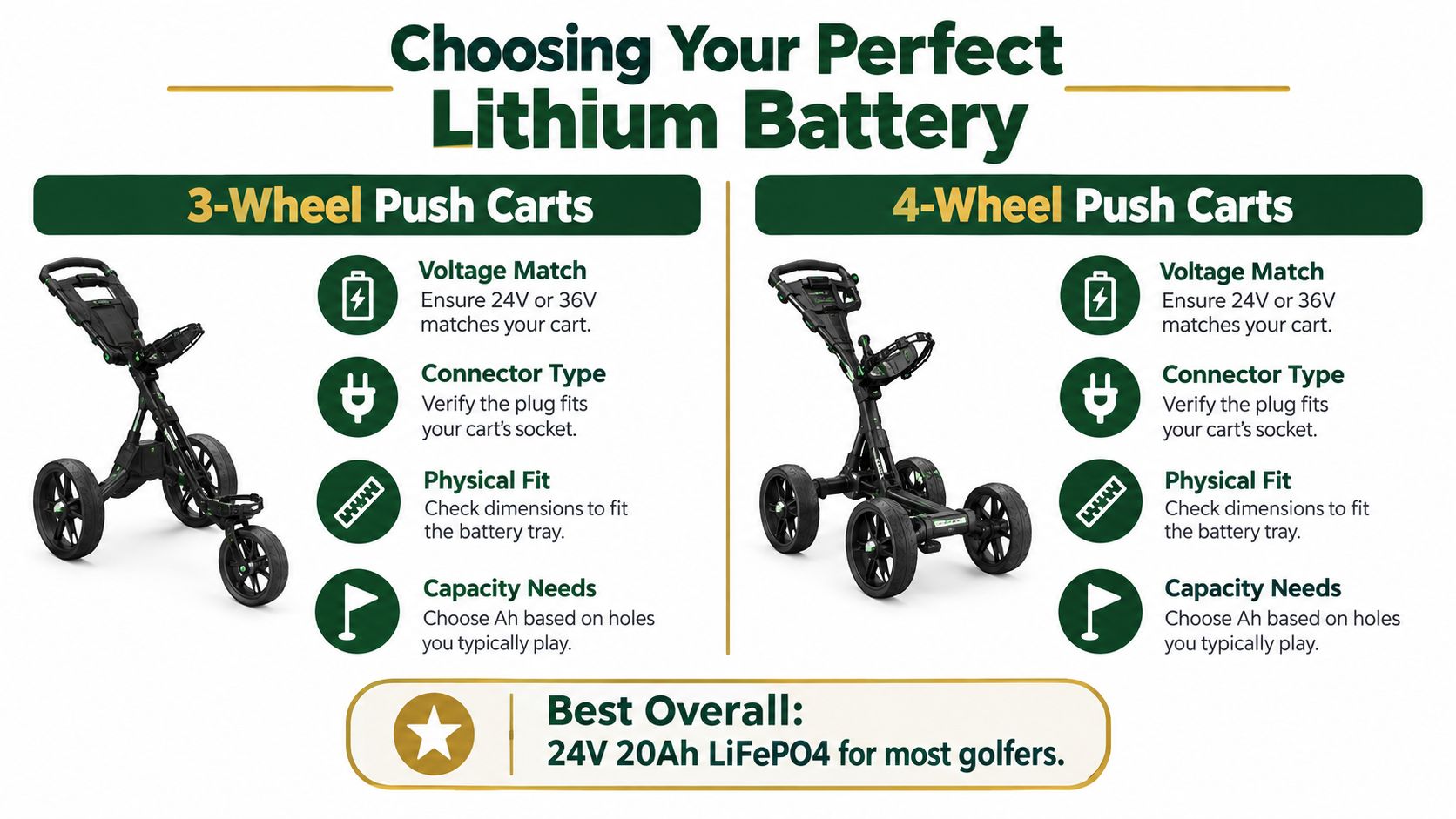
Guidance for golf trolley batteries commonly specifies charging only between 0°C and 45°C and avoiding storage or charging below freezing or above roughly 40°C, according to Lucas battery guidance for golf applications. In plain language, don't plug in a very cold battery and assume it's harmless.
Everyday rules that prevent trouble
Manufacturer guidance says not to short-circuit, immerse, or use damaged batteries, not to store or charge them in extreme temperatures, to use only the approved charger, and to fully charge before storage with periodic top-ups. Another manufacturer warning notes that leaving a battery uncharged in cold conditions can create a fire risk when later charged, according to the PowaKaddy FX1 owner's manual.
That means good habits matter more than clever gadgets.
- Use the approved charger: Mixing chargers is one of the easiest mistakes to avoid. If you need background on charger fit and compatibility, this guide to a lithium battery charger for golf cart systems gives a useful starting point.
- Inspect before charging: Don't charge a pack that looks cracked, swollen, wet, or otherwise damaged.
- Store thoughtfully: A garage is only a good battery home if temperatures stay within sane limits.
- Keep terminals protected: Accidental shorting is a real risk during transport or loose storage.
Storage habit: If your battery spent the night in freezing conditions, let it warm to a safe charging temperature before plugging it in.
Travel and end-of-life handling
Flying with lithium batteries can be more complicated than golfers expect. Standalone lithium-ion batteries above 100 Wh are classified as Class 9 dangerous goods for air freight, and standalone lithium-ion batteries may be limited to a maximum state of charge of 30% for transport, according to LionCare guidance on air-freight transport of lithium batteries.
At the end of the battery's life, don't toss it into general waste. If you're looking into responsible disposal routes beyond local municipal options, this guide to enterprise battery recycling from Beyond Surplus gives useful context on how lithium battery recycling is handled.
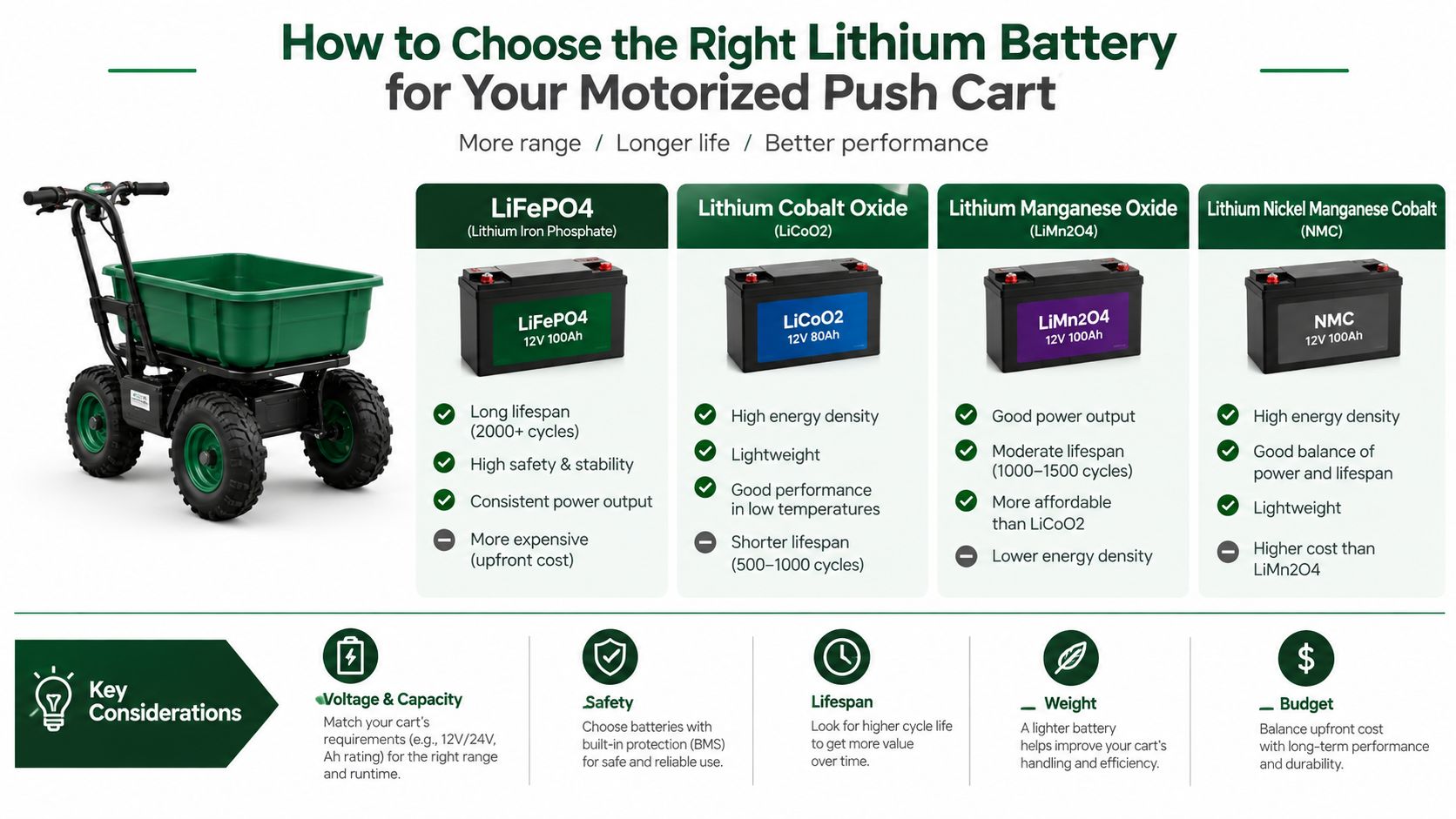
How to Choose the Right Lithium Battery for Your Motorized Push Cart
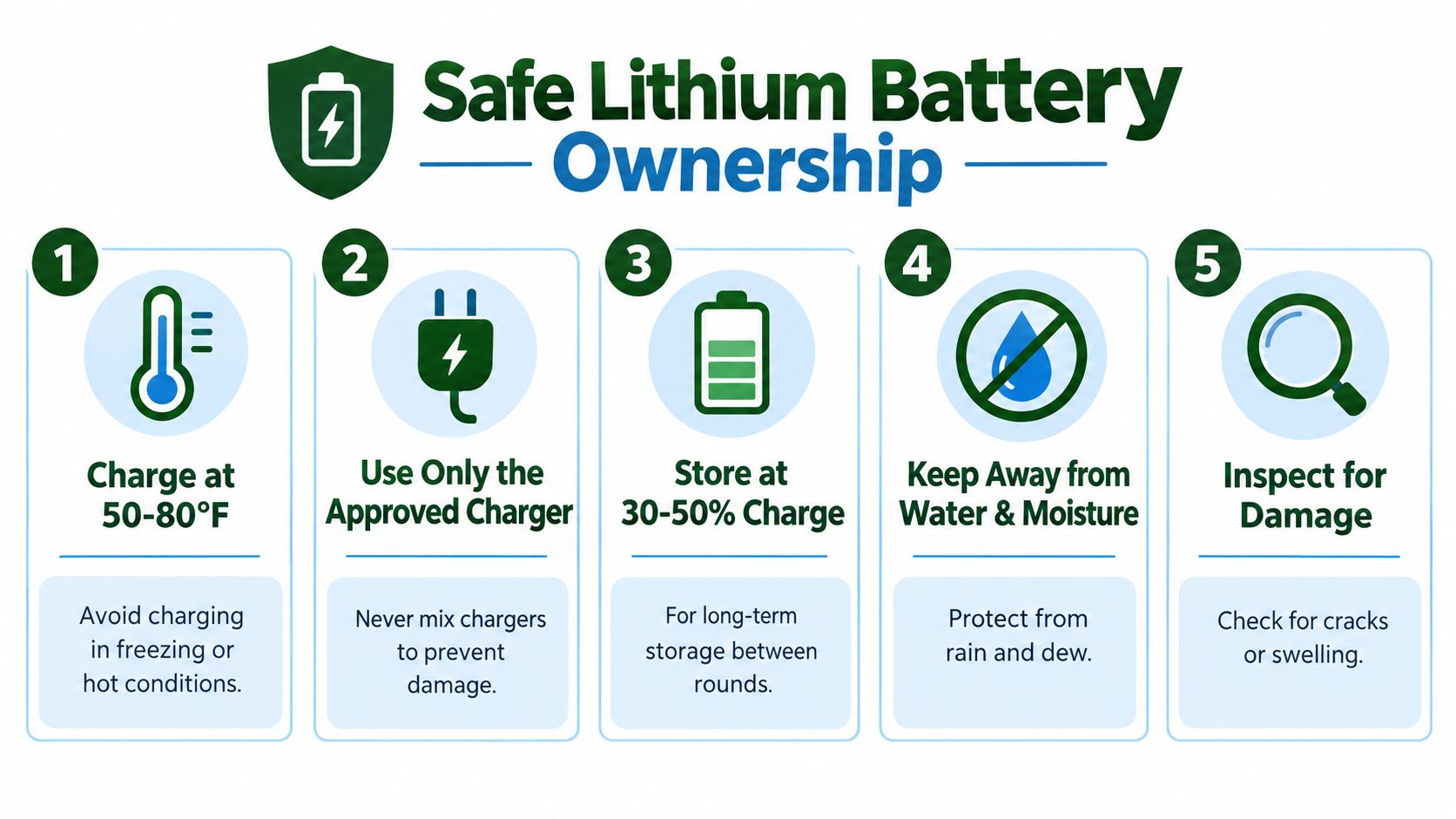
Buying the right battery is mostly about avoiding mismatch. The wrong voltage, the wrong connector, or the wrong physical dimensions can ruin an otherwise sensible purchase.
Compatibility comes first
Before comparing capacities, check these basics:
- Voltage match: Your trolley or power-assist system must match the battery voltage it's designed for.
- Connector type: The plug needs to fit the trolley's socket and wiring setup.
- Physical fit: The battery tray or mounting area needs enough room for the pack.
- Use case: A three-wheel walker on flatter ground may not need the same battery strategy as a four-wheel setup used on hilly tracks.
Build your shortlist around energy, not hype
Once compatibility is sorted, compare batteries by usable watt-hours, then check whether the pack suits your typical round. If you usually play one standard loop on moderate terrain, you can prioritize lighter weight and portability. If you regularly play double rounds or climb a lot of elevation, buy with a bigger reserve margin.
Some golfers also prefer a conversion approach instead of a fully integrated trolley. For example, Caddie Wheel is a battery-powered add-on that turns many standard three- and four-wheel push carts into a motorized setup, and its battery specifications are discussed in this replacement lithium battery guide. That kind of setup can make sense if you already like your current cart and want powered assistance rather than a whole new trolley.
A practical buying filter
When readers ask me what matters most, I usually suggest this order:
- Will it fit and connect properly?
- Does the voltage match exactly?
- Do the watt-hours suit my hardest realistic day?
- Will I still have reserve left, not just enough to scrape home?
- Is the carry weight acceptable for how I store and transport it?
That sequence saves more bad purchases than obsessing over one headline spec.
Buy for your real course, your real bag, and your real walking habits. Don't buy for the flattest round you ever play.
Final Takeaways for Choosing Golf Trolley Lithium With Confidence
Golfers choose lithium for a simple reason. It makes walking golf easier to live with. The pack is easier to carry, the trolley is easier to manage, and the whole round feels less like work.
The smarter way to shop is to stop treating amp-hours as the whole story. Usable watt-hours, reserve planning, and your normal depth of discharge tell you far more about real range and long-term value. A battery that regularly finishes with reserve is usually the one that gives you a calmer round and a longer service life.
Safety matters just as much as performance. Charge in the right temperature range, use the approved charger, avoid damaged packs, and think ahead if you store batteries in sheds, garages, or vehicles.
If you're deciding between sizes, let your toughest normal day lead the choice. Think about whether you usually play 18, sometimes stretch to 27 or 36, and whether your course is flat, rolling, or relentlessly hilly. That's how you choose golf trolley lithium with confidence and avoid paying twice for the wrong pack.
Caddie Wheel offers a practical way to add electric assistance to many standard push carts, which makes all this battery planning matter in a very real way on the course. If you want to walk more holes with less strain and see how a power-assist approach fits your current setup, visit Caddie Wheel.
Share:
Portable Charger Long Lasting: How to Pick the Best One
Brake Brackets for Golf Push Carts Explained