
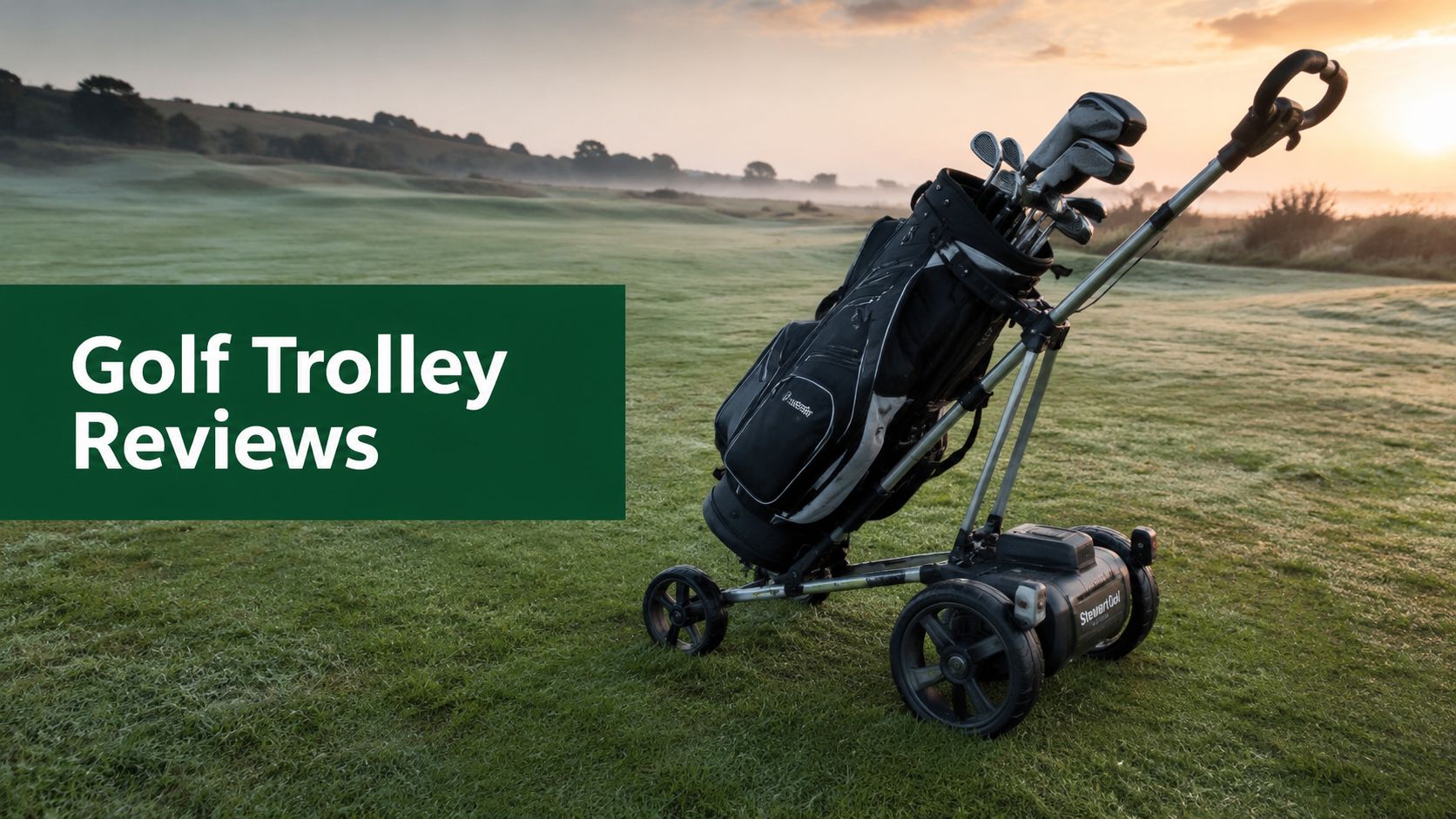
By the time you reach the last few holes of a long walking round, the difference between a good decision and a bad one shows up in your shoulders, your legs, and your swing tempo. On a flat course, pushing a manual cart is manageable. On a hilly course with a full bag, it starts to steal energy from the part of the day that matters.
That's why motorized golf trolley reviews matter more now than they used to. Walking golfers aren't just shopping for convenience. They're trying to protect their focus, keep their rhythm, and make walking a round feel sustainable instead of draining.
The first choice usually isn't brand. It's format. Some golfers want a fully integrated electric trolley that arrives as a complete system. Others already own a push cart they like and would rather add power to it with a conversion kit. That split changes everything, including cost, setup, storage, and long-term satisfaction.
Walk the Course Smarter Not Harder
A lot of golfers start looking at motorized trolleys after the same kind of round. The front nine feels fine. By the back nine, the course turns uphill, the bag feels heavier, and the push cart that seemed perfectly adequate in the pro shop parking lot becomes one more thing to wrestle.
That fatigue isn't dramatic. It's subtle. You arrive at the ball a little flatter, a little less patient, and a little more interested in getting to the clubhouse than committing to the shot.
A motorized trolley changes that equation. It doesn't hit the shot for you, and it doesn't fix poor decisions, but it does remove a steady stream of low-level effort that adds up over a round. For walking golfers, that's the main benefit.
On-course reality: The best trolley is the one that helps you keep walking without turning every hill into work.
What makes the buying process confusing is that the market blends together two very different products. One is the integrated electric trolley, built from the ground up as a powered cart. The other is the conversion kit, which adds motorized assistance to a push cart you already own.
Both can make a round easier. They just solve the problem in different ways.
Some golfers want the clean, all-in-one feel of a purpose-built electric cart with a polished frame and feature-rich controls. Others care less about extra technology and more about getting reliable assistance without replacing a cart that already fits their bag, their trunk, and their habits.
That's where a good review lens matters. Instead of asking which option looks most advanced, ask which one fits the way you play. If you walk rolling terrain every week, reliability and downhill control matter. If you're trying to avoid a big upfront spend, the upgrade path matters. If your garage and car are already tight on space, foldability and transport matter more than showroom appeal.
Two Paths to an Effortless Round Integrated vs Conversion
The easiest way to understand the market is to separate integrated electric trolleys from conversion kits.
An integrated trolley is a complete powered unit. The frame, motor, battery, wheels, and controls are designed as one product. You buy it, charge it, and take it to the course as a dedicated electric cart.
A conversion kit works differently. It adds power to a standard push cart you already own. Think of it as turning a familiar manual setup into a motorized one, rather than replacing the whole system.
| Type | What it is | Best fit | Main trade-off |
|---|---|---|---|
| Integrated electric trolley | Full purpose-built powered cart | Golfers who want a dedicated all-in-one unit | Higher cost and more total hardware |
| Conversion kit | Motorized add-on for an existing push cart | Golfers who already like their cart and want an upgrade path | Requires initial setup on the cart |

Integrated trolleys are the factory-built option
If you like a product that feels complete out of the box, integrated carts make sense. They're designed around electric propulsion from day one. That often means a tidy fit and finish, built-in displays, and a stronger sense that every part belongs together.
For some golfers, that matters. They don't want to think about adapters, brackets, or compatibility. They want a dedicated machine.
The downside is that you're buying the whole platform, whether you need every extra feature or not.
Conversion kits are the upgrade path
A conversion kit is closer to keeping the car you already trust and adding the power you were missing. If your current push cart folds well, tracks straight, and fits your routine, there's a strong case for keeping it and adding motor assist.
That approach is especially appealing to golfers who already own a quality three- or four-wheel cart and don't want to start over. It also tends to keep the decision focused on function instead of feature creep.
For a closer look at how the upgrade route works in practice, this overview of an electric golf push cart conversion kit shows the basic idea.
Simpler gear often gives you a clearer answer to a common buyer question: what exactly am I paying to replace?
The design philosophy is different
Integrated carts usually chase a broader feature list. Conversion kits usually chase practical assistance. Neither approach is automatically better.
If you value cohesive design and built-in extras, an integrated cart will feel more natural. If you value keeping gear you already trust, a conversion kit is often the smarter buy.
That's the split in motorized golf trolley reviews. It isn't just product versus product. It's replacement versus upgrade.
Decoding the Specs What Matters in 2026 Trolley Reviews
A lot of reviews bury the decision under technical language. Most golfers don't need more jargon. They need to know which specs make a difference to the round.
The short version is this. Battery life, slope handling, control feel, and portability matter far more than flashy speed claims.

Battery life sets the ceiling
Battery capacity is the first filter because it determines how much trust you can place in the trolley. Independent buyer guides and reviews in 2025 to 2026 treat 36-hole battery life as a major premium benchmark, and one tested model was described as offering 36-hole battery life on a single charge while also handling steep inclines up to a 25% grade, according to Golf Monthly's electric trolley buying guide.
That matters because the number isn't just marketing shorthand. It tells you whether the trolley is built for a full day of play and whether the battery is being judged under meaningful load, not just ideal flat-ground conditions.
If you regularly play hilly courses, endurance and climbing ability belong in the same conversation.
Speed is less important than control
Review videos from the 2026 PGA Show noted roughly 7 mph top speed, about 10 km/h, and around 14 km range for chargeable-wheel systems, while higher-end fully remote carts were positioned around 36 holes of battery life in the same comparison context, as discussed in this PGA Show review video.
For buyers, that's useful because it puts speed in perspective. A golf trolley doesn't need to be fast. It needs to move predictably, hold pace, and stay composed on terrain that isn't perfectly flat.
Torque and hill behavior are what you feel
Many written reviews often remain superficial. They'll say a trolley is “powerful” without explaining whether that power shows up where it counts. On a course, you feel useful power in three places:
- Starts from a stop: A loaded bag shouldn't make the trolley hesitate.
- Climbs: The unit should keep moving uphill without sounding strained or losing composure.
- Descents: Good braking and pace control matter as much as uphill pull.
If you want a better feel for what motor output means in practical terms, this guide to motor torque ratings is worth reading alongside any spec sheet.
Weight and foldability affect every round
A trolley can perform beautifully on the fairway and still become annoying in the parking lot. If it's awkward to lift, awkward to fold, or awkward to fit in the trunk, you'll feel that every time you play.
Look at portability as a real use metric, not a side note. Ask simple questions:
- Does it fold quickly?
- Can you lift it comfortably?
- Does it store cleanly with your bag and other gear?
Buying rule: If a trolley makes transport harder than walking with it makes golf easier, it's the wrong trolley.
Control system matters more than novelty
Remote control is useful when it's responsive and intuitive. It becomes less useful when a product tries to do too much and asks you to manage behavior instead of enabling unhindered movement.
That doesn't mean advanced modes are bad. It means they need to work cleanly on real ground, not just in a demo.
When reading motorized golf trolley reviews, look for comments about straight-line tracking, side-hill behavior, stopping confidence, and how easy it is to regain control when the course gets awkward. Those details tell you more than a long feature list ever will.
Head-to-Head Comparison Integrated Carts vs Conversion Kits
The right choice usually becomes clearer when you compare the two formats by buying criteria instead of by brand reputation. Most golfers don't need a winner. They need a fit.
Integrated Trolley vs. Conversion Kit Comparison
| Factor | Integrated Electric Trolley | Conversion Kit (e.g., Caddie Wheel) |
|---|---|---|
| Cost | Higher upfront spend for a full powered cart | Lower replacement burden if you already own a push cart |
| Setup | Ready as a dedicated unit | Requires one-time fitting to your current cart |
| Features | More likely to include advanced display or automation features | More likely to focus on straightforward powered assistance |
| Storage | Full separate cart to store and transport | Lets you keep using your existing cart format |
| Upgrade logic | Replaces your current setup | Builds on gear you already trust |
| Simplicity | Clean all-in-one product | Fewer system layers if you want direct control |
Cost and value
Price is one of the clearest dividing lines. In a 2026 review ecosystem, one remote-controlled electric trolley was priced at $1,600, while another model was listed at just under $1,000 for the base version and $1,749 for the version with a 36-hole battery, as discussed in this 2026 electric trolley review video.
That tells you two things. First, integrated carts can move upmarket quickly. Second, battery upgrades can push the final decision higher than buyers expect.
If you already own a push cart you like, a conversion kit changes the value equation because you're not paying to replace the frame, handle, and wheel platform along with the motor system. That won't matter to every golfer, but it matters a lot if your current cart is already doing its job well.
Convenience means different things
Integrated carts win on out-of-box simplicity. You buy one unit, charge it, and use it as intended. That's appealing for golfers who want a dedicated system and don't want to think about compatibility.
Conversion kits win a different kind of convenience. Once fitted, they let you keep the handle shape, bag fit, folding behavior, and storage pattern you already know. For golfers who dislike changing multiple parts of their setup at once, that familiarity counts for a lot.
More convenience on paper doesn't always mean less hassle in practice. Sometimes familiar gear with one useful upgrade is the easier path.
Features and feature creep
Integrated carts often look strongest in listings and videos. They may offer remote control, follow behavior, displays, settings menus, and other premium touches.
Some golfers want that. Others end up paying for modes they won't use consistently.
A conversion kit usually narrows the promise. It's there to provide powered assistance, not to become a dashboard. That can feel less impressive in a product comparison, but more satisfying over months of actual use.
In this category, what works depends on your tolerance for complexity. If you enjoy gadgets and like experimenting with modes, an integrated cart may suit you. If you want to press a button and move the bag without extra decision-making, the simpler path often ages better.
Storage and transport
This criterion gets ignored until ownership begins. A dedicated integrated trolley takes up dedicated space. That's fine if you have room and don't mind loading a separate powered unit every round.
A conversion setup usually makes more sense for golfers who already have a cart that fits their vehicle and storage area well. You preserve the footprint and habits you're used to.
One practical example is Caddie Wheel, which is designed as a power-assist unit for standard push carts rather than a full replacement trolley. That format won't suit everyone, but it fits golfers who prefer upgrading a working cart instead of buying a separate electric platform.
Which side usually fits which golfer
Integrated carts usually fit golfers who want a self-contained product, are comfortable spending more, and don't mind a broader feature set.
Conversion kits usually fit golfers who already trust their push cart, care about value, and want assistance without rebuilding their whole setup.
Neither is automatically the smarter choice. The smarter choice is the one that matches how much you want to replace, how much complexity you want to manage, and how often you'll use the extra features.
Beyond the Spec Sheet Real-World Reliability
The weakest part of many motorized golf trolley reviews isn't the battery discussion or the speed discussion. It's the reliability discussion. A trolley can look excellent in a feature rundown and still become frustrating when the course gets uneven, windy, or awkward.

A major underserved angle in this category is fault recovery on real terrain. Independent reviewer commentary has pointed out that current coverage leans heavily on features like remote control, follow mode, and stability, but often skips the practical question golfers ask on the course: what happens when the trolley loses tracking, drifts on a slope, or needs a manual fallback mid-round, as discussed in this review commentary on reliability and recovery.
More features can raise the stakes
Automation sounds reassuring until it misbehaves on a side-hill. A trolley that follows beautifully on level ground may become less comforting when the lie gets awkward and there's water, rough, or a path edge nearby.
That doesn't mean advanced systems are bad. It means they should be judged by recovery as much as by capability.
Ask these questions when you read reviews or watch demos:
- If tracking drops, how quickly can you regain control?
- If it drifts downhill, does it stop predictably?
- Can you switch to a manual fallback without drama?
Those are ownership questions, not showroom questions.
Simplicity often wins under pressure
Golfers don't need a trolley to feel clever. They need it to behave. Direct forward, reverse, and braking control is often more useful than higher automation when the course stops being tidy.
That's especially true on rolling fairways, damp turf, and uneven edges where the trolley is constantly making small demands on traction and steering. A simpler control approach may look less impressive in a sales video, but it can be easier to trust when a round gets messy.
Here's a useful visual reference on powered assistance in action:
Reliability isn't just whether the trolley works. It's whether the golfer can recover quickly when conditions stop being ideal.
Who Is the Caddie Wheel For A Situational Guide
Some products make sense only for a narrow buyer. A push-cart conversion system has a broader fit than many golfers assume, but only if the golfer values the trade-offs that come with it.

The golfer who already likes their cart
This is the most obvious match. If your current push cart tracks well, folds easily, fits your bag properly, and slides into the trunk without fuss, replacing it may solve a problem you don't have.
For that golfer, adding power makes more sense than buying a whole new frame.
The budget-conscious upgrader
Many golfers want motorized assistance but don't want to move straight into premium integrated-cart pricing. That buyer usually isn't chasing novelty. They're trying to reduce effort and keep walking enjoyable.
A conversion kit fits that thinking because it concentrates the spend on propulsion rather than on replacing the full cart platform.
The golfer who wants straightforward control
Not everyone wants follow mode, app layers, or a more elaborate user interface. Some golfers prefer simple commands and predictable response. That preference becomes more sensible, not less, when they play courses with side slopes, uneven paths, or frequent stop-start movement around greens and tees.
This golfer often gets more value from fewer functions that work cleanly.
The player managing strain
Walking is still the best part of golf for many older players and for golfers managing fatigue or mobility limitations. The challenge isn't whether they want to walk. It's whether pushing a loaded cart takes enough out of them to affect the round.
For that player, dependable assistance can make walking realistic again. The right setup reduces strain without changing the rhythm of being a walking golfer.
Choose the format that removes effort from your round, not the one that adds the most technology to your cart.
A conversion system won't fit every golfer. If you want an all-new dedicated electric trolley with every integrated extra, that path is still there. But if your real goal is to keep your current cart, cut the physical load, and avoid unnecessary complexity, this category deserves serious attention.
Simple Maintenance for Long-Lasting Performance
Most trolley maintenance is basic. The golfers who avoid problems usually do the simple things consistently.
Keep the essentials clean
Grass, mud, and grit build up around wheels and moving parts. Wipe the trolley down after dirty rounds, and pay special attention to the wheel area and any points where debris can affect smooth movement.
Treat the battery like the heart of the system
Follow the charging routine from the manufacturer and avoid getting casual about battery care. If you want a practical primer, this guide to golf cart battery maintenance covers the basics that matter most.
Check fit and attachments
With integrated carts, that means making sure folding parts, wheels, and controls feel secure. With conversion kits, it means confirming the bracket and mounted drive unit stay clean and properly seated before a round.
Keep maintenance realistic
You don't need a workshop mindset. You need habits. Charge it properly, store it sensibly, and don't leave dirt packed into the working parts.
If you already own a push cart and want motorized assistance without replacing your whole setup, Caddie Wheel is worth a look. It's built around the conversion approach discussed above, with powered assistance for standard push carts and a simpler control philosophy than many feature-heavy integrated systems.
Share:
Unlock Golf Cart Motor Prices: 2026 Cost & Value Guide
Best Battery Operated Fan for Golf Cart: 2026 Buyer's Guide