
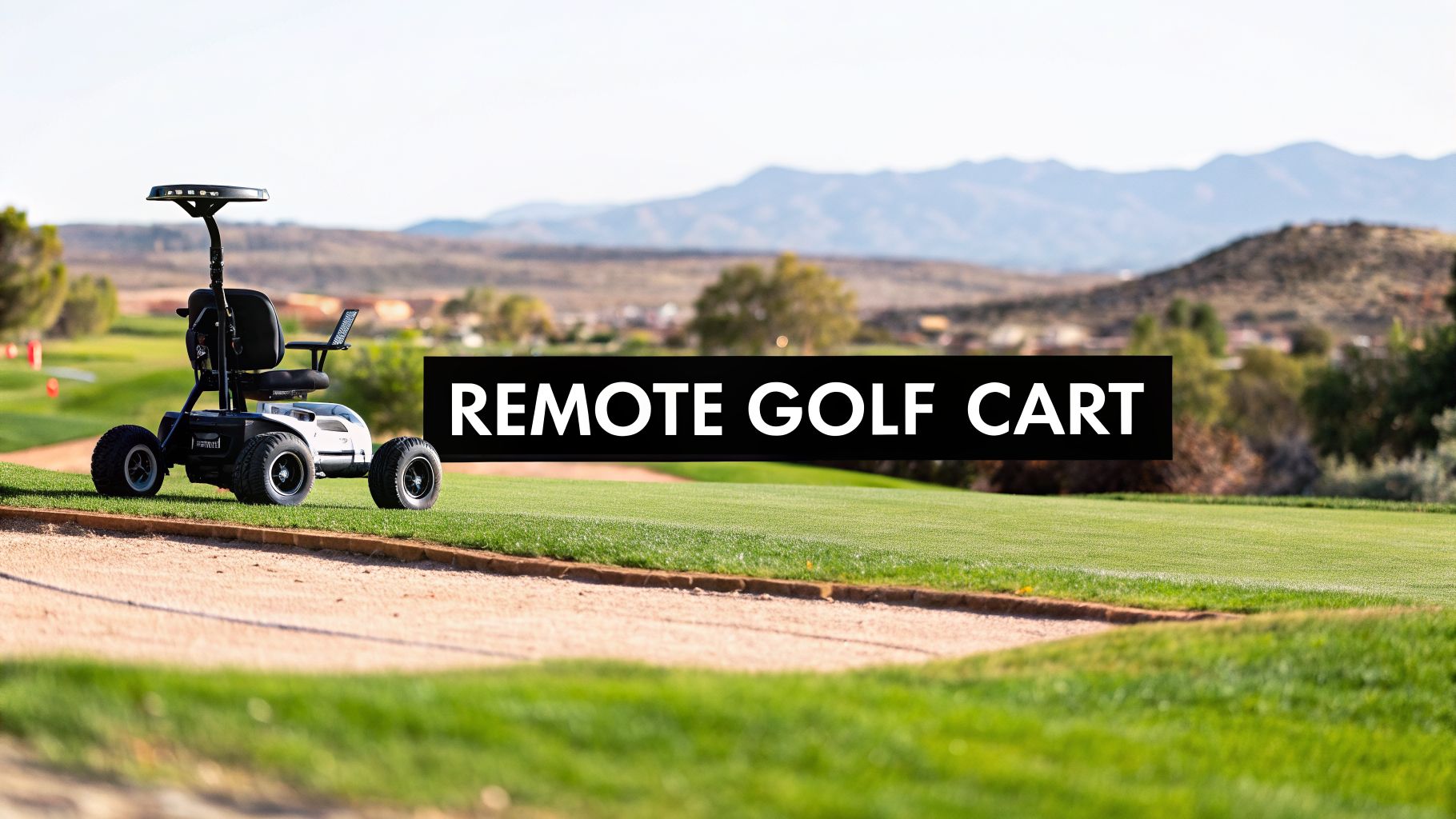
A remote controlled golf cart completely changes how you experience a round. It lets you walk the course and get all the health benefits without the back-breaking work of pushing or pulling your clubs. All that energy you save goes right back into what matters most: your swing.
Welcome to a Smarter Walk on the Course
Picture this: you're on the 14th hole of a beautiful but hilly course. Your shoulders are aching, your legs feel like lead, and your focus is shifting from your next shot to just getting your bag up another hill. By the time you hit the final stretch, fatigue has already cost you a few strokes. Sound familiar? That’s the reality for tons of walking golfers.
Now, imagine a different round. You’re strolling down the fairway, hands-free, while your cart glides silently alongside you. You get to your ball feeling fresh, clear-headed, and ready to plan your next shot. This isn’t some far-off luxury; it’s the huge advantage a remote controlled golf cart gives you.
Conserve Energy, Improve Your Game
The main benefit is dead simple but has a massive impact: you save a ton of energy. Shoving a 30-40 pound bag over miles of uneven ground is a serious workout. And while that's great for fitness, that physical drain can kill your performance, especially on the back nine.
A remote controlled cart takes that burden away, transforming your game in a few key ways:
- Sustained Physical Performance: You save your strength for your swings, not for the long walks in between.
- Enhanced Mental Focus: When you're less physically tired, your mind stays sharper. That means better course management and smarter shot selection.
- Full Enjoyment of the Walk: You can actually soak in the scenery and chat with your buddies without being chained to a heavy, awkward cart.
Not Just One-Size-Fits-All
The market for these smart caddies is blowing up, which shows a real shift in how golfers are thinking about the game. In fact, the global electric golf cart market is expected to hit USD 3.39 billion by 2030—a huge jump driven by players who want more convenient and sustainable ways to play. You can explore more data on this expanding market to see just how big this trend is getting.
All this growth means you have more options than ever. You could go all-in on a fully integrated, all-in-one remote caddy built from the ground up for motorized power. Or, you could check out clever conversion kits like the Caddie Wheel, which let you upgrade the push cart you already own and love with powerful remote features. Each route offers its own mix of convenience, cost, and features, so there’s definitely a perfect fit out there for your game and your wallet.
Choosing Your Path: Full Carts vs. Conversion Kits
When you decide to add a remote-controlled golf caddy to your game, you’re faced with a choice that feels a lot like upgrading your car. Do you buy a brand-new, top-of-the-line electric vehicle with every feature built-in, or do you install a high-tech upgrade package into the reliable car you already own and love? Both get you to a similar destination, but the cost, process, and overall experience are worlds apart.
This is the core decision you'll make between a fully integrated remote caddy and a conversion kit. Each one offers a different path to a less strenuous, more focused round of golf.
The All-In-One Solution: Fully Integrated Remote Caddies
Think of fully integrated remote caddies as the "smart car" option. These are complete, purpose-built units designed from the ground up to be motorized and remote-controlled. Everything—from the frame and wheels to the battery and motors—is engineered to work together as one seamless system.
These models often come with a premium price tag, typically ranging from $1,500 to over $3,000, but they justify the cost with some seriously advanced features. You’ll find things like gyroscopic straight-line tracking, multiple speed settings, automatic downhill braking, and even "follow me" technology that turns the cart into your loyal shadow.
- Pros: Sleek, integrated design, a full suite of advanced features, and optimized stability since all components are designed to work together.
- Cons: A much higher cost, they're often heavier and bulkier, and you have to ditch your existing push cart.
The Smart Upgrade: Conversion Kits
A conversion kit is the "high-tech upgrade" for the cart you already know and trust. Instead of replacing your entire setup, these kits add motorized, remote-controlled power to your current three or four-wheel push cart. This approach is far more affordable and practical for golfers who are perfectly happy with their current gear.
Think of a conversion kit as adding a powerful, smart engine to your favorite push cart. You get the convenience of remote control without having to give up the cart you've grown to love, all at a fraction of the cost of a new, fully integrated caddy.
For golfers who enjoy a hands-on project, exploring how to implement DIY conversion kits can be a rewarding path, showing just how adaptable this technology can be. This simple flowchart can help you visualize your starting point.

The chart really simplifies the decision: if walking the course is starting to feel like a chore, a remote-controlled solution is probably the right move for you.
A Head-to-Head Comparison
To make the choice crystal clear, let's break down the key differences. This table gives you a quick, at-a-glance look at how these two remote-controlled solutions stack up. For an even deeper dive, you can explore some of the top electric golf cart conversion kit options for 2025.
Full Remote Caddy vs. Conversion Kit: A Quick Comparison
| Feature | Fully Integrated Remote Caddy | Wheel-Assist Conversion Kit |
|---|---|---|
| Average Cost | High ($1,500 - $3,000+) | Low ($500 - $900) |
| Installation | None required (ready out of the box) | Simple; often takes just minutes |
| Portability | Can be heavy and bulky | Lightweight and detachable |
| Compatibility | Not applicable | Fits most major push cart brands |
| Core Features | Advanced (follow modes, GPS) | Essential (forward, reverse, speed control) |
Ultimately, the right choice comes down to your budget and what you prioritize on the course. If you want the absolute latest features and a perfectly integrated system, a full remote caddy is a fantastic option.
However, for golfers looking for an affordable, practical, and effective way to motorize their existing equipment, a conversion kit like the Caddie Wheel offers an unbeatable blend of value and performance. It delivers the core benefits—saving your energy and sharpening your focus—without forcing you to invest in a completely new system.
Evaluating the Features That Truly Matter
When you start shopping for a remote-controlled golf cart, it's easy to get lost in a sea of marketing claims and fancy features. But to find the right one for your game, you need to cut through the noise and focus on what actually makes a difference on the course. Think of it like buying any other piece of important golf equipment—the flashy stuff is nice, but performance and reliability are what really count.

Let's break down the core components, from the battery that gets you through the round to the remote that puts you in the driver's seat. This will give you a clear checklist to compare models and make a choice you won't regret.
Battery Life and Real-World Range
Without a doubt, the single most critical feature of any remote-controlled cart is its battery. It's the heart of the machine. If it dies mid-round, your high-tech caddy instantly becomes a very heavy, very frustrating manual push cart.
You'll see manufacturers claiming their carts can last for 18, 27, or even 36 holes on a single charge. Take those numbers with a grain of salt. They're usually based on perfect conditions—a flat course, a light bag, and a sunny day. In the real world, several things can drain that battery much faster.
- Hilly Terrain: Climbing up and down hills sucks up a ton of power. It’s the biggest battery-killer out there.
- Heavy Golf Bag: A fully loaded tour bag is going to make the motor work a lot harder than a lightweight Sunday bag.
- Course Conditions: Soft, wet turf creates more friction and resistance, forcing the motor to work overtime compared to a firm, dry fairway.
When you see a "36-hole" promise, treat it as a best-case scenario, not a daily guarantee. A good rule of thumb is to pick a battery rated for at least nine holes more than you typically play. That gives you a comfortable safety net for those longer rounds or tougher courses.
The Brains of the Operation: The Remote Control
The remote is your connection to the cart, so it absolutely has to be reliable, responsive, and easy to use. A finicky or confusing remote is more of a headache than it's worth.
A great remote should feel natural in your hand, with buttons that are easy to find and press without having to stare at it. Here are the non-negotiables:
- Variable Speed Control: You need to be able to smoothly dial the speed up or down to match your walking pace.
- Directional Controls: Simple forward, reverse, left, and right commands should feel immediate and precise.
- Braking System: An electronic brake, especially one with downhill speed control, is a huge safety feature. It keeps your cart from running away from you on a steep slope.
- Signal Reliability: The remote needs a rock-solid connection to the cart. Most modern systems are pretty good, maintaining a stable signal over 50-100 yards without interference.
Here's a pro tip: check what happens if the remote gets bumped in your pocket. Look for models with a lock function or a smart design that prevents accidental button presses. You don't want your cart taking off on its own.
Motor Power and Hill-Climbing Ability
A remote caddy's toughness on hills boils down to its motor. A weak motor will whine and struggle on inclines, and you'll end up having to help push it—which completely defeats the purpose.
Motor power is usually measured in watts. You don't need an engineering degree, but just know that higher wattage generally means better climbing power and the ability to handle a heavier bag. Carts with dual motors—one for each rear wheel—are often the best climbers, providing better traction and stability on wet or uneven ground.
This focus on performance is why electric models now dominate the golf cart industry, capturing an estimated 81.81% market share in 2023. Golfers are choosing them for their reliability and lower operating costs, which is exactly what you need on a demanding course.
Portability, Weight, and Storage
Remember, you don’t just use your cart on the course—you have to get it there and back. The cart's weight and how small it folds down are massive practical considerations. Before you even think about buying, picture your car. Will it fit in the trunk? Can you lift it in and out without throwing your back out?
Many modern carts have slick one- or two-step folding mechanisms that make setup and takedown a breeze. Lighter materials like aluminum are great for reducing weight, but just make sure the frame still feels sturdy and durable. If you want to dive deeper into the tech, check out your guide to electric golf cart remote control systems.
Warranty and Customer Support
Last but not least, don't overlook the warranty and the company's reputation for customer service. You're buying a complex piece of equipment, and things can go wrong. A solid warranty—usually 1-2 years on both the cart and the battery—is your safety net.
Look for brands known for being responsive and helpful. If you run into an issue, you want to know you can get a real person on the phone to help you troubleshoot or order a part. That kind of long-term support is every bit as valuable as any feature on the cart itself.
Who Really Gets the Most Out of a Remote Control Cart?
A remote-controlled golf cart isn't just a cool gadget; it's a practical tool that solves real-world problems for a surprisingly wide range of players. While pretty much anyone can appreciate the convenience, for certain golfers, this technology fundamentally changes their relationship with the game—for the better. It empowers them to play more often, perform at a higher level, and simply enjoy their rounds more.

Let’s take a look at three types of golfers who see the biggest and most immediate benefits from adding remote control to their game.
The Senior Golfer Looking to Play Longer
First up, the senior golfer. They've played for decades, love the sport, and cherish the health benefits of walking the course. The problem is, years of wrestling a heavy cart are starting to catch up. Aching backs, sore shoulders, and tired knees are turning an enjoyable walk into a physical chore.
For this player, a remote controlled golf cart is a ticket to more golf, more comfortably. By completely removing the strain of pushing, they can keep walking 18 holes without the aches and pains that follow. This translates to less fatigue, a lower risk of injury, and the freedom to focus on their swing instead of just gutting out the walk.
- Saves Energy: They can finish the round feeling refreshed, not completely drained.
- Prevents Injury: It eliminates the repetitive strain on joints that often leads to chronic pain.
- Extends Their Game: Many seniors find they can add years to their walking golf life just by making this simple switch.
The Competitive Player Protecting Every Edge
Next, let's talk about the competitive player. This golfer lives and breathes performance, and they know every single stroke counts. For them, championship golf is a game of razor-thin margins, where physical and mental fatigue are the ultimate enemies, especially in a tournament.
They see a remote-controlled cart as a strategic weapon. Every bit of energy saved by not pushing a cart is energy they can pour into their swing on those critical final holes. Walking hands-free also gives them more mental bandwidth between shots, letting them analyze the next lie or read a putt without distraction.
For the serious competitor, physical energy is a finite resource. A remote cart acts like an energy bank, ensuring they have maximum reserves available for the shots that truly define their score.
It's all about eliminating a variable. By taking physical exertion out of the equation, they create a more consistent and controlled environment, allowing their skill to shine through when the pressure is on.
The Hill Course Regular Tired of the Climb
Finally, picture the golfer whose home course is a battlefield of steep hills and dramatic elevation changes. For them, every round feels like a grueling cardio workout. Pushing a cart up a sharp incline on the 16th hole can feel like a monumental effort, leaving them breathless and unfocused for their next shot.
This player benefits immediately and profoundly from a motorized caddy. What was once the most dreaded part of their round becomes completely effortless. A quality remote controlled golf cart with a strong motor and solid braking turns intimidating hills into just another part of the fairway. They can walk up slopes at a normal pace, arriving at their ball ready to play, not gasping for air. This doesn't just improve their score—it makes playing their challenging home course a whole lot more fun.
Getting Set Up and Keeping It Running Smoothly
Bringing home a new remote-controlled golf cart should feel like adding a reliable partner to your foursome, not like you’ve just signed up for a complicated DIY project. A lot of golfers get hung up on the idea of a tricky setup or endless maintenance, but today’s designs are built to be user-friendly right out of the box.
For a fully integrated electric caddy, there’s practically no installation. You just charge it up, pop on the wheels, and you’re good to go. If you're using a conversion kit like the Caddie Wheel, the process is designed to be just as simple, usually taking only a few minutes. You’ll snap a custom bracket onto your push cart’s frame and then slide the motorized wheel right into place.
Once it's assembled, the next step is pairing the remote control with the main unit. This is typically as easy as pressing a button, which creates the secure digital link that gives you full command over your cart.
Taking It for a Spin Before Your First Round
Before you head to the first tee, it's a great idea to take your new remote caddy for a quick test drive. Find an open space like your driveway or a quiet corner of the practice range to get comfortable with the controls without any on-course pressure.
This little practice session helps you get a feel for a few key things:
- Speed Control: Play around with the speed settings to find the perfect pace that matches your natural stride.
- Turning Radius: Make some gentle left and right turns to see how it maneuvers.
- Stopping Distance: Get a sense of how quickly the cart stops when you hit the electronic brake.
A few minutes of this is all it takes to build confidence. It’s the difference between feeling like you’re managing a new piece of tech and knowing you have a familiar tool ready for the course.
The demand for this kind of convenience is skyrocketing. The smart follow and remote-controlled cart market was valued at USD 240.1 million in 2023 and is projected to hit USD 410.5 million by 2032. It’s all driven by golfers who want a more comfortable, hands-free round. You can discover more insights about the electric golf cart market and its impressive growth.
Simple Upkeep for a Long-Lasting Caddy
You don’t need a mechanic’s toolkit to keep your remote-controlled cart in prime condition. A few simple habits will protect your investment and ensure it runs like a charm for years, saving you from any frustrating on-course hiccups.
-
Treat the Battery Right: The battery is the engine of your caddy. Make it a habit to give it a full charge after every single round, even if the indicator says it still has juice left. Storing a lithium-ion battery when it's partially drained can shorten its overall lifespan. For a deeper dive, check out our guide to golf cart battery maintenance.
-
A Quick Wipe-Down: After your round, take a minute to wipe down the wheels and the motor housing. Getting rid of grass clippings, sand, and dirt prevents buildup that can mess with the cart's mechanics and cause extra wear on its moving parts.
-
Pre-Round Check: Before you play, do a quick spot-check. Make sure the remote has fresh batteries to avoid losing signal. Double-check that all connections feel snug and that the cart responds instantly to the remote. This simple pre-game routine can head off almost any common issue before it even starts.
Your Best Round Is a Button Push Away
We've covered a lot of ground in this guide, and by now, you probably see that a remote controlled golf cart is much more than a cool gadget. It’s an investment in your energy, your focus, and your long-term love for the game. When you hand off the physical work of carrying your clubs, you’re free to concentrate on what really matters: your next shot.
We’ve also walked through the two main paths you can take. You can go all-in with a high-end, fully integrated remote caddy loaded with features, or you can make a smart, affordable upgrade like the Caddie Wheel to motorize the push cart you already have. There’s no single "best" answer here—only what’s right for your game and your budget.
From Features to Fairways
We also zeroed in on the features that actually make a difference on the course. A reliable battery that can easily outlast your longest rounds, a responsive remote that feels like a natural extension of your hand, and a motor that doesn’t flinch at steep hills—these are the things that define a great remote caddy experience. Knowing this stuff turns you from a casual browser into a smart buyer, ready to pick a cart that will be a dependable partner for years.
At the end of the day, the goal is simple: to walk off the 18th green feeling less tired and more satisfied with how you played. A remote controlled golf cart helps you save your physical and mental energy for the moments that truly count.
Whether you’re a senior golfer hoping to play for many more years, a competitive player looking for any edge you can get, or just someone who wants to make a hilly course a lot more fun, this technology has a clear and powerful answer. The right choice doesn't just carry your clubs; it elevates your entire round, bringing you one step closer to playing your best game yet.
Have a Few More Questions?
It's completely normal to have a few last questions before you're ready to add a remote-controlled cart to your golf setup. We hear from golfers all the time, so we've put together some clear, straightforward answers to the most common things people ask. This should help you make your final decision with total confidence.
Can Remote Carts Handle Tough Courses?
What about steep hills and bumpy fairways? Absolutely. Most high-quality remote carts are built specifically for the real world of golf, which is rarely flat. You'll want to look for models with powerful motors, good torque, and—most importantly—features like downhill speed control or automatic braking. These systems are a lifesaver, preventing your cart from getting away from you on slopes and giving you the muscle needed to climb hills without a second thought.
A big worry for many is what happens if the remote's battery dies mid-round. Don't sweat it. The vast majority of remote carts can be easily switched into a 'freewheel' mode, letting you push them manually just like a standard push cart. Some brands even toss in a spare battery for the remote or include a handy USB charging port on the main cart battery itself.
And what about conversion kits—do they fit any push cart? While many kits are designed to be as universal as possible, you absolutely have to check the specs. Most will easily fit standard three- and four-wheel carts from the big names like Clicgear, Bag Boy, or Sun Mountain. But it's always smart to double-check that your specific model is on the compatible list before you buy.
Ready to make walking the course a whole lot easier? The Caddie Wheel is the simplest, most powerful, and most affordable way to upgrade your push cart with remote-controlled convenience. Get your Caddie Wheel today and experience a smarter, less tiring round of golf.
Share:
Your Complete Guide to Hub Motor Kits for Any Project
Weight golf cart: How Much Does a Golf Cart Weigh in 2026?