
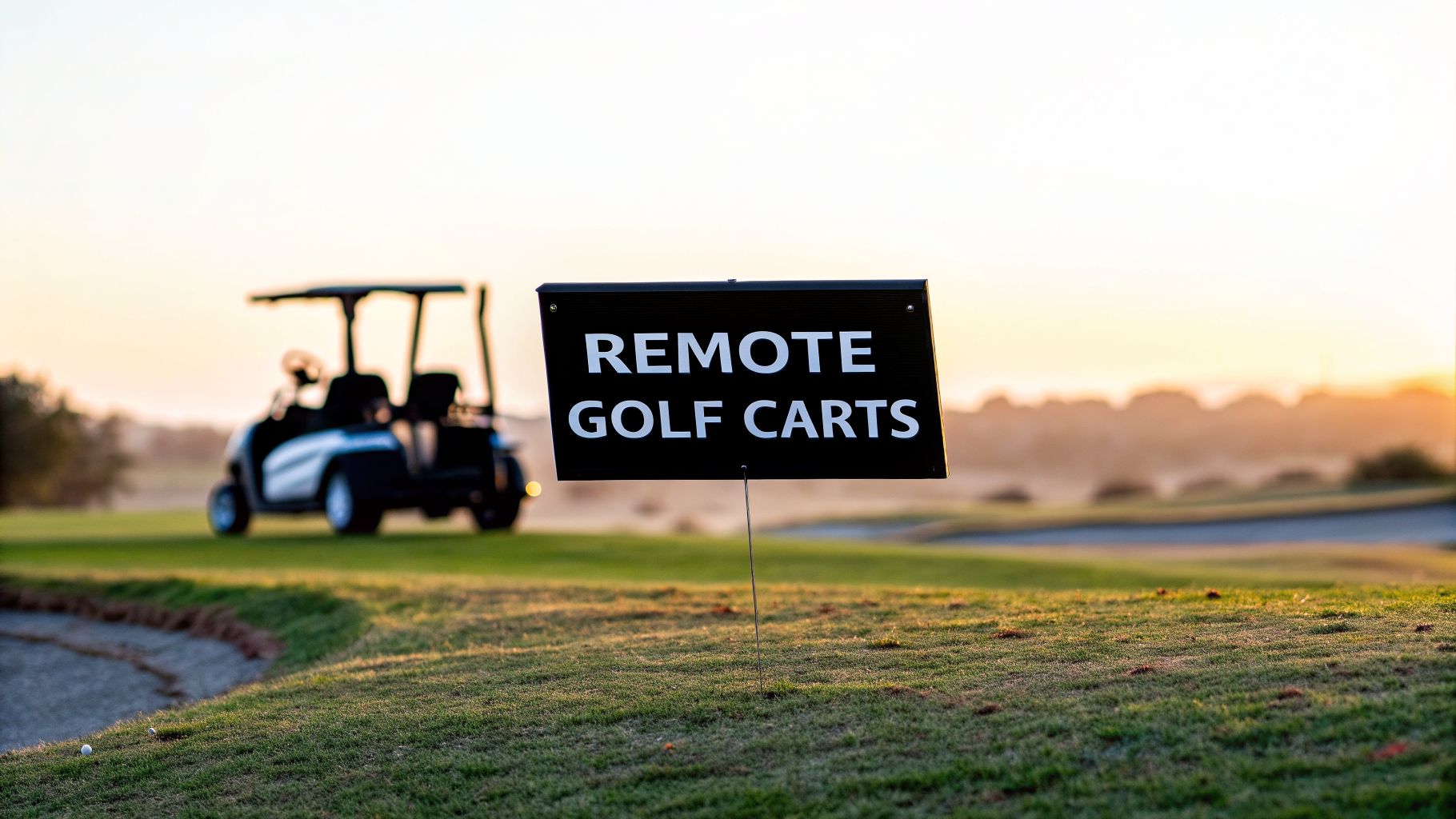
Imagine this: you're walking up the 18th fairway, feeling just as fresh as you did on the first tee. You’re not tired from lugging a heavy bag or pushing a cart up and down hills. Instead, you've been able to focus purely on your shots, strategy, and the simple joy of the walk. That’s the experience remote golf carts are bringing to the game, perfectly blending the health benefits of walking with modern, hands-free convenience.
Welcome to Effortless Golf With Remote Carts

Think of a remote-controlled golf cart as your personal electronic caddie. It follows your lead, carries your gear, and completely removes the push-pull grind of a manual cart from your round. This lets you walk the course freely, conserving precious energy for what really counts: your swing.
This isn't just a niche trend; it's a significant shift in how golfers are choosing to play. The global golf cart market was valued at USD 2.12 billion in 2025 and is on track to hit USD 3.70 billion by 2034. That boom is driven by players like you who are looking for smarter, more efficient ways to enjoy their rounds.
Redefining Your On-Course Experience
A remote-controlled cart does a lot more than just haul your clubs. It fundamentally changes the rhythm and feel of your game, offering some serious advantages over both traditional push carts and riding carts.
- Conserve Your Energy: Pushing 30+ pounds of gear up and down hills takes a toll. By letting a motor do the work, you stay stronger and more focused, especially on the back nine where rounds can fall apart.
- Improve Your Pace of Play: Finished putting out? You can send your cart ahead to the next tee box while you mark your scorecard. It’s a small trick that helps keep your group moving and the round flowing smoothly.
- Enhance Focus: When you're not physically managing your equipment, you free up mental space. This allows you to better analyze your next shot, read the subtleties of the green, and stay locked into your game plan.
The core benefit is simple: you get the full health advantage of walking a golf course without the fatigue. It’s the best of both worlds, allowing you to finish 18 holes feeling fresh, not drained.
This idea of investing in your performance isn't just limited to the course. Many dedicated golfers find the best golf simulator for home to sharpen their skills year-round. In the same way, a remote cart is a direct investment in lowering your scores. And if you already love your current push cart, you can even explore an https://caddiewheel.com/blogs/golf-content/power-push-cart-golf that gives you all the benefits of remote control.
The Game-Changing Benefits of Going Remote

Switching to one of the many remote golf carts on the market isn't just about adding a cool gadget to your setup—it’s a strategic decision that can seriously improve your health and your scores. While the idea of a hands-free round is nice, the real advantages go much deeper, directly impacting your physical energy and mental game from the first tee to the 18th green.
Just think about your round without having to constantly wrestle with a manual cart. Pushing 30 pounds of clubs and gear over five miles of uneven ground is a real workout, and it slowly drains your stamina shot by shot. By letting a motor handle that physical labor, you walk up to each ball feeling fresher and more focused.
That conserved energy translates directly into better golf. When you’re not physically worn down, you can hold your posture and maintain solid swing mechanics through all 18 holes, not just the front nine. Golfers who make the switch often say they have more power and control later in the round—exactly when fatigue usually causes scores to balloon.
Less Strain, More Gain
One of the biggest wins is the reduction in physical strain, especially on your back, shoulders, and knees. This is a huge deal for senior golfers or anyone trying to manage chronic aches and pains. A remote cart can be the very thing that extends your playing years, letting you enjoy the walk without the punishing physical cost.
Think about the layout of your home course. Is it hilly? For many of us, those steep inclines are the most exhausting part of walking a round.
- Uphill Climbs: A remote cart powers up hills effortlessly, so you can stroll alongside it instead of fighting for breath.
- Downhill Control: Modern electronic braking systems stop the cart from getting away from you on descents, giving you stable, safe control.
- Sidehill Stability: Many units are built with a low center of gravity to stay upright on tricky side-slopes, preventing those frustrating tip-overs.
By taking these physical struggles out of the equation, you turn what could be a grueling trek into what it’s meant to be: a healthy and enjoyable walk through the course.
The core advantage is conserving your mental and physical capital. Instead of wasting energy managing your equipment, you can invest it in course strategy, reading putts, and executing your best possible swing.
A Sharper Mental Game
This physical relief pays massive dividends for your mental game, too. When your mind isn't busy navigating your cart around a bunker or just trying to catch your breath, it’s free to lock in completely on the next shot. You’ll have more bandwidth to visualize the ball flight, account for the wind, and fully commit to your club selection.
This is the headspace that leads to lower scores. Players often find the biggest difference is their ability to stay "in the zone" for longer stretches. You finish the round feeling mentally sharp, not just physically less tired.
Ultimately, remote golf carts let you play the game you want to play, not the one that fatigue forces you to play.
When you start looking at remote-controlled golf carts, the technical jargon can feel overwhelming. Suddenly you’re hearing about "lithium-ion," "torque," and "watt-hours," and it might feel like you need an engineering degree just to choose a cart.
The good news is, you don’t. Let's cut through the noise and talk about what really matters on the course, so you can find the perfect remote caddie for your game.
Battery Life and Range: Your Cart’s Stamina
Think of the battery as the heart of your remote cart. It dictates how far you can go, plain and simple. You’ll see a lot of options out there, but a high-quality lithium-ion battery is the gold standard today. They pack more power into a lighter frame, which is exactly what you want.
For most golfers, a battery rated for 27 to 36 holes is the sweet spot. That gives you more than enough juice for a long day of golf, and you’ll never have to worry about your cart dying on the back nine.
Navigating the world of remote carts can be tricky, but understanding the key features makes all the difference. This checklist breaks down the most important technical specs to look for.
Essential Remote Cart Feature Checklist
| Feature | What to Look For | Why It Matters |
|---|---|---|
| Battery Type & Capacity | Lithium-ion, rated for at least 27-36 holes. | Ensures your cart lasts the entire round (and then some) without adding excessive weight. |
| Motor Power & Torque | A motor strong enough for hills, often with dual-motor options. | Prevents your cart from slowing down or struggling on steep inclines. |
| Control Style | Intuitive joystick or simple directional buttons. | You want a remote that feels natural in your hand and responds instantly. |
| Advanced Controls | Preset distance sending, automatic downhill braking. | Gives you greater control and convenience, letting the cart do more work for you. |
| Weight & Portability | Lightweight frame (e.g., aluminum) and a compact folding mechanism. | Makes it easy to transport the cart from your car to the course without a struggle. |
| Installation | "Drop-on" or tool-free setup for conversion kits. | Lets you get started quickly without a complicated assembly process. |
By keeping these points in mind, you can confidently compare different models and find a cart that’s built for performance, not just for the showroom floor.
The Power and Control System
Beyond just battery life, you need a cart that can actually handle the course. The motor is the muscle, providing the torque to climb hills without losing steam. A weak motor will leave you frustrated on anything but the flattest fairways.
The remote, on the other hand, is your command center. It needs to be responsive and easy to use.
- Simple Directional Remotes: These are the no-fuss option with basic forward, back, left, and right buttons. They’re incredibly easy to learn and master.
- Joystick Controls: A lot of players prefer the smooth, one-handed control of a joystick for steering and adjusting speed on the fly.
- Advanced Features: Some of the best systems come with game-changing features, like preset distance buttons (send your cart 15, 30, or 60 yards ahead to the next tee) and automatic downhill braking for total control on slopes.
This blend of powerful motors and smart controls is exactly why electric carts are taking over. The North America golf cart market was valued at USD 729 million in 2024 and is expected to grow at a 4.7% CAGR through 2031. This trend is fueled by golfers wanting better battery life and smarter controls. You can dig into more data on the global golf cart market to see just how fast this space is moving.
Portability and Ease of Use
Finally, let’s talk about the practical side of things. How much does the cart weigh? How big is it when folded down? A cart is useless if it’s a pain to get from your car trunk to the first tee.
The best technology is the technology you don't have to think about. Your cart should be easy to transport, quick to set up, and simple to operate, allowing you to focus completely on your game.
This is where clever conversion kits like the Caddie Wheel really stand out. Instead of buying a whole new, bulky unit, they offer a "drop-on" installation that turns your current push cart into a fully remote-controlled one in minutes.
Because these kits use your existing cart’s frame, you get a familiar, lightweight setup without the high cost or hassle. It's one of the simplest and most accessible ways to get started with a remote-controlled caddie.
Integrated Carts Versus Conversion Kits
So, you're ready to add some remote-control convenience to your game. This brings you to a big decision: do you spring for a fully integrated remote cart, or do you upgrade your trusty push cart with a conversion kit?
It’s a bit like choosing between a brand-new car with all the tech built-in versus adding a top-of-the-line sound system and navigation to the car you already love. Both get you where you want to go, but the cost, experience, and level of customization are worlds apart.
Remote golf carts that come fully integrated are designed from the ground up as a single, cohesive machine. The motor, battery, and remote system are all seamlessly built right into the frame. This often means you get a sleek, purpose-built cart with advanced features like "follow-me" modes and gyroscopic controls that are perfectly dialed in for that specific model.
Of course, this all-in-one approach comes with a premium price tag. You're not just buying the remote technology; you're buying an entirely new piece of golf equipment.
The Smart Money Is on Upgrading
On the other hand, a conversion kit offers a much more practical and budget-friendly path. Kits like the Caddie Wheel are engineered to add powerful remote capabilities to the push cart you already own and trust. For a huge number of golfers, this approach just makes more sense.
The most obvious win is the cost. Instead of shelling out a thousand dollars or more for a new integrated system, a conversion kit delivers the same hands-free freedom for a fraction of the price. You can learn more about how to electrify your current setup in our complete guide to electric golf push cart conversion kits.
This visual breakdown shows the key decision points when you're weighing your options.

As you can see, things like battery performance, remote features, and motor power all play a role in whether an integrated unit or a conversion kit is the right fit for you.
The Power of Customization and Simplicity
But it's not just about the money. Conversion kits give you a level of flexibility that integrated carts simply can't offer. You aren’t locked into one manufacturer's design or stuck with a cart that might not have the features you like.
You get to keep using the push cart you’ve already broken in—the one that fits perfectly in your trunk and has all your favorite accessories attached.
The core idea behind a conversion kit is sustainability and efficiency. Why replace what already works? Upgrading your existing gear is not only friendlier on your wallet but also reduces waste.
This trend toward customization and smart upgrades is a huge driver in the market. The smart follow golf cart segment, which is directly tied to these remote innovations, hit USD 215.7 million in 2024 and is expected to climb to USD 240.1 million in 2025. That kind of growth shows a massive demand for adding hands-free power without having to buy bulky, all-new equipment.
For the vast majority of golfers, a high-quality conversion kit hits the sweet spot—it’s the perfect blend of performance, affordability, and convenience. It's the most logical way to step into the world of remote-controlled golf.
Your First Round With a Remote Golf Cart

The excitement of unboxing a new remote golf cart is hard to beat. You're probably already picturing yourself strolling down the fairway, hands-free. But to make sure that first round is fun, not frustrating, a little prep work is key.
Think of it like breaking in a brand-new pair of golf shoes. You wouldn't wear them straight out of the box for a club championship, would you? A quick practice run with your cart will make all the difference, helping you build confidence so you can focus on your game, not your gear.
Pre-Round Checklist for a Smooth Start
Before you even load up the car, a few simple steps at home will set you up for a great day on the course. This isn't about complicated tech support; it's about getting the basics right so your first on-course experience is seamless.
- Fully Charge Everything: The night before you play, make sure both the main cart battery and the remote control are plugged in and fully charged. There's nothing worse than your new caddie running out of juice on the back nine.
- Pair the Remote: Take a minute to sync the remote to the cart right there in your garage. This confirms they're communicating properly before you're standing on the first tee with a group behind you.
- Review the Controls: Spend five minutes just getting familiar with the remote's layout. Know which button is forward, reverse, left, right, and any other functions like cruise control or braking.
A little prep goes a long way. Getting these basics handled at home means you can show up to the course ready to play golf, not troubleshoot technology.
Your First On-Course Experience
Once you get to the course, find an open area to practice before your round officially starts. The practice green or even a quiet corner of the parking lot works perfectly. This is where you'll get a real feel for how your new caddie moves.
Start by simply driving it forward, backward, and making a few turns. Get a sense of its response time, turning radius, and speed. Practice sending it ahead a short distance and then calling it back to you.
Next, find a small hill or slope. This is crucial. Test the cart's ability to climb, but more importantly, see how its automatic braking works on the way down. See how it holds its line on a slight side-hill lie. This builds the trust you need to let it roam while you walk freely.
This quick practice session is your ticket to a successful first round. Once you understand how your remote golf cart handles in different situations, you can seamlessly integrate it into your game and start enjoying the walk.
Taking Care of Your Cart for the Long Haul
Think of your remote golf cart as a key piece of your equipment, right up there with your driver and putter. It’s a serious investment in your game, and a little bit of regular upkeep will ensure it stays reliable round after round. This isn't about getting your hands dirty with complex mechanical work; it's about simple habits that protect its performance.
After a day on the course, just a few minutes of attention can make a world of difference. Grab a damp cloth and wipe down the frame, wheels, and motor housing. Getting rid of any caked-on mud, sand, or grass clippings prevents debris from working its way into moving parts and causing trouble down the road.
Proper battery care is just as crucial for keeping your cart running strong. Most modern remote golf carts run on high-quality lithium-ion batteries. They're built to last, but they thrive on good habits.
Post-Round Care Checklist
- Wipe It Down: Always clean the frame and wheels to get rid of course gunk.
- Charge It Up: Plug the battery in after every round so it’s always ready to go when you are.
- Store It Smart: Keep your cart and its battery in a cool, dry spot, away from extreme heat or cold.
Think of it like your smartphone—you wouldn't leave it baking in a hot car or let the battery sit dead for weeks. The same common sense applies here. It’s the secret to maintaining battery health and making sure you always have enough juice for a full 36 holes.
For a deeper dive, be sure to check out our detailed guide on golf cart battery maintenance.
On-Course Safety and Awareness
Operating your cart safely is just as important as maintaining it. The number one rule is simple: always be aware of what’s happening around you. Keep a safe following distance, especially on crowded days or when you're navigating around other players. Give your cart plenty of space to maneuver, and stay well clear of bunkers and water hazards.
When you get to a hilly part of the course, let the cart’s technology do the heavy lifting. On an uphill climb, trust the motor to power through it. When heading downhill, let the automatic braking system manage the speed. This simple trust in the cart’s design keeps it from getting away from you and ensures you, your clubs, and your cart are always safe. A bit of situational awareness makes every round a good one.
Your Top Questions About Remote Carts, Answered
Stepping into the world of remote golf carts naturally brings up a few questions. We get it. You want to feel confident before making a change. This section is here to give you clear, straightforward answers on everything from compatibility to on-course performance.
Will It Fit My Current Push Cart?
This is easily one of the most common concerns we hear, and the good news is, the answer is almost always yes. Modern conversion kits are designed from the ground up with universal compatibility in mind. They use smart, adjustable brackets that clamp securely onto the frames of popular three and four-wheel carts from all the major brands, like Clicgear, Bag Boy, and Sun Mountain.
That said, it’s always a smart move to double-check the manufacturer’s compatibility list before you buy. This just confirms you’ll get a perfect, stable fit right out of the box.
How Well Do They Handle Hills?
They’re built for them. A quality remote cart or conversion kit isn’t just a motor slapped onto some wheels; it’s an engineered system. The powerful motors are designed specifically to tackle steep inclines without breaking a sweat, letting you stroll up hills without any physical strain.
But the real game-changer is the automatic electronic braking. This tech is what keeps the cart from getting away from you on steep downhills, giving you total control and turning what used to be a taxing walk into an enjoyable one.
What Is the Typical Battery Lifespan?
Modern lithium-ion batteries are built for the long haul. You can expect them to last for hundreds of charge cycles, which for the average golfer, translates to several years of regular play. On a single charge, a good high-capacity battery will easily power your cart for up to 36 holes—more than enough for a long day of golf. When you're done, a full recharge only takes a few hours.
What Kind of Warranty and Support Should I Expect?
Any brand worth your money will stand firmly behind its products. You should look for a comprehensive warranty of at least 12 months that covers the big-ticket items: the motor, battery, and remote control. Just as important is having accessible customer support. Knowing there’s a reliable team you can reach by phone or email for help provides peace of mind from day one.
Ready to transform your walk? The Caddie Wheel delivers robust power and a simple, drop-on installation that makes every round more enjoyable. Explore the difference at https://caddiewheel.com.
Share:
GPS for Golf Courses A Guide to Smarter Golf in 2026
Your Guide to Finding Pull Golf Carts for Sale in 2026