
Picture this: you’re gliding down the fairway, your mind totally locked in on the next shot, not on the heavy bag digging into your shoulder. That’s the freedom a three wheel cart gives you. It’s the perfect blend of effortless maneuverability and solid stability for any golfer who loves to walk the course. Its design is smart, simple, and built to make your game better, not more complicated.
Why Walkers Are Choosing the Three Wheel Cart
For a huge number of golfers, walking the course isn't just an option—it's a core part of the experience. It connects you to the rhythm of the game and offers some fantastic health perks. The three wheel cart has quickly become the go-to for these players, acting like the perfect caddy that carries the load without a single complaint. Its appeal is all about a beautiful balance of form and function.
The biggest win is its nimble design. With a single front wheel, a three wheel cart can pivot on a dime. This lets you navigate tight turns around bunkers or weave through a patch of trees without breaking a sweat. That kind of agility means you spend less energy wrestling your gear and more time planning that perfect approach shot.
The Rise of Health-Conscious Golf
The shift towards walking isn't just something we're noticing on our home courses. The golf push and pull cart market is exploding, driven by health-conscious players of all ages. Projections show the market is expected to jump from an estimated USD 0.29 billion in 2026 to a massive USD 0.65 billion by 2035. This isn't just a fad; it's a movement where golfers are embracing the fitness side of the game without the back-breaking strain of carrying a 30-pound bag.
A three wheel cart doesn't just carry your clubs; it conserves your energy. By the time you reach the 18th green, that saved energy can be the difference between a good shot and a great one.
Beyond the Fairway
The fundamental appeal of that three-wheeled design—stability paired with easy steering—isn't just for golf. It’s a principle that applies in many other areas. For individuals who need a bit more mobility and support, especially with walking, the right equipment is key. Exploring options like specialized three-wheeled walkers and rollators shows just how effective this design is for different needs.
This focus on user-friendly engineering has cemented the three wheel cart as a staple on courses everywhere. It offers a simple, effective solution that supports a healthier, more enjoyable round of golf, proving that the best technology is often the kind you barely even notice.
Three Wheels vs. Four Wheels: The On-Course Difference
Deciding between a three-wheel and a four-wheel cart isn't just about counting wheels—it completely changes how you get around the course. The choice you make will directly impact your round, from how easily you can push your gear up a steep fairway to how you navigate those tight spots around the green.
To find the right fit, you need to understand the core differences and match the cart’s design to your style of play and the kind of courses you walk most often.
Think of a three-wheel cart as the nimble sports car of the golf world. It’s built for agility. That single front wheel acts as a perfect pivot point, letting you make incredibly sharp turns and steer almost effortlessly. This design makes it a breeze to weave around bunkers, trees, and other obstacles you'll find out there. You can guide it with a light touch, which saves a surprising amount of energy over 18 holes.
A four-wheel cart, on the other hand, is more like a steady SUV. With four points of contact on the ground, its biggest advantage is rock-solid stability. This setup really shines on extremely hilly or uneven terrain, where the wider base prevents tipping and keeps your bag locked in place. If you're curious about their specific strengths, you can dive deeper in our guide to four-wheel push golf carts.
Maneuverability and Control
Without a doubt, the single greatest advantage of the three-wheel setup is its superior maneuverability. The front wheel swivels on a dime, letting you change direction with minimal effort. You’ll really notice this on winding cart paths or when you have to make a quick dodge around a rogue sprinkler head.
For golfers who typically play on flatter, more open courses, this agility means a smoother, less tiring walk. Having one less wheel on the ground also reduces rolling resistance, so it takes less energy to push. Trust me, that makes a huge difference by the time you reach the back nine.
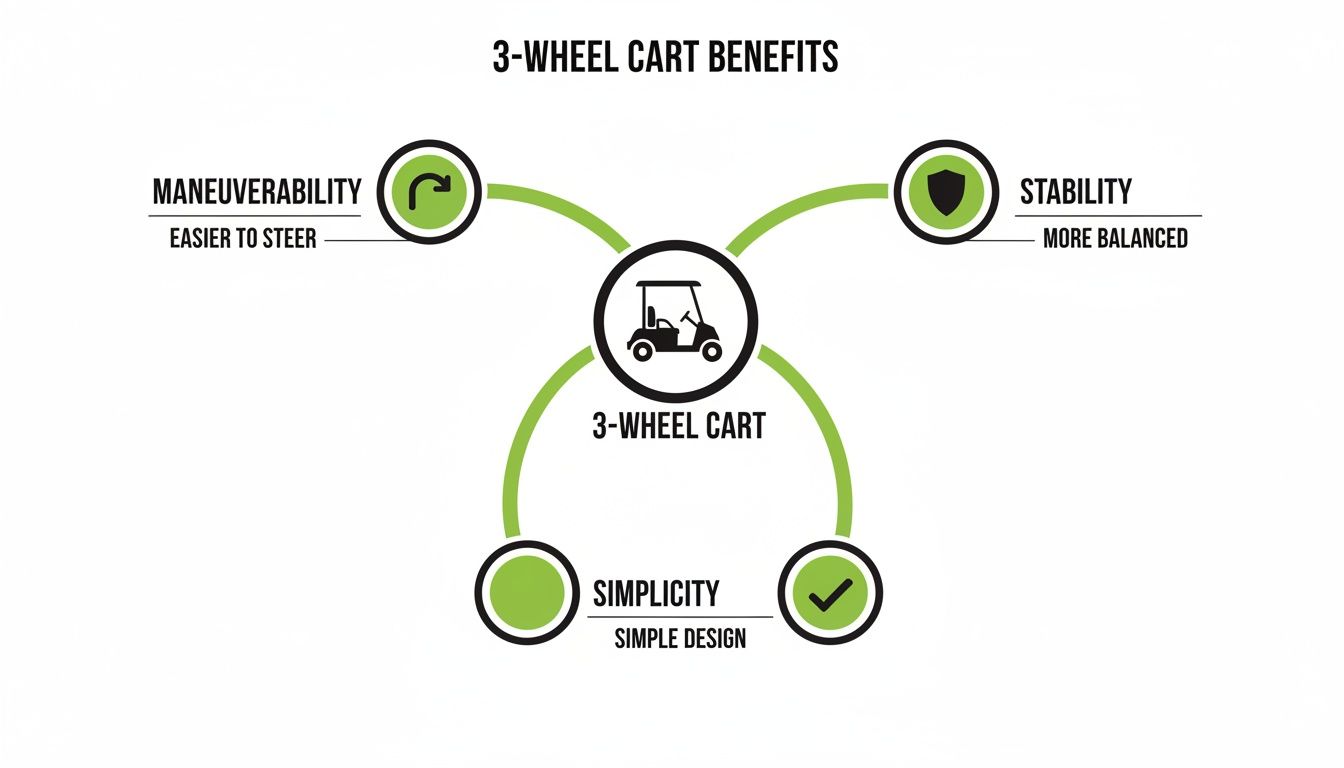
This visual really breaks down how a three-wheeler's core strengths—maneuverability, stability, and simplicity—all work together to make your walk more enjoyable.
Stability on Uneven Ground
While three-wheel models are surprisingly stable thanks to a wide rear wheelbase, four-wheel carts naturally have an edge here. That extra wheel provides a larger, more balanced footprint. If your home course is particularly rugged or has a lot of steep, side-hill lies, the extra stability of a four-wheeler might give you more peace of mind.
That said, modern three-wheel cart designs have come a long way and have pretty much closed this gap.
With a low center of gravity and well-engineered frames, today's three-wheelers handle most hills with confidence. The key is to push, not pull, when going uphill to maintain balance.
Ultimately, the choice comes down to a trade-off. Do you prioritize the effortless steering and agility of a three-wheel model, or the tank-like stability of a four-wheel one?
To make it even clearer, let's put them head-to-head.
Three-Wheel vs. Four-Wheel Golf Cart Showdown
| Feature | Three Wheel Cart | Four Wheel Cart |
|---|---|---|
| Maneuverability | Excellent. Turns on a dime with a single front pivot wheel. | Good. Stable and straight, but less nimble in tight spaces. |
| Stability | Very Good. Modern designs offer great balance, especially on moderate hills. | Excellent. The four-point base is the most stable, ideal for rugged terrain. |
| Push Effort | Lower. Less ground contact means less rolling resistance. | Slightly Higher. An extra wheel adds a bit more friction. |
| Storage | Often more compact. Tends to fold down into a smaller package. | Can be bulkier. The four-wheel frame can take up more space. |
| Best For | Most golfers. Ideal for typical parkland or flatter courses. | Golfers on hilly courses. Perfect for those needing maximum stability. |
For the majority of golfers playing on typical courses, the three-wheel cart strikes the perfect balance of performance and practicality. It's no wonder it has become the most popular choice for walkers everywhere.
What to Look for in a Modern Three-Wheel Cart
It's easy to think a push cart is just a frame and three wheels, but the best ones today are loaded with smart, practical features that genuinely make your round better. Knowing what to look for is the difference between buying a cart that just carries your clubs and one that feels like a true on-course assistant. These are the non-negotiable features you should have on your checklist.
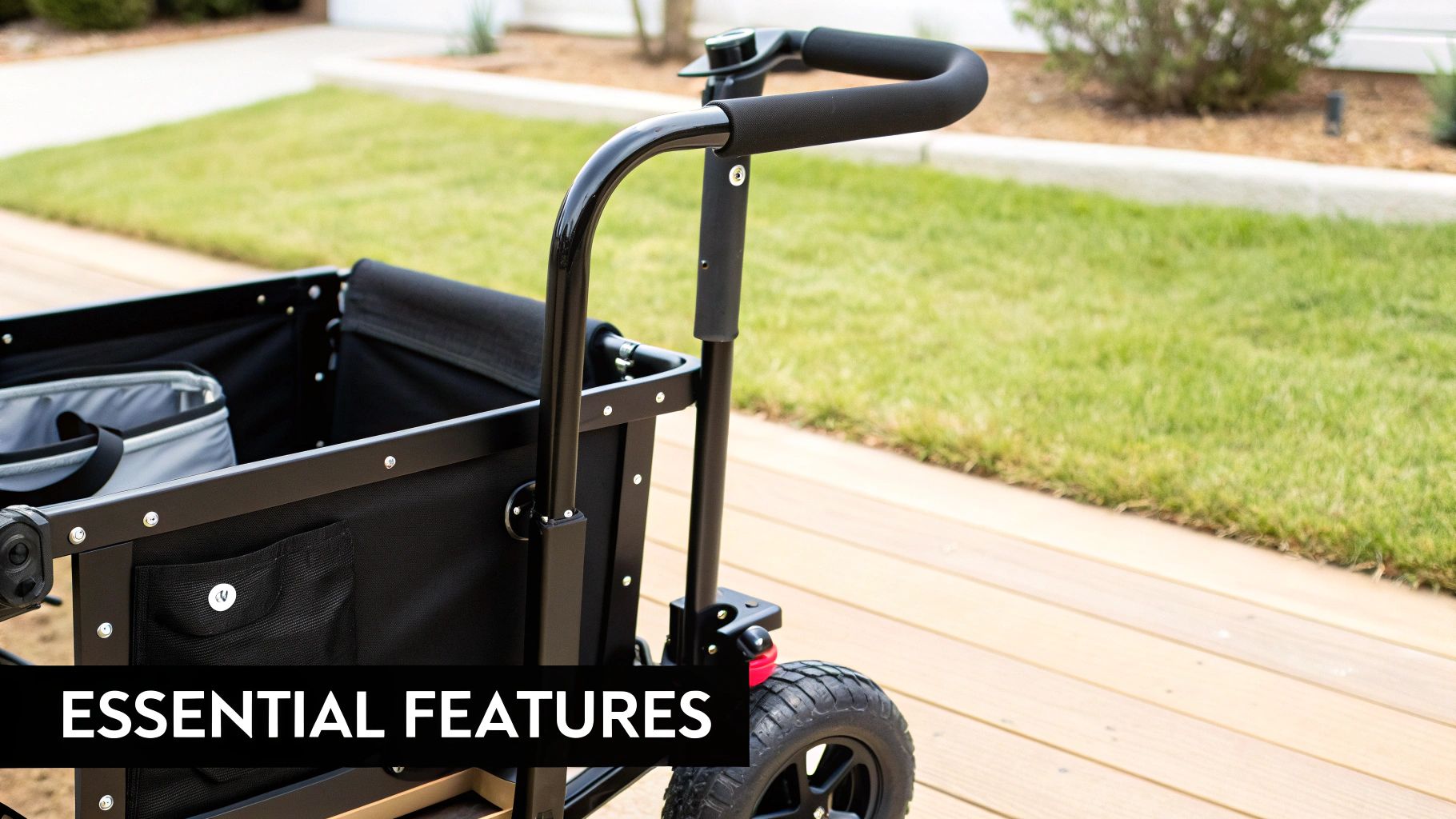
First up, the folding mechanism. A clunky, multi-step process can be a real source of frustration in the parking lot. The gold standard is a one-step or one-click folding system. These designs let the cart collapse into a compact, manageable size with a single motion, saving you time and hassle before you tee off and after you sink that final putt.
Next, pay close attention to the handle. A fixed-height handle is a recipe for a sore back, forcing you to stoop or over-reach for 18 holes. An adjustable handle is absolutely crucial for comfort. It allows you to set the height perfectly for your frame, ensuring you can walk with a natural posture.
Braking Systems and Wheels
If you play on a course with even the slightest elevation change, a solid brake is non-negotiable. You'll generally find two types on a three-wheel cart, and the right one for you often comes down to personal feel.
- Hand Brakes: Just like on a bicycle, these are located right on the handle for quick, convenient access. They’re fantastic for tapping the brakes to control your speed on a downhill walk or for making a quick stop.
- Foot Brakes: You’ll find these near one of the rear wheels, engaged with a simple tap of your foot. They are perfect for securely parking the cart on a slope and are often incredibly sturdy.
So, which is better? A hand brake gives you more dynamic, in-motion control, while a foot brake offers that simple, "set-it-and-forget-it" security when you’re parked.
The wheels themselves also play a huge role in the cart's performance on the course. Bigger wheels roll over rough terrain—from thick rough to bumpy cart paths—much more easily. Always opt for airless, foam-filled, or solid rubber tires. They require zero maintenance—no flats, no air pressure checks—and give you a consistently smooth ride, round after round.
A well-designed cart with large, maintenance-free wheels and a simple folding system transforms the logistics of golf. It removes minor annoyances, letting you stay focused on your game, not your equipment.
Onboard Storage and Accessories
Finally, think about all the little conveniences that keep your gear organized and right where you need it. A quality three-wheel cart should feel like your mobile command center on the course.
Look for a storage console that includes these essentials:
- A holder for your scorecard and pencil.
- A secure slot for your smartphone.
- Compartments for tees, balls, and a rangefinder.
- An integrated beverage holder.
An umbrella holder is another feature you'll be thankful for, whether it's shielding you from a surprise shower or the summer sun. These thoughtful accessories are what separate a basic cart from a truly premium one, making your round more comfortable, organized, and enjoyable.
The Power Upgrade: From Manual Push to Electric Glide
For a lot of golfers who love to walk the course, the real battle isn't the five-mile trek itself—it's the grind of shoving a loaded cart up and down every hill. All that effort can seriously drain the energy you'd rather be putting into your swing. But this is where a simple, yet game-changing, piece of golf tech comes in: the electric-assist upgrade.
We're not talking about buying a brand-new, massive remote-controlled caddy. Instead, this is about smart, add-on solutions that can turn the three wheel cart you already own and love into a self-propelled machine. Just imagine your trusty cart gliding up inclines with a simple tap of a button.
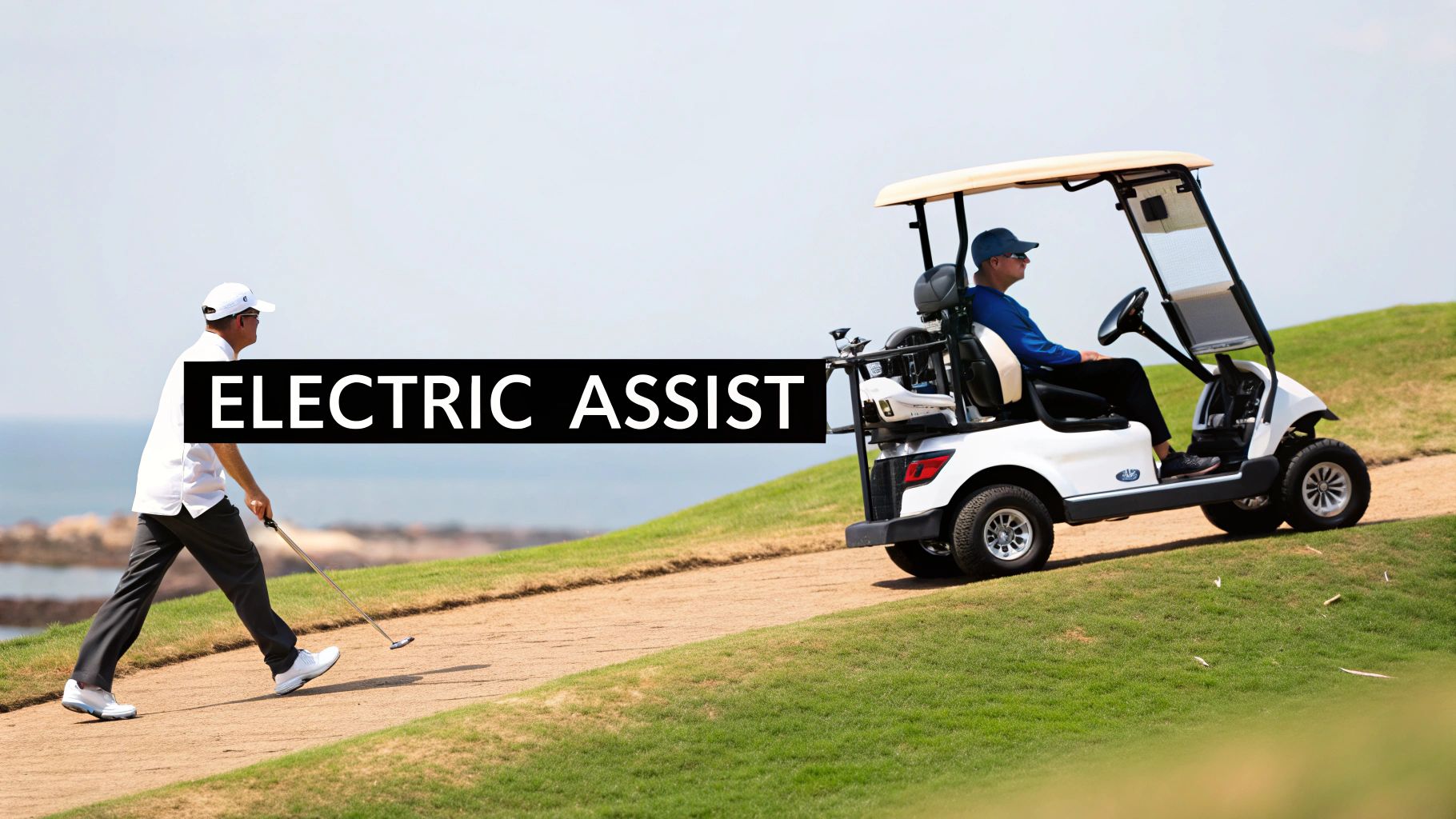
This kind of upgrade is all about conserving your physical energy and taking the strain off your back and shoulders, making even the hilliest courses feel refreshingly flat. It doesn't take the walk out of your game; it just takes the exhaustion out.
How Does an Electric Conversion Actually Work?
The real magic of modern electric assists is in their simplicity. These systems are designed to be incredibly user-friendly, so you don't need an engineering degree to add a little power to your push cart. A great example is an add-on motorized wheel, and the process usually looks something like this:
- Mount a Simple Bracket: A small, lightweight bracket gets attached to your cart's rear axle. This usually just takes a few minutes with basic tools and stays on your cart for good.
- Attach the Motorized Wheel: The power unit, which has the motor and battery all in one, simply clicks or snaps right onto that bracket. You can pop it on or off in a matter of seconds.
- Control It with a Remote: A small, handheld remote gives you total control over the speed, letting you match the cart's pace perfectly to your own walking stride.
The practicality of this setup is a huge win. You get all the perks of an electric cart without having to shell out for an entirely new, often very expensive, piece of gear. You can learn more about how a three wheel golf cart can go electric and explore the different options out there.
A huge moment for this technology came in May 2025 when the USGA officially gave electric-assist push carts the green light for use in all sanctioned competitions. That single decision is expected to grow the golf push and pull cart market by a massive USD 204.3 million between 2024 and 2029. And three-wheel models, already loved for their balanced design, are seeing a huge surge in interest from golfers wanting that effortless glide.
The goal of an electric upgrade is seamless integration. It should feel like a natural extension of your cart, providing power when you need it and staying out of the way when you don't.
By adding an electric assist, you're enhancing all the best parts of walking the course—the fresh air, the exercise, the direct connection to the game—while getting rid of the one major downside: fatigue. This simple power-up lets you finish 18 holes feeling just as fresh and focused as you were standing on the first tee.
Keeping Your Cart in Top Condition for Years to Come
A quality three-wheel cart is an investment in your game, and just like your clubs, it needs a little TLC to perform at its best. Think of it as a quick post-round routine—a few minutes of simple, consistent care will keep it rolling smoothly for years and prevent small issues from turning into major headaches.
This isn't about busting out a full toolbox. It’s a straightforward checklist designed to protect your cart from the usual suspects: dirt, moisture, and friction. A clean cart is a happy cart, so start by giving the frame and wheels a quick wipe-down after your round. Getting rid of that built-up grass, sand, and dirt is the easiest way to keep all the moving parts from getting gummed up.
A Simple Maintenance Checklist
Regular check-ups are your best defense against surprises on the course. Before you head out for a round, just give your cart a quick once-over, paying attention to a few key spots. Making this a habit means your gear is always ready to go when you are.
- Check Bolts and Fasteners: The vibrations from rolling over fairways and cart paths can loosen things up over time. Give the bolts a quick check to make sure they're snug, especially around the wheels and folding joints.
- Inspect the Brakes: Whether you have a hand or foot brake, test it out. You want to feel it engage firmly. A reliable brake is a must-have for safety, particularly when parking your three wheel cart on a slope.
- Lubricate Moving Parts: Every few months, hit the hinges and wheel axles with a bit of silicone-based lubricant. This simple step keeps the folding mechanism silky smooth and gets rid of any annoying squeaks.
For a deeper dive, check out our guide covering 6 essential golf cart maintenance tips.
Caring for Electric Upgrades and Off-Season Storage
If you've added an electric assist to your cart, battery health is everything. For electric three-wheel carts, proper battery care is non-negotiable; knowing how to store lithium batteries safely can seriously extend its lifespan. Always stick to the manufacturer's charging instructions and try to avoid leaving the battery out in extreme heat or cold.
When the golf season winds down, proper storage is your cart’s best friend. Tucking it away in a clean, dry place like a garage or shed is the best way to prevent rust and protect the tires from weather damage.
This little bit of effort pays off big time. When spring finally rolls around, your three-wheel cart will be in pristine condition, ready to hit the links without a hitch.
Is a Three-Wheel Cart the Right Choice for You?
Deciding on the right golf equipment always comes down to your personal style of play and what you want from your time on the course. A three-wheel cart isn't a one-size-fits-all solution, but for certain types of golfers, it’s the perfect match—a blend of smart performance, unmatched convenience, and real health benefits. Figuring out which camp you fall into can make the choice crystal clear.
It's no secret that the three-wheel design has carved out a serious niche in the golf world. The global golf cart market was valued at USD 3.3 billion in 2025 and is on track to hit USD 7.2 billion by 2035. While ride-on carts are a big piece of that pie, the push cart segment—where three-wheelers shine—is growing fast among walking purists and savvy players. You can discover more insights from the full research on the golf cart market.
Who Benefits Most from a Three-Wheel Cart?
So, who are these carts really for? Let's break down the golfer profiles who will get the most out of this design. See if one of these sounds like you.
-
The Fitness-Focused Walker: If your main goal is to get a great workout while you play, a three-wheel cart is your best friend on the fairway. Its lightweight frame and minimal rolling resistance mean you spend less energy wrestling with your gear and more on the walk itself. You can keep a brisk pace without feeling completely wiped out by the back nine.
-
The Weekend Warrior: For the golfer who plays regularly, often on different courses, convenience is everything. The simple, one-step folding mechanisms and compact size of most three-wheel carts make transport and storage a total non-issue. You'll spend less time fumbling with your equipment and more time focused on your first tee shot.
A three-wheel cart offers a powerful combination of agility and simplicity. For the senior golfer, this translates to less physical strain, easier navigation, and ultimately, more enjoyable and frequent rounds of golf.
- The Senior Golfer: Players prioritizing ease of use and stability love the effortless maneuverability of a three-wheeler. Plus, the option to add an electric-assist like the Caddie Wheel completely transforms the experience, taking the burn out of hills and making every round more accessible.
A Few Common Questions Answered
When you're digging into the world of golf gear, a few questions always pop up. Let's tackle some of the most common ones about three-wheel carts to help you figure out if one is the right fit for your game.
Is A Three-Wheel Cart Stable Enough For A Hilly Course?
You bet. Modern three-wheel carts are built with stability at their core. Designers give them a low center of gravity and a wide rear wheelbase, which work together to create a surprisingly solid footprint. This setup keeps them grounded on most terrains, including moderate hills and uneven lies.
The single front wheel is what gives it that nimble, easy-to-steer feel, letting you navigate slopes and tight spots without a fight. If your home course has some seriously steep climbs, adding an electric assist can make a huge difference. It adds another layer of stability and provides braking control, so you feel just as secure walking downhill as you do climbing up.
How Difficult Is It To Add An Electric Motor?
It's way easier than you might think, especially with today's conversion kits. Most electric assist systems, like the Caddie Wheel, are designed to be a quick and universal upgrade. The whole process usually just involves clamping a small bracket onto your cart's axle, which takes a few minutes with a basic wrench.
Once that little bracket is on, the motorized wheel unit just clicks on and off in seconds. There's no complicated wiring or permanent changes to your cart, making it a simple, reversible way to give your trusty three-wheel cart a major boost.
Will A Three-Wheel Cart Fit In My Car Trunk?
For the vast majority of cars, absolutely. One of the biggest selling points of modern three-wheelers is how incredibly compact they get. Most popular models are engineered to fold down into a small, flat package in just one or two moves.
This isn't an accident—they're specifically designed for easy transport and storage. While it never hurts to double-check the folded dimensions of a cart you're eyeing and measure your trunk, most are built to slide right in next to your golf bag with room to spare.
How Long Does A Quality Cart Typically Last?
A well-made three-wheel cart from a good brand can be your on-course companion for years—often 5 to 10 years, sometimes even longer. A lot depends on the build quality (aluminum frames are a great mix of durable and lightweight), how often you play, and how you treat it.
A little TLC goes a long way. Simple things like wiping it down after a muddy round, checking for loose bolts every now and then, and storing it somewhere dry in the off-season will add years to its life. It's a small effort to ensure your cart stays a reliable part of your game for many seasons to come.
Ready to transform your walk and take the strain out of every round? The Caddie Wheel offers a simple, powerful electric upgrade for your favorite push cart. Conserve your energy for the shots that matter.
Share:
A Golfer's Guide to Electric Push Carts for Golf
The Ultimate Guide to a 4 Wheeled Golf Push Cart