
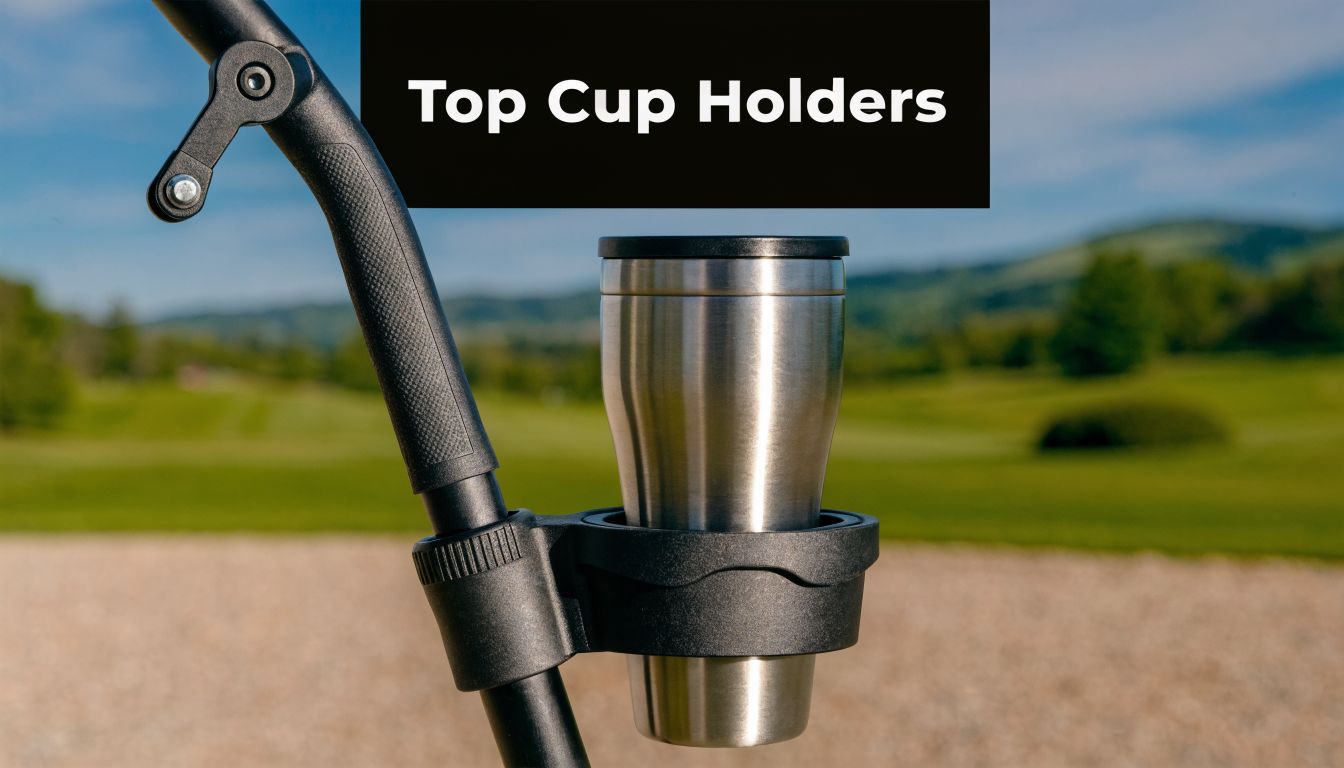
You’re probably here because your current setup is annoying in a very specific way. Your drink tips when the cart leans on a sidehill. Your coffee goes warm because the holder is too shallow for an insulated tumbler. Or you added power to your push cart and suddenly a cup holder that used to seem “fine” now rattles, shifts, or throws a bottle loose when the cart starts or stops.
That frustration is easy to dismiss until it keeps happening. A bad cup holder for golf push cart use doesn’t just make a mess. It breaks rhythm. You stop paying attention to the hole in front of you and start thinking about where to stash your bottle, whether the cart will spill on the next slope, and whether the holder will catch when you fold the frame.
Most buying guides stop at “does it fit a bottle?” That’s not enough. Cart design, terrain, handle position, and especially motorized add-ons all change what “good” looks like. A holder that works on a flat practice path can struggle on a real course with cambers, hills, braking, and vibration.
Why Your Push Cart Needs a Better Cup Holder
A lot of golfers live with the wrong holder longer than they should. They buy a push cart, accept the included drink mount, and assume all cup holders are basically the same. Then the problems show up one round at a time.
You hit a cart path seam and the bottle chatters. You park on a slope near the green and the drink leans enough to slosh. You reach for water with one hand and realize the holder sits too low, too far back, or too close to the bag. None of these issues ruins a round on its own. Together, they make walking less enjoyable than it should be.
The right cup holder for golf push cart use fixes a small but constant point of friction. It keeps hydration close, stable, and easy to reach. That matters more than many golfers expect, especially late in the round when routine and focus start to slip.
Small accessory, real effect
A cup holder does three jobs at once:
- Protects the drink: It reduces tipping, bouncing, and spill risk on uneven ground.
- Improves access: It puts water or coffee where you can grab it without breaking stride.
- Supports better habits: If the drink is easy to reach, you’re more likely to use it.
Practical rule: If you’ve ever moved your bottle to the scorecard tray, basket, or bag pocket because the cup holder felt unreliable, the holder is already failing its job.
There’s also a comfort angle people overlook. Walking golfers often build their cart around convenience. They add an umbrella holder, a phone mount, maybe a cooler or extra storage. In that setup, the drink holder isn’t a throw-in accessory. It’s part of the command center.
And once a cart gets more advanced, the holder has to keep up.
Understanding the Different Types of Cart Cup Holders
A cup holder is really a stability system. The shape of the basket matters, but so does how the holder reacts when your cart tilts, rattles, or changes speed. That last part matters even more if you use a motorized add-on such as the Caddie Wheel, because the holder has to deal with vibration and small surges in motion that a standard walking cart guide usually ignores.

Rigid and integrated holders
Rigid holders are the factory-style option. They are usually molded plastic, fixed in one position, and designed around a specific cart frame.
That gives them two clear strengths. They usually look cleaner than add-on models, and they often fold with the cart without extra fuss. If you use the same bottle every round and play mostly flat courses, a rigid holder can be perfectly adequate.
Their limitation is simple. The cup stays at the same angle as the cart. On a side slope, the drink leans with it. On a motorized setup, that fixed angle also means the holder cannot absorb much of the small jolts that happen when the cart starts rolling or crosses rough pavement.
Universal clamp-on and strap styles
Universal holders are built for golfers who need flexibility. Some clamp to a tube, some wrap with a strap, and some use both so the holder resists twisting better.
This group works well for golfers who switch carts, share a cart with a spouse, or use more than one drink size during the season. A universal design also makes sense if your stock holder is too shallow for an insulated bottle or blocked by another accessory. The same logic shows up in packable gear choices such as convenient outdoor dishes. Small items work better when they store neatly and stay easy to reach.
There is a tradeoff. Universal fit is not the same as perfect fit. A holder that accepts many frame shapes can still rotate under vibration if the clamp area is narrow or the cart tubing is slick. That is one reason universal holders need a closer look if your push cart has a powered wheel attached.
Deep holders for insulated bottles
Big insulated bottles ask more from a holder than a can or a slim plastic water bottle. They carry more weight higher off the cart, so every bump puts more strain on the mount.
Depth helps here. A deeper basket supports more of the bottle’s lower half, which reduces wobble. Flexible side arms or a slightly tapered opening help too, because they keep the bottle from rattling without forcing one exact diameter.
If you carry a 20 to 24 ounce insulated bottle for all 18 holes, look past the word "universal." Check whether the holder is shaped to control a taller, heavier drink. A holder that only grabs the bottle near the middle can feel fine in the parking lot and loose by the third cart path crossing.
Auto-leveling designs
Auto-leveling holders are the most interesting category for golfers using hilly courses or motorized push cart attachments. The idea is straightforward. The mount moves with the cart, but the cup cradle pivots so the drink stays more upright.
A gimbal works like the stabilizer on a camera. The cart can lean left or right, yet the inner section keeps correcting toward level. That is why self-leveling holders make more sense than they first appear. They are not just about spills on slopes. They also help manage the quick pitch changes that happen when a powered cart starts, slows, or rolls off a curb edge.
A useful example is the CaddyTek 360° auto-leveling cup holder, which uses a 360-degree self-correcting gimbal system, according to CaddyTek’s product details. For golfers using a Caddie Wheel or a similar motorized attachment, that kind of design deserves more attention than standard roundups usually give it.
A rigid holder copies the cart’s angle. A self-leveling holder keeps correcting back toward upright.
If you want a broader view of how a drink holder fits into a walking setup, this guide to the best golf push cart accessories for 2025 rounds is a useful companion.
A Guide to Mounting Systems and Cart Compatibility
A cup holder can look perfect on the product page and still fail on your cart for a simple reason. Mounting hardware has to match the frame, the folding action, and the way you use the cart. That gets even more important if you may add a motorized assist system later, because a mount that only barely fits by hand-push standards usually shows its weakness once vibration and powered starts enter the picture.

Start with the cart frame
Begin with the cart, not the drink.
Three details decide whether a holder stays put or slowly twists loose during a round:
-
Tube shape
Round tubes are the easiest match for clamp-on holders. Oval and square sections can work too, but they ask more from the clamp. If the contact patch is small, the holder can rotate under the weight of a full bottle. -
Tube location
A straight upright is usually more stable than a curved rail. Curves and angled sections often create a small gap between the clamp and the frame, which reduces grip. -
Folding path
Some holders fit well when the cart is open, then block the frame when you collapse it. Check the cart’s hinge points and where the bracket will swing as the cart folds.
Universal clamps often cover a fairly broad range of tubing sizes, but the label “universal” can mislead golfers. A clamp can technically fit a tube and still be a poor match. The easiest comparison is a shoe that is your size but the wrong width. It goes on, yet it never feels planted.
Match the holder to your drink
Compatibility is not only about the cart. It is also about what sits inside the holder.
A shallow cup cradle may work for a small water bottle, then become unstable with a tall insulated tumbler. An oversized holder creates the opposite problem. The drink fits, but rattles and shifts because the sidewalls do too little work.
A simple rule helps:
| Drink you carry most | Best holder style | Common mistake |
|---|---|---|
| Standard can or small bottle | Compact rigid or integrated | Choosing a wide holder that lets the drink chatter around |
| Insulated water bottle | Deep clamp-on holder | Using a shallow stock tray |
| Mixed drink sizes | Universal holder with lower support | Picking a model that grips only near the rim |
Lower support matters more than many golfers expect. If the holder only grabs the upper half of the drink, every bump acts like a lever against the mount.
Best mounting spots on most carts
The best location is usually the spot that combines easy reach with the least frame movement.
For many three-wheel carts, that means inside the handle triangle or on a straight handle upright. For many four-wheel carts, a side upright can be cleaner because the center area is already busy with consoles, brake controls, or storage. Tall bottles also need clearance from the golf bag, especially when the bag shifts slightly over rough paths.
Use this rule on the course. Mount the holder where your hand falls naturally during a normal walk, then confirm that the bottle will not hit the bag, brake, or scorecard console.
A slightly off-center position is often the smarter choice. Center-mounted holders can look tidy in the garage, yet interfere more often once the cart is loaded and folded.
Why compatibility matters more with motorized add-ons
This is the part standard guides usually skip.
Golfers using systems like the Caddie Wheel need to judge compatibility more strictly because the holder is no longer dealing only with walking pace and gravity. The mount also has to resist vibration, brief acceleration, and weight transfer as the cart starts, slows, or crosses uneven ground. A clamp that feels acceptable on a manual setup can rotate or creep downward once powered movement adds repeated stress.
That is why future-proofing the mount makes sense even if you still push by hand today. If there is any chance you will add motorized assist, choose a mounting point on a straight, solid section of frame and avoid any setup that already feels close to the limit.
If you are still comparing cart designs before choosing accessories, this guide on how to choose a golf push cart helps you sort out which frame layouts tend to be easier to equip.
A simple fit check before you commit
Run a short test before your first round. It saves frustration later.
- Twist the mounted holder by hand: It should resist rotation without needing constant retightening.
- Test your heaviest drink: A slim can does not reveal the same problems as a full insulated bottle.
- Fold and unfold the cart completely: Make sure the holder clears hinges, wheels, and storage trays.
- Roll over a curb cut or sloped driveway: Small changes in angle expose weak mounting points quickly.
- Check clearance at your hands and bag: You should be able to steer, brake, and access pockets without bumping the drink.
A good fit feels boring in the best way. The holder stays in place, the drink stays stable, and you stop thinking about it after the first hole.
How Motorized Carts Change Your Cup Holder Needs
The typical recommendations for cup holders often fall short. Once you add motorized assist to a push cart, the holder is no longer dealing only with gravity and your walking pace. It now has to manage vibration, powered starts, braking forces, and a different balance profile.

Standard product listings usually don’t address that. As noted in KVV’s cup holder product context, existing guides often fail to explain how holders behave with the added weight, vibration, and modified geometry of a push cart retrofitted with motorized assist systems. That gap matters because a mount that behaves acceptably when pushed by hand can become unreliable once the cart is powered.
Why powered movement is different
Manual pushing is smoother than many golfers realize. Your body naturally softens starts and stops. A motor doesn’t always do that in the same way.
With a powered setup, the holder has to resist:
- Constant vibration
- Short bursts of acceleration
- Braking shifts that pitch the drink forward
- Extra stress on the clamp from a heavier, more complex cart setup
Consider the difference between carrying a full coffee mug while walking and setting that mug on a tray attached to a small moving machine. The machine may be efficient, but it creates a different kind of motion.
That’s why holder quality becomes less about convenience and more about system stability. A weak clamp, a shallow basket, or a poor mounting position gets exposed quickly.
Balance and placement matter more
Motorized add-ons can change where weight sits on the cart. That can affect how the frame reacts when turning, descending, or crossing uneven ground. A cup holder placed too high, too far outboard, or too close to another mounted accessory may become more prone to wobble than it was in a manual setup.
A smart approach is to favor:
- Deeper holders for taller bottles
- More secure clamps over loose strap-only mounts
- Positions close to a stable upright
- Designs that control bottle sway, not just bottle fit
For a broader look at powered walking setups, this overview of motorized push carts is a helpful companion.
A quick visual makes the point even clearer:
What to upgrade first
If you already use a push cart happily by hand and plan to add power, don’t assume every accessory can stay unchanged. The cup holder should be one of the first items you re-evaluate.
On a powered cart, “good enough” accessories usually reveal themselves by failing at the worst moment, on a slope, during a stop, with a full drink.
The golfers most likely to care are often the ones least well served by generic advice. Senior players, golfers managing fatigue, and walkers trying to stretch to longer rounds benefit from powered assist. They also have the least patience for a rattling drink holder that demands constant attention.
Finding the Perfect Cup Holder for Your Golfing Style
A good recommendation begins with how you play. The best cup holder for golf push cart use isn’t the fanciest model. It’s the one that matches your drink habits, your cart layout, and the way you move around the course.

One reason this matters is hydration. According to Cart Tek’s product context on large drink holders, over 60% of walking golfers report dehydration as a factor limiting their ability to complete longer rounds. Better drink access won’t solve every endurance problem, but it removes one obvious barrier.
The senior or comfort-first golfer
This player wants stability and easy reach more than anything else. Bending down to grab a bottle from a lower tray or side pocket gets old fast, especially late in the round.
The best fit is usually a secure clamp-on holder mounted near the handle, with enough depth to keep the drink from shifting when the cart rolls over uneven turf. If the course is hilly, an auto-leveling design deserves a hard look because it cuts down on fuss and cleanup.
What to prioritize:
- Easy one-hand access
- Stable mount that doesn’t rotate
- Bottle support that feels secure on side slopes
The fitness walker
This golfer often carries a larger insulated bottle and may walk more holes in a day. For them, cup holder choice is about staying consistent, not just preventing spills.
A deep holder built for 20-24 ounce insulated bottles usually makes the most sense. Shallow, open-top holders can work at first, but they often become annoying once fatigue sets in and the cart sees more varied terrain.
This is also the golfer most likely to appreciate supporting gear that improves distance control and pacing. If you’re balancing walking goals with on-course data, a guide to a budget-friendly GPS golf watch can complement a practical push cart setup without adding much complexity.
The budget-conscious player
You don’t need a premium holder if your needs are simple. If you mostly carry a standard bottle, play flatter courses, and use a manual cart, a well-made universal clamp holder can be enough.
The key is not to confuse “cheap” with “good value.” A basic holder is fine if it grips the frame securely and supports your usual drink size. It becomes false economy when it twists, sags, or forces you to replace it after a few rounds.
A sensible buying filter looks like this:
| Golfer type | Best match | Skip this |
|---|---|---|
| Senior or comfort-first | Secure handle-height clamp holder | Low-mounted flexible sling |
| Fitness walker | Deep insulated-bottle holder | Shallow can-style holder |
| Budget-focused golfer | Simple universal clamp model | Proprietary mount that only sort of fits |
| Powered-cart user | Robust mount with motion control | Loose universal option with weak side support |
The golfer with a powered setup
This is the group most guides ignore. For a motorized cart, you want a holder that controls motion, not just accommodates diameter.
That usually means a high-grip, firmly clamped holder, and often a self-leveling design if your course has elevation changes. The ideal setup also keeps the drink close enough to reach easily without crowding remote use, storage access, or folding points.
If your cart does more than roll, your cup holder has to do more than hold.
A quick self-test before you buy
Ask yourself these three questions:
- What drink do I carry most often?
- Do I play flatter courses or sidehill-heavy courses?
- Am I pushing manually or using powered assist?
Most golfers can answer those in ten seconds. That’s usually enough to rule out half the market and focus on a holder that will work.
Simple Installation and Maintenance for Lasting Performance
Even a good holder can disappoint if it’s mounted badly. The fix is usually simple. Install it with a little more care than you think necessary, then check it occasionally instead of forgetting about it for the season.
Installation checklist
- Choose the spot with the cart open and the bag attached: A holder can look perfect on an empty cart and become awkward once the bag is loaded.
- Use your normal bottle during setup: Don’t test fit with a smaller container than the one you carry.
- Keep folding clearance in mind: Open and close the cart before final tightening.
- Check wrist and hand movement: You shouldn’t bump the holder while steering, braking, or reaching for tees.
- Twist-test the mount after tightening: If the bracket rotates by hand, it will move more on the course.
Basic upkeep that prevents most problems
Cup holders live hard lives. They deal with sun, sports drink residue, mud, and repeated jostling.
A few habits help a lot:
- Wipe sticky spills quickly: Sugar buildup makes holders grimy and can affect moving parts on gimbal-style designs.
- Inspect clamps regularly: Powered carts and rough terrain can loosen hardware over time.
- Look for stress marks in plastic: Small cracks near the clamp or rim are early warning signs.
- Clean grit from pivot points: If the holder self-levels, dirt can reduce smooth movement.
Check the holder the same day you clean your clubs. That simple routine catches loosening and wear before a round starts.
If a holder starts moving, don’t just tighten it harder immediately. First check whether the mount is on a tapered or slick section of tubing. Repositioning it slightly often solves the issue better than brute force.
Your Next Step to a Spill-Free Round of Golf
A cup holder seems minor until you use the right one. Then the difference is obvious. Your drink stays upright, your water is easy to reach, and one more small distraction disappears from the round.
The best choice depends on your actual setup. Some golfers need nothing more than a well-placed universal clamp holder for a standard bottle. Others need a deeper design for insulated drinkware. Golfers using powered assistance should be more selective, because vibration, starts, braking, and shifted cart balance put more stress on both the mount and the drink.
That’s the part most advice misses. A cup holder for golf push cart use isn’t just about container size. It’s about how the holder behaves when the cart is moving, across slopes, rough paths, and changing conditions.
Choose based on fit, access, and stability. Test it with the drink you carry. Mount it where your body naturally reaches. If your cart is powered, raise your standards. That small decision can make the whole walking experience feel cleaner, easier, and more settled.
If you want to make your push cart easier to walk without replacing the cart you already own, Caddie Wheel offers a lightweight electric power assist designed for standard push carts. It’s a practical next step for golfers who want less strain, smoother walking, and a more enjoyable round.
Partager:
Operation Game Spare Parts: A Complete Repair Guide
Best GPS Navigation Holder for Your Golf Cart