
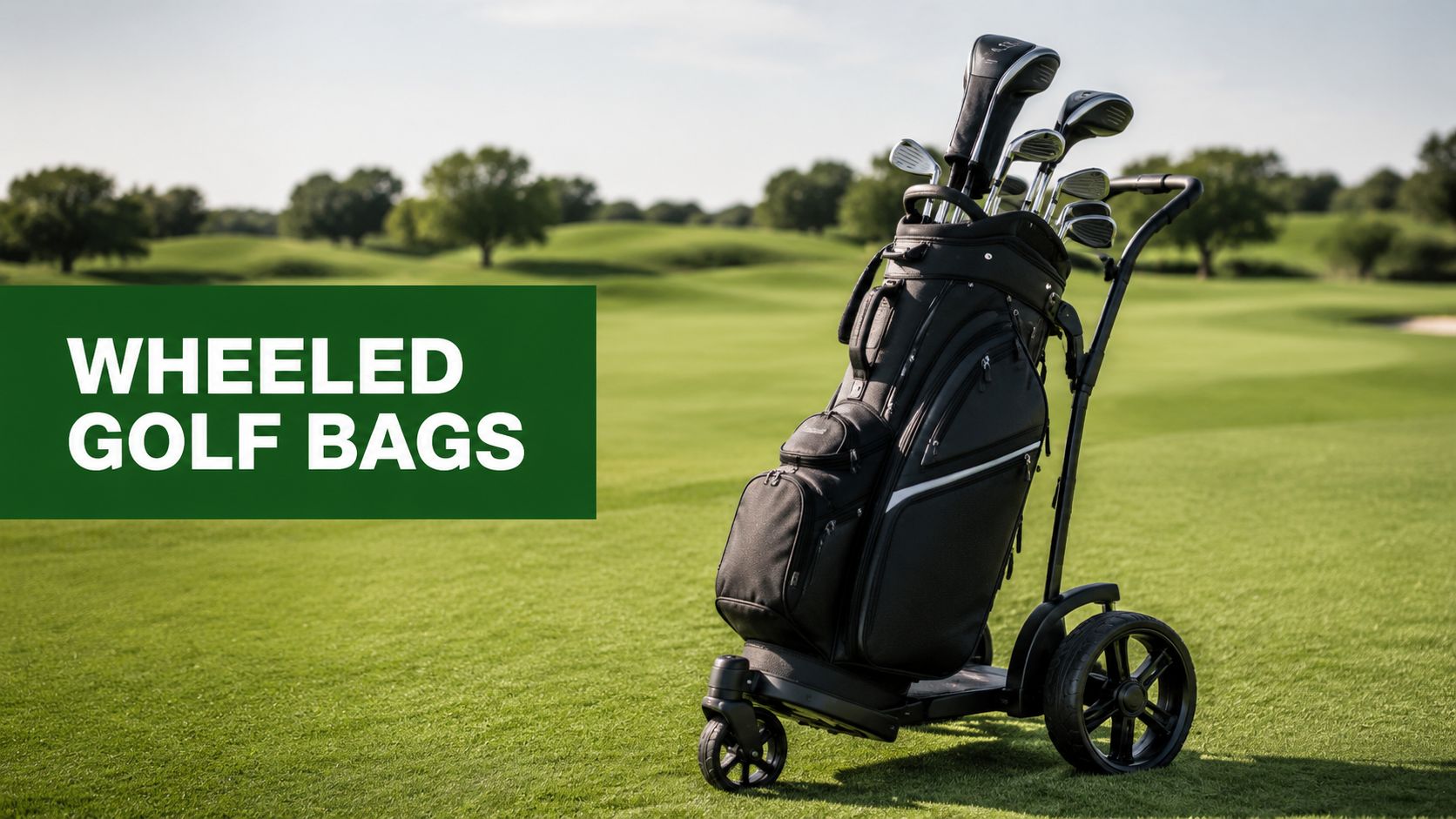
You're standing beside the first tee with a shoulder bag digging into your neck, a manual cart that feels awkward on slopes, and a motorized model that looks like overkill in the shop. The choice isn't whether to buy a golf bag on wheels. It's whether your clubs should travel in a dedicated wheeled case, roll on a manual frame, or move with electric assistance while you keep walking.
That distinction matters. A travel bag protects clubs in transit, but it doesn't belong on the fairway. A push cart can make walking easier, but it still demands effort on hills. An electric assist system can solve that problem, especially if you already own a cart that fits your bag. The right setup depends on your course, your body, your storage space, and how you play.
Why Your Golf Bag Needs Wheels
A golfer who carries everything may enjoy the simplicity at first. The bag stays close, there's no frame to unfold, and every club is immediately accessible. After several holes, though, the weight becomes part of every decision. You notice it walking between shots, climbing a slope, and standing over a putt after a long trek from the fairway.
Manual pushing changes the equation. You still walk the course, but the bag's weight travels on wheels instead of your shoulders. Exercise research found that using a pushcart reduced transport load compared with carrying, including a 10.4% decrease in VO2 and a 6.8% decrease in heart rate during transport, according to independent exercise-science research on golf bag transport. That's a meaningful difference for golfers who want the activity of walking without turning the bag into a second workout.
Course-tested rule: If carrying makes you think more about your shoulders, back, or knees than your next shot, the bag is costing you concentration.
Riding removes even more physical effort, but it also removes much of the walking. A peer-reviewed study recorded 624.07 kcal for walking nine holes versus 335.72 kcal when riding, showing how strongly transport mode changes the energy cost of a round (Gazzetta Medica Italiana study). Walking with a cart occupies the useful middle ground. You stay active, but you aren't forced to carry the full load.
That makes wheels a performance decision, not an age-related concession. A steady walking rhythm can help you preserve energy for the back nine, arrive at shots less fatigued, and keep playing when carrying would make you choose a riding cart. Electric assistance extends that logic to hilly courses, heavier cart bags, and golfers whose joints tolerate walking better than pushing.
The question is practical: do you need wheels for travel, for ordinary walking, or for difficult terrain? Buy the wrong category and you'll have an expensive bag that solves a different problem.
Types of Golf Bags on Wheels Explained
The phrase golf bag on wheels covers three different products. Separate them before you compare brands or features.

Integrated wheeled travel bags
A wheeled travel bag, such as the Sun Mountain ClubGlider range, is built for airports, car parks, and hotel corridors. It surrounds your regular stand or cart bag with padding, reinforced material, and enough room for travel accessories. Its wheels make a loaded case easier to move through a terminal, while its structure helps protect clubheads and shafts during handling.
It's the right purchase if you fly with clubs. It isn't a fairway cart. The large cover, soft-sided construction, and travel-focused proportions make it unsuitable for normal shots, storage on a cart frame, or quick movement around a course.
Manual push carts
A manual push cart is the familiar folding frame with wheels, a handle, and straps or brackets for securing a bag. Three-wheel folders usually offer a useful balance between stability and compact storage, while four-wheel designs can provide a broader base for heavier equipment.
Your existing stand bag or cart bag may work, but the fit matters. Check whether the upper and lower supports hold the bag securely, whether the base sits flat, and whether the strap can tighten without crushing pockets or blocking access. A bag that technically fits but shifts on every turn is a poor combination. For more detail on bag and frame arrangements, consult this guide to roll cart bags.
Electric push carts and motorized assists
An electric push cart includes a motor, battery, controls, and a frame designed to carry the bag. A motorized assist can instead attach to a compatible manual cart, giving the existing frame powered movement without replacing the entire setup.
The distinction is important. A complete electric cart gives you an integrated package, but it also means storing and transporting another full cart. An attachment lets you keep the frame you already understand. Either option should offer controlled forward movement, reliable braking, and a secure connection between the bag and frame.
Standard carry bags generally work best when the cart provides a firm lower cradle and an adjustable upper strap. Cart bags usually sit more securely because they're designed for rolling transport. Lightweight stand bags can be convenient, but their legs and narrow bases may need careful positioning so they don't interfere with wheels or brackets.
Comparing Wheeled Bags and Push Cart Systems
The best option depends on where the wheels operate. A travel bag protects clubs away from the course. A manual cart moves them during a walking round. An electric cart or assist system reduces propulsion effort while preserving the walking experience.
| Feature | Wheeled Travel Bag | Manual Push Cart | Electric Push Cart |
|---|---|---|---|
| Primary use | Airport and vehicle transport | Walking the course | Walking the course with powered assistance |
| Bag compatibility | Holds a regular golf bag inside | Supports compatible stand or cart bags | Supports compatible stand or cart bags |
| Terrain handling | Pavement, terminals, and parking areas | Best on stable course surfaces and manageable slopes | Better suited to hills and heavier setups |
| Physical effort | Pulling or rolling through travel areas | You push throughout the round | You guide the cart while the motor supplies propulsion |
| Storage | Large when packed, though some models fold | Usually folds for a car trunk or garage | Requires room for the frame, motor, battery, and controls |
| Accessories | Travel pockets and protective padding | Scorecard, drink, umbrella, and equipment mounts | Similar cart accessories, plus battery and control hardware |
| Main limitation | Not designed for fairway use | Manual effort remains | More setup, charging, and battery safety responsibilities |
Weight and setup
A travel bag adds a protective shell around your existing clubs. It's not meant to be carried as a normal course bag, so its bulk matters less during play than during storage and transport. A manual cart adds a frame but removes the bag from your shoulders. An electric system adds a motor and battery, which increases complexity even as it reduces pushing effort.
Setup time also matters. Manual carts are usually quick to unfold. Electric systems require battery installation, a secure connection, and a charge before play. If you want the simplest possible routine for occasional rounds, manual may be enough. If hills repeatedly drain you, the extra preparation can be worthwhile.
Wheels and terrain
Small, rigid wheels that feel fine on a smooth path can become unpleasant on uneven ground. Look for a stable wheelbase, a frame that doesn't twist under load, and a bag cradle that keeps the center of gravity controlled. A cart should track predictably when turning and shouldn't force you to fight the handle.
Travel wheels prioritize maneuverability on airport surfaces. Course carts need stability across grass, transitions, and slopes. Electric systems need both stable wheels and controlled speed. A motor that moves quickly without dependable braking is a liability, especially downhill.
Compatibility and storage
Your bag's shape is as important as the cart's wheel design. Measure the bag base, inspect the strap path, and check whether pockets remain accessible when the bag is mounted. Don't assume a cart designed for a narrow stand bag will handle a broad cart bag comfortably.
Storage can decide the purchase. A manual frame may fit beside a set of clubs in a trunk, while an electric setup needs space for its battery and motorized components. For a broader comparison of how measurable equipment choices affect everyday routines, you can also read this smart scale app experience review. The same principle applies here: convenience only counts if the equipment fits your real storage and preparation habits.
The Health and Energy Trade-Offs of Walking with Wheels
A golfer who carries a heavy bag up the final fairway may finish the round with plenty of exercise but too little energy for the last few swings. A wheeled setup changes that balance. Walking, pushing, and riding place different demands on the body, so choosing between a dedicated wheeled bag and an upgraded push cart should start with the effort you want to preserve.
Walking still produces substantially more activity than riding. In the research summarized in the osteoarthritis study, walking 18 holes produced 17,007 steps and 880 kcal, compared with 6,274 steps and 456 kcal when using a golf cart (peer-reviewed comparison of walking and riding in golfers). A golf bag on wheels can therefore suit golfers who want the exercise of walking without the strain of carrying their equipment.

A push cart removes much of the load from your shoulders and back while keeping you on your feet. The transport study cited earlier found lower VO2 and heart rate compared with carrying, leaving more capacity for walking, swinging, and recovering between shots. A dedicated wheeled bag offers similar relief, but only if its base, attachment points, and frame work together. If an existing bag already fits a reliable push cart, electric assist can be the more practical upgrade.
Why electric assistance doesn't erase the workout
Electric assistance changes how the equipment moves, not how you play the round. You still walk to the ball, assess lies, move around greens, and cover the course on foot. For a golfer who would otherwise ride because carrying or pushing is too demanding, powered assistance can preserve more walking than it removes.
That distinction matters for older players and golfers with recurring joint discomfort. The osteoarthritis research found no clinically meaningful pain or inflammation penalty from walking compared with riding among golfers with knee osteoarthritis, while individual conditions still require personal judgment (the osteoarthritis golf study). The study supports reducing equipment strain without assuming that every golfer should switch to a riding cart.
The healthiest setup is the one that lets you walk consistently without turning every round into a recovery problem.
Harvard Health reports that a controlled trial found regular golf-course walking produced positive health and fitness effects in sedentary middle-aged men (Harvard Health coverage of walking golf). Another randomized comparison found that golf, brisk walking, and Nordic walking lowered blood pressure, blood sugar, and cholesterol, with golf showing slightly more beneficial short-term effects on blood sugar and cholesterol (Harvard Health cardiovascular review).
Use this guide to calorie burn while playing golf when comparing transport choices. A motor reduces the effort of moving the bag, but golf remains more active than riding when you continue walking the course.
Persistent back or joint symptoms deserve qualified medical guidance. Information about PRP and biologics in Overland Park can introduce broader treatment discussions, but it cannot replace an assessment from your clinician.
Here's a short visual guide to the difference between carrying, pushing, and motorized assistance:
How to Choose the Right Wheeled Setup for Your Game
Start with the job, not the product category. A golfer who flies several times a season needs a different golf bag on wheels from a player who walks the same hilly course every weekend.

Match the wheels to the terrain
Flat or gently rolling courses rarely require motorized propulsion. A dependable manual three-wheel cart should handle the job if its wheels track straight and its frame fits your bag securely.
Hilly courses are different. Repeated climbs, uneven paths, and downhill braking expose weak frames quickly. If you already own a manual cart that fits your bag, electric assist is the logical upgrade. You keep the familiar bag position and cart storage pattern while reducing the effort required to move it.
Match the system to your body
If your main issue is shoulder, neck, or back fatigue, carrying is the first option to eliminate. A manual cart often provides enough relief while preserving a strong walking workout.
If pushing aggravates your joints or hills leave you exhausted before the final holes, choose powered assistance or a complete electric cart. The goal isn't to remove every physical demand. It's to remove the specific demand that stops you from walking comfortably.
A systematic review of golf and physical health concluded that golfers should walk rather than ride when they want to maximize health benefits (systematic review on golf and physical health). That recommendation only works when the equipment makes walking sustainable.
Match the purchase to your habits
Frequent travelers should buy a dedicated wheeled travel bag. It protects a normal golf bag during transit and rolls through airports, but it should remain separate from your on-course transport system.
Occasional walkers can start with a manual cart. Choose electric assistance when you already own a suitable frame and want more power without replacing it. A complete electric cart makes more sense when you're starting from scratch and want one integrated system.
Before buying, check these practical points:
- Bag shape: Confirm that the lower cradle and upper strap fit your stand or cart bag.
- Course access: Make sure the cart is accepted on your usual courses and can handle their paths.
- Trunk space: Measure the folded frame, motor, and battery together, not separately.
- Charging routine: Decide where the battery will charge and how you'll store it between rounds.
- Control needs: Look for predictable speed changes, stopping, reversing, and downhill control.
- Budget discipline: Don't pay for travel protection if you need fairway mobility, or for a full electric frame if your current cart is already sound.
Florida golfers should also check local competition rules. The Florida State Golf Association permits electric push carts, but a player transported any distance on the electric push cart breaches the transportation rule and receives the general penalty (Florida State Golf Association policy record). The cart can move the bag. It can't carry you.
Upgrading Your Push Cart with Electric Assist
If your manual push cart fits your bag, folds well, and tracks properly, replacing the entire unit may be unnecessary. A drop-on motorized wheel can preserve the frame you already know while adding powered movement.
The attachment process should be straightforward. A bracket connects the motorized wheel to the cart, the battery supplies power, and a remote controls movement. The useful controls are simple: forward, reverse, variable speed, and braking. Anything that makes those functions difficult to access will become irritating during a real round.

Caddie Wheel is one example of this upgrade approach. Its motorized wheel attaches to compatible three- and four-wheel push carts, uses a variable-speed remote with forward, reverse, and braking control, and has a battery rated to support up to 36 holes per charge, according to the publisher's product information. It's designed for golfers who want powered propulsion without buying a completely new cart frame.
Check compatibility before you order
Compatibility is more important than motor output. Inspect the shape and tubing of your existing cart, confirm that the bracket has a secure mounting point, and check that the added wheel won't interfere with folding. A motorized wheel should sit firmly under load and remain aligned when the cart turns.
The battery also changes your routine. Charge it in a dry, ventilated area, inspect it before charging, and follow the manufacturer's instructions for storage and transport. Lithium-ion battery guidance deserves more attention than it usually receives in golf-cart buying advice. For broader charging and storage advice, use a guide that addresses battery care rather than focusing only on range.
An upgrade still adds weight, charging responsibility, and another component to remember. It won't transform a poorly balanced cart into a good one. If your current frame wobbles, the bag shifts, or the wheels struggle on your home course, fix those weaknesses first or buy an integrated electric model.
For a closer look at powered golf-cart configurations, explore electric golf bag carts. The key buying question remains simple: is your existing cart good enough to keep? If yes, electric assist is often the cleaner path. If no, start with a properly designed electric frame.
Your Action Plan for Buying a Golf Bag on Wheels
Make the decision in this order:
- Define the job. If you're protecting clubs during flights, buy a wheeled travel bag. If you're walking fairways, choose a manual or electric push-cart system.
- Inspect your current equipment. Measure your bag base, examine the straps, and test whether the frame stays stable when folded and opened.
- Assess your course. Flat terrain favors manual pushing. Hills, heavy bags, and repeated fatigue favor electric assistance.
- Choose the upgrade path. Keep a reliable manual cart and add electric assist when the frame already fits your game. Replace the whole system when compatibility or stability is poor.
- Plan storage and charging. Reserve space for the folded cart, motor, battery, and accessories before purchase.
- Verify course rules. Electric transport may be allowed, but rules can prohibit riding on the cart, as the Florida policy illustrates.
- Avoid the common mistake. Don't buy an airport travel cover expecting it to function as an on-course cart.
Walking delivers the greatest health value when you can sustain it. The right wheels don't make golf effortless. They remove the unnecessary strain that keeps many golfers from walking at all.
Caddie Wheel offers a motorized wheel attachment for compatible standard push carts, with remote forward, reverse, speed, and braking control, plus a battery rated for up to 36 holes per charge and a 12-month warranty. If you already own a suitable cart and want powered assistance without replacing the whole frame, visit Caddie Wheel and check whether your setup is compatible.
Partager:
Electric Golf Cart Performance: The Complete Guide
Battery Remote Control for Caddie Wheel: Replacement