

Picture this: you're on the seventh hole, facing a tricky downhill lie. You line up your shot, only to look up and see your push cart silently rolling away, picking up speed as it heads for the nearest bunker. It's a frustrating—and potentially dangerous—scenario that underscores just why understanding your golf cart brakes is so critical for a stress-free round.
Why Brakes Are Your Push Cart's Most Important Upgrade
On a walking golf course, a reliable braking system is the bedrock of control and safety. We often get caught up in a cart's storage capacity or how easily it folds, but its ability to stop and stay put is, without a doubt, its most vital function. An unreliable brake can quickly turn a relaxing walk into a constant, frustrating battle against gravity.
This becomes painfully obvious on courses with any kind of elevation. A simple manual brake might get the job done on flat ground, but the moment you introduce a few hills, its limitations are thrown into sharp relief. The physical effort needed to hold a fully loaded cart on a slope is surprisingly draining and pulls your focus away from the game. This is exactly where modern braking technology changes everything.
The Shift from Manual to Smart Control
The evolution of the humble push cart into a sophisticated piece of golf equipment has made advanced braking a necessity, not just a luxury. With the introduction of electric-assist wheels, like the Caddie Wheel, the entire dynamic between you and your gear has changed.
Suddenly, the brake isn't just a parking mechanism to prevent a runaway cart; it becomes an active tool for managing the course. Think of it as the difference between a bike with old-school coaster brakes and a car with a modern anti-lock braking system. Sure, both will eventually stop you, but one provides far more precision, control, and confidence along the way.
A dependable brake system isn't just about stopping. It's about giving you the mental freedom to focus entirely on your next shot, knowing your equipment is secure.
Modern systems deliver benefits that go way beyond just parking on a hill. They contribute to a better, more enjoyable round in several key ways:
- Enhanced Safety: A good brake prevents accidents and protects your expensive clubs and gear from damage caused by a runaway cart.
- Energy Conservation: It eliminates the physical strain of holding a cart on inclines, saving your energy for your swing, not for wrestling your equipment.
- Greater Control: It allows for precise speed management on downhills, making navigation feel effortless and secure.
- Increased Confidence: It gives you the peace of mind to walk away from your cart on any lie, knowing it will stay exactly where you left it.
Ultimately, upgrading your cart's braking capability is one of the most impactful improvements you can make. It transforms the cart from a passive bag carrier into an active, reliable partner on the course. To get a better handle on the fundamentals, check out our detailed guide on what is a push cart.
How Different Golf Cart Brake Systems Work
To really get a feel for the control you get with a modern electric caddie, it helps to pull back the curtain on the different kinds of golf cart brakes out there. The tech runs the gamut from dead-simple mechanical systems to brainy electronic ones, and each has its own way of slowing your roll.
Think of it less like a dry engineering lesson and more like comparing different tools for the same job. Each system gives you stopping power, but how it gets there affects everything from maintenance to how it feels on a steep fairway. Let’s break down the most common types using some simple, real-world analogies.
A Quick Comparison of Golf Cart Brake Systems
Before we dive deep, this table gives you a quick snapshot of the braking systems you'll most likely encounter. It's a handy way to compare how they work, what they're best for, and where you'll find them.
| Brake Type | How It Works (Analogy) | Primary Benefit | Common Application |
|---|---|---|---|
| Mechanical Drum | Like brakes on a classic bicycle. | Simple, cost-effective, and reliable for basic use. | Older golf carts, basic utility vehicles. |
| Hydraulic | The same system used in your car. | Powerful, smooth, and highly responsive braking. | Modern riding golf carts, fleet vehicles. |
| Regenerative | An electric car recharging as it slows down. | Energy-efficient and provides seamless, smooth braking. | Electric-assist push carts, modern electric vehicles. |
As you can see, the technology has evolved quite a bit, moving from pure friction to smart, energy-saving systems that do more than just stop the cart.
Mechanical Drum Brakes: The Classic Bicycle Approach
Mechanical drum brakes are the old-school workhorses of the golf cart world, especially on older models. The best way to picture them is to think about the hand brakes on a classic ten-speed bike. When you squeeze the lever, a cable gets pulled tight, forcing brake pads to clamp down on the wheel’s rim.
Drum brakes are built on a similar idea. Pushing the brake pedal pulls a cable that activates a set of "brake shoes" tucked inside a sealed drum. These shoes push outward, creating friction against the inside of the drum and slowing the cart down. They’re simple, cheap to make, and generally dependable for casual use on mostly flat courses.
Hydraulic Brakes: The Power of Fluid Pressure
Now, hydraulic systems are a serious upgrade in stopping power. The analogy here is the brake system in your own car. When you step on the brake pedal, you're not yanking on a cable—you're pushing fluid through a sealed network of tubes.
This pressurized fluid acts as a force multiplier, taking the gentle push from your foot and turning it into strong, even pressure on the brakes at each wheel. The result? Much more responsive and powerful braking with way less legwork. While mechanical systems might need service after around 5,000 stops, hydraulic systems on electric carts can often go for 8,000 stops, which is a big deal for busy courses trying to keep their fleets running.
Just like in your car, hydraulic fluid gives the brakes a smooth, powerful, and consistent feel. That extra responsiveness is a huge safety advantage, especially when you need to stop on a dime.
Regenerative Braking: The Smart Energy Saver
This is where the technology gets really cool, especially for electric golf carts and modern push cart conversion kits. Imagine an electric car that actually puts a little juice back into its battery every single time you slow down. That’s regenerative braking in a nutshell.
Instead of relying on friction to stop the cart, this system flips the script on the electric motor. When you ease off the throttle or start heading downhill, the motor temporarily acts like a generator. It captures the cart's momentum—its kinetic energy—and converts it back into electricity to top off the battery. Not only does this slow the cart down with incredible smoothness, but it also extends your range on the course.
You can get the full scoop on this process in our guide that explains what a regenerative braking system is.
This idea of smart energy management is central to today's best electric caddies. A modern push cart needs to balance control, safety, and energy, and its braking system plays a huge role in all three.
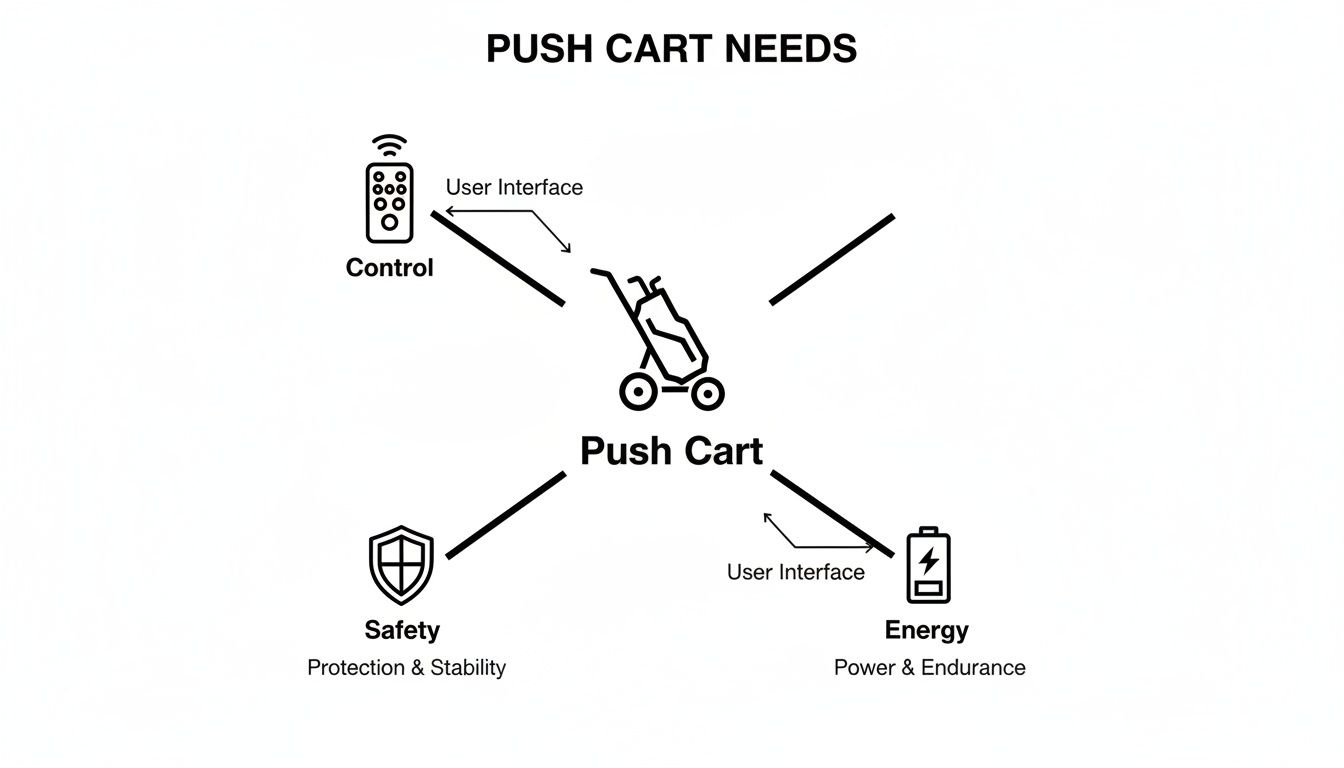
As you can see, these elements are all tied together. Better brakes mean better control and safety, and regenerative systems add a layer of energy efficiency that older technologies just can't match. This shift is a pretty big deal. Since the 2000s, the move to better batteries has made regenerative braking a star feature, capable of recovering up to 30% of kinetic energy that would otherwise be lost. In a golf cart market valued at $2.6 billion, that kind of efficiency boost is critical, especially after course visits jumped 22% in 2020.
How Caddie Wheel Changes the Game for Push Cart Control
Understanding the mechanics of old-school golf cart brakes is a good starting point, but the real revolution for walking golfers is seeing how modern tech completely rethinks on-course control. Instead of wrestling with manual levers or using your own body as a brake, systems like the Caddie Wheel introduce a level of precision that feels almost second nature. It's a huge leap from just stopping your cart to actively managing its every move.
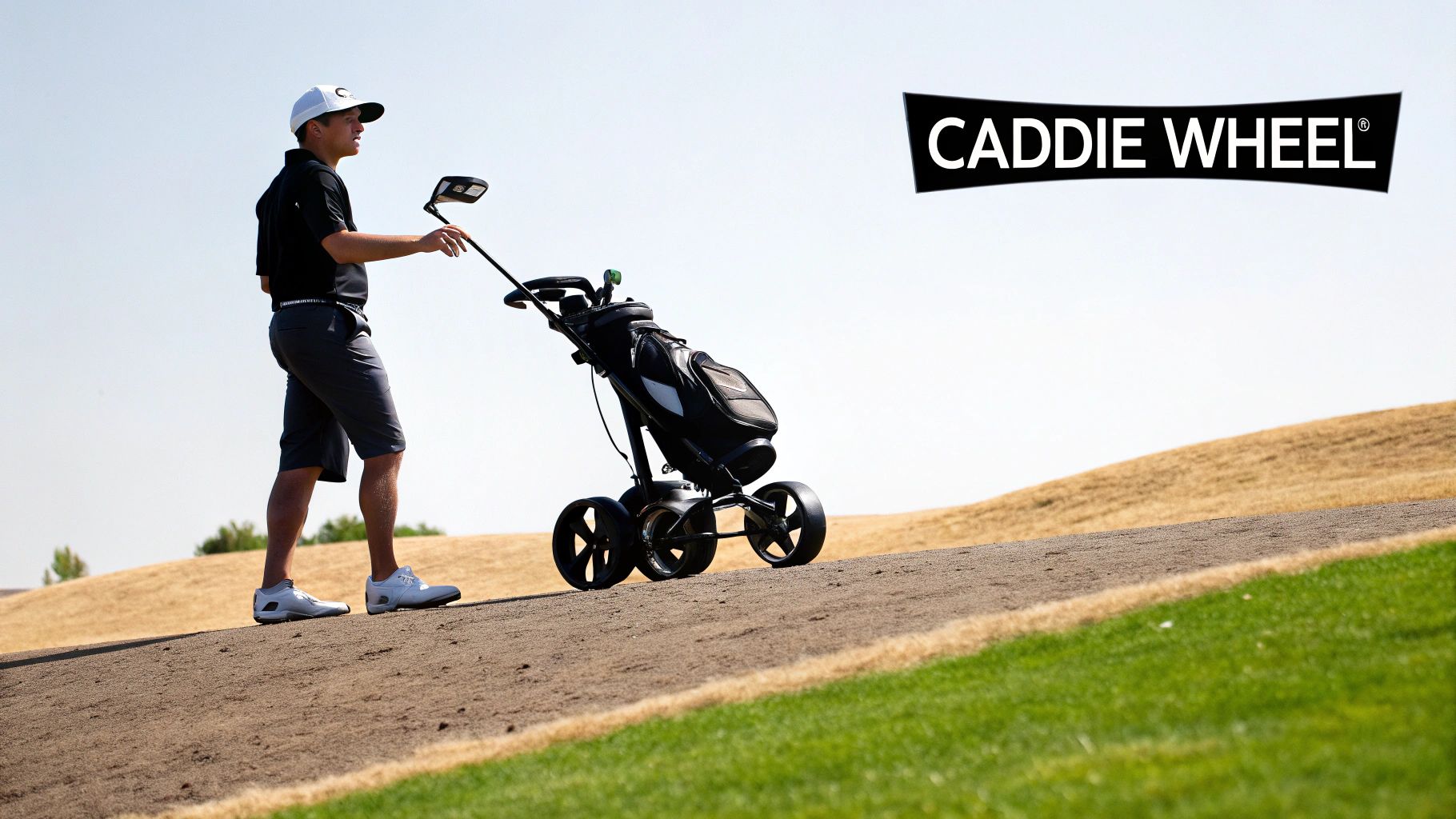
The Caddie Wheel essentially supercharges your standard push cart by adding an integrated, remote-controlled electronic braking system. This puts complete command over your cart's speed and positioning right in the palm of your hand.
Picture this: you're standing on a steep fairway, sizing up your approach shot. Instead of fumbling with your cart or searching for a level patch of grass, you just tap a button. The electronic brake engages instantly, holding your cart right where you left it, safe and secure.
This immediate, reliable stopping power lets you focus 100% on your shot, clearing your mind of that nagging worry about a runaway cart. It’s a small detail that makes a massive difference to your mental game over 18 holes.
Precision Control That Goes Beyond a Simple Stop
The Caddie Wheel's system is so much more than a parking brake. It gives you dynamic control that helps you navigate the entire course with more ease and safety. The real magic is in the practical, on-course moments where this technology truly shines.
Here are a few game-changing examples:
- Controlled Descents: On those steep downhill paths, you can use the remote to dial in a slow, steady pace. The electronic brake automatically manages the speed, so the cart never pulls you down the hill. This takes a ton of strain off your back and joints.
- Effortless Maneuvering: Tight corners and crowded spots around the clubhouse or first tee are no longer a headache. The reverse function, paired with pinpoint braking, lets you navigate these spaces like a pro, avoiding those awkward three-point turns.
- Parking on Any Lie: Finding a perfectly flat spot to park is officially a thing of the past. The brake is strong enough to hold a fully loaded cart on a serious incline, giving you the freedom to leave it wherever is most convenient for your next shot.
This kind of control fundamentally changes how you interact with your gear. Your push cart is no longer a clumsy piece of equipment you have to babysit; it becomes a responsive partner that works right alongside you.
The ability to stop, start, and reverse your cart with a remote isn't just a cool feature—it's a strategic advantage. It saves your physical energy and mental focus for what really matters: your game.
The Evolution of Braking on the Golf Course
The advanced electronic brakes in devices like the Caddie Wheel are built on a long history of safety innovations in golf. Back in the early 1960s, Club Car made a huge leap by introducing mechanical brakes as a standard feature, a major upgrade from the basic foot brakes of the 1950s.
By 1963, this single innovation had already cut stopping distances on wet turf by 40%, making carts much safer across the 15,000 U.S. courses at the time. This was a critical improvement, as golf cart accidents had spiked 25% between 1958 and 1962, mostly due to poor braking on downhill slopes.
Today, with hydraulic drum brakes as the norm, we see systems that can stop a cart in under 2.5 seconds from 20 mph, preventing over 70% of potential rollaways. For walking golfers, the Caddie Wheel’s motorized wheel builds on this legacy, adding regenerative braking that can even extend battery life by 15-20% over a full round. You can learn more about the growth and innovations in the golf cart market to see how far the technology has come.
Simple Maintenance for Flawless Brake Performance
Just like any other piece of high-performance equipment, your push cart’s braking system needs a little attention to keep it working perfectly. The good news? Keeping your golf cart brakes in check doesn’t mean you need to be a mechanic. A few moments of preventative care before you even head to the first tee can save you from major headaches on the course.
Think of it like checking the air in your car’s tires before a long road trip. It’s a simple, quick step that guarantees safety and reliability, so you can focus on the journey. That same logic applies here, whether you're using a classic manual cart or a modern electric-assist system.
This proactive approach not only keeps your gear in top shape and extends its lifespan, but it also ensures your cart is ready to perform when you need it most—especially on that tricky par 4 with the steep, sloping fairway.
Your Pre-Round Brake Inspection Checklist
Before you even think about loading your bag, get into the habit of running through this quick inspection. This two-minute routine is your best defense against unexpected brake issues and is easy enough for any golfer to master.
For Manual Push Carts:
- Check Cable Tension: Give the brake lever a squeeze. It should feel firm, not spongy or loose. If you can pull it all the way to the handlebar without the brake engaging, the cable probably needs a quick tightening.
- Inspect the Brake Mechanism: Take a look at where the brake actually meets the wheel. Clear out any trapped grass, mud, or tiny rocks that could get in the way of a solid connection.
- Test the Lock: Engage the parking brake and give the cart a gentle push. The wheels should lock up tight and not slip at all.
For Caddie Wheel and Other Electric Systems:
- Verify Remote Responsiveness: Power on your system and hit the brake button on your remote. The wheel should stop on a dime and hold its ground.
- Clean the Motor Hub: The electronic hub is the heart and soul of the braking system. Give it a quick wipe with a cloth to remove any dirt or debris that might interfere with its operation.
- Confirm Battery Charge: A low battery can mess with all electronic functions, brakes included. Always start your round with a full charge to ensure everything works reliably.
A simple pre-round check is the single most effective way to maintain trust in your equipment. It transforms brake maintenance from a chore into a routine that builds confidence for every round you play.
Keeping Your Brakes in Top Condition
Beyond the quick pre-round check, a little ongoing care will go a long way in making sure your braking system stays dependable season after season. This is less about daily tasks and more about forming good habits to protect your investment.
Proper maintenance is the key to preventing the most common problems that lead to brake failure, like worn-out parts on manual carts or connectivity hiccups on electronic ones. If you want to dive deeper into overall cart care, check out these 6 essential golf cart maintenance tips for 2025, which offer some fantastic advice for keeping your entire setup in prime condition.
Long-Term Care for Lasting Performance
Thinking long-term is what really gets you the most out of your golf cart brakes. For manual systems, this means occasionally lubricating the brake cable to stop rust and keep it moving smoothly. You should also take a peek at the brake pads or shoes every so often to check for wear, just like you would on a bicycle. If they’re looking thin, it's time to swap them out.
With an electronic system like the Caddie Wheel, long-term care is even simpler. The motor hub is completely sealed, which means no brake pads to replace or cables to adjust. Your main job is to look after the battery. Try not to leave it completely dead for long stretches, and store it somewhere cool and dry during the off-season. Follow these simple steps, and your cart’s most important safety feature will always be ready when you are.
Mastering Hilly Terrains with Smart Braking Techniques
Navigating a course with dramatic elevation changes can be one of the most physically demanding parts of a walking round. Steep hills present a unique challenge, turning what should be a peaceful walk into a battle against gravity. Mastering the terrain requires not just physical effort but smart strategies, where your golf cart brakes become your most valuable tool for safety and control.
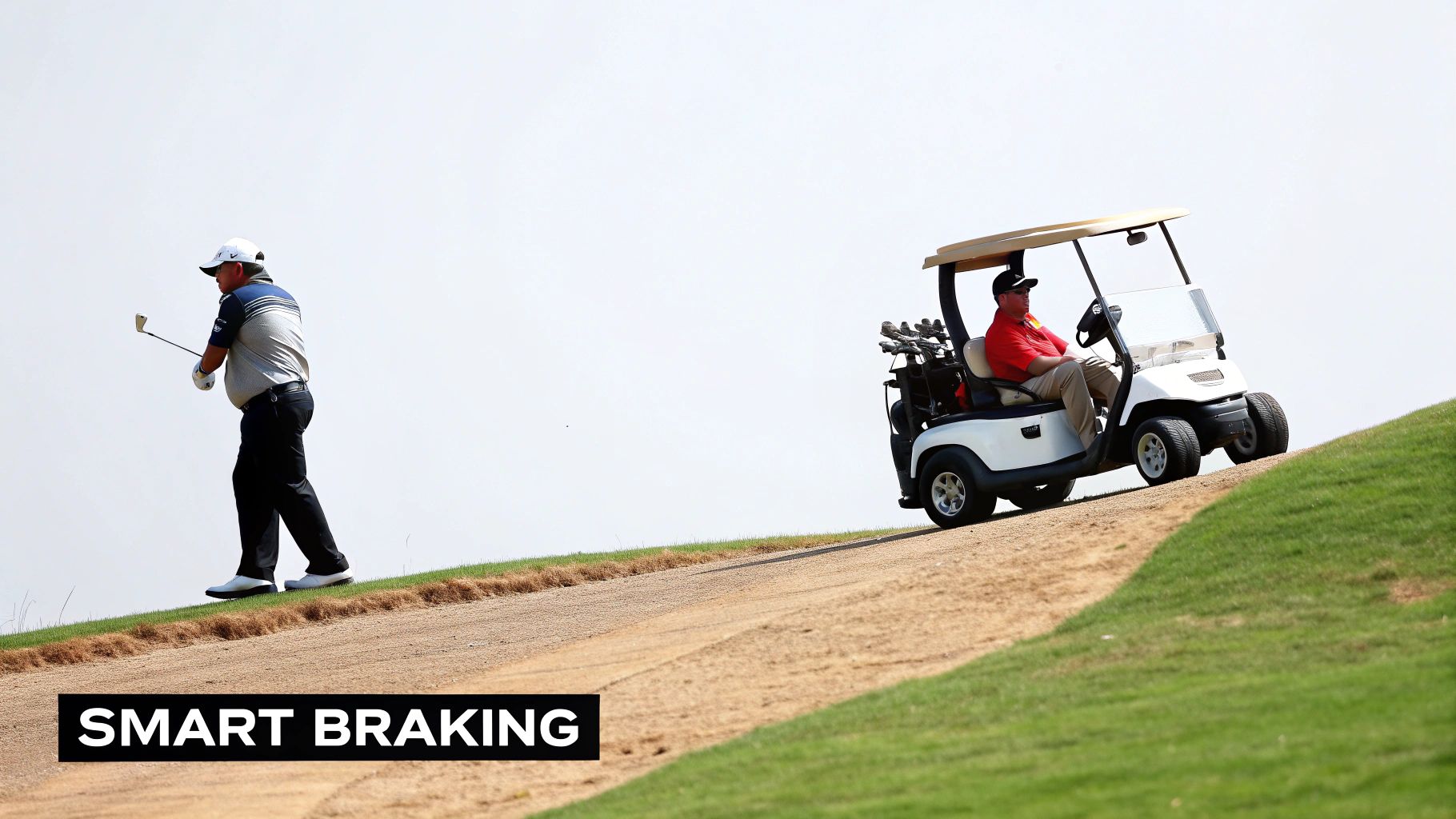
The key is to think ahead. As you approach a downhill slope, don't wait for your cart to pick up momentum before you react. Getting ahead of the descent by engaging your brakes early allows you to maintain a controlled, comfortable walking pace from the get-go. This simple trick prevents the cart from ever getting away from you.
Control Your Descent with Gradual Braking
Think of walking your cart down a steep path like driving a car down a mountain road. You wouldn't just slam on the brakes at the last second, right? You'd apply gentle, consistent pressure to keep your speed in check. The same idea applies to your push cart, but with a manual brake, this often means awkwardly holding a lever while trying to walk—which is both clumsy and tiring.
This is where an electronic system like the Caddie Wheel changes the game entirely. Its remote-controlled braking lets you manage your momentum, hands-free.
- Set Your Pace: You can dial in a slow, steady speed with the remote, and the electronic brake will hold it for you, preventing the cart from tugging you down the hill.
- Make Adjustments on the Fly: If you hit an even steeper section, a simple press of a button can slow the cart further. You get complete, continuous control without ever breaking your stride.
This approach transforms what used to be a strenuous descent into an effortless glide, saving your energy and reducing the strain on your joints.
Parking Securely on Any Incline
Finding a safe place to park on a hill is another major headache. With a standard push cart, you’re often left searching for a relatively flat spot or turning the wheels sideways and just hoping for the best. An unreliable manual brake can easily lead to your cart taking off on its own while you’re lining up your shot.
The consequences of brake failure are more serious than most golfers realize. A startling report from the Consumer Product Safety Commission revealed that faulty golf cart brakes contributed to a staggering 12,450 emergency room visits in the U.S. between 2016 and 2025. These incidents, which account for 28% of all golf cart accidents, often happen because worn-out brakes simply can't hold a heavy cart on an incline. With the global golf cart market projected to hit $4.18 billion by 2032, the demand for truly reliable braking has never been higher. You can learn more by checking out these critical golf cart market trends.
An electronic parking brake offers absolute confidence. With the Caddie Wheel, a single button press engages a powerful hold that keeps your cart securely in place, no matter the angle.
This feature gives you the mental freedom to walk away from your cart on any lie, knowing it will be exactly where you left it when you get back. It’s the difference between constant worry and complete peace of mind, allowing you to dedicate all your focus to the game. By using these smart braking techniques, you can conquer any hill with confidence and ease.
Your Top Questions About Push Cart Brakes, Answered
Even after you get the hang of the tech, you probably have some practical questions about how an electric assist and its braking system will actually work for your game. Getting those real-world concerns sorted out is the key to feeling confident in your gear. Let's dig into some of the most common questions golfers have when thinking about upgrading their push cart with advanced golf cart brakes.
We'll get into the nitty-gritty details, from whether a device will fit your current cart to how it handles the toughest conditions on the course. Think of this as translating the feature list into what it means for a better round of golf.
Will Caddie Wheel Fit My Current Push Cart?
This is usually the first question on everyone's mind: "Will this thing even work with my cart?" The good news is the Caddie Wheel was engineered from the ground up to be nearly universal, fitting the vast majority of three and four-wheel push carts out there. That includes the most popular models from big names like Clicgear, Bag Boy, and Sun Mountain.
Its simple drop-on design and adaptable snap-in bracket system make connecting it to all sorts of cart frames a breeze. The most important thing is making sure the bracket can clamp securely onto your cart’s lower frame, which is pretty standard on most modern designs. To take the guesswork out of it, we have a detailed compatibility guide on our website. And if you're still on the fence, just snap a photo of your cart and send it to our support team—they can tell you right away if you're good to go.
What Maintenance Does the Caddie Wheel Brake System Need?
Here’s where modern electronic systems really flex their muscles. The Caddie Wheel's integrated electronic braking system is pretty much maintenance-free. That’s a massive leg up on traditional mechanical golf cart brakes.
Because the braking is regenerative and built right into the motorized hub, there are no brake pads to wear down or cables to tighten and replace. The whole system is self-contained, which gets rid of the most common points of failure you’d see in a mechanical setup. Honestly, it saves you a ton of time and hassle.
Your only "maintenance" tasks are the simple things you’d do anyway:
- Keep It Clean: Give the wheel unit a quick wipe-down after a muddy round to get rid of any caked-on grass or dirt.
- Charge the Battery: Just follow good charging habits to keep the battery healthy for the long haul.
- Check the Remote: Make sure the remote is working properly before you head to the first tee.
That’s it. The durable, enclosed design means you can spend your time thinking about your next shot, not worrying about adjustments or repairs.
How Well Does Caddie Wheel Work on Wet and Steep Hills?
Let's be honest, this is what really matters. Tough conditions are exactly where the Caddie Wheel's braking system proves its worth. On wet, slick grass, manual brakes can sometimes lock up the wheels, causing the cart to skid. The Caddie Wheel’s motorized brake, on the other hand, delivers precise, gradual stopping power that keeps that from happening. It helps maintain traction and control, giving you a much more secure feeling on slippery ground.
On steep hills, the electronic brake is a total game-changer. It gives you two huge benefits that old-school manual brakes just can't touch:
- Rock-Solid Parking: When you park on an incline, the brake engages with enough force to hold a fully loaded cart firmly in place. No more chasing a runaway cart down the fairway.
- Controlled Descents: Using the remote, you can effortlessly manage the cart’s speed as you walk downhill. It won't get away from you, period.
This level of control is a massive confidence booster. It turns physically demanding courses into far more manageable and enjoyable walks, taking the strain off your body and the worry out of your mind.
Can I Still Push My Cart Manually with Caddie Wheel Attached?
Yes, absolutely. We designed the Caddie Wheel to give you total flexibility—the best of both worlds. You're never locked into using the motor if you don't want to.
When the motor isn't engaged, the wheel is designed to free-wheel with almost no resistance. Pushing the cart manually feels pretty much the same as it did with its original wheel. That means you can easily push it around the clubhouse, across the parking lot, or on flat terrain without any extra effort.
The unit itself is lightweight, so it doesn't add a bunch of bulk or weight to your setup. This flexibility is perfect because it lets you switch between powered assistance and manual pushing whenever you feel like it—tailoring the experience to the round, or even just to a specific hole.
Ready to transform your push cart and conquer any course with complete control? The Caddie Wheel provides the effortless power and reliable braking you need to walk the course with confidence and save your energy for the game.
Partager:
Your Essential Guide to Golf Push Carts Sun Mountain Models
Your Guide to the Perfect Golf Bag Cart Electric Upgrade