
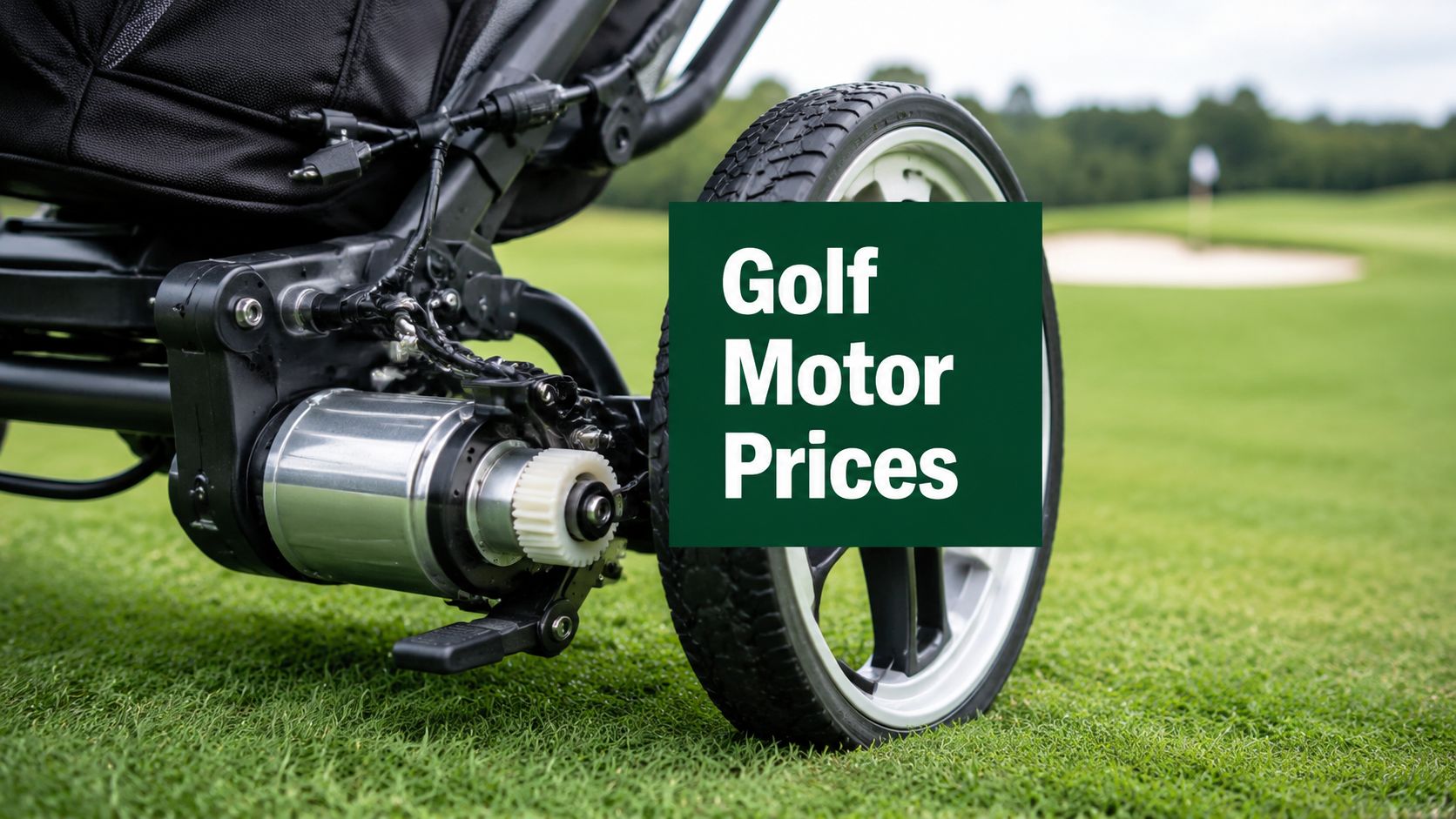
Golf cart motor prices run from $300 to $1,000 for a basic DC replacement motor, $800 to $2,000 for an AC motor, and $500 to $1,500 for motor kits, with total installed cost rising further when labor is involved. At the high end, golfers also look at complete electric push-cart conversion systems, which can push the spend well past the cheapest repair option.
Those searching golf cart motor price are typically in one of two spots. One golfer has a riding cart that suddenly won't pull up a hill. Another is tired of pushing a loaded cart through the back nine and wants powered help without buying a full riding cart. The phrase is the same, but the buying decision isn't.
That's why broad averages can mislead. The wider market for golf carts is already large and layered, with the global market valued at USD 2.3 billion in 2025 and projected to reach USD 5.1 billion by 2035, while the U.S. alone generated about USD 1.4 billion in 2025 and average golf cart prices sit near $9.4K according to golf cart market data from GM Insights. If you want a bigger-picture example of how electrified vehicle pricing shifts as adoption expands, this look at making UK electric motorbikes affordable is useful context.
What Does a Golf Cart Motor Cost in 2026
A dead riding cart motor and a hard-to-push walking setup create the same search, but they lead to different budgets.
If you own a traditional riding cart, the motor itself can land anywhere from $300 to $1,000 for a DC replacement or $800 to $2,000 for an AC motor, based on replacement cost ranges published by Vatrer Power. If you're trying to motorize a push cart instead, the practical comparison isn't a stock replacement part. It's a powered assist system or conversion kit, which usually needs to be judged by convenience, battery setup, weight, and how much strain it removes from your round.
The fast way to think about price
For most golfers, the cost question breaks into three buckets:
- Basic repair: A lower-cost DC motor swap makes sense when your cart is otherwise sound and you just need it moving again.
- Performance rebuild: AC motors, upgraded kits, and supporting electronics cost more when you want stronger hill pulling, speed changes, or better sustained output.
- Walking upgrade: A push-cart motor system changes the experience of walking the course rather than repairing a vehicle you drive.
Practical rule: Don't shop by motor price alone. Shop by what problem you're actually solving.
There's also a market reality behind the spread. Buyers don't shop in a tiny niche. They shop inside a business that has both budget and premium ends. One industry overview says golf cart manufacturing is a $7 billion industry, with complete carts ranging from $1,000 to $30,000, and that most use a battery-powered motor with less than 10 horsepower according to Golf Cart Garage's industry history overview. That's why golf cart motor price varies so much. A simple stock drive unit and a more demanding performance setup are not built for the same job.
Riding Cart Motors vs Push Cart Upgrades
A replacement riding-cart motor is like an engine transplant. A push-cart upgrade is closer to adding e-bike style assistance to something you already use.
The first path keeps a full-size vehicle on the course. The second path helps a walking golfer avoid pushing and fighting hills. They solve different problems, carry different ownership costs, and fit different habits.

How the two paths differ in practice
A riding cart replacement is the right search if you own a Club Car, E-Z-GO, Yamaha, or similar full-size cart and need to restore or change driveline performance. In that case, you're thinking about voltage compatibility, controller matching, torque under load, and whether your existing electrical system can support an upgrade. If you want a technical refresher on powertrain differences, Caddie Wheel has a useful explainer on AC motors for golf carts.
A push-cart upgrade is a different category altogether. You already walk. You already own a push cart, or plan to. What you want is less effort, better control on slopes, and fewer energy leaks late in the round. You're not trying to rebuild a cart drivetrain. You're trying to preserve the benefits of walking without doing all the pushing yourself.
Which buyer each option fits
| Path | Best for | Main concern |
|---|---|---|
| Riding cart motor | Owners repairing or upgrading a full-size cart | Compatibility, power, installation |
| Push cart motor system | Walking golfers who want powered assistance | Portability, battery setup, ease of use |
Most overspending happens when golfers confuse these categories and compare them as if they do the same job.
The broad pricing benchmark supports that distinction. The golf cart industry is valued around $7 billion, complete vehicles run from $1,000 to $30,000, and the motor is a major cost driver, with most carts using a battery-powered motor under 10 horsepower, according to Golf Cart Garage's market overview. That tells you why full-size riding-cart motor decisions look more like vehicle repair, while push-cart motorization is about lightweight assistance and walking comfort.
Breaking Down Replacement Riding Cart Motor Prices
When a riding cart motor fails, the cheapest option isn't always the right one. A low-cost stock replacement works well when the rest of the cart is staying stock. It usually disappoints when the cart carries heavier loads, climbs regularly, or already has speed modifications.

What the market listings show
Replacement motor pricing for major brands follows a clear pattern. Stock motors are commonly listed between $600 and $780, while high-speed torque motors with 9.4 peak HP can reach nearly $930, based on current electric motor listings at Carts Zone. That premium isn't random. It reflects more output and a motor built for harder use.
If you're shopping for a repair, a quick frame helps:
- Stock replacement motors: Best when your cart's job hasn't changed. You want reliability and proper fit, not extra speed.
- Torque-focused motors: Better for hilly courses, heavier passengers, or carts that bog down under load.
- High-speed motors: Useful only if your overall setup is built to support that goal. Speed parts without matching electronics often create frustration.
For a more detailed repair checklist, this guide to golf cart motor replacement is worth reviewing before you order parts.
Why higher output costs more
Motor pricing rises with more than the badge on the housing. Output changes how the cart behaves off the line, on inclines, and over a full round. As power climbs, so do the demands on cooling, current handling, and durability.
One reason golfers get burned here is that a stronger motor often exposes weak links elsewhere. A tired controller, undersized cables, worn solenoid, or old battery pack can make a good motor feel mediocre.
Buy the motor your whole system can support. Otherwise you pay for capability you can't use.
What works and what doesn't
What works is matching the motor to the cart's real duty cycle. Flat-course carts that stay near stock speed usually do fine with a stock-style replacement. What doesn't work is installing a performance motor because the listing sounds impressive, then expecting the same controller and wiring to deliver the advertised feel.
Another mistake is buying for top speed when the underlying complaint is poor hill climbing. If your cart slows badly on inclines, torque matters more than bragging rights. That's usually the smarter spend.
The Price of an Effortless Walk Motorizing Your Push Cart
Walking golfers care about a different kind of value. They don't need a full-size vehicle drive system. They need enough power to remove strain, hold pace, and keep the bag moving cleanly across hills and uneven ground.

What you're really paying for
With a push-cart motor system, the sticker price should be judged by four things:
- Drive durability: The motor has to cope with starts, stops, slopes, and grass resistance without feeling flimsy.
- Battery practicality: Range matters, but so do recharge habits, storage, and carrying weight.
- Control setup: Good remote or speed control makes the assist useful instead of awkward.
- Attachment design: A system that installs easily tends to get used more often.
A lot of golfers make a better value decision than they expect. Instead of buying a heavy dedicated electric caddie, they can convert a push cart they already like. Caddie Wheel is one example of that category. It's a powered wheel assist that attaches to many standard push carts, so the golfer keeps the walking format but adds electric propulsion.
Why some systems cost more
The pricing logic is similar to riding-cart motors in one respect. Better-built motors cost more because they're expected to handle more stress. A high-speed Club Car motor listed at $719.99 includes a Class H insulation rating for higher-temperature operation, as noted in Pete's Golf Carts product listing. The same principle carries over to push-cart power systems. Durable components, better heat tolerance, and more dependable output are worth paying for when the cart has to work repeatedly on real terrain.
If you walk hilly courses, paying for reliable pulling power makes more sense than paying for extra top speed.
The smart comparison for walkers
A walking golfer should compare options this way:
| Option | Best use | Watch for |
|---|---|---|
| Dedicated electric caddie | Turnkey solution | Bulk, transport, replacement cost |
| Push-cart conversion system | Keep your current push cart and add assist | Fit, battery routine, control style |
| Manual push cart | Lowest upfront spend | Full physical effort every round |
What doesn't work well for most walkers is chasing a vehicle-style performance mindset. You're not trying to build speed. You're trying to keep the round enjoyable and physically sustainable.
Understanding the Total Cost of Ownership
The biggest pricing mistake isn't overpaying for the motor. It's forgetting everything around the motor.
For riding carts, the all-in bill often climbs after the first quote. A DC motor may cost $300 to $1,000, professional installation may add $200 to $500, and a full motor kit with controller can run $500 to $1,500, according to replacement cost guidance from Vatrer Power. That gap between part price and actual invoice catches a lot of owners off guard.

Riding cart costs that show up later
If you're repairing a riding cart, budget for more than the motor itself.
- Installation labor: Motor swaps can be straightforward, but seized hardware, wiring issues, or controller mismatch quickly add shop time.
- Supporting electronics: A stronger motor may need a controller or wiring upgrade to perform properly.
- System condition: Old batteries and worn drivetrain parts can reduce the payoff from a fresh motor.
If you're comparing repair bills with replacement alternatives, it helps to look at broader electric golf cart pricing rather than isolating one part.
Push cart ownership is different, not cost-free
A push-cart motor system usually avoids the same installation complexity, but it still has ownership considerations. Battery care matters. Storage habits matter. Added weight matters if you frequently lift the cart in and out of a trunk. The difference is that the cost structure is usually simpler and easier to predict than a full-size cart repair.
The cheapest sticker price can become the expensive choice if it creates repeat labor, poor fit, or a second purchase later.
For many golfers, total cost of ownership is where the walking setup starts to look attractive. Fewer vehicle-level components usually means fewer expensive surprises.
Making the Smart Choice for Your Game and Budget
The right answer depends less on what's available and more on how you play.
If you already own a riding cart in good condition and the failure is limited to the motor, repair can make perfect sense. If the cart also needs controller work, wiring attention, battery money, and labor, the value math changes fast. That's when you need to ask whether you're preserving a useful asset or pouring money into a machine you don't enjoy enough to justify the bill.
Three buyer profiles that keep the decision simple
- The occasional riding-cart owner: Choose a stock replacement when you just need reliable operation and don't care about speed gains.
- The golfer on hilly terrain: Prioritize torque over headline speed. Suppliers separate motors into torque, high speed, and stock replacement categories, and some performance motors cost over $1,100, as shown in Plum Quick's motor listings and categories.
- The committed walker: A push-cart assist system usually offers better value than repairing or buying more cart than you need.
What tends to be a waste of money
A premium motor is wasted when the course is flat, the cart stays lightly loaded, and the rest of the system remains stock. A cheap motor is wasted when the need is pulling power on climbs or dependable performance under regular strain.
The same rule applies to walkers. If your goal is reducing effort, not impressing anyone with speed, buy for control, battery practicality, and hill help. That's where the value lives.
Match the motor to the round you play most often, not the one sales copy makes you imagine.
The practical decision is usually straightforward. Repair a riding cart when the platform is healthy and the fix is contained. Upgrade a push cart when you value walking, want less fatigue, and don't want the cost or bulk of a full-size electric solution.
If you want powered walking without committing to a full electric caddie, Caddie Wheel offers a straightforward way to convert many standard push carts into electric-assist setups, which can be a more value-driven option for golfers who already like walking but want help on hills and long rounds.
Partager:
Golf Push Cart Basket: The Ultimate Buyer's Guide
Motorized Golf Trolley Reviews: Best Carts & Kits 2026