
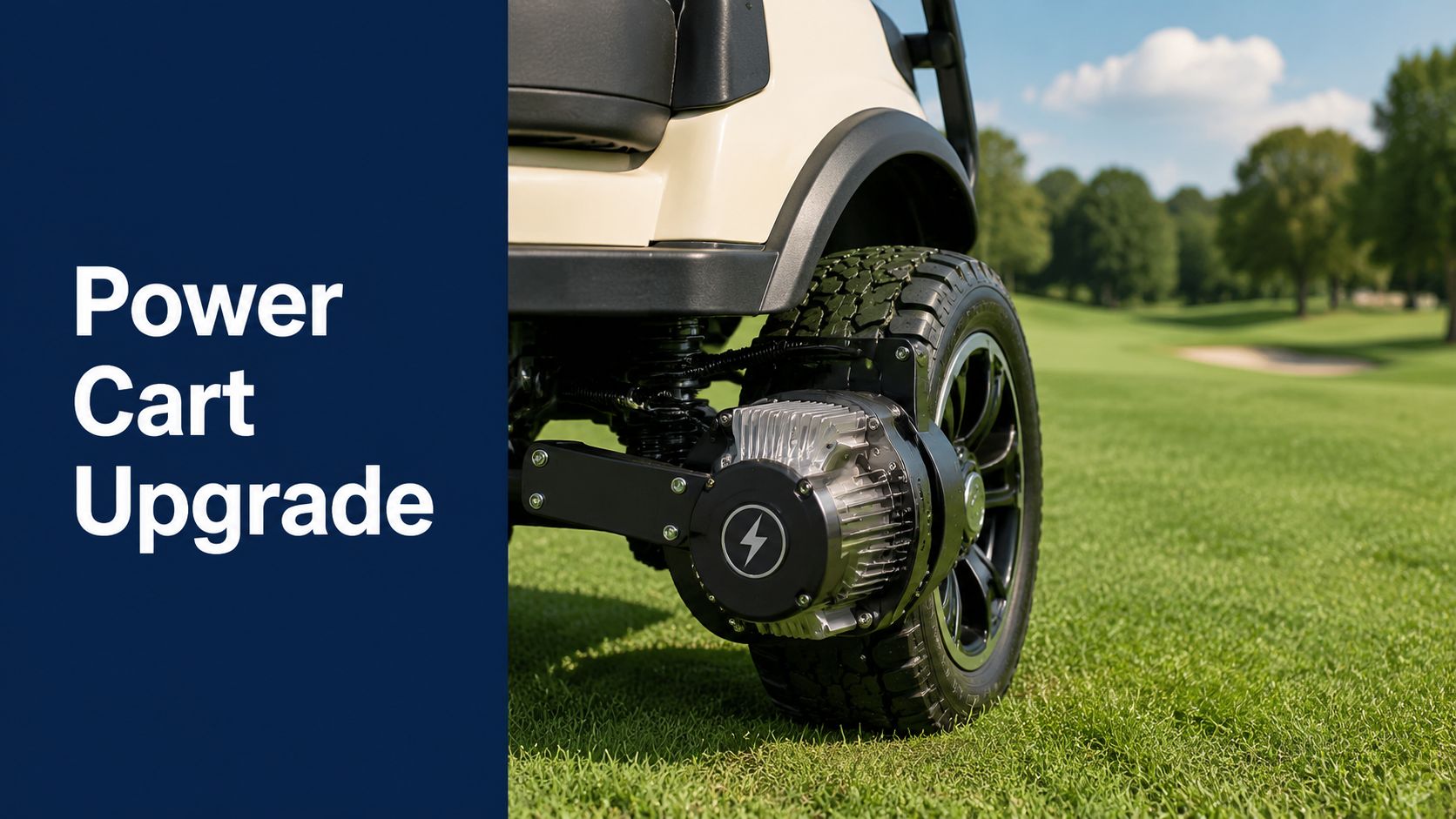
You're probably here because you typed something like Golf Cart Parts Unlimited into search, hoping to solve a very specific problem. A worn tire. A charger issue. A battery lead. A bracket. A missing switch. That's how most cart upgrades start.
The problem is that small-part shopping often turns into a bigger headache than the repair itself. You find the part category fast, but then the specific work begins. Which year is your cart? Which voltage setup? OEM or aftermarket? Will it fit your exact frame, axle, or mounting point? By the time you sort that out, the “simple fix” doesn't feel simple anymore.
Rethinking Your Search for Golf Cart Parts
A lot of golfers and cart owners search Golf Cart Parts Unlimited with a repair mindset. That makes sense. If something's broken, replacing the failed piece is the obvious move.
But that assumption can keep you stuck in maintenance mode.
The real bottleneck isn't always the broken part
For many buyers, the hardest part of shopping isn't finding a store with inventory. It's verifying fit. Public content around Golf Cart Parts Unlimited often leaves a gap around how buyers should confirm year, model, voltage, or OEM-versus-aftermarket fit before ordering, which matters if you're trying to avoid expensive returns and downtime for a Yamaha, Club Car, or E-Z-GO setup, as noted in this BBB business profile context.
That's the part experienced owners learn quickly. Catalog depth is helpful. Decision support is what saves you.
Practical rule: If a parts search starts with “I just need one thing,” stop and ask whether you're solving a failure or solving a limitation.
Those are different jobs.
A failed wheel, battery cable, or switch needs replacement. A cart that feels tiring, awkward on hills, or annoying over a full walking round needs a different kind of answer. In that case, the highest-impact “part” may not be a replacement item at all. It may be a system that changes how the whole setup behaves.
Small fixes are common. Bigger upgrades change the round
That shift matters most for walking golfers. If you already own a push cart and like walking, the usual parts-store mindset can be too narrow. You don't necessarily need more accessories. You may need less effort between shots.
Here's where many golfers miss the opportunity:
- Repair thinking: Replace what wore out and keep the same experience.
- Upgrade thinking: Add a component that changes how much energy the round takes out of you.
- Performance thinking: Reduce physical strain so your attention stays on club choice, target line, and pace.
That last category is where power assist earns attention. It's not a cosmetic add-on. It changes the job your cart does.
The best upgrade isn't always the part that gets your gear back to normal. Sometimes it's the one that makes normal feel outdated.
If your search for Golf Cart Parts Unlimited started with a practical errand, that's fine. But it's worth asking a better question before you check out: are you replacing a minor component, or are you passing on a much more useful upgrade?
From Push Cart to Power Cart with Caddie Wheel
The easiest way to understand a power-assist wheel is to compare it to adding electric assist to a bicycle. You still keep the platform you know. You're not replacing your whole setup. You're adding controlled propulsion to something you already like using.
That's why this category matters. It sits between a manual push cart and a full electric caddy.
What the system actually does
Instead of buying a separate dedicated power cart, you add a motorized drive unit to your existing push cart. The point isn't just movement. The point is to remove the repeated push effort that wears on your legs, shoulders, and focus over a round.
This visual shows that progression clearly.

A well-designed assist unit should feel like a complete product, not a garage-built workaround. That means the wheel, battery, controls, and mounting system need to work together from the start.
Why integration matters more than a parts list
Golf cart parts stores often train buyers to think in categories. Wheels here. Electronics there. Mounts somewhere else. That works when you're maintaining a vehicle. It's less helpful when you're trying to improve the walking experience on the course.
An integrated power-assist setup is appealing because it cuts out a lot of project friction:
- You keep your cart: No need to scrap a push cart you already trust.
- You avoid piecing together a system: Fewer chances to mismatch hardware.
- You get one operating experience: Mount it, charge it, control it, and walk.
If you're also evaluating how the rest of your setup carries and organizes gear, it's worth looking at well-designed options when you shop golf bags, because bag balance and pocket access still affect how your cart feels in real use.
A practical conversion mindset helps here. This push cart to electric conversion guide is useful because it frames the upgrade as a controlled add-on, not a full rebuild.
What separates a polished upgrade from a DIY experiment
The golfers I've seen get the most value from power assist aren't always the most technical. They're usually the ones who want fewer friction points before the first tee.
They care about three things:
- Can I attach it without turning this into a project?
- Can I trust it to respond consistently during a round?
- Does it preserve the compact, walkable feel of my current cart?
If the answer is yes, then the upgrade makes sense. If the answer requires extra adapters, custom wiring, or trial-and-error fitment, most golfers will use it less than they expect.
That's the practical appeal of Caddie Wheel. It's a power-assist wheel for a standard golf push cart, built as a self-contained system with the drive unit, battery, and controls working together. For golfers who want electric assist without moving to a bulkier dedicated caddy, that's a cleaner path than shopping loose components and hoping they play nicely together.
Top Features That Elevate Your Golf Game
Specs matter. On the course, benefits matter more. A feature only earns its place if it changes how you play, how you feel late in the round, or how easy it is to keep using the setup week after week.

Remote control that saves energy for golf
Remote operation sounds like a convenience feature until you use it over a full round. Then you realize it changes the rhythm of walking.
You're not leaning into the cart on inclines. You're not wrestling it across uneven turf. You're guiding it. That distinction matters because walking golfers don't usually lose energy in one dramatic moment. They lose it in small pushes, small corrections, and small efforts that stack up.
A power-assist system earns its keep when you stop thinking about moving the cart and start thinking only about the next shot.
That's the true value. Less effort between shots means more attention left for decision-making.
Rugged wheel, lighter work
The wheel itself has to do more than turn. It has to stay composed over slopes, cart paths, transitions, and rougher edges near tee boxes and greens. A weak drive wheel feels fine in the parking lot and underwhelms on the course.
A strong wheel design helps in practical ways:
- Better hill handling: The cart keeps moving without that dead, dragging feel.
- Cleaner tracking: Less correction through uneven lies and sidehill sections.
- More confidence loaded up: Full bags, water, layers, and accessories don't turn into a chore.
This is one place where golfers often underestimate the benefit until they've played a windy or hilly course. That's when pushing weight stops being theoretical.
Seamless integration beats replacement
There's a value argument here that has nothing to do with bargain hunting. If you already own a push cart you like, replacing the whole setup can be wasteful.
Upgrading the cart you know often makes more sense than starting over. You already know how it folds. You know how your bag sits on it. You know whether it fits your trunk and your normal routine. Keeping those familiar wins while adding propulsion is a smarter move than many golfers first realize.
Less strain changes your swing late in the day
Most golfers focus on distance, alignment, or putter feel when they think about performance. Physical fatigue is quieter, but it affects all of them.
By the back side of a round, a tired golfer tends to rush setup, get lazy with posture, or make poorer decisions. A cart upgrade won't fix mechanics. It can reduce one source of wear that chips away at mechanics.
That's why this category matters. You aren't buying a gadget for the parking lot demo. You're buying a smoother walk so your body and brain arrive at the ball in better shape.
A Simple Installation and Universal Compatibility
Compatibility is where many parts purchases go sideways. That's especially true in the broader Golf Cart Parts Unlimited ecosystem, where stores may carry wide assortments across brands and models but not always provide enough guidance to help a buyer verify the exact fitment path before ordering.
A well-designed push-cart power assist solves that problem differently. Instead of asking you to decode vehicle year, voltage, controller family, or motor spec, it focuses on the frame and attachment method of the push cart you already use.
What universal compatibility should mean in practice
When a company says a product fits “most” carts, that phrase needs a practical interpretation. For this kind of upgrade, what you want is a mounting system that works across the common three-wheel and four-wheel push cart formats golfers already own.
That's a much simpler compatibility question than traditional powered cart parts.
You're usually looking at:
- Bracket fit: Will the attachment point match the cart frame securely?
- Clearance: Does the wheel have enough room to operate without rubbing?
- Folding routine: Can the cart still fit your normal transport and storage habits?
Those are solvable checks. They're also far easier to verify than many OEM-versus-aftermarket part decisions in the cart world.
Here's a useful visual of what the install flow looks like.

What installation should feel like
A golfer shouldn't need to block off an afternoon and open a toolbox just to add powered assistance to a push cart. The cleaner setups use a bracket and snap-in approach so the process feels closer to mounting an accessory than rebuilding equipment.
The sequence is usually straightforward:
- Confirm your cart style and make sure the mounting area matches the bracket design.
- Attach the bracket where the drive wheel is intended to sit.
- Snap in the powered unit so it locks into place cleanly.
- Charge and pair the control system before the first round.
- Test low-speed movement in a driveway, parking lot, or practice area before taking it to the course.
Don't judge install quality by how fast the first attachment goes. Judge it by whether you'd willingly remove and reinstall it without frustration.
That's the standard that matters in real ownership.
For golfers who want a broader primer on manual cart setup and everyday use, this guide to cart golf manual basics is a helpful reference point.
What doesn't work
The bad installations all share the same traits. Too many loose pieces. Vague instructions. Brackets that “almost” fit. Systems that technically mount but make folding, loading, or steering awkward.
That's why universal design isn't a marketing extra. It's the whole point. If the setup process introduces uncertainty, many golfers won't trust the product enough to rely on it during a round.
Understanding Battery Life and On-Course Performance
Most golfers don't care about electronics in abstract terms. They care about whether the cart will keep moving through the last few holes, whether it can climb a hill without bogging down, and whether the assist feels steady instead of jerky.
That's the right way to judge performance.

Battery life should be read as confidence, not just capacity
Caddie Wheel states that its battery supports up to 36 holes per charge in the publisher information provided for this article. For a walking golfer, that's not just a spec. It means you can think in terms of a full golf day instead of worrying whether assist will fade before you finish.
Battery confidence matters differently depending on how you play:
| Playing situation | What battery confidence means |
|---|---|
| Regular 18-hole round | Charge once, play without watching the system |
| Replay day or extended practice | Less concern about whether a second loop is realistic |
| Hilly course | More trust that terrain won't drain the experience mentally |
| Travel or club storage routine | Simpler planning with a portable charger |
That kind of predictability changes whether a power-assist product feels practical or fussy.
Why integrated powertrains usually outperform DIY mixes
Many technically curious buyers often get themselves into trouble. They assume more customization automatically means better performance. In reality, custom electric cart builds depend on a careful match between the controller's current capacity, cable gauge, and motor selection, and getting that balance wrong can lead to poor torque, slow acceleration, or overheating, while an integrated system is built with those elements pre-optimized for reliability and power delivery, according to Parts Unlimited industry context.
That principle translates directly to golf use. Smooth starts, controlled climbing, and consistent response usually come from systems engineered as a package.
The strongest motor on paper won't feel strong on the course if the rest of the electrical system isn't matched to it.
For golfers trying to understand how battery health affects long-term use, this guide to golf cart battery lifespan covers the maintenance side well.
What good on-course performance feels like
You don't need a spreadsheet to evaluate this. You need a few honest questions after a round.
- Did the unit pull cleanly on inclines?
- Did speed changes feel predictable?
- Did steering corrections stay manageable?
- Did you finish the round feeling less worn down than usual?
If the answer is yes, the system is doing its job.
What doesn't work is a setup that surges, hesitates, or feels underpowered once the bag is fully loaded and the course starts rolling. Golfers can forgive a learning curve. They won't forgive a product that makes them babysit it.
Your Buying Guide and Final Considerations
If you're comparing options, there are really three paths. Keep pushing manually. Buy a full electric caddy. Or upgrade the push cart you already own with power assist.
Each path makes sense for a different golfer. The right choice depends less on hype and more on how you play, store your gear, and value walking without fatigue.
Choosing your on-course experience
| Criteria | Manual Push Cart | Full Electric Caddy | Caddie Wheel Upgrade |
|---|---|---|---|
| Effort during the round | Highest physical effort | Lowest push effort | Low push effort with existing cart |
| Learning curve | Very low | Moderate, depends on controls and folding system | Low to moderate |
| Storage and portability | Usually compact | Often bulkier as a complete unit | Usually easier if you already like your cart footprint |
| Upgrade path | No propulsion change | Full replacement purchase | Adds propulsion without replacing the whole cart |
| Best fit | Golfers who don't mind pushing | Golfers ready for a dedicated powered platform | Golfers who want assist while keeping their current push cart |
The trade-offs worth thinking through
A manual push cart stays simple. That's its strength. It's also the reason many golfers outgrow it once hills, heat, or back fatigue become more noticeable.
A full electric caddy gives you a purpose-built powered unit. The trade-off is committing to an entirely separate platform, with its own size, feel, and transport routine.
A power-assist upgrade sits in the middle. It won't be the perfect choice for every golfer, but it makes a lot of sense if you already own a push cart you trust and want a more relaxed walking round without replacing everything.
One buying signal I do like to see is warranty support. Caddie Wheel includes a 12-month warranty in the publisher information provided for this article, and that matters because power-assist products live outdoors, move over uneven surfaces, and need to earn trust over repeated use.
Buy for the round you actually play, not the setup that sounds impressive in product copy.
If your normal golf life involves walking, carrying less strain into the back nine, and keeping your current push cart in service, then power assist isn't just another accessory category. It's a smarter way to rethink what you were searching for when you typed Golf Cart Parts Unlimited in the first place.
If you want to see what a push-cart power-assist upgrade looks like in practice, Caddie Wheel is worth a look. It's built for golfers who want to keep walking, reduce push fatigue, and add electric assistance to a standard push cart without moving to a full dedicated caddy.
Partager:
The 7 Parts of a Golf Swing for Better Consistency
Adaptive Sports Equipment: A Complete 2026 Guide