
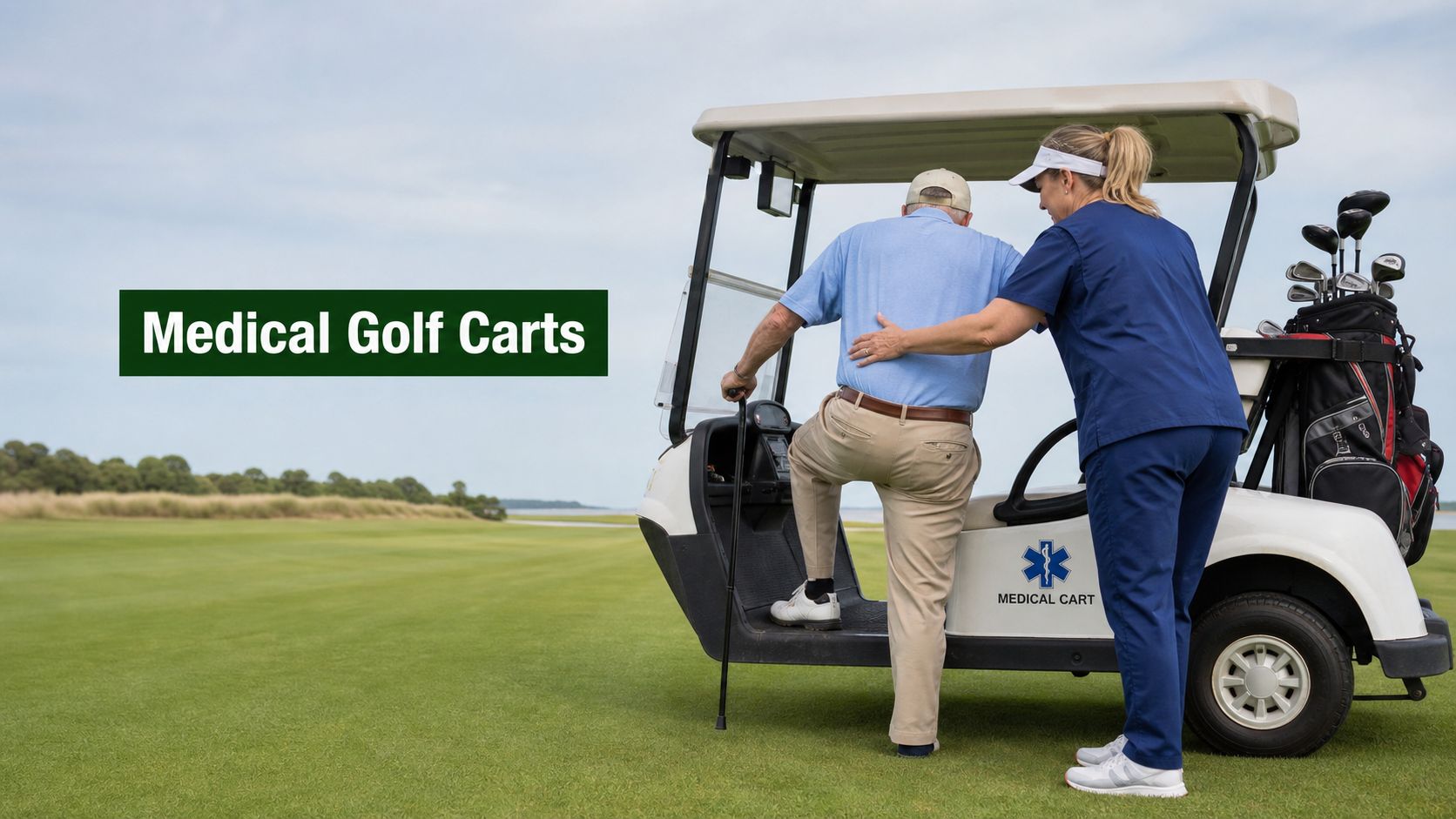
Some golfers know this moment well. You still love the walk from tee to green, still enjoy carrying a score in your head, still want the rhythm of a proper round. But somewhere along the way, the hills got steeper, the push cart felt heavier, and the back, knees, hips, or balance issues you once managed privately started shaping every shot before you even swung.
For some players, the problem is stamina. For others, it's joint pain after the front nine, a recent surgery, pelvic discomfort, or a condition that makes repeated pushing and stopping feel like work instead of recreation. If that's part of your golf life right now, you're not alone, and you're not out of options. Some golfers also find it helpful to look beyond equipment and address the body side of the problem, especially when pain shows up after walking and rotating through a round. Resources like pelvic floor therapy for female golfers can help connect those symptoms to practical treatment.
The phrase medical golf carts can sound straightforward, but it encompasses two very different things. One type is built for staff who need to respond to emergencies on a course or facility. The other type is meant to help players move around the course safely and keep playing. That second group includes full adaptive riding carts and simpler mobility-assistance tools that support walking rather than replace it.
Keeping Your Love for Golf on the Course
A lot of golfers don't start by searching for a medical solution. They start by making small compromises. Maybe you begin skipping the back tees because the walk is too much. Maybe you lean more heavily on a cart path than you used to. Maybe you finish the round and feel proud of the score, but pay for it the next morning.
That doesn't mean golf is over. It means your equipment needs to match your body as it is now, not as it was twenty years ago.
What golfers usually mean by medical help on the course
The confusion starts with the wording. When people hear "medical golf carts," they often picture one thing. In reality, golfers usually need help in one of two directions:
- Emergency-response vehicles: These are for staff, medics, or facility teams handling on-course incidents.
- Mobility-assistance solutions for players: These are the products a golfer uses to keep playing with less strain.
Those are different tools for different jobs. Mixing them together makes shopping harder than it needs to be.
Golfers rarely need a hospital-style cart. Most need a practical way to reduce strain, stay upright, and keep enjoying the health benefits of walking.
The real goal isn't just getting around
For many players, the goal isn't only transportation. It's staying part of the game in a way that still feels like golf. Riding in a standard cart works for some people. For others, walking with assistance feels better physically and mentally because it preserves pace, routine, and a sense of independence.
That difference matters. A player recovering from injury may need full riding support for a period of time. Another golfer with arthritis or balance concerns may do better with a setup that removes the burden of pushing while still allowing a normal walking round.
The Two Worlds of Medical Golf Carts
If you want clear language, think of this like the difference between an ambulance and a personal mobility device. Both relate to health. They are not built for the same person or the same task.

First-responder carts
A first-responder cart is a facility vehicle. You see these at larger golf properties, resorts, campuses, and event venues where staff may need to reach an injured guest quickly.
These units are designed around response, not recreation. They may carry first-aid supplies, medical gear, and space for patient transport. Some are built with stopping power as a priority because they may be moving under load on narrow paths. According to this product overview of a first-aid response cart, medical golf carts designed for first-aid response are typically equipped with 4-wheel hydraulic disc brakes and an electronic motor brake to ensure rapid, controlled stopping under load on narrow facility pathways.
Adaptive player carts
An adaptive player cart is for the golfer. This category is broader than many people expect, because it includes more than one way to stay mobile.
Some golfers use a single-rider adaptive cart. That setup makes sense when walking the course isn't realistic or safe. These carts focus on access, support, and course navigation.
Other golfers use power-assist walking devices. These don't replace the walking round. They reduce the work of pushing and controlling equipment over hills, side slopes, and long transitions between holes.
Why the distinction matters
A lot of bad buying decisions happen because golfers shop by keyword instead of need. They search "medical golf carts," land on emergency vehicles, and assume that's the category. Or they jump straight to a full rider cart when what they really need is less strain on the shoulders, back, and knees.
A better way to sort the options is to ask one question first.
Start here: Do you need a vehicle that replaces walking, or a device that makes walking manageable again?
If your answer is "I can still walk, but pushing the bag wears me down," then a walking-assist solution belongs on your shortlist. If your answer is "I can't safely or comfortably walk the course," then a dedicated adaptive rider deserves a closer look.
A simple comparison
| Type | Who uses it | Main purpose |
|---|---|---|
| First-responder cart | Staff or emergency personnel | Reach and transport injured people |
| Single-rider adaptive cart | Golfers with major mobility limits | Replace walking during play |
| Power-assist walking device | Golfers who can still walk | Reduce strain while preserving the walking round |
That one distinction clears up most of the confusion around medical golf carts.
Essential Features for Adaptive Player Carts
Choosing an adaptive setup gets easier when you stop looking at labels and start looking at friction points. Where does the round become difficult for you? Getting in and out? Controlling speed on hills? Managing fatigue over eighteen holes? The best features are the ones that solve the moments that usually force you to quit early or ride when you'd rather walk.

Entry and seating support
For golfers using a dedicated adaptive rider, the first test isn't top speed or storage. It's transfer. If getting into a seat is awkward, too high, or unstable, the cart may be a poor fit no matter how capable it looks on paper.
Look for features such as:
- Low, manageable entry: A lower step-in height reduces the effort needed to mount and dismount.
- Supportive seat design: Swivel seats, arm support, and stable positioning can help golfers with hip, knee, or balance limitations.
- Secure posture: If a player struggles with trunk stability, extra support can make the difference between confidence and constant tension.
Controls you can trust
Adaptive equipment shouldn't require fine motor gymnastics. Buttons, levers, brakes, and speed changes need to feel obvious the first time you use them.
A practical test is this. Could you operate the unit confidently late in the round, when you're tired, on a slight slope, with your attention split between your footing and your clubs? If the answer is no, keep looking.
The best adaptive controls disappear into the round. You shouldn't have to think about them on every shot.
Stability and braking on real terrain
Golf courses aren't smooth sidewalks. You deal with side hills, damp turf, cart paths, bunker edges, and transitions that can feel minor until you're the one trying to control a motorized device with tired legs.
That makes stability and braking feel more important than flashy extras. A wider stance, predictable tracking, and reliable stopping are what keep a mobility aid useful instead of nerve-racking.
Golfers who want to compare broader equipment categories can browse adaptive golf equipment options for 2025 play to get a sense of how different devices fit different levels of support.
Battery range that fits a real day
Battery claims matter, but they only matter when you interpret them correctly. A round on a flat municipal course isn't the same as a windy day on a hilly layout with extra walking between greens and tees.
One useful benchmark comes from the walking-cart side of the market. According to this comparison guide for electric golf walking carts, a unit should comfortably handle 27 to 36 holes, and Caddie Wheel's battery is listed for up to 36 holes on a single charge. In plain terms, that suggests a healthy cushion for many golfers playing a full day, though terrain, load, and conditions still matter.
A quick visual example helps if you're comparing mobility setups in action:
Build your checklist around your body
Before you buy, write down the exact moments when mobility becomes a problem. Then match features to those moments.
- If transfers are hard: Prioritize seat access, support points, and stability at a stop.
- If hills cause anxiety: Focus on braking control and sure-footed handling.
- If fatigue is the main issue: Battery endurance and ease of operation should move to the top.
- If you still want exercise: Walking-assist options may fit better than a full riding cart.
That approach keeps the decision grounded in your game, not marketing language.
Upgrading Your Push Cart with Electric Assist
Not every golfer who searches medical golf carts needs a specialized vehicle. Plenty of players can still walk the course and want to keep doing it. Their issue is narrower. Pushing a loaded cart over four hours asks too much from the back, shoulders, wrists, or knees.
That's where retrofitting starts to make sense. Instead of buying a dedicated rider, you convert the push cart you already know and like into a powered assist setup.

Why retrofit instead of replace
A full adaptive cart can be the right answer for severe mobility limits. But if your body can still handle walking, replacing the whole experience may be more than you need.
Electric assist does something more balanced. It keeps the walking pattern many golfers value while removing one of the biggest physical drains, namely the repeated force of pushing and controlling a bag across uneven ground.
That can be especially helpful for golfers who:
- Still enjoy walking: They want movement and routine, not a fully seated round.
- Use a favorite push cart already: Familiar equipment lowers the learning curve.
- Need support, not a total workaround: Their problem is strain, not total inability.
What makes the retrofit category appealing
Retrofit systems are easier to live with than many golfers expect. You aren't buying a separate course vehicle, figuring out where to store it, or adapting to a whole new mode of play. You're adding power to a setup that already fits your habits.
For golfers curious about the process, this guide to converting a push cart to electric shows what that upgrade path looks like in practical terms.
The appeal isn't only convenience. It's preservation. You keep your walking game. You keep your pace. You keep the feeling of moving through the course under your own steam, just with less wear and tear.
The people behind this kind of design
When retrofit products are done well, they usually come from golfers who understand the nuisance of overcomplicated gear. According to the Caddie Wheel company page, the system was built and branded by Bob Houston and Robert Paffrath, two avid golfers from Montreal who developed it to merge performance with simplicity in an affordable electric assist package.
That design philosophy matters in this category. Golfers who need mobility help usually don't want one more gadget that feels fragile, bulky, or fussy.
A good retrofit doesn't turn your round into a tech project. It simply removes the push from the push cart.
Who tends to benefit most
Electric assist often suits golfers in the middle ground. They aren't looking for a medical transport vehicle, and they aren't ready to give up walking. They just need the course to stop fighting them every hole.
That includes players managing arthritis, post-rehab fatigue, recurring back irritation, or general age-related loss of stamina. For many of them, retrofit support is the smart answer because it enhances the round instead of replacing it.
Navigating Course Rules and Safety Concerns
Mobility equipment only helps if you can use it smoothly at the course. That starts with a phone call before your tee time, not a debate in the parking lot.
Ask the pro shop what kinds of mobility devices they allow, whether they have path restrictions, and whether there are procedures for players using adaptive equipment. Some courses are very familiar with these requests. Others need a little notice so they can point you toward the right staff member.
Questions worth asking before you arrive
A short conversation can prevent a frustrating first visit. Keep the questions practical.
- Device acceptance: Ask whether the course allows adaptive rider carts, electric push-cart assist systems, or both.
- Terrain concerns: Mention if you need to know about steep areas, long transfers, or path-only sections.
- Storage and charging: If your device uses a battery, ask whether there is a convenient place to stage it before or after the round.
Safety matters more than most golfers think
Golf carts often look harmless because they live in recreational spaces. The injury record says otherwise. Between 2007 and 2017, an estimated 156,040 patients were treated in U.S. emergency departments for golf cart-related injuries, and the rate among seniors increased by 67.6% over that decade, according to this PubMed study on golf cart-related injuries.
That doesn't mean you should fear adaptive equipment. It means you should respect it. Learn how your device starts, stops, turns, and holds on slopes before you use it in traffic around tees, greens, bridges, or crowded staging areas.
A safer way to operate on course
You don't need a complicated protocol. You need steady habits.
Practical rule: Test braking and turning in an open area before the first tee, especially if you're using a new setup or playing a hillier course than usual.
A few other habits help:
- Go slow near people: Tees, bag-drop areas, and clubhouse paths create the most unpredictable movement.
- Plan your line early: Don't wait until the slope is under you to decide how you'll approach it.
- Know your brakes: If you use any powered mobility setup, review how golf cart brakes work so you understand stopping behavior before you're on a downhill lie.
Good course etiquette and good safety habits usually look the same. Controlled speed. Clear awareness. No sudden moves.
Making the Right Mobility Choice for Your Game
The right answer depends less on the label and more on how you move through a round. Some golfers need a cart that replaces walking. Others need help preserving it. That's where the decision lies.
If standing and walking are difficult throughout the round, a single-rider adaptive cart may be the better fit. If you can still walk but struggle with the physical drag of pushing your clubs, electric push-cart assist can be the more natural solution. In many cases, the second option feels less like giving something up and more like getting your normal game back.
Choosing your mobility solution
| Consideration | Single-Rider Cart | Electric Push Cart Assist (e.g., Caddie Wheel) |
|---|---|---|
| Best for | Golfers who can't comfortably or safely walk the course | Golfers who can walk but want less strain |
| Walking benefit | Limited, since it replaces much of the walk | Preserved, since you still walk the course |
| Learning curve | Often higher because it's a dedicated vehicle | Often lower because it builds on a familiar push cart |
| Course logistics | May require more coordination with the facility | Usually simpler if the course allows motorized walking aids |
| Storage and transport | Larger footprint | More manageable for many golfers |
| Feel of the round | More dependent on riding | Closer to a traditional walking round |
One overlooked factor
There's also a financial question some golfers ask only after they've already bought equipment. Can a mobility-assist device count as a medical expense?
The answer isn't clear. According to this discussion of IRS ambiguity around electric golf carts and medical equipment, there is no clear guidance on whether power-assist devices for walking golfers qualify as tax-deductible medical equipment under IRS rules, which require the equipment to be primarily to alleviate a physical disability. That's enough uncertainty that it's worth talking with a qualified tax professional before you make assumptions.
A simple way to decide
If you're torn, ask yourself three direct questions:
- Can I still walk the course safely?
- Is pushing the bag the primary problem?
- Do I want support that preserves the health benefits of walking?
If your answers point toward walking with less strain, retrofit assist deserves a serious look. If they point toward replacing walking entirely, a dedicated adaptive rider may be the wiser choice.
The best mobility solution is the one that lets you finish a round feeling like you played golf, not like you survived it.
If you want to keep walking the course without fighting your push cart every hole, Caddie Wheel offers a practical electric-assist option built for golfers who want less strain and a more enjoyable round.
Partager:
Golf World Handicap System Explained: A 2026 Guide
Find the Best Golf Ball Holder for Golf Cart in 2026