
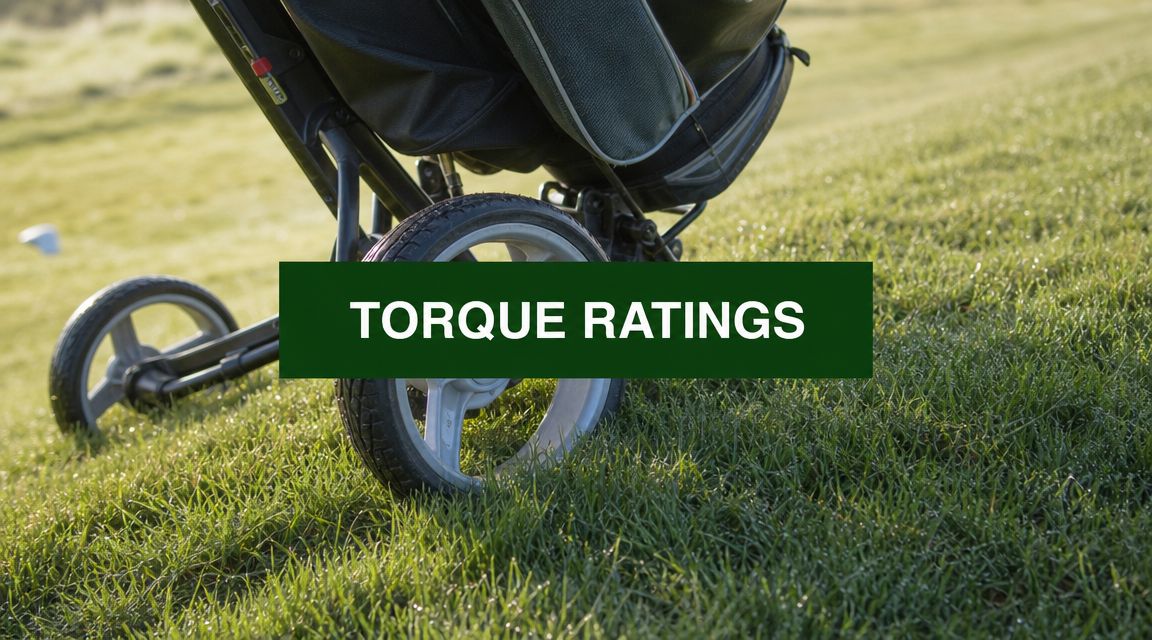
You know the hole. The fairway kicks up harder than it looked from the tee, your bag feels heavier with every step, and by the time you reach the ball you're breathing like you sprinted the last stretch. That kind of climb doesn't just wear on your legs. It steals focus from the next shot.
That's where electric assist starts to make sense. Not as a gadget, but as a way to save energy for golf. The hidden spec that decides whether an assist wheel glides uphill or bogs down is motor torque.
Think of torque like using a wrench. A stubborn bolt doesn't care how shiny the wrench is. It cares how much twisting force you can apply. A motor works the same way. Its job isn't just to spin. Its job is to twist with enough force to move your cart through grass, over small bumps, and up the steepest hill on your course. That twisting force is usually expressed in Newton-meters, often shortened to Nm.
Golfers often get tripped up by motor torque ratings because product pages compress a lot of engineering into one number. Some quote a big number without saying how long the motor can hold it. Some leave out gearing. Some never connect the spec to the one question buyers care about. Will this thing get my loaded cart up my home-course climb without struggling?
If you like seeing how torque is handled in heavier-duty drive systems, MA Hydraulics high torque solutions are a useful reference point for how engineers think about turning force in real applications.
Introduction
A good way to understand motor torque ratings is to forget the spec sheet for a moment and think like a caddie. On flat ground, almost any push cart feels manageable. Add a slope, wet turf, and a full bag, and suddenly the cart needs more than motion. It needs force at the wheel.
That matters because the course doesn't ask for power in a neat, lab-style way. One moment you're rolling along at walking pace. The next, you're starting from a stop on a side slope near a green complex. Then you're climbing again. The motor has to handle changing resistance without cooking itself.
Why golfers get confused
Most confusion starts when shoppers see one torque figure and assume that's the whole story. It isn't. A cart motor has to do three things well:
- Start moving cleanly when the cart is stopped
- Keep moving steadily on a climb
- Repeat that effort over a full round without fading
A single headline number doesn't answer all three.
Practical rule: If a motor spec doesn't tell you how torque behaves over time, you still don't know how it will behave on the steepest part of your course.
The go or no-go question
The most useful way to read torque isn't as an abstract engineering term. Read it like a course-management decision. You wouldn't choose a club by loft alone. You'd ask how far the shot is, whether you're into the wind, and what kind of lie you have. Torque works the same way. The better question isn't "How much torque does it claim?" It's "Can it deliver the needed wheel force, at walking speed, for the full length of my hill?"
That's the standard worth using when you compare electric assist options.
What Is Motor Torque and Why It Matters on the Course
Torque is rotational force. If force pushes in a straight line, torque twists around a point. The classic example is a wrench on a bolt. The longer the wrench, the easier it is to turn the bolt because you're applying force farther from the pivot point.
A cart motor creates that same kind of twisting action. Instead of turning a bolt, it turns a wheel. That twist is what overcomes the drag of grass, the pull of gravity on a slope, and the rolling resistance of a loaded cart.

What torque does during a round
On the course, torque shows up in moments golfers feel right away:
- Hill starts: You stop beside your ball on an incline, then ask the cart to move again.
- Thick turf: The wheel needs more shove to keep rolling through soft ground.
- Acceleration at walking pace: The cart should move smoothly with you, not jerk or hesitate.
- Braking and control transitions: Any stop-start pattern puts demand on the drive system.
If you've ever pushed a manual cart uphill, you've felt the exact job torque has to do. The motor is taking over some of that twisting effort.
Why torque matters more than a flashy spec
A motor can spin quickly and still be poor at climbing. Speed alone doesn't tell you much about pulling ability. A golfer understands this instinctively. A low-lofted club can produce plenty of speed, but that doesn't make it the right choice for a soft, uphill approach. You need the right kind of force for the situation.
Torque is closer to that idea. It tells you whether the system can apply useful turning force where the course asks for it.
A cart that struggles most often doesn't need "more motion." It needs more usable turning force at the wheel.
The first split that matters
Many buying mistakes happen because there isn't just one kind of torque in real motor use. One number may describe what the motor can do briefly. Another describes what it can keep doing without trouble.
That difference is why two products with seemingly similar motor torque ratings can feel very different on the same hill. One may leap off the line, then fade on a long climb. The other may feel calmer at the start but pull steadily all the way up.
Continuous Torque vs Peak Torque
If torque is the cart's twisting muscle, continuous torque is its all-day walking strength. Peak torque is its short sprint.
That distinction isn't marketing trivia. For electric motors, rated torque is the continuous torque a motor can sustain under normal conditions, while peak torque is only for short bursts. Using peak torque as if it were continuous can cause overheating, unstable motion, and reduced service life because torque capability is limited by thermal equilibrium, as explained in this overview of rated torque and peak torque in motor performance.

Think sprinter versus marathoner
Peak torque helps with moments like:
- Starting from a standstill
- Popping over a small bump
- Responding to a brief load spike
Continuous torque handles the hard, boring work that decides whether a motor suits golf. That's the long rise from fairway to green. That's repeated starts on a hilly back nine. That's sustained pulling with a full bag when the cart can't get a cooling break.
A spec sheet that shouts a big peak number but stays quiet on continuous output is like bragging about driving distance while hiding how often the ball stays in play.
Why long hills expose weak specs
A short burst of torque can make a cart feel strong in the parking lot. It starts sharply. It seems eager. Then the round begins, and the steepest hole asks for force over time, not just at the first second.
That's where heat becomes part of the story. Motors don't get to produce maximum output forever. The more demanding the load, the more carefully the system has to manage sustained effort. A motor that's living off short bursts may perform well for moments but struggle when the climb keeps going.
Course test: If your home course has one hill that forces a sustained pull instead of a quick surge, continuous torque is the number that matters most.
Where gearing enters the picture
This is also why a compact motor can still move a loaded cart if the gearbox is chosen properly. Think of a bicycle climbing a hill. In a low gear, the rider gives up speed to gain easier turning at the wheel. The same tradeoff helps small motors do useful work.
Raw motor output gets reshaped by the gearbox into something practical for golf. That means you can't judge a system by torque in isolation. You need to know whether the design delivers that torque at the wheel, at walking speed, and for long enough to finish the climb without strain.
What to ask when a spec seems vague
When you compare products, don't stop at the biggest number on the page. Ask:
- Is this rated torque or peak torque?
- How long can that output be sustained?
- Does the system describe hill use as repeated bursts or steady climbing?
- How is the motor geared for low-speed walking conditions?
Those questions turn a fuzzy spec into a practical buying filter.
How Gearing and Speed Affect Torque
A small motor doesn't win on a hill by brute force alone. It wins by using gearing well. That's the part many golfers never see, but it's the part that often separates a smooth uphill assist from a motor that sounds busy and feels weak.
Think about a bicycle on a climb. Shift into a low gear and your legs turn more easily, but the bike moves slower. Shift into a high gear and you go faster on flat ground, but climbing gets harder. A motor gearbox makes the same bargain. It trades speed for more usable turning force at the wheel.
Why slower can be stronger
Golf push-cart assist isn't trying to race. It only needs to move at walking pace. That changes the design target completely. Engineers can give up top-end speed and concentrate on stronger wheel torque where it counts.
That matters because the wheel is what meets the ground. The motor may spin fast internally, but the gearbox reduces that speed and multiplies the twist that reaches the wheel. If the gearbox is chosen well, a compact system can feel composed on a climb instead of frantic.
A simple way to think about the load
Three variables shape the torque demand on a hill:
| Variable | What it means on the course | Why it matters |
|---|---|---|
| Cart load | Cart, bag, and anything else you're carrying | More load needs more turning force |
| Slope | The steepness of the fairway or path | A steeper climb increases resistance |
| Wheel size | The radius of the driven wheel | A larger wheel needs more torque for the same push |
The wheel-size point gets missed all the time. A bigger wheel covers more ground per rotation, which sounds helpful, but it also gives the motor a longer lever arm to work against. That means more torque is needed to create the same thrust at the turf.
Motor design tradeoffs also matter
Torque behavior also depends on the motor's design. In NEMA induction-motor classes, Design C motors typically deliver 200 to 285% locked-rotor torque, 140 to 195% pull-up torque, and 190 to 225% breakdown torque, while Design D motors can reach up to 275% breakdown torque but with 5 to 8% slip versus 1 to 5% for many other designs, a tradeoff that increases torque at the cost of efficiency and heat, according to this review of NEMA torque characteristics.
For a golfer, the takeaway is simple. More starting punch can help prevent stalling on a hill start, but some designs pay for that with more heat and lower efficiency during sustained use.
A cart motor should feel like the right club for the shot. Enough force to handle the lie, without swinging harder than the situation can support.
What to look at in a real system
When you study an electric-assist design, check how the drive system balances motor output and reduction. A useful technical primer is this guide to an electric gear motor for golf carts, because it helps connect abstract motor behavior to the slow, controlled speeds golfers use.
A fast motor with poor reduction can disappoint on hills. A well-geared system often feels stronger than the raw motor size suggests.
Calculating Torque Needs for Your Golf Cart
You don't need to be an engineer to make a smart go or no-go judgment. You only need a practical way to estimate whether a system has enough torque for the steepest hill you regularly face.
Start with the hill you know best. Not the average hole. The one that exposes weak setups. The uphill walk where your manual cart feels stubborn and your legs start bargaining with you.

The simple model
A practical estimate uses this idea:
Required wheel torque = force needed to move uphill × wheel radius
You don't need exact lab precision. You need a realistic estimate built from course conditions.
Use these inputs:
- Total load: Your cart, bag, balls, water, and anything else you bring
- Steepest regular incline: The hill you expect the assist to handle without drama
- Wheel radius: The distance from the wheel center to the tire edge
- Surface resistance: Grass and uneven ground add to the effort beyond the pure slope
The key caution is this. Torque alone won't predict performance in a vacuum. The final result depends on application-specific geometry. For a wheeled cart, the same motor torque can produce very different thrust depending on wheel diameter and gear reduction, as explained in this discussion of torque, angle, and application geometry.
A golfer-friendly go or no-go method
Instead of trying to calculate every force perfectly, use a field-based checklist:
-
Identify your worst regular climb
Pick the hole or path that repeats often enough to matter. If the assist handles that section calmly, the rest of the course is usually easier. -
Load the cart the way you play
Test with your real bag, not an empty frame. A demo on flat pavement tells you almost nothing about hill performance. -
Note wheel size and drive layout
Larger driven wheels may need more torque to create the same shove at the ground. Gear reduction can offset that, but only if the design accounts for it. -
Ask about sustained climbing, not just startup
A motor that starts well can still fade if the climb lasts.
A comparison table you can use
This table isn't a lab calculation. It's a buying lens.
| Course situation | What the motor needs to do | What to ask |
|---|---|---|
| Flat to gently rolling course | Maintain steady walking pace with light interruptions | Is the system tuned for smooth low-speed control? |
| Frequent hill starts | Restart under load without bogging down | How does it handle repeated starts on inclines? |
| Long uphill fairway sections | Pull steadily for longer periods | What continuous output can it sustain? |
| Larger driven wheel setup | Apply enough torque at the wheel despite added leverage | What gear reduction supports the wheel size? |
How to spot a misleading torque claim
Buyers frequently encounter difficulties because many product pages lead with a single torque number and leave out the context that makes it useful.
Watch for these red flags:
-
Only one big number appears
If the page doesn't distinguish rated output from short-burst output, you can't tell how the motor behaves on a real climb. -
No mention of duration
Torque without time is like saying a golfer can swing hard without saying for how many holes. -
No explanation of gearing
Wheel thrust depends on how motor torque is translated through the drive system. If the product avoids that topic, you're missing part of the story. -
No course-specific language
Ask whether the setup is intended for repeated hill starts, sustained fairway climbs, or mostly flat paths.
A useful comparison point is this overview of a wheel hub motor kit for golf carts, which frames torque in terms of wheel-driven performance rather than abstract motor hype.
The smart buyer doesn't chase the largest torque claim. The smart buyer asks whether the system can deliver the needed force on the hardest hole they actually play.
How to Choose an Electric Assist Based on Torque Ratings
Once you know what you're looking for, spec sheets become easier to read. You're no longer asking, "Which one has the biggest number?" You're asking, "Which one gives me reliable uphill performance at walking speed without hiding the important details?"
The first filter is simple. If a product talks about torque but never clarifies whether it's continuous or peak, treat that as incomplete information. Many product pages and guides create confusion by focusing on a single torque number, and the gap between rated and peak output often causes shoppers to overestimate true continuous pulling ability, especially for repeated hill starts and sustained loads, as noted in Bodine Electric's explanation of peak or obtainable torque.

The buying checklist that matters
Bring these questions to any comparison:
-
What is the continuous torque rating?
If the answer stays fuzzy, you still don't know how the cart will behave on a long climb. -
What is the peak torque used for?
Startup and brief overloads are valid uses. They shouldn't be presented as everyday climbing output. -
How is the system geared?
Torque at the wheel depends on reduction, not just raw motor output. -
Is the setup designed for sustained hills or mostly flat courses?
That answer tells you more than polished marketing copy. -
How does it control low-speed movement?
Golfers need calm walking-speed behavior, not abrupt surges.
Reading the system, not just the number
This is also where it helps to judge the whole package. Drive wheel placement, wheel diameter, gearing, control response, and braking all shape how torque feels on the course. One option in this category is Caddie Wheel, which adds electric power assist to standard push carts through a motorized wheel and remote control. The relevant question isn't whether it claims a dramatic figure. It's whether its drive design matches the stop-start, low-speed, hilly conditions many golfers play.
If you want a broader framework for evaluating motor options, this guide on how to choose the best electric motor for a golf cart is a useful companion when you're comparing real products.
The final go or no-go test
Use your home course as the standard.
If the product can explain how it handles your steepest regular hill, with your normal bag, at walking pace, and for the full climb, that's a serious contender. If the product relies on one isolated torque number with no context about duration or gearing, keep looking.
Golfers make better decisions when they match tools to the shot. Electric assist works the same way. Understand the torque rating, and you'll choose with far more confidence.
If you'd like a simpler way to walk hilly rounds without pushing all that load yourself, take a look at Caddie Wheel. It adds electric assist to a standard push cart, and it's built for golfers who want practical low-speed propulsion, braking control, and less fatigue over the course of a full round.
Partager:
10 Energy Efficiency Best Practices for Golf in 2026
Cold Weather Battery Performance: A Golfer's Guide