
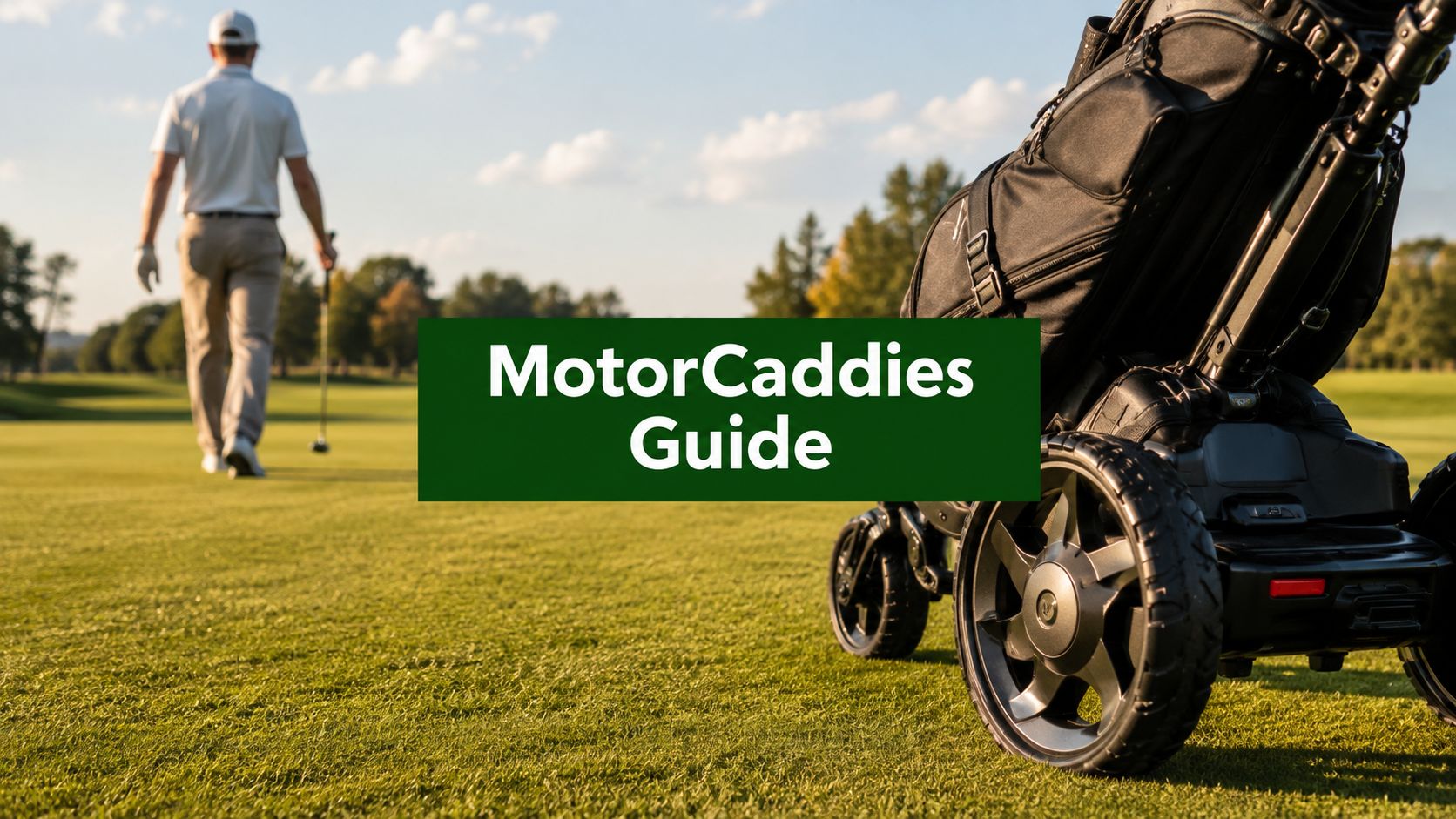
You finish 18 holes and realize your swing wasn't the only thing that got tired. The push cart felt heavier on every hill, the last few approaches lost a little focus, and by the back nine you were managing the cart instead of managing the round. That's the moment most golfers start looking at a motorcaddies golf cart as a category, not just a gadget, because the right powered setup can keep the walk enjoyable without turning the day into a workout.
That interest isn't limited to one region either. In 2025, about 65% of golfers in the U.K. used electric caddies, compared with 25% in Canada and 8% in the U.S. (Plugged In Golf review). For golfers in North America, that gap matters because it shows there's still plenty of room for more practical, walking-first solutions.
If you're also thinking about the rest of your golf routine at home, it can help to create your perfect home setup so the practice side of the game feels as organized as your on-course gear. The same logic applies on the course, less strain, fewer distractions, better rhythm.
Enjoying the Walk Without the Work
A lot of golfers love walking, but not every round feels kind to the body. The first nine holes are usually fine, then the slope changes, the bag feels heavier, and every push across a wet fairway starts to chip away at concentration. That's where a motorized golf cart changes the experience, it keeps the walk, but removes the constant effort that can make a round feel longer than it is.
Why the category exists
The roots go back much farther than most golfers realize. Motorized golf carts trace to the early 1930s, with an early milestone in 1932 tied to Lyman Beecher in Clearwater, Florida, and wider acceptance by the mid-1950s (Los Angeles Times archive). That history matters because this wasn't invented to chase a trend, it grew out of a real need for easier mobility on course.
Practical rule: If you enjoy walking but finish rounds physically drained, the problem usually isn't the walking itself, it's the pushing.
For many players, the appeal is simple. A powered cart protects your energy for shot-making, keeps your shoulders and hands fresher, and makes hilly courses far less punishing. That's true whether you're a senior golfer, a fitness-minded walker, or someone who just wants the last three holes to feel as sharp as the first three.
A home practice area can serve the same purpose off the course. If you're building a setup that supports more reps with less hassle, the convenience of a tidy practice space and the convenience of a powered cart solve the same problem in different places. A golfer who values efficiency at home usually sees the value on the course quickly too.
Understanding Your Motorized Caddy Options
The biggest mistake shoppers make is treating all motorized carts as one thing. They're not. You usually have two paths, buy an integrated electric caddy, or convert the push cart you already own with a power-assist wheel.
The full replacement route
An integrated electric caddy is a complete unit. It comes as a full system in one box, with the frame, drive, controls, and battery designed to work together. Modern electric caddies often include remote control, folding frames, and slope handling features built into the design from day one.
The add-on route
A power-assist wheel does something different. It turns an existing push cart into a motorized one, so you keep your current frame and upgrade the movement. If the smart TV analogy helped, this is more like adding a streaming stick to the TV you already like, less replacement, more function.
For golfers who already own a decent push cart, that distinction is huge. You're not just choosing between products, you're choosing between replacement and retrofit. If your current cart fits your bag well, folds neatly, and still feels solid, an add-on can make more sense than starting over.
You can see how the retrofit category fits into the wider market in this overview of electric push cart attachment options. That's the better route for golfers who want motor help without giving up a cart they already trust.

A good purchase starts with a blunt question, do you want to replace your cart or improve the one already in your garage?
How These Smart Golf Carts Operate
A motorized caddy looks simple from the outside. Under the shell, it is doing three jobs at once, moving the cart, storing enough power for the round, and letting you control pace and direction without constant pushing.
Motor, battery, control, in plain English
The basic setup is easy to understand once you break it into parts. The motor provides the pull, the battery supplies the energy, and the control system decides how the cart responds when you want it to move, stop, or change direction.
Modern electric caddies often use a 28V high-power system with a 230W motor and a lightweight lithium battery, a setup Motocaddy describes as more powerful and efficient than older models (Motocaddy electric caddies). That kind of setup matters because the motor affects how well the cart handles hills and soft ground, while the battery affects how long it can keep doing the work without adding unnecessary bulk.
The control side changes the round just as much as the power side. Remote systems let you send the cart forward, bring it back, or position it more precisely, which helps on tee boxes, narrow paths, and tight parking spots near the green. Some premium caddies also use Automatic Downhill Control, or DHC, plus an electronic parking brake so the cart holds a steadier pace on descents instead of rolling faster than you want.
What the range claims really mean
Battery range is the part that catches many golfers out. A cart that feels fine on a flat, dry course can behave differently on steep holes, wet turf, or colder days, so the number in the brochure is only part of the story.
Motocaddy's FAQ says a full recharge typically takes 8 to 14 hours, depending on the model and battery capacity, and the same source lists a 20 kg maximum load for typical use (Motocaddy FAQ). That load limit matters because it points to normal golf use, a cart bag and the gear you carry, rather than a setup stuffed beyond what the system was built to handle.
For a closer look at the parts inside a powered cart, see this infographic on motorized golf caddy components. It makes the layout easier to picture, especially if you are comparing a full electric caddy with a retrofit attachment and trying to decide which one fits your own round.

Simple takeaway: The motor moves the cart, the battery keeps it going, and the control system keeps the round calm.
Full Caddy vs Power Assist Which Is Right for You
A golfer standing at the tee with a heavy bag has two practical ways to add motor help. One is to replace the whole cart with a powered unit. The other is to keep the cart that already fits your routine and add motor support where the pushing gets tiring. That choice affects price, storage, setup, and how much of your current gear you have to give up.
Compare the trade-offs
The cleanest way to compare them is by looking at the round itself. A full electric caddy is a single system, so the frame, drive, and controls are designed together from the start. A power-assist wheel is more like upgrading a trusted club instead of buying a new set, because the cart stays in play and only the propulsion changes.
| Decision factor | Integrated electric caddy | Power-assist wheel |
|---|---|---|
| What you buy | A full cart system | A motor add-on for your current cart |
| Setup | Usually ready out of the box | Needs compatible cart attachment |
| Transport | Foldable designs are common | Depends on your existing push cart |
| Control style | Often remote or advanced automation | Usually simpler, focused on movement assist |
| Best fit | Golfers who want a new all-in-one unit | Golfers who want to keep their current cart |
The add-on route makes more sense for golfers who already own a push cart they trust. Compatibility is the key question, because the attachment has to match the frame, wheel layout, and folding shape you already use. If you want to see how that kind of upgrade is usually approached, this electric push cart attachment guide is a useful starting point.
That practical angle matters because plenty of players do not want to replace a good cart just to get motor help, a point that comes up often in forum discussion on retrofit practicality. The whole debate is less about which option looks more advanced and more about which one fits the way you already move around the course.
For a broader look at conversion-style options, this motorized golf caddy overview shows how different models solve the same problem in different ways. The useful question is simple. Do you want a fresh all-in-one machine, or do you want to keep the cart that already works and add power where you need it?
Essential Buying and Maintenance Advice
A powered cart should make a round easier, not give you a second piece of equipment to worry about. Before you buy, check how it fits the way you already play. That means looking at compatibility, charging habits, and how much help you can expect if something needs adjustment after setup.
What to check before you buy
Start with the simplest question. Will it work with your current push cart if you are choosing an add-on route? Compatibility needs to match your exact frame style, wheel layout, and folding shape, because “most carts” is not the same as the cart in your garage. If you are buying a complete unit instead, pay attention to how it folds, how it fits in the trunk, and whether the controls still feel easy to use when you are wearing gloves.
A few details usually separate a smooth ownership experience from an irritating one.
- Compatibility first: Match the attachment system to your exact push cart model before you order.
- Support matters: Look for clear setup help and responsive customer service, especially if you are new to electric assist.
- Charging routine: Make sure your schedule can handle overnight or next-day charging without rushing.
- Load discipline: Do not treat the cart like a moving storage locker, stay within the recommended gear limit.
Effective Battery Care
Battery habits decide a lot of the long-term value. Motocaddy says a full recharge can take 8 to 14 hours, so it makes sense to plug in early and avoid waiting until the morning of your round. The same guidance around the 20 kg maximum load is a useful reminder that the cart is meant to carry golf gear, not extra clutter.
For a broader maintenance checklist, the guide to golf cart maintenance tips for 2025 is a practical companion read. Clean the wheels after wet rounds, keep the battery dry, and store the unit where cords and accessories will not get knocked around.

Charge it before you need it, not after you've already promised yourself an early tee time.
Frequently Asked Questions About Motorcaddies
Are motorized walking carts allowed at all golf courses?
Most courses allow them, but policies can vary, especially at private clubs or events with special rules. The safest move is to check the course's riding and walking policy before you book.
How do they handle wet grass or steep hills?
That depends on the design. Models with DHC, wider stance, and better traction are built to feel steadier on slopes, while simpler units may need more careful handling on slick ground.
Can I travel with the lithium battery on an airplane?
Airline rules vary, so you need to check the carrier's battery policy before you fly. Don't assume a golf battery is automatically carry-on friendly.
Is a remote control really necessary?
Not always. If you mostly want help pushing, a simpler power-assist setup can be enough. If you like hands-free positioning on tees, paths, and hills, remote control is easier to live with.
What's the most common mistake buyers make?
Buying for features they won't use. A golfer on flat courses often doesn't need the most advanced control system, while a player with a trusted push cart may be better served by a retrofit than a complete replacement.
If you're deciding between a full cart and a retrofit, Caddie Wheel gives you a straightforward way to motorize an existing push cart without starting over. If that sounds closer to how you play, visit Caddie Wheel and compare it against the rest of your setup before your next round.
Partager:
Portable Misters for Golf Carts: A Complete Buying Guide
Golf Fitness Equipment Guide for Better Performance