
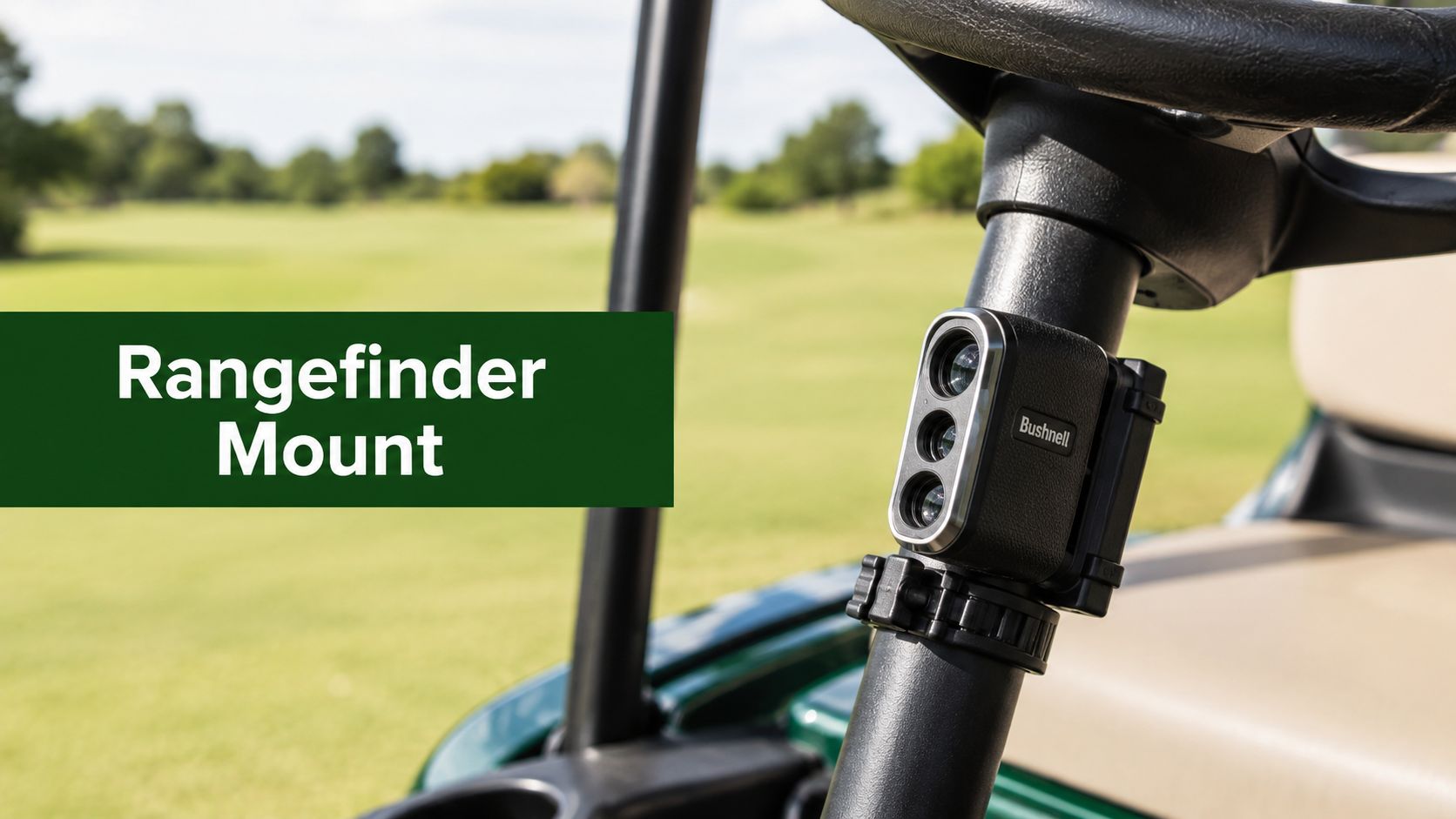
You pull up to your ball, glance at the flag, and then start the little routine most golfers know too well. Check the side pocket. Open the pouch. Pat the cart seat. Look in the basket. Your group is waiting, your rhythm is gone, and your rangefinder is either buried in the wrong spot or hanging by a weak magnet you don't fully trust.
That's why a good rangefinder holder for golf cart setups matters more than people think. It isn't just a place to stash a gadget. It keeps a valuable device close, protected, and easy to grab when you need a number fast. Done right, it also helps with the part most buyers forget to think about until it's too late. Not leaving the thing on the cart after the round.
Your Guide to a Secure and Accessible Rangefinder
A lot of golfers buy a rangefinder first and only think about storage after they get annoyed enough. That's usually after a few rounds of pocket digging, a near-drop on a cart path, or that sinking feeling when you realize you left your laser behind.
A holder fixes a simple but important problem. Your rangefinder needs a home. If it has one reliable place on the cart, you stop wasting motion and attention on finding it. You also stop treating an expensive piece of gear like a loose accessory.
What a good setup changes
On the course, small interruptions add up. Reaching into a bag zipper ten times a round doesn't sound like much, but it breaks your flow. The same goes for using a pouch that's secure but slow, or a magnet that's convenient but makes you nervous on rough terrain.
A well-placed holder helps in three ways:
- Access gets faster: You can grab the device, shoot the flag, and put it back without opening a case.
- Protection gets better: The rangefinder stays in one spot instead of sliding around with tees, ball markers, and whatever else lives in your cart.
- Your routine gets cleaner: When every tool has a place, decision-making feels simpler.
If you already think this sounds a lot like dialing in the rest of your cart accessories, that's because it is. The same logic applies whether you're mounting a laser or sorting out a phone holder setup for walking golfers.
Practical rule: The best holder isn't the one with the flashiest feature. It's the one you'll actually use every shot and notice before you leave the cart.
What to pay attention to
Most confusion starts with two questions. First, what kind of holder works with your cart? Second, where should it go so it's easy to reach and hard to forget?
Those are the questions that matter. Attachment style, fit, and placement all work together. A holder can be secure but awkward. It can be easy to reach but badly positioned for pack-up at the end of the round. The smart buy solves both problems at once.
Why a Dedicated Holder Is a Better On-Cart System
The moment most golfers realize a holder matters is not on the first tee. It is in the parking lot after the round, when they pat the seat, the basket, and their pockets and feel that awful jolt. The rangefinder is gone.
That is why a dedicated holder is more than a convenience add-on. It gives the rangefinder a home. And once a tool has a home, you are far less likely to leave it behind when the round gets rushed, the weather turns, or the cart gets swapped.
It reduces mental clutter
Golf already asks you to keep track of enough. Yardage. Wind. Club choice. Miss shape. Your rangefinder should not become one more loose item floating around the cart.
A holder works like the key tray by your front door. Put the device in the same place every time, and your brain stops spending energy on where it went. Over a full round, that small bit of order helps more than golfers expect. You pull up, grab the rangefinder, get the number, and return it to the same spot. The routine becomes automatic.
That matters for scoring, but it matters just as much for loss prevention.
It turns visibility into protection
Golfers often focus on whether a holder grips tightly enough. That matters, but visibility matters too. A rangefinder left in a cup holder or rear basket can disappear into the background of towels, drinks, scorecards, and trash. A dedicated holder keeps it out in the open, where it is easy to spot before you walk away from the cart.
I have found that the best setups do two jobs at once. They keep the device stable during the round, and they place it where your eye naturally catches it when you park the cart or head to the next tee. That is a smarter kind of security than raw grip strength alone.
The same logic shows up in other cart accessories. Good golf GPS holder setups for carts and push carts work because they keep the device both secure and obvious.
It protects an expensive piece of gear in ordinary moments
Rangefinders are not fragile because of one dramatic impact. They usually get beaten up by small, careless moments. Sliding around in the basket. Bouncing against a metal rail. Getting set on the seat for one shot and forgotten three holes later.
A holder cuts down those everyday risks. The device stays separated from tees, sand bottles, and whatever else is rolling around the cart. It also stays in a spot you can reach with one hand, which means you are less tempted to set it down somewhere temporary.
That last part gets overlooked. Temporary spots are where expensive golf gear disappears.
It makes your routine easier to trust
The best golf accessories are the ones you stop thinking about because they suit your habits. That idea applies to what matters in golf gear more broadly, and it applies here too. A dedicated holder should make the right action the easy action.
If you need to unzip, dig, reposition, or balance the rangefinder between shots, you will eventually cut corners. If the holder puts it in the same secure, visible place every time, you build a habit that protects both your pace and your wallet.
That is a key benefit. A dedicated holder does not just store your rangefinder. It helps make forgetting it less likely.
How to Choose the Right Rangefinder Holder
Buying the right holder gets easier when you stop thinking in terms of brands first and start with fit, attachment, and cart type. Most bad purchases happen because golfers choose by appearance or price, then discover the mount doesn't match their cart or their laser sits awkwardly.

Start with the attachment style
Rangefinder holders for golf carts generally use four mechanical attachment systems: magnets, straps, clips, or adjustable clamps, according to GoGoGo Sport's overview of holder designs.
Each style solves a slightly different problem.
| Attachment Type | Best For | Pros | Cons |
|---|---|---|---|
| Magnets | Metal cart surfaces and golfers who want quick on-off use | Fast access, simple setup, clean look | Can be less reassuring on rough terrain or with tricky surfaces |
| Straps | Push carts, steering columns, and odd-shaped mounting points | Flexible, cheap, works on many frames | Can look less tidy, may shift if poorly tightened |
| Clips | Golfers who want fast removal and reattachment | Convenient for repeated use, compact | Depends on clip strength and mount design |
| Adjustable clamps | Roof posts, frame tubes, and mixed cart designs | Secure fit, no reliance on magnet strength, often stable | Bulkier than simple magnetic options |
If you want the shortest version, magnets are convenient, clamps are usually confidence-inspiring, straps are versatile, and clips live or die by build quality.
Match the holder to your cart first
Buyers often get tripped up. A holder can be excellent and still be wrong for your setup.
The biggest blind spot today is compatibility with newer push-cart setups. The question of fit with non-standard push carts is still poorly answered in a lot of product content, even though user discussion points to a 35% rise in electric power-assist push carts that often don't have traditional mounting points for magnetic or adhesive holders, according to this discussion of electric power-assist cart compatibility.
That matters because many walking golfers now use lighter carts, power-assist add-ons, or frames with fewer obvious metal surfaces. If your cart doesn't offer a flat, ferrous spot in the right place, a magnet-only solution may disappoint you.
A few buying filters help:
- If you ride in standard golf carts often: Magnetic and clamp systems are usually the easiest starting point.
- If you walk with a push cart: Look closely at handle tubes, accessory tabs, and frame geometry.
- If you use an electric-assist setup: Favor universal brackets, strap systems, or clamp designs that don't depend on a perfect metal surface.
For a broader view of accessory fit and function, I like Dartee Golf's piece on what matters in golf gear. It frames a useful buying principle. Look for gear that solves a real on-course problem, not just gear that looks clever online.
Then confirm your rangefinder fit
A holder doesn't work if your device rattles, sits too deep, or needs two hands to remove. Therefore, universal-fit claims deserve a closer look.
One standout example is a universal holder engineered to fit major push and electric cart brands including MGI Zip, Clicgear, and Sun Mountain, with three precision-tuned sizes for devices from Bushnell, Nikon, Leupold, Precision Pro, Shot Scope, Garmin, and Blue Tees. It uses heat-resistant PETG construction, a Silicone Security Strap, and snap-fit geometry designed for differences among cart accessory mounts. It also supports standard rangefinders with a tripod screw hole and offers a custom option for unusual shapes through this universal holder listing with brand-specific fit details.
That tells you what to look for in any holder, even if you buy something else:
- Fit by actual device shape: Not just "universal" language.
- A retention feature: Strap, clip, or snug geometry that keeps the laser from bouncing out.
- Fast retrieval: A low front cut or open-top design makes a big difference during play.
- Cart-specific mounting logic: Especially important on MGI, Clicgear, Sun Mountain, and similar systems.
If a holder says it fits everything, check whether it mentions how it handles different cart mounts and different laser body shapes. That's where "universal" claims usually break down.
For golfers building out a more complete cart setup, it's also worth seeing how accessory locations interact. A GPS navigation holder guide for push carts can help you think through overall layout so your rangefinder doesn't end up competing with your phone, scorecard, or drink holder.
Installing Your Holder for Access and Prevention
Where you mount the holder matters almost as much as which holder you buy. A bad location can make a good product annoying. A smart location makes the holder feel natural by the second hole.

The best position does two jobs at once. It keeps the rangefinder within easy reach during the round, and it puts the device in your line of sight when you're unloading the cart after the round.
The three mounting spots most golfers consider
Steering column area works well for quick access. The downside is clutter. If you already have a phone mount, scorecard clip, or other accessory there, the whole area can get busy fast.
Side frame or roof support post is often the cleanest compromise on a riding cart. It keeps the laser handy without crowding the controls. It also tends to be visible when you stand up to leave the cart.
Rear basket or bag area is the worst location for loss prevention. It's out of the way, but that's exactly the problem. Gear that lives behind you is easier to ignore at the end of the round.
Install for your exit routine, not just your swing routine
A lot of golfers mount the holder where it feels best while playing and never consider the last thirty seconds of the day. That's when mistakes happen. You're talking, packing up, grabbing clubs, maybe heading inside for a drink. If the rangefinder isn't easy to see during that moment, you're relying on memory.
Best habit-builder: Mount the holder where your eyes naturally go when you reach for your keys, scorecard, or drink before leaving the cart.
A practical example is a universal mount that wraps around a golf cart roof support post and clamps directly onto it without tools, allowing the laser to be removed and clipped back in quickly, as shown in this roof-post mount demonstration.
A simple clamp-on setup that works
If your holder uses a clamp or post mount, this sequence keeps things simple:
- Sit in the cart first: Reach to a few likely spots and notice what feels natural.
- Pick a vertical support post or side frame point: Avoid any place that blocks controls or your leg room.
- Attach the mount snugly: It should feel firm without twisting when you remove the rangefinder.
- Test one-handed access: You should be able to return the device without looking down for long.
- Drive over a rough patch if possible: Better to discover movement now than on a cart path later.
A short visual makes that easier to picture:
If you're mounting accessories to a walking setup instead of a riding cart, a golf cart bracket guide for accessory positioning is useful for thinking through where support points exist and how much space each accessory needs.
One last check before you commit
Stand up as if the round is over. Grab your towel. Look toward your bag. Step away from the cart. If the rangefinder disappears from view during that motion, reconsider the spot.
That one test catches a surprising number of bad installations.
Clever DIY Solutions and Quick Fixes
Not every golfer needs a polished retail mount on day one. Some of the most reliable setups I've seen were built from parts already sitting in the garage or golf closet. The trick is making the fix secure enough that it doesn't become another source of worry.

DIY ideas that actually make sense
A heavy-duty hook-and-loop strap around a steering column or frame tube is one of the better low-cost options. Add a short lanyard or tether and you've got both quick access and a backup in case the strap loosens.
A foam-lined cup holder hack can also work if the fit is snug and the rangefinder sits upright. I wouldn't use this on a bouncy cart unless the device also has a secondary tether, but for calm riding conditions it can be surprisingly functional.
Then there are the golfer fixes that sound improvised because they are, but they come from real habits. In a discussion about never forgetting a rangefinder, golfers mentioned magnetizing the unit to the cart, using adhesive mounts, adding cable ties, or even attaching steel pieces to improve security. Others said the only foolproof method for them was always returning the device to the same designated place in the bag or cart, while some used reminders like storing car keys, wallets, or even a shoe in the case. One golfer said they bought the same Blue Tees rangefinder three times after misplacing it before changing habits, according to this thread on real-world anti-loss routines.
Quick fixes for store-bought holders
If your current holder is close but not quite there, a small tweak may solve it.
- Weak magnet problem: Add a better contact surface on the cart side if your frame material isn't giving the magnet a confident hold.
- Too much bounce: Add a secondary strap or tether. Even a simple silicone or hook-and-loop backup can settle your nerves.
- Awkward retrieval angle: Rotate the mount slightly so the eyepiece or grip side faces your dominant hand.
Good DIY doesn't mean cheap-looking. It means you solved the exact problem your cart and your rangefinder created.
The best homemade setup is the one that feels repeatable. If it takes fiddling every hole, keep tinkering.
Beyond the Mount A Habit for Never Losing Your Rangefinder
You finish on 18, toss your glove in the basket, chat for a minute in the parking lot, and then it hits you halfway home. The rangefinder is still on the cart.
That is how a lot of expensive devices disappear. The holder matters, but your routine matters just as much. A good setup should help you grab the rangefinder fast during the round and help you notice it before you walk away.

The mistake most golfers don't notice
Golfers rarely lose a rangefinder because it vanished from a secure holder. They lose it because the round ends, the conversation starts, and the usual visual reminder is gone.
The empty case is often the problem. If you stuff it in a side pocket or drop it in the rear basket, you remove the one object that could remind you the rangefinder is still sitting up front. It is the same reason players leave a wedge by the green. Once the cue disappears, memory gets shaky.
The better approach is simple. Mount the holder where you naturally look during play and during cleanup. Then keep the case somewhere visible enough to prompt a final check.
A routine that works when you're tired and distracted
Use the same sequence every round so it becomes automatic:
- Before the first tee, confirm the rangefinder is fully seated in the holder.
- After every shot, return it to that exact spot right away.
- Keep the empty case visible instead of burying it in a bag pocket.
- Place one must-have item in the case if that helps, such as your car keys.
- At the end of the round, check the holder first, then the seat, then the basket.
This works like a pre-shot routine. The point is not creativity. The point is repetition.
Small cues save expensive gear
A bright lanyard, a colored wrap, or a visible tag can help your eye catch the rangefinder during post-round cleanup. Playing partners help too. If your usual group knows your device lives on the right upright or beside the scorecard, someone may spot it before the cart staff does.
The holder protects the rangefinder during the round. Your habit protects it after the round.
If you want one rule to remember, use this one. Buy a holder that keeps the rangefinder easy to reach, install it where you will see it when unloading, and build a last-look habit around that location.
If you're building a walking setup and want to make your push cart easier to use without adding bulk or complexity, take a look at Caddie Wheel. It helps standard push carts handle the heavy work, which makes it easier to walk more holes comfortably while keeping your accessories organized and within reach.
Partager:
Best Cheap Golf Range Finders: 2026 Buyer's Guide
Electric Golf Trolley Accessories: A 2026 Buyer's Guide