Updated November 2026
Quick answer
A remote control golf caddy goes where you steer it with a handheld remote, while a follow-me caddy trails a handset clipped to your belt or pocket. Remote carts cost roughly $1,400 to $2,100 and give you precise control; follow carts are the most hands-free option but start around $2,400. If hills are your real problem, a power-assist wheel on your own push cart does the hard work for under $1,000.
Shopping for a remote control golf caddy usually leads to a second question fast: should you skip the remote and get a cart that follows you instead? Both promise a round without pushing 30-plus pounds of cart and bag up every hill, and both cost serious money. They behave very differently on the course, though, and the right choice depends on your terrain, your budget and how much you actually want to let go of the handle.
This guide explains how remote and follow-me electric golf trolleys work, where each one shines and struggles, what they cost in 2026, and when a simpler power-assist push cart is the smarter buy. Full disclosure: we make the Caddie Wheel, a power-assist wheel that clips onto your existing push cart. It is neither a remote-steered cart nor a follow cart, and we will be upfront about where those products beat ours.

Not every powered cart needs to steer itself. These push carts use a Caddie Wheel for drive while the golfers guide the handle.
What is a remote control golf caddy?
A remote control golf caddy is a fully electric cart, usually with three or four wheels and two motors, that you drive from a small handheld remote. Press forward and it rolls ahead; tap left or right and the motors change speed on each side to turn it; hit stop and it parks. Many can also be walked like a traditional electric trolley when you would rather keep a hand on the handle.
The appeal is control without contact. You can walk to your ball with nothing in your hands, send the cart toward the next tee while you finish putting, or steer it around a bunker from 20 yards away. Popular examples in the US include the Alphard Cybercart, the Axglo e3 Remote and the Motocaddy M7 Remote. In MyGolfSpy's 2026 electric push cart guide, remote carts took most of the top spots, with the Cybercart named Best Overall and the Motocaddy M7 GPS Remote finishing runner-up.
The trade-off is attention. A remote cart does exactly what you tell it, so you are the pilot for the whole round. On a flat parkland course that is easy. On a course full of side slopes, narrow bridges and water, you will be watching the cart as much as your ball.
How does a follow-me golf caddy work?
A follow-me caddy (also called a follow cart or follow trolley) tracks a small handset that you clip to your belt or keep in a pocket. When you walk, it walks; when you stop, it stops. It stays a few steps behind you at your pace, so you never touch a remote between shots. Most follow carts also include a remote mode for the moments when following is a bad idea.
The best-known model in North America is the Stewart Q Follow, which MyGolfSpy named its Best Follow cart for 2026. In Golf Monthly's review of the Q Follow, the tester describes it trailing at a safe distance, matching walking pace even on downhill slopes, and recommends switching to remote mode for things like narrow bridges. Other follow options include the Gozo Auto-Follow, which MyGolfSpy described as bulky and hard to transport, and the MGI AI Navigator Halo, which adds follow and obstacle avoidance through an optional Halo Eye accessory.
Follow mode is the closest thing to having a human caddie carry your bag. It is also the most expensive way to walk, and it asks you to think about where the cart will go when you walk somewhere a cart should not.
Remote control vs follow-me golf caddy: how do they compare?
Here is how the two hands-free styles stack up against each other and against a power-assist push cart, the third option most golfers end up considering.
| Factor | Remote control | Follow-me | Power-assist push cart |
|---|---|---|---|
| Who steers | You, with a handheld remote | The cart, tracking your handset | You, with the handle |
| Hands-free? | Yes, but you operate the remote | Yes, most of the time | No, hand on or near the handle |
| Typical US price | About $1,400 to $2,100 | About $2,400 to $3,300 | About $600 to $950 |
| Best terrain | Most courses, with care on side slopes | Open, walkable layouts | Hilly courses where pushing is the pain point |
| Attention needed | High: you pilot every move | Medium: switch modes near hazards | Low: it goes where you walk it |
| Keeps your current cart? | No, it is a new cart | No, it is a new cart | Yes, with a clip-on wheel |
| Example models | Alphard Cybercart, Axglo e3 Remote, Motocaddy M7 Remote | Stewart Q Follow, Gozo Auto-Follow | Caddie Wheel (ours), MGI E-Boost |
The short version: remote carts trade money for control, follow carts trade more money for freedom, and power-assist carts trade the hands-free experience for a much lower price and a simpler routine.
Which works better on hills, slopes and tight spots?
Terrain is where the differences really show. A few patterns hold across brands:
- Steep climbs. Twin-motor remote and follow carts climb well on their own. A power-assist wheel also handles climbs, with you guiding the handle, which many golfers find reassuring on the steepest pitches.
- Side slopes. This is the weak spot for any cart running without a hand on it. MyGolfSpy's buying advice warns that most carts risk tipping on side slopes and recommends avoiding reversing downhill. Owners of some remote carts, such as the Cybercart, point to built-in stability control and downhill speed control as a real help.
- Bridges, narrow paths and water. Follow mode is designed to stay behind you, but if you step onto a narrow bridge or along a lake edge, the cart will try to come too. That is why follow cart reviewers, including Golf Monthly's, recommend remote mode in those situations.
- Greens and tees. No cart belongs on a green or a tee box. With a remote cart, you park it on the path side of the green. With a follow cart, you switch off follow before you walk onto the putting surface. With a push cart, you simply leave it where you would leave any trolley.

Lakes, bridges and side slopes are where you want the most direct control over any electric caddy. Photo: Patrick Konior on Unsplash
If your home course is flat and open, a follow cart can feel magical. If it is tight, hilly and full of water, many golfers find a remote cart, or a cart they guide by hand, less stressful. Our list of the most hilly golf courses in North America gives a sense of the kind of terrain where that difference matters.
How much does a remote control golf caddy cost compared with a follow cart?
Price is the clearest dividing line. Using the US prices listed in MyGolfSpy's 2026 guide, a remote control golf caddy like the Alphard Cybercart sits at $1,379, the Axglo e3 Remote at $1,449.99 and the Motocaddy M7 Remote at $1,699, with the GPS version at $2,099. The Stewart Q Follow is listed at $2,800, and Golf Monthly's review shows US list prices from $3,049 to $3,349 for its versions before discounts.
On the power-assist side, the MGI E-Boost was MyGolfSpy's Best Value pick at $599, and our Caddie Wheel is $749 regular price with the bracket kit for your cart included. Here is where each one wins, honestly:
- Follow carts win if you want to walk completely hands-free and the budget is there.
- Remote carts win if you want hands-free walking with more control, and you are happy buying a whole new cart.
- The MGI E-Boost wins on lowest price for a power-assist cart, if you are fine replacing the cart you own.
- The Caddie Wheel wins if you already have a push cart you like and want to take the effort out of hills without buying a new cart.
Want the hills handled without paying for a robot?
The Caddie Wheel clips onto the push cart you already own and powers it up every climb, with a 4-speed remote and 36+ holes per charge. It is $649 during our Black Friday sale, through December 1 (regular $749), and the Clicgear 4.5 + Caddie Wheel bundle is $849 (regular $949).
Is there a middle ground between remote and follow carts?
Yes, and for a lot of walkers it is the one that makes the most sense. A power-assist push cart keeps the familiar routine of walking with your cart, but a motor does the pushing. You are not trying to steer from 20 yards away or trusting a sensor near a pond. You just stop straining on the climbs.
That is the job the Caddie Wheel was built for. It is a 15 lb (6.8 kg) drive wheel that clips onto your existing push cart through a cart-specific bracket kit. It drives straight ahead at one of four speeds set on a small remote, and you guide the handle to steer. To be clear about what it is not: it has no follow mode and it does not steer itself. If those are must-haves, a dedicated remote or follow cart is the right tool, and our electric golf push cart buyer's guide covers the main models.

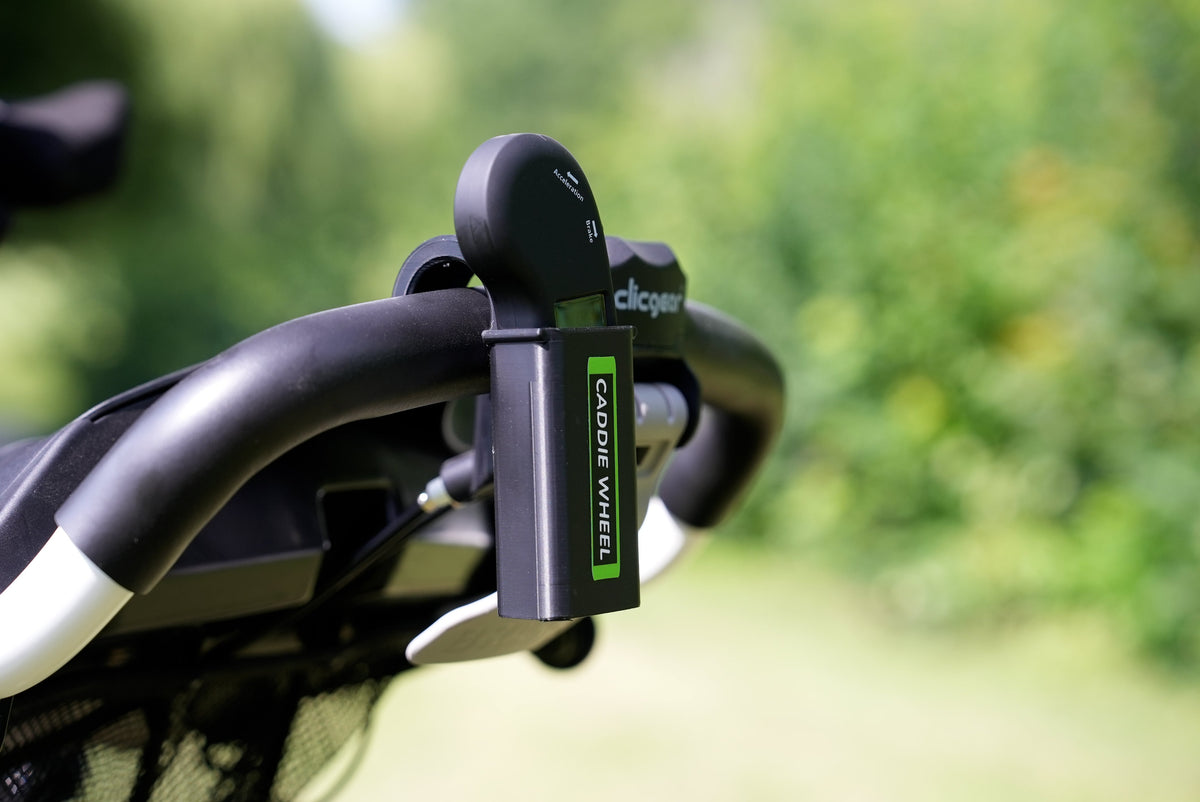
The Caddie Wheel's remote sets speed, reverse and brake. It does not steer: your hand on the handle does that.
What you get in return:
- Your own cart. The Caddie Wheel fits dozens of popular models from Clicgear, Bag Boy, Big Max, CaddyTek, Sun Mountain and more. Check the compatible carts list for yours. If you are not sure what fits, our guide to which golf push carts can be motorized walks through it brand by brand.
- Range. 36+ holes per charge, with a battery rated for about 400 charge cycles.
- Light, separate pieces. Remove the wheel before folding the cart, and you lift a 15 lb wheel and your usual cart instead of one heavy electric chassis.
- Support. A 12-month warranty and free help with your first install, with a technician available if you need one.
The honest limits: the battery is water-resistant and fine in light rain, not downpours, and you do have a hand on the cart. Golfers who want to stroll down the fairway with their hands in their pockets should buy a follow cart.
Which type should you choose? A 5-step decision guide
- Decide how hands-free you really want to be. If the dream is walking with nothing in your hands, you are choosing between remote and follow. If the real problem is tired legs on the back nine, a power-assist cart solves it for much less.
- Look hard at your home course. Lots of side slopes, narrow bridges and water favor a remote cart or a hand-guided cart. Open, rolling parkland suits follow mode best.
- Set a budget that includes the extras. Remote carts start around $1,400 and follow carts around $2,400 before accessories. A power-assist wheel for the cart you own is under $1,000.
- Think about your car and your back. Full electric carts are heavy to lift into a trunk; MyGolfSpy notes the Gozo Auto-Follow is hard to transport. A clip-on wheel splits the load into two lighter lifts.
- Try before you commit if you can. Ask golfers at your club what they use, read owner reviews, or talk to a Caddie Wheel user about a power-assist setup.
Common mistakes when choosing between remote and follow carts
- Paying for follow mode you will rarely use. If your course has a lot of hazards and tight paths, you may spend half the round in remote mode anyway.
- Ignoring weight and folded size. A cart that is a struggle to get in and out of the car is a cart that stays in the garage.
- Forgetting free-wheel mode. MyGolfSpy recommends learning how to push your cart manually before the first round, in case the battery runs flat.
- Letting any cart run unattended on side slopes. Keep remote carts close and slow on slopes, and switch follow carts to remote near hazards.
- Not checking battery range against how you play. If you play 36 holes, choose a battery rated for it. Heavier bags and hilly courses use more charge.
- Buying a whole new cart when you like the one you have. If your push cart is in good shape and hills are the only issue, adding power is usually cheaper than replacing it.
Still weighing it up? Our guide to walking a golf course like a pro covers pacing, packing and routine, whichever cart you choose.
Frequently asked questions
What is the difference between a remote control golf caddy and a follow-me caddy?
A remote control golf caddy moves only when you steer it with a handheld remote. A follow-me caddy tracks a handset on your belt or in your pocket and trails behind you automatically, stopping when you stop. Most follow carts also have a remote mode, so they can do both, but they cost noticeably more.
Are follow-me golf carts worth the extra money?
They can be if you want the most hands-free round possible and play open, walkable courses. On tight layouts with water, bridges and side slopes, you will often switch to remote mode anyway. If that describes your course, a remote cart or a power-assist push cart may give you most of the benefit for far less.
How much does a remote control golf caddy cost?
In MyGolfSpy's 2026 guide, popular remote carts range from about $1,379 for the Alphard Cybercart to $1,699 for the Motocaddy M7 Remote and $2,099 for the M7 GPS Remote. Follow carts like the Stewart Q Follow are listed around $2,800. Power-assist options start near $600.
Do follow-me golf caddies work on hilly courses?
Yes, good follow carts climb hills and control their speed downhill. The bigger challenge is side slopes and hazards, where a cart running without a hand on it can tip or roll somewhere it should not. Reviewers recommend switching to remote mode on narrow bridges and near water.
Can the Caddie Wheel follow me or be steered by remote?
No. The Caddie Wheel is a power-assist wheel that drives your push cart straight ahead at one of four speeds set on its remote, and you guide the handle to steer. It has no follow mode and does not steer itself. If you need either feature, a dedicated remote or follow cart is the better choice.
How far will a remote or follow golf caddy go on one charge?
It depends on the battery, the course and your bag. Golf Monthly's tester comfortably got 36 holes from a Stewart Q Follow, even on hilly courses. The Caddie Wheel is rated for 36+ holes per charge. For any other cart, check the maker's rating, and remember that heavy bags and steep courses shorten range.
Keep your push cart and let the motor climb the hills
The Caddie Wheel turns the push cart you already own into an electric caddy: 4-speed remote, 36+ holes per charge, bracket kit included, 12-month warranty and free first-install support. Rated 4.8/5 by 500+ golfers and made in Montreal. It is $649 during our Black Friday sale, through December 1 (regular $749), and the Clicgear 4.5 bundle is $849 (regular $949).
Partager:
Best Gifts for Walking Golfers: 2026 Gift Guide