
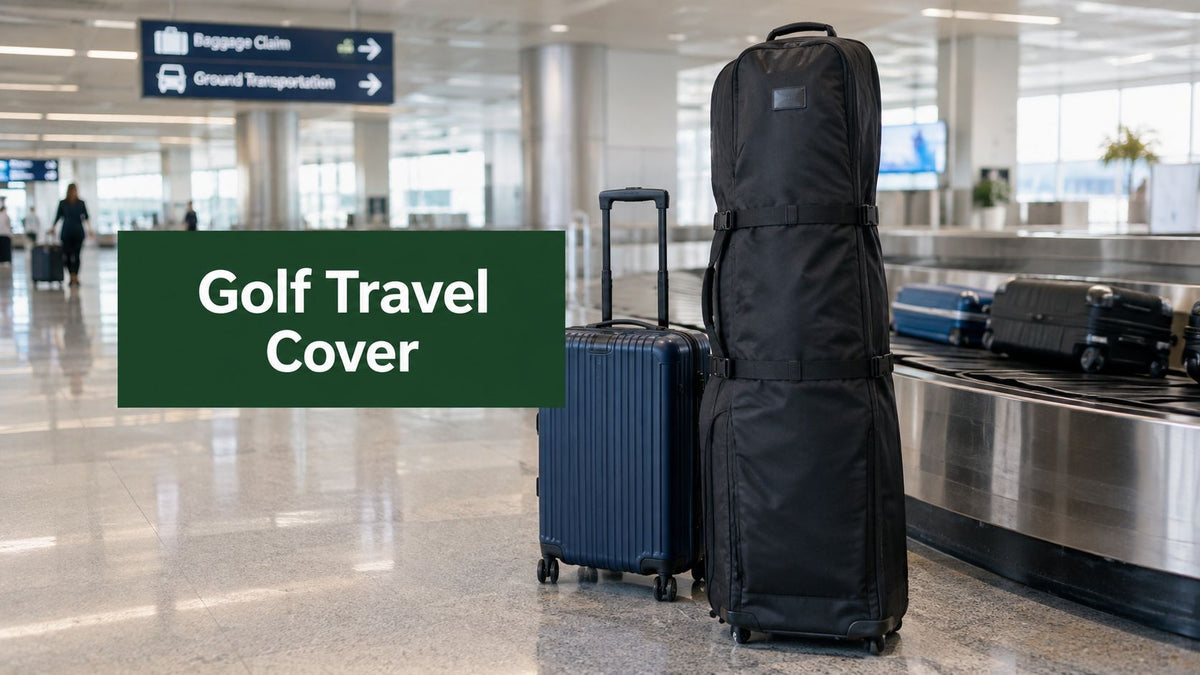
You're standing at the airport baggage desk with your golf clubs beside you, watching the scale climb as the agent asks whether the case contains anything besides sporting equipment. The clubs are protected, but the case itself is heavy, awkward in the rental car, and expensive to replace if the airline damages the contents. That's the decision behind choosing a travel cover for golf bags.
A cover isn't just padding around your golf bag. It affects checked-baggage weight, crush resistance, airline liability, terminal mobility, and storage at your destination. The right choice depends on how often you fly, what your equipment is worth, which routes you take, and whether you'll need to fit the case into a trunk or shuttle after landing.
| Attribute | Hard Shell Cases | Soft Sided Covers |
|---|---|---|
| Empty weight | Typically heavier, often 10 to 15 lb or more in independent testing | Commonly around 6 to 10 lb empty |
| Crush resistance | Strongest protection against external compression | Relies on padding, structure, and careful packing |
| Wheels | Premium designs may use four-wheel systems | Two skate wheels are common |
| Storage | Bulky unless designed to fold | Usually folds or compresses more easily |
| Airline allowance | The case consumes more of your weight limit | Leaves more allowance for clubs and clothing |
| Best fit | Valuable clubs, long-haul routes, frequent baggage handling | Domestic trips, tight allowances, limited storage |
Why Your Golf Travel Cover Choice Matters More Than You Think
At baggage drop, the case already affects your trip before a single club goes inside. A soft cover may roll easily and leave room for shoes or clothing, while a rigid case can consume a large share of the checked allowance. That difference becomes uncomfortable when the packed bag approaches the airline limit and you are repacking beside a queue.
The hidden trade-off is weight. A case weighing 10.5 lb paired with a golf bag weighing 9 kg leaves less room for accessories under a 23 kg allowance. A lighter cover preserves capacity, but may provide less resistance when luggage is stacked on top. Empty-case weight also matters after landing, when the case must fit a rental-car trunk, hotel storage area, or shuttle compartment.
The costs extend beyond the airport
A cover can shield clubheads from impact, but it cannot solve every travel problem. A full hard case may be difficult to fit into a compact rental car, awkward to carry through a hotel, and inconvenient to store in a room. A soft-sided design usually handles those transitions more easily, while offering baggage handlers less rigid structure when other luggage lands on top.
Airline liability creates another gap. Reimbursement for damaged equipment may fall well below the cost of replacing a modern set, particularly when it includes expensive woods, shafts, or electronics. The cover is therefore part of your risk management. It cannot guarantee compensation, but it can reduce the chance that pressure and impact reach the clubs.
Practical rule: Choose protection for the worst realistic handling your clubs will face, then confirm that you can still lift, move, and weigh the packed case comfortably.
The decision also includes logistics that buying guides often overlook. A bulky shell may protect better in a cargo hold, yet become a daily nuisance once you are driving between courses. A lighter soft cover may suit short domestic trips, especially when storage and baggage limits matter more than maximum crush resistance.
Flexible cushioning follows the same practical principle used in other protective packaging. wholesale padded bags for retailers show how padding and flexible materials can protect contents without a rigid outer shell. For golf travel, that approach works only when the cover is packed carefully and the vulnerable clubheads are secured.
The useful question is not “Which cover is best?” It is “Which compromise creates fewer problems on my trips?” Frequent flyers with limited storage may choose low weight every time. Golfers carrying high-value clubs on long international itineraries may accept extra bulk and weight to reduce crush risk. In both cases, check the packed weight, not only the advertised empty weight.
Hard Shell Versus Soft Sided Travel Covers Compared
Hard-shell and soft-sided covers protect golf clubs in different ways. A hard shell resists external pressure by holding its shape. A soft cover absorbs movement through fabric, foam, padding, internal straps, and the way you arrange the clubs. Neither construction is automatically right for every golfer.
Independent 2026 testing places many soft-sided models around 6 to 10 lb empty, while hard-shell models commonly weigh 10 to 15 lb or more. The same testing noted that the Club Traveler weighed 10.5 lb, lighter than many competitors while retaining stronger material durability, as reported in Independent Golf Reviews' golf travel-bag testing. The operating principle is straightforward. Lighter covers reduce handling strain and leave more room under airline limits, while heavier cases generally provide more resistance against crushing.
Protection, wheels, and storage
A full shell is most valuable when the bag will face repeated stacking, pressure, or rough transfers. Hard plastic or composite walls distribute force across the case instead of letting that force reach the clubheads and shafts directly. A hybrid cover, such as a rigid top joined to a fabric body, can protect the vulnerable upper section while avoiding the full weight and storage burden of a molded case.
Wheel architecture changes the experience at the airport. A structured comparison of tested bags found four-wheel systems around 11.3 lb, hard cases with TSA locking systems around 18.16 lb, and soft covers with two skate wheels around 6.6 to 10.6 lb, according to Critical Golf's travel-bag testing methodology. That comparison places the usual convenience penalty at roughly 2 to 8 lb for more advanced wheel systems and stiffer constructions.
| Attribute | Hard Shell Cases | Soft Sided Covers |
|---|---|---|
| Protection | Best against crush loads and hard external impacts | Better for lighter handling and flexible packing |
| Weight | Often consumes a meaningful part of the allowance | Usually leaves more capacity for golf accessories |
| Wheel design | More likely to support upright multi-wheel movement | Commonly uses two in-line or skate wheels |
| Vehicle loading | Can be difficult in small trunks | Compresses more easily around other luggage |
| Home storage | Needs dedicated space unless collapsible | Easier to fold and store |
| Loading method | Holds its shape, but may be less forgiving with oversized bags | Easier to open wide and accommodate different bag shapes |
Where each type works best
Choose a hard shell when the equipment value and handling risk outweigh the inconvenience of weight. That's particularly relevant for long itineraries, multiple connections, or a set you couldn't comfortably replace.
Choose a soft-sided cover when you fly regularly with strict baggage limits, drive directly to the course, or need the case to fit into shared transport. A quality soft cover still needs a strong base, dependable zips, internal restraint, padded clubhead protection, and a stiff-arm style support rod where appropriate.
For a closer look at related waterproof protection, see this guide to waterproof golf bag covers. Waterproofing helps with rain and wet baggage areas, but it doesn't turn a soft cover into a crush-proof case.

Airline Rules and Weight Limits That Shape Your Decision
Your airline's baggage rules can decide whether a travel cover is practical before protection even enters the discussion. Check the carrier's weight limit, dimensions, included equipment, and damage liability before buying. A case that protects clubs well can still create a costly check-in problem if its own weight pushes the packed bag over the allowance.
British Airways permits golf equipment in a protective golf bag or hard case as one checked-baggage item when the ticket includes checked baggage. Its definition of a full golf set covers the clubs, one golf bag, and one pair of golf shoes, with a maximum weight of 23 kg or 50 lb, according to the British Airways sports-equipment policy.
Delta permits one checked golf bag containing one golf bag, one set of clubs, golf balls, tees, and one pair of golf shoes. Its policy says bags over 50 lb incur the applicable excess-weight fee, and equipment exceeding 115 linear inches, calculated as length plus width plus height, will not be accepted. Check the current details in Delta's sporting-equipment policy.
Why the empty case deserves its own calculation
The cover's empty weight can consume a meaningful part of the allowance before you add clubs, shoes, towels, or rainwear. Hard-shell models may weigh from around 3.08 kg to 8.4 kg, while many airlines set sporting-equipment limits at 20 kg or 23 kg, as outlined in The Golf Shop Online's hard-case cover guide.
Weigh the complete setup at home. Include the travel cover, support rod, accessories, and anything placed in external pockets. If the total is close to the limit, remove nonessential items first. Clothing can provide padding, but using the case as a general suitcase makes the weight calculation harder and leaves less room for the equipment that needs protection.
Trunk space creates another trade-off. A rigid case may occupy more room in a rental car or airport transfer vehicle, especially when several passengers bring luggage. A lighter, more compressible cover can fit shared transport more easily, but it may shift more responsibility to the internal packing and support system.
Liability changes the protection calculation
Under the Montreal Convention, international liability for checked baggage is capped at around 1,288 SDR, roughly $1,700–1,900 depending on the exchange rate. The exact amount and exclusions depend on the carrier's contract of carriage, so confirm those terms before relying on airline reimbursement. That ceiling can sit well below the replacement cost of high-value clubs, shafts, and accessories.
Before you fly: Photograph the clubs, bag, and cover before check-in. Keep receipts or ownership records for valuable equipment, and read the airline's claim exclusions before assuming damage will be reimbursed.
If your route involves rough handling or your equipment costs more than likely airline liability, a stronger case may justify its added weight and storage demands. If you would rather avoid checking a bulky case, compare the dimensions, insurance terms, collection process, and delivery timing of shipping bags internationally with the airline option.

How to Pack Your Golf Travel Cover for Maximum Protection
A good cover can't compensate for loose clubs moving inside it. The packing routine should keep the clubheads from striking one another, prevent shafts from shifting, and place soft padding where pressure is most likely to reach the equipment.
The empty case also matters. A heavy construction leaves less room for clubs and clothing, so weigh the case before packing and decide how much of the airline allowance it has already used. Pack only what you need inside the golf case, then move ordinary travel items to another bag if the total becomes borderline.
Use this loading sequence
- Measure the longest club first. Confirm that the travel cover accommodates the full length without forcing the shaft or grip against the closure. A case that closes under tension can transfer pressure to the clubheads.
- Remove detachable wood heads where practical. Place the head in its protective cover and position it so it can't rattle against other equipment. If you carry the head separately, keep it with you only when the airline and security rules permit it.
- Arrange the clubs to limit movement. Put the longest clubs into the bag first, then fill the remaining spaces with shorter clubs. Keep headcovers on woods, hybrids, and the putter, and avoid leaving empty pockets where clubheads can swing into one another.
- Install a support rod or stiff-arm. The rod should extend above the clubheads and take pressure from the top of the cover rather than allowing a downward impact to load the shafts. Tighten the bag's internal restraint so the golf bag can't slide from end to end.
- Use clothing as controlled padding. Towels, a shirt, or soft clothing can fill gaps around the clubheads and sides. Don't pack hard shoes, electronics, tools, or valuables beside the clubs, and don't use the cover as a second suitcase unless the airline expressly allows the contents.
- Close every restraint before weighing. Zip the main compartment, tighten external straps, check the wheel and handle areas, and lift the finished case by its main handle. If the contents shift audibly, open it and repack rather than hoping the outer shell will solve the problem.
For a more detailed club arrangement routine, follow this guide on how to pack a golf bag.

The ground journey deserves the same attention. Independent golf guidance warns that hard plastic “coffin” covers take up far more room, while soft covers fit more easily in car trunks and bus underbellies, as described by Pioneer Golf's travel-cover guidance. A cover that fits the aircraft but won't fit the rental car can create a problem every day of the trip.
Before departure, check the trunk opening, not just the available interior volume. A long rigid case may fit diagonally in a large vehicle but fail to pass through the opening of a smaller one. Soft-sided covers have more forgiveness, while collapsible hard designs offer a compromise if you need a rigid structure during transit but limited storage afterward.
Matching Your Travel Cover to Your Trip Type and Frequency
Your travel pattern should determine the cover, not the logo on it. A golfer flying twice a month on short domestic routes has different priorities from someone taking one international holiday with a new set of clubs. Frequency, route complexity, equipment value, and ground transport all affect the right choice.
Frequent domestic flyer
A frequent domestic traveler will usually get more value from a lighter soft-sided or hybrid cover. Every flight makes empty-case weight, terminal carrying, and vehicle storage more relevant. A 9 kg soft case leaves roughly 3 kg more baggage allowance than a 12 kg hard shell on each trip, provided both packed setups meet the airline's limits. Across repeated flights, that difference can determine whether clothing or accessories stay in the main bag.
Choose reinforced clubhead protection, internal compression straps, a durable base, dependable wheels, and padding where shafts and heads can take impact. Also check the case length against your usual car. A cover that saves weight but cannot fit through a rental car's trunk opening becomes a daily inconvenience.
Occasional international traveler
A golfer taking a long international itinerary can justify a heavier hard shell more easily. Multiple transfers and longer handling chains increase the value of crush resistance, particularly when the clubs are expensive to replace. Airline liability limits may still leave part of the loss uncovered, so protection should match the equipment's replacement cost rather than the ticket price.
The trade-off is storage and baggage allowance. A rigid case may protect better against compression, yet its empty weight consumes allowance before the clubs, golf bag, or clothing go in. Confirm the airline's current rules and weigh the complete packed case at home.
Annual golf-trip traveler
An annual traveler can prioritize storage and budget because the cover spends most of the year unused. A collapsible semi-rigid model or reinforced soft case may provide enough protection without requiring permanent garage space. If the trip includes a valuable new set, accept more bulk if that case gives better protection through transfers and rough handling.

Car, shuttle, and rental logistics
Ground transport can change the decision. A large rigid cover may fit an airport trolley but fail at the rental car, shuttle, or hotel storage area. Measure the trunk opening, not only the interior volume. Soft-sided covers tolerate awkward loading, while collapsible hard designs offer a middle option when transit protection matters but storage space is limited.
Use this golf clubs carrier guide to plan movement between airport, vehicle, hotel, and course. The strongest case is not automatically the most practical choice if its weight reduces your allowance and its shape creates problems at every stop.
Traveling with Push Cart Accessories and Motorized Add-Ons
A golf travel cover must accommodate more than the bag when you travel with a push cart. Folded frames, wheel assemblies, brackets, batteries, chargers, and accessory mounts can quickly occupy space that the cover wasn't designed to hold.
Start by separating the equipment into three groups: items that belong inside the golf-bag cover, items that need their own protective bag, and items that should travel in carry-on luggage. Clubheads and shafts need the main protective compartment. A motorized wheel unit should only go inside that case if the manufacturer's dimensions and packing guidance allow it, and only if it can't press against the clubs.
Check fit before the airport
Measure the folded push cart and compare it with the cover's internal length, width, and opening. Don't assume that an expandable pocket can safely carry a rigid frame or motor. Check the combined packed weight as well, because the cover's empty weight, golf bag, clubs, cart components, and clothing all count toward the airline allowance.
Caddie Wheel uses a drop-on design and snap-in bracket for attaching motorized assistance to compatible standard push carts. Its product setup includes a separate carry bag for storing and transporting the Caddie Wheel itself, so treat the motorized wheel as a distinct piece of travel equipment rather than forcing it into the club compartment.
Protect the motor, bracket, and charger from impact and moisture, and keep small removable parts together in a labeled pouch. If the airline treats the cart or motorized unit as a separate checked item, confirm the carrier's rules before arriving at the airport. A cover that protects clubs well may still be the wrong container for a folded cart.
Situational Recommendations for Every Type of Golf Traveler
Frequent domestic flyer: Choose a lightweight soft-sided or hybrid cover with a reinforced clubhead area, compression straps, and dependable wheels. You'll save allowance and gain easier storage, provided you pack carefully.
International traveler with valuable clubs: Accept the weight of a rigid or semi-rigid case when crush resistance matters more than trunk space. The protection decision is stronger when airline liability could fall below replacement cost.
Budget-conscious golfer: A durable soft cover with clubhead padding and a stiff support rod can work for occasional trips. Don't pay for a full shell if your routes, equipment value, and storage constraints don't justify it.
Push-cart user: Select a cover with enough external capacity for accessories, then transport motorized components separately when their shape or weight makes the club case unsafe. Measure the folded equipment before booking.
Golfer with mixed travel habits: Owning a lightweight soft cover for short trips and a hard case for longer journeys can be more practical than forcing one design to handle every situation. The extra flexibility helps you choose protection according to the route rather than carrying maximum bulk every time.
Caddie Wheel offers a compact motorized power-assist option for compatible three- and four-wheel push carts, with a separate carry bag for transport. If you want to coordinate your walking setup with a practical travel cover and reduce the effort of moving your cart between course and vehicle, visit Caddie Wheel to review the system.
Partager:
Cart Golf Push Guide to Smarter Walking Rounds
8 Compatibility Test Questions for Golf Push Carts