
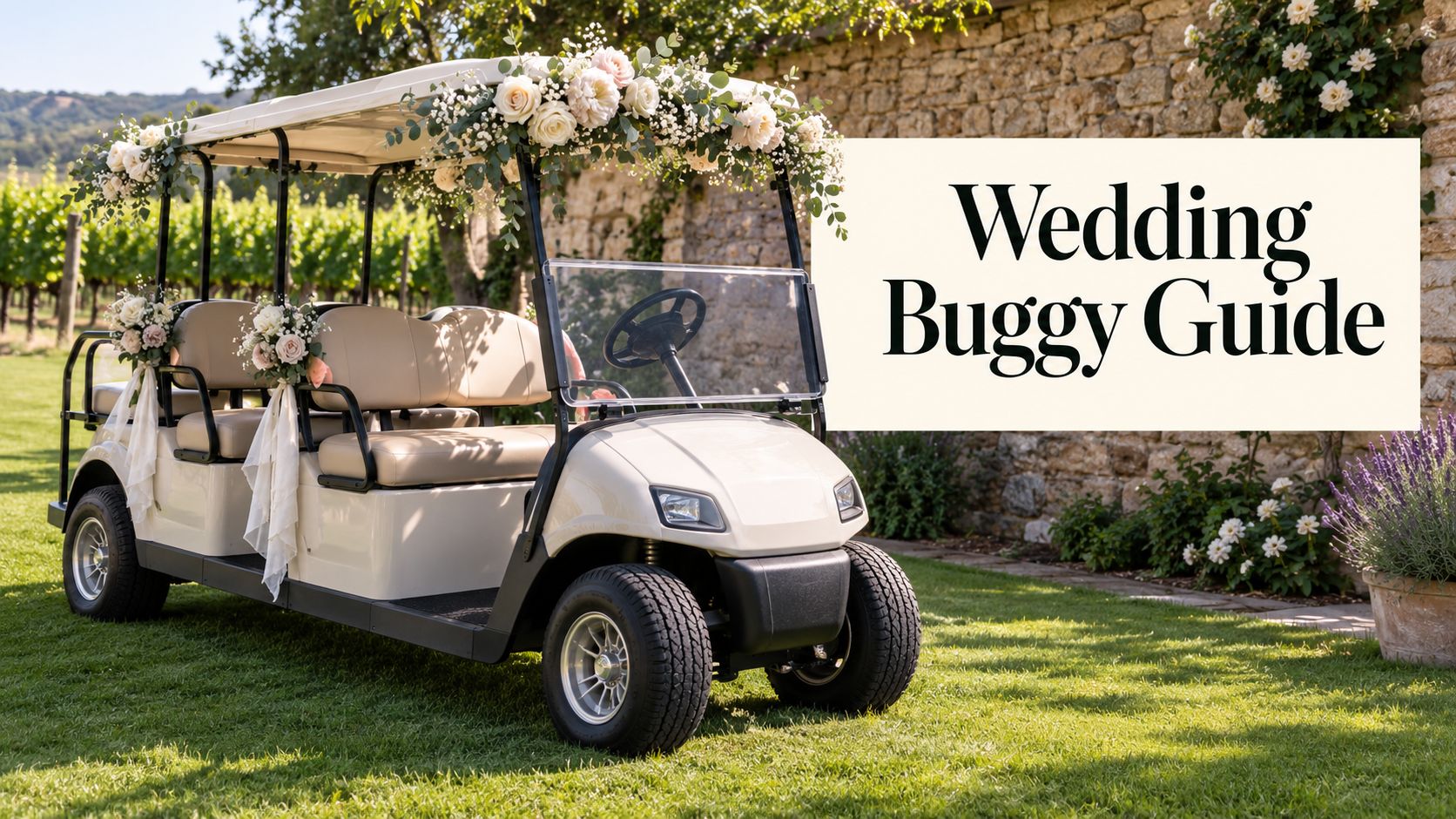
You're standing on a property that looks beautiful on paper and slightly chaotic in real life. The ceremony lawn is farther than people expect, the reception entrance is on the opposite side of the venue, and someone has already asked how Grandma is supposed to make it in formal shoes. That is exactly when a wedding golf buggy stops being a cute add-on and becomes the thing that keeps the day moving.
Treat it like transport first, décor second. If you get the route, the terrain, and the staffing right, the buggy solves the hard parts of the day without calling attention to itself. If you choose it for looks only, it becomes one more thing for your team to manage.
Why a Wedding Golf Buggy Is a Logistics Decision First
A wedding golf buggy earns its place when the venue is large, the walk is awkward, or the timeline is tight. I've seen it used well at estate weddings, golf course weddings, vineyard properties, and resort venues where the ceremony, cocktail hour, and reception sit in different corners of the property. In those settings, the buggy is not about making an entrance. It's about keeping people comfortable, on time, and off their feet.
The best planning starts with a walkthrough, not a mood board. I want to know where the ceremony starts, where elderly guests will park, which route the photographer needs, and whether the bridal party has to move between three spots in formal wear. That is the core job. A vehicle can look polished in photos, but the win is when grandparents arrive without strain and the wedding party stops losing five minutes every time they move.
What the buggy is actually doing
Use it to solve specific problems, not general wishes. It can move mobility-limited guests, help a photographer hop between portrait locations, and keep bridal-party timing from slipping when the venue layout is spread out. It also helps when the venue has staff parking away from guest areas, because you can move people without sending everyone on foot through the same route.
Practical rule: If the route matters more than the styling shot, the buggy is worth it.
For a useful planning comparison on guest movement, how shuttles keep guests happy is a strong reminder that transport decisions are really guest-experience decisions.
The long commercial history of these vehicles explains why they work so well now. Golf carts were first used in the 1930s, stayed closely tied to accessibility through the 1950s, and later became standardized, mass-produced transport rather than a novelty. A 2021 forecast projected the golf cart and buggy market would grow at a 4.6% CAGR from 2021 to 2026, with one-four-seater golf carts expected to exceed 549,000 units by 2026 in that projection, which helps explain why venue transport is now a mature category, not a specialty gimmick (market forecast).
Matching the Buggy to Your Guest List and Venue Terrain
Start with the people, then the ground they need to cross. A buggy that looks fine on paper can turn awkward once you factor in older guests, mobility needs, bridal-party bags, and the actual route between parking, ceremony, and reception. Guest count, distance, surface type, and accessibility needs decide whether the buggy earns its place.

If the venue has a long flat run from parking to ceremony, a buggy is a smart move for older relatives and anyone who should not be walking in formalwear. If the layout is compact, with short distances and no meaningful slope, leave it alone. A buggy is worth using when it removes friction from the schedule and the walk, not when it adds one more vehicle to manage.
The buggy does
Use it to solve a real transport problem. A buggy can move mobility-limited guests, carry a photographer between portrait spots, and keep the bridal party on time when the venue is spread across a wide property. It also helps when staff parking sits away from guest areas, because people can be moved without sending everyone down the same path on foot.
Practical rule: If the route matters more than the styling shot, the buggy is worth it.
Grass is where the decision gets serious. A manicured lawn can still be soft after rain, and a buggy that rolls well on pavement may bog down on turf. Gravel and crushed stone usually behave better than wet grass, but narrow paths make turning harder. Steep slopes are the clearest test, because the vehicle has to carry passengers and gear without losing control.
Plan your golf wedding here helps you judge how a golf-property layout changes transport needs. Venue shape matters more than décor packages.
A compact venue makes buggy use feel optional. A spread-out estate makes it feel obvious.
How to make the call
Use this filter before you book anything:
- If guests must cross uneven ground, put accessibility first and map the buggy route before styling.
- If the ceremony and reception are far apart, stage the buggy as part of the timeline.
- If the paths are narrow or the turns are tight, choose maneuverability over seat count.
- If the venue already has transport rules, follow those before you decide how many passengers you want to carry.
For a visual planning reference, An infographic titled Match Your Buggy outlining four key factors for choosing wedding transportation vehicles. shows the main factors to weigh, and plan your golf wedding here gives you another way to assess which property type makes a buggy useful.
Renting Versus Buying a Wedding Golf Buggy
Renting is the right answer for most couples. It keeps the decision simple. The supplier drops off a charged, cleaned vehicle, and you aren't left storing it, charging it, maintaining it, or wondering what to do with it after the wedding. Buying only makes sense when the buggy will keep getting used on the same property or by the same household within a fairly short window after the event.
That's why I tell couples to think in terms of frequency, not fantasy. If this is a one-day transport problem, rent. If the buggy will be used again for estate work, guest transport, or ongoing family use, ownership starts to make sense. Anything else turns into a storage headache, and nobody wants a wedding purchase that turns into an expensive garage ornament.
The real trade-off
A rental from an events supplier usually brings one huge advantage, convenience. You're not chasing charging access, spare parts, or insurance paperwork. You also get more styling freedom because you can choose a vehicle that fits the venue rather than settling for the one you happen to own. If you want more examples of polished event hire choices, elegant event rental ideas can help you think in terms of the full guest experience instead of one object.
Buying adds control, but it also adds admin. You need storage, charging, servicing, and a plan for resale or long-term use. That matters only if the vehicle is going to earn its keep more than once.
| Factor | Renting | Buying |
|---|---|---|
| Cost | Lower upfront commitment | Higher upfront commitment |
| Effort | Supplier handles delivery and prep | You handle storage and maintenance |
| Flexibility | Easy to match the venue and day | Best only if you'll reuse it |
| Styling freedom | High, within supplier options | High, but you own the logistics |
| Best fit | Most weddings | Repeat use on the same property |
The clean takeaway is simple. Rent for a wedding. Buy only when you already know the buggy will have a real life after the cake is cut.
Permissions, Insurance, and Venue Rules to Lock Down Early
This is the unglamorous part that saves the day. Before you book anything, get the venue's buggy policy in writing. Some properties allow transport only on certain paths, during certain hours, or with specific drivers. Others ban guest-driven carts entirely, even if staff use the same roads. Don't assume anything because the course has buggies on-site.
Ask the supplier for proof of insurance, the driver requirements, and whether the vehicle can legally cross any public road between ceremony and reception sites. If the route involves paths used by staff or service vehicles, confirm whether those routes are off-limits to guests. That single question prevents the kind of same-day surprise that turns into a venue argument.
Documents to request before you pay
- Insurance certificate covering the event period.
- Written route permission from the venue coordinator.
- Driver rules that spell out age, licence, and responsibility.
- Vehicle specification sheet so the buggy matches the terrain.
- Charging and delivery schedule so the cart is ready before guest movement starts.
If the venue can't put the route in writing, treat that as a warning sign.
This is also where you want a route walk, not a quick chat. Stand where the buggy will load, turn, and park. Check whether there's a slope, a wet patch, a narrow gate, or a stretch of gravel that will make the vehicle awkward. If the coordinator seems vague, push for clarity immediately. Ambiguous transport rules always become your problem later.
Charging, Range, and Battery Planning for the Day
A wedding golf buggy has to finish the day with power left. If it is hauling guests over slopes, gravel, lawns, and stop-start routes, battery planning matters more than the brochure claims. A practical event benchmark is a 48V system with 4 kW to 5 kW of motor power for multi-passenger use, because that setup is common in the class of buggies used for weddings and venue transport (spec benchmark). Even then, range is not fixed. Add passengers, slope, frequent stops, décor, and wet ground, and usable distance drops quickly.
I've seen the failure point in the most ordinary wedding moments. Grandparents get loaded first, the photographer wants a quick hop to portraits, then the bridal party asks for one more run back to the cocktail lawn. If the buggy was chosen on paper instead of for the actual route, the last trip gets delayed at exactly the wrong time. Book more range than the route needs, and charge before the vehicle ever reaches the venue.
A useful reference point is one 8-seater spec listing 50 km maximum range, 20 km/h top speed, a 6 m minimum turning radius, and 20% climbing ability on a 48V 4 kW setup. That shows the kind of performance range vendors talk about, not a promise for your wedding day. Real output depends on load, terrain, and how often the cart stops and starts.

The battery rule I trust
- Book extra range so the route never runs the battery flat.
- Charge overnight before delivery if the buggy is owned or borrowed.
- Build in a backup plan if the ceremony runs long.
- Check cycle life if the buggy is used often, because battery replacement timing affects real cost.
For owners or borrowers handling their own setup, how to charge a golf cart is a useful technical refresher. Rental suppliers usually cover charging, but self-managed use needs a real charging window in the rehearsal-day schedule.
Styling the Buggy Without Overloading It
A decorated buggy should still work like a vehicle. That means the florals, signage, and ribbon need to sit where they won't block mirrors, lights, or access points. A clean “Just Married” sign, a small floral cluster, and one or two simple ribbon elements are enough. Anything more starts to fight the structure of the cart.
The safest attachment methods are removable ones. Use magnetic mounts or temporary ties that won't damage paint or trim. Put heavier decoration low and secure, not high and wind-catching. If the buggy is being used only for a quick exit, you can be slightly more playful. If it's shuttling guests all day, every extra item needs to survive movement, stop-start riding, and the occasional awkward turn.
Where décor actually belongs
Front grille, rear canopy frame, and one spare seat are the most sensible spots. The grille takes signage well. The canopy frame can hold lightweight florals or ribbon without crowding the driver. The spare seat is useful for a flower girl, ring bearer, or for keeping personal items out of the aisle. Keep the centerline clear and don't wrap anything so tightly that it affects visibility.
If you want ideas for add-ons that are still practical, cool accessories for golf carts to upgrade your ride is a handy reference point for thinking about function before flair.
Decor that survives a 20-minute photo op is not always fit for a four-hour transport job.
That distinction matters. A one-trip getaway cart can be styled more aggressively because the load is brief. A buggy working through the day needs restraint. Guests care more about a smooth ride than a crowded roofline.
Running the Buggy on the Day Without Burning Out Your Team
The buggy works best when one person owns it and everyone else stays out of the way. If the rental supplier can provide a driver, take it. That keeps venue staff from becoming chauffeurs, loaders, and route finders at the same time. If the budget forces an in-house driver, brief one staffer clearly and make that person the only one who moves the vehicle.
The staging plan belongs in the run-sheet. Put the buggy where it can load quickly, not where it looks good but creates traffic. Grandparents should not be left waiting at valet while someone hunts for keys. The bridal party should know which side they board from. The photographer should know where the buggy is parked when they need a quick portrait move. Clear instructions keep the transport side quiet and prevent small delays from spreading through the schedule.

Effective choreography
- Driver briefing. One person gets the route, the timing, and the passenger list.
- Staging location. Park where loading is fast and clear.
- Passenger loading protocol. Older guests and anyone in formal footwear board first.
- Route and schedule. Tie each trip to the event timeline, not to guesswork.
- Driver relief plan. If the event runs long, someone else needs to be ready.
Weather changes the job fast. Wet grass makes movement harder, and narrow paths become more dangerous when people are in a hurry. If it rains, switch to the backup route or stop using the buggy where the surface becomes unstable. If the venue restricts vehicle use after rain, follow that immediately. A delayed walk is better than a guest fall.
Power planning matters as well. If you are managing a borrowed or owned unit yourself, use a portable charger correctly and check it before the event, so the battery is not the reason the transport stops mid-flow.
Lock transportation in early, alongside the rest of the venue logistics, because the buggy is part of how the day runs, not a last-minute accessory. Keep the driver rule simple. Only the approved driver drives.
The best buggy plan is the one guests never notice because everyone arrives on time and unhurt.
Partager:
Electric Golf Cart Mods: A Practical Upgrade Guide
Stephen Curry Golf Handicap: What You Need to Know in 2026