
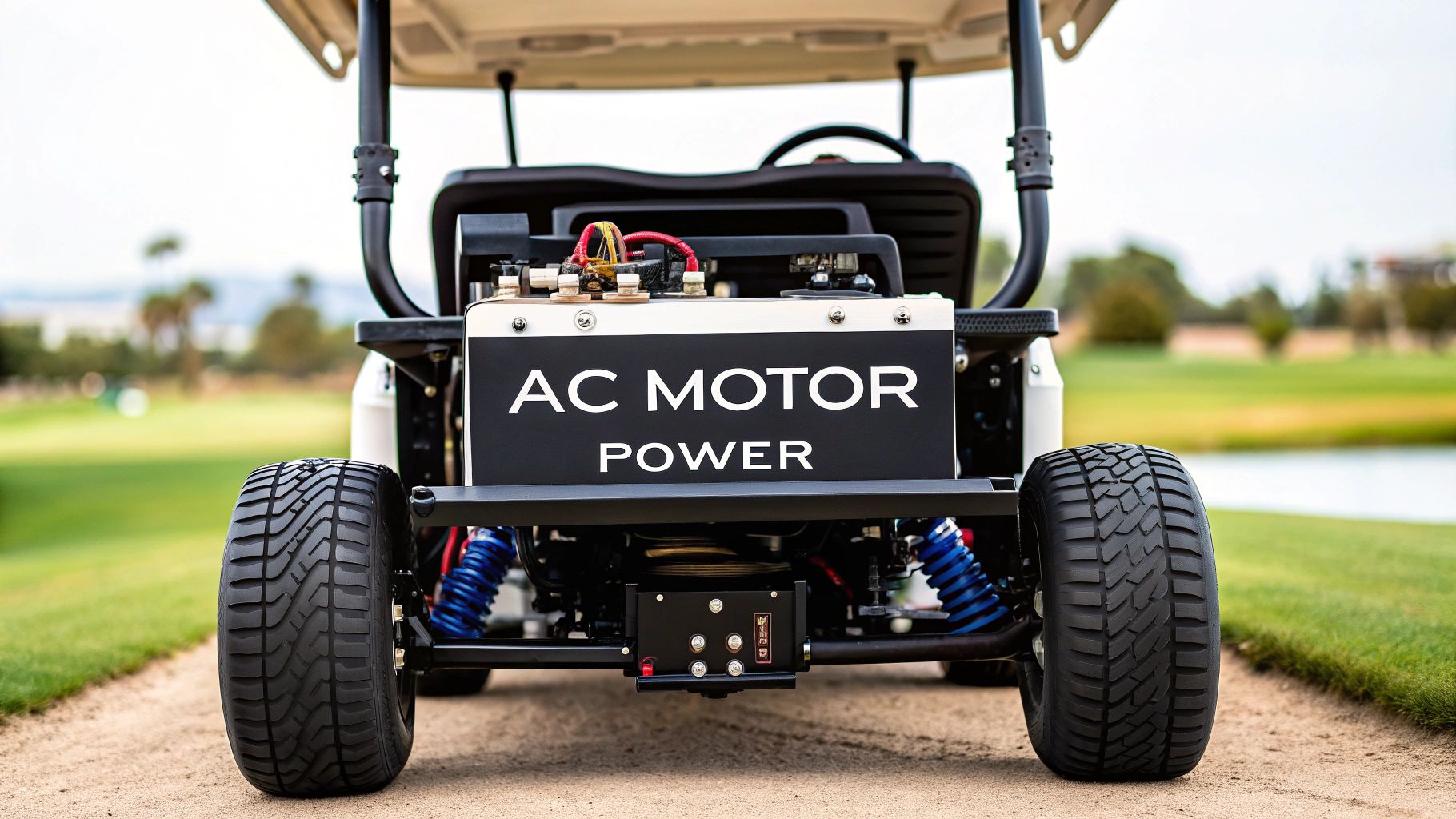
AC motors are a genuine game-changer for golf carts, bringing smoother acceleration, serious hill-climbing power, and much better energy efficiency than the old DC motor tech. There's a reason this modern approach is the new standard—it delivers a quieter, more reliable ride that you can feel from the driver's seat.
So, What’s the Big Deal With AC Motors?
If you've ever driven a newer golf cart and noticed its quiet confidence and impressive ability to tackle steep hills without breaking a sweat, you've experienced an AC motor. The single biggest factor that dictates your cart's performance, range, and overall feel is its motor type. And today, Alternating Current (AC) motors are running the show.
So how does it work? Think of an AC motor like a compass needle that's constantly chasing a spinning magnet. The motor generates a rotating magnetic field, and the rotor gets pulled along for the ride, creating smooth, continuous motion. This is a world away from older Direct Current (DC) motors, which need physical brushes to make contact and send power to the motor—a design that creates friction, noise, and wear.
Why This Matters for Your Ride
The real-world results are obvious the moment you press the pedal. That smooth power delivery means no more jerky starts and stops. More importantly, AC motors deliver consistent torque across a wide range of speeds, so you can climb hills with confidence instead of losing momentum. This efficiency isn't just about raw power; it adds up to a far better driving experience.
Choosing between an AC or DC motor is the most critical decision influencing your cart's performance and battery life. Understanding this difference is key to making a smart investment.
The shift to AC motors isn't just a passing trend; it's a complete transformation of the market. The global golf cart industry has seen massive growth, almost all of it driven by electric power. As of 2024, electric carts dominate with 81.81% of the market share, largely because they're quieter and have 62% lower operating costs per round than their gas-guzzling cousins. Read the full research about these market trends to see the data for yourself.
This guide will walk you through everything you need to know about AC technology, helping you understand why it’s the clear winner for most modern golf cart owners.
AC vs DC: The Great Golf Cart Motor Debate
When you're looking at what powers a golf cart, the conversation always comes down to two options: Alternating Current (AC) and Direct Current (DC) motors. For a long time, DC motors were the undisputed champs. They were simple, affordable, and did a perfectly fine job cruising around flat, predictable courses. They were the reliable workhorse in almost every cart.
But the moment the terrain gets interesting—say, a steep, grassy hill slick with morning dew—the cracks in DC technology start to show. A DC motor often bleeds speed and torque as it works harder, which can turn a confident climb into a sluggish, nerve-wracking crawl. This is exactly where AC motors for golf carts prove their worth.
Picture yourself at the bottom of that same hill. An AC motor delivers steady, powerful torque from a dead stop all the way up to its top speed. It doesn’t bog down or sound like it's struggling; it just pulls. The result is a smooth, controlled ascent that feels completely effortless. This real-world performance gap is why AC technology has become the new standard for modern, high-performance carts.
Core Differences in Performance
The battle between these two motors goes way beyond just climbing hills. It touches everything from speed and efficiency to how long your cart's components will last. A key difference is that AC motors are brushless, which means they don’t have physical brushes making contact to transfer power. This simple design change dramatically cuts down on friction and wear, making the motor much quieter and more efficient.
This brushless design translates into real benefits you can feel on every ride. Less energy is wasted as heat from friction, so more of that precious battery power goes straight to the wheels. What does that mean for you? A longer range, letting you squeeze in more holes on a single charge. If you want to get into the nitty-gritty, you can delve deeper into the principles of AC vs DC motors, as the core concepts are the same across many applications.
This simple graphic breaks down the key advantages an AC motor brings to your golf cart.
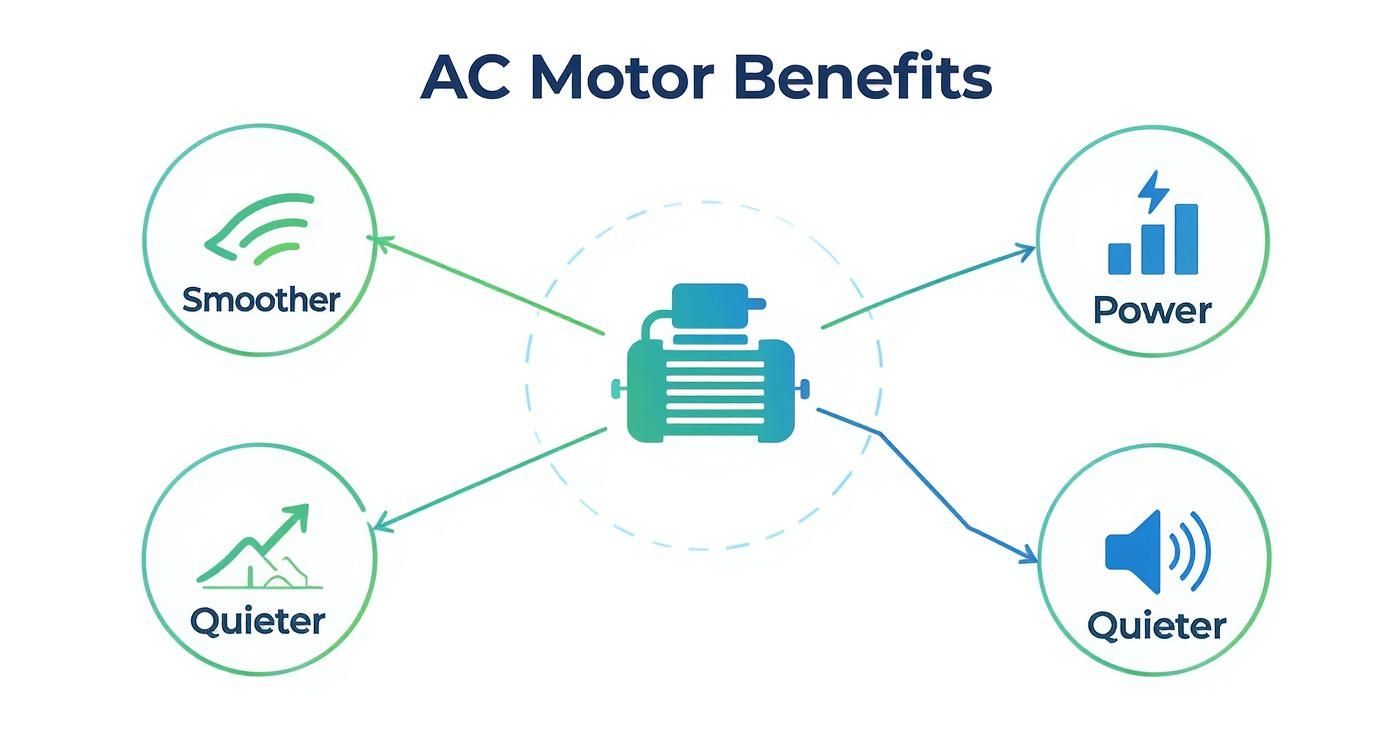
As you can see, all the perks of AC technology work together to deliver a better driving experience defined by smooth power, quiet operation, and solid performance.
A Clear Head-to-Head Comparison
To lay it all out, let's put these two technologies side-by-side. The table below really highlights the practical differences you'll face when choosing a motor for your golf cart.
AC vs DC Golf Cart Motor Comparison
This table offers a straightforward look at how AC and DC motors stack up in the areas that matter most to a golf cart owner.
| Feature | AC Motor | DC Motor |
|---|---|---|
| Hill Climbing | Excellent, provides consistent torque at all speeds. | Fair, tends to lose speed and power under load. |
| Energy Efficiency | High, less energy wasted as heat, longer range. | Moderate, energy is lost through brush friction. |
| Maintenance | Virtually maintenance-free due to brushless design. | Requires periodic brush inspection and replacement. |
| Acceleration | Smooth, linear, and responsive. | Can be jerky, especially from a stop. |
| Top Speed | Generally higher and more sustainable. | Speed often drops as the battery drains. |
| Initial Cost | Higher, due to more complex controller technology. | Lower, simpler and less expensive to produce. |
While a DC motor might get the job done on simple, flat courses, the table makes it clear that an AC motor is a significant upgrade in almost every performance category. For more help on this, our guide on how to choose the best electric motor for a golf cart dives even deeper into matching the right technology to your specific needs.
Unpacking the AC Motor Advantage
So, what does choosing an AC motor really mean for your daily drives? The benefits aren't just technical specs on a sheet; they're upgrades you can actually feel every time you get behind the wheel. From conquering steep inclines to enjoying a longer-lasting battery, the advantages are practical and immediate.
The most noticeable improvement is how AC motors for golf carts handle hills. Their knack for delivering consistent, powerful torque right from a dead stop means you can start on a steep grade and accelerate smoothly—no more rollback or losing momentum. This transforms challenging terrain into just another part of the ride.
This superior performance is a huge reason why AC motors are taking over. In North America, which holds a massive 38.6% share of the electric golf cart market in 2024, AC motors are the go-to choice. Their efficiency and power are a perfect match for the gated communities, resorts, and hilly courses that define the region’s golfing culture. You can read more about the electric golf cart market trends on grandviewresearch.com to see just how dominant they've become.
The Magic of Regenerative Braking
One of the smartest features baked into an AC system is regenerative braking. Think of it as your cart's own personal power plant. When you coast downhill or slow down, the motor essentially runs in reverse, acting like a generator.
Instead of just wasting that forward momentum as heat through traditional brakes, the system captures that energy and sends it right back to your batteries for a little recharge. This process not only stretches your driving range but also provides a smooth, engine-braking effect, giving you more control on descents without ever touching the brake pedal.
Key Takeaway: Regenerative braking is a classic win-win. It boosts your cart's efficiency by recapturing energy and makes your ride safer by providing automatic speed control on declines.
Built for Longevity and Less Hassle
Beyond performance, the long-term ownership experience is where AC motors truly shine. Their brushless design is a massive leap forward from older DC motors. With no physical brushes to wear down, you've just eliminated a major point of failure and a recurring maintenance headache.
This translates directly into real savings and less downtime over the life of your cart. For owners, this means:
- No more brush replacements: A common and recurring expense with DC motors is completely gone.
- Reduced mechanical wear: Fewer moving parts grinding against each other means less friction and a much longer operational lifespan.
- Quieter, cooler operation: The sheer efficiency of the brushless design cuts down on both noise and heat buildup.
Ultimately, the slightly higher initial investment in an AC motor system pays you back through better performance, incredible efficiency, and way less maintenance. It's simply a smarter, more robust technology built for the demands of today's golf cart owner.
Upgrading Your Cart to an AC Motor System

So, you're thinking about giving your trusty golf cart an AC motor overhaul? It's a fantastic way to unlock modern performance, but it’s crucial to know this isn't just a simple motor swap. Converting from DC to AC is a full system upgrade, and everything needs to work together.
The new AC motor has to be paired with a new, specifically matched AC controller. Think of them as a brain and a muscle—one can't do its job without the other. This upgrade almost always requires a new wiring harness too, built to handle the different electrical signals and power loads.
The Critical Role of Your Battery Pack
The heart of any high-performance AC system is the battery pack. An AC motor can draw a huge amount of current, especially when you punch the accelerator or start climbing a steep hill. If your existing batteries are old, weak, or just not up to the task, they become a bottleneck, starving your new motor of the power it craves.
You simply won’t get the performance you paid for. This is exactly why lithium batteries are now considered the gold standard for AC conversions.
- Consistent Power Delivery: Lithium batteries hold a higher, more stable voltage under load. This means your motor gets full power right until the battery is nearly empty, unlike lead-acid which sags.
- Higher Current Output: They are built to handle the high-amperage demands of powerful AC motors for golf carts without taking damage or suffering a major performance drop.
- Reduced Weight: Slashing the weight of your cart with lithium batteries gives you another boost in efficiency, acceleration, and handling.
Pro Tip: Before you even think about buying an AC kit, get your current battery pack professionally tested. If it’s not in top shape, you absolutely need to factor a new battery pack—preferably lithium—into your total project budget.
Understanding the Conversion Process
While the exact steps will vary between cart models and conversion kits, the general process involves several key stages. This is a project that demands precision and a solid understanding of electrical systems.
A typical conversion breaks down like this:
- Safety First: Disconnecting the battery pack completely is non-negotiable. Then, you'll safely remove the old DC motor and controller.
- Mounting New Hardware: This involves installing the new AC motor and securely mounting its matched AC controller, often in a different spot.
- Wiring the System: You'll either replace the entire wiring harness or make significant modifications to accommodate the new controller and its inputs, like speed sensors and throttle signals.
- System Integration: This is where you connect the motor, controller, throttle, and battery pack according to the manufacturer's diagram. No winging it here.
- Programming and Testing: The controller's parameters are programmed to match your cart's specs and your performance goals, followed by a whole lot of testing.
To get that fine-tuned control over speed, torque, and efficiency, many modern controllers act like specialized Variable Frequency Drives (VFDs), which precisely manage the power sent to the motor.
Given the complexity and the high stakes of getting it wrong, most cart owners find that hiring a professional is the smartest move. An experienced tech will make sure every component is compatible, installed correctly, and programmed for peak performance and safety. For a deeper look at what a motor swap involves, check out our complete guide to golf cart motor replacement for more insights.
Taking Care of Your AC-Powered Golf Cart
One of the biggest draws of an AC motor for your golf cart is just how little maintenance they need. Because they’re brushless, you can say goodbye to the constant brush inspections and replacements that are a regular chore on older DC motors. That alone gets rid of a huge source of wear and tear.
But "low-maintenance" doesn't mean "no-maintenance." While the motor itself is a tough, sealed unit, the system around it still needs a little attention to keep everything running at its best for years to come. A few good habits are all it takes.
Simple Care for Long-Term Reliability
The most important jobs are simple and don't require a mechanic. Your main focus should be on keeping the motor and its controller clean. Just wiping away dirt, mud, or grass clippings is enough to prevent heat from building up, which is the number one enemy of any electronic component.
Also, get into the habit of giving the heavy-gauge wires connecting the motor, controller, and batteries a quick visual check. Vibrations from the course can sometimes work connections loose over time. Making sure they’re all snug and free of corrosion can save you from frustrating power problems later on. This kind of proactive care is key, especially as the global market grows—efficient AC motors are critical for reliability in fast-growing regions like Asia-Pacific, which is projected to hit $525 million by 2030. Discover more insights about these golf cart facts.
Basic Troubleshooting Tips
Even the most dependable systems can run into a snag every now and then. If your cart starts acting up, it’s usually one of a few common culprits.
- Listen for Strange Noises: AC motors are famously quiet. If you suddenly hear a grinding or whining sound, it could point to a failing bearing. It's rare, but something you'll want to get checked out right away.
- Check the Speed Sensor: If your speedometer is acting erratically or not working at all, the speed sensor on the motor is often to blame. Thankfully, it's a relatively easy fix.
- Look for Controller Fault Codes: Many modern AC controllers have a diagnostic LED that flashes in specific patterns to tell you what's wrong. Your owner's manual will have a guide to help you figure out what those codes mean.
Key Insight: Most performance problems in an AC system don't start with the motor itself. They usually come from the components supporting it—the controller, the wiring, or the batteries.
Keeping your power source in good shape is just as important as caring for the motor. For a full rundown, take a look at our comprehensive guide to golf cart battery maintenance to ensure the heart of your cart stays healthy.
So, Is an AC Motor Upgrade Really Worth It for You?
We’ve dug into the tech, the benefits, and what it takes to make the switch. Now it’s time for the big question: should you go with an AC motor for your cart? This isn't a small decision—it fundamentally changes how your cart performs, how often you’ll need to tinker with it, and its overall value down the road.
Let’s cut to the chase. Think about how you actually use your cart. If you’re the type who wants top-shelf performance, regularly muscles up steep hills, and would rather be driving than doing maintenance, then an AC motor for your golf cart is a no-brainer. Yes, it costs more upfront, but that investment comes back to you in pure power, rock-solid reliability, and a far better driving experience. There’s a reason it’s the new standard.
The Bottom Line on Your Decision
On the flip side, there's nothing wrong with a trusty DC motor. If your needs are simple—like cruising around a flat, quiet neighborhood or a level golf course—a DC system gets the job done without any fuss. It's a reliable workhorse for straightforward tasks, and it's definitely easier on the wallet.
Final Takeaway: Your terrain and what you demand from your cart are the two biggest factors. Let those guide your choice between the future-proof muscle of AC technology and the proven simplicity of a DC system.
Ultimately, AC motors are a huge leap forward in the golf cart world. They deliver the efficiency, instant torque, and low-maintenance lifestyle that today's owners are looking for. By weighing these perks against your budget and daily driving habits, you can confidently pick the right powerhouse for your ride and lock in years of dependable fun.
Common Questions About AC Golf Cart Motors
Thinking about upgrading to an AC motor? You're not alone. It’s a popular move, but it definitely brings up some good questions. Let's clear the air on a few of the most common ones we hear from cart owners.
Can I Put an AC Motor in Any Golf Cart?
Technically, yes, you can convert most major DC cart brands like Club Car, EZGO, or Yamaha. But—and this is a big but—it’s not a simple drop-in replacement. Think of it less like swapping a part and more like a full system transplant.
An AC conversion means you're replacing the entire powertrain: a new AC motor, a precisely matched AC controller, and usually a new wiring harness to get them talking to each other. It's a complex electrical project that involves high-amperage systems. We'd strongly recommend leaving this one to an experienced technician or a very skilled DIY enthusiast who knows their way around a multimeter.
How Much More Does an AC Motor System Cost?
You're right to ask about the price tag. Expect an AC conversion kit, or a new cart with a factory AC system, to cost about 20-40% more than a comparable high-performance DC setup. The technology in the motor and controller is just more advanced, and that's reflected in the price.
However, a lot of owners see it as money well spent. The brushless design means less maintenance down the road, and the improved energy efficiency can lead to real long-term savings. The upfront cost stings a little, but the benefits often pay for themselves over the life of the cart.
It's no surprise that most modern, high-performance golf carts now come standard with AC motors. For serious users, the superior performance, efficiency, and reliability easily justify the investment.
Do AC Motors Need Special Batteries?
AC motors don’t need a “special” kind of battery, but they are very demanding. To get the performance you’re paying for, you absolutely need a strong, healthy battery pack that can deliver a serious amount of amperage when called upon. If you want the best, lithium batteries are the undisputed champ for AC systems.
Here’s why a powerful battery pack is non-negotiable:
- Performance: A weak battery pack will be a massive bottleneck. You'll get sluggish acceleration and disappointing hill-climbing power, completely defeating the purpose of the upgrade.
- Compatibility: Lithium batteries are much lighter and hold their voltage steady under heavy loads. They handle the high current draws of an AC system far better than old-school lead-acid batteries.
- Longevity: Running an old or undersized battery pack doesn't just hurt performance—it puts a major strain on your brand-new controller and motor.
Think of it this way: putting a powerful AC motor in a cart with old batteries is like putting a race engine in a car with flat tires. You simply won't get the horsepower you paid for.
At Caddie Wheel, we believe in making golf more enjoyable by reducing physical strain. Our electric power assist wheel delivers robust, quiet power to your existing push cart, letting you walk the course with less effort so you can focus on your game. Discover the Caddie Wheel and elevate your round today!
Share:
Your Essential Guide to a Fireproof Lithium Battery Container
Your Guide To The Best Motorized Golf Caddies