Updated October 2026
Quick answer
An electric caddy is worth it over a push cart if you walk 18 holes regularly, play a hilly course, or finish rounds tired enough that it hurts your back nine. If you play flat courses and enjoy pushing, a manual push cart is still the best value. Many golfers land in the middle: they keep their push cart and add a power-assist wheel for a fraction of the price of a new electric caddy.
The electric caddy vs push cart question usually comes up at the same moment: you love walking the course, but somewhere around the 14th hole the bag starts to feel heavier than it did on the first tee. A full electric golf caddy can cost anywhere from about $1,400 to $2,800, while a good push cart costs a few hundred dollars. So is the upgrade worth the money?
This guide breaks it down honestly: what each option actually does, what it costs in 2026, who benefits most, and where a third option, a power-assist conversion like our Caddie Wheel, fits in. We make the Caddie Wheel, so we will say so whenever it comes up, and we will be clear about where competitors are the better choice.
What is the difference between an electric caddy and a push cart?
A push cart (also called a push trolley) is a three- or four-wheeled frame that holds your bag. You supply all the effort, uphill and on flat ground, and you control speed with your arms. Good ones fold quickly, weigh around 15 to 20 lb and cost roughly $200 to $400. MyGolfSpy's 2026 push cart rankings put the Bag Boy Nitron Swivel and Alphard Cybercart Push+ at the top, with the Clicgear Model 4.5 as runner-up at $339.
An electric caddy (electric push cart, electric trolley) adds a motor and a battery. There are three main types:
- Handle-controlled electric carts: you walk with your hand on the handle and set the speed with a dial. The motor does the pushing.
- Remote control caddies: you can steer the cart from a handheld remote and send it ahead while you walk to your ball.
- Follow-me caddies: the cart tracks a sensor you wear and follows you around the course hands-free.
There is also a fourth category that sits between the two: power-assist conversions. These clip a motorized drive wheel onto the push cart you already own. You still guide the handle, but the motor supplies the push. The MGI E-Boost, the Alphard Club Booster and our Caddie Wheel all live here.

A power-assist wheel turns an existing push cart into an electric one. Shown: the Caddie Wheel on a Clicgear.
How much does an electric caddy cost compared with a push cart?
Price is the biggest gap between the two. Here is what the main options cost at list price in October 2026, based on MyGolfSpy's 2026 electric push cart buyer's guide and manufacturer pricing. Prices move with sales, so treat them as a guide.
| Feature | Manual push cart | Power-assist add-on | Full electric caddy |
|---|---|---|---|
| Typical price | $200 to $400 | $600 to $950 | $1,400 to $2,800 |
| Who supplies the push | You | Motor (you guide) | Motor |
| Hands-free | No | No | Remote and follow models, yes |
| Charging | None | After each round or two | After each round or two |
| Keeps your current cart | Yes | Yes | No, it replaces it |
| Best for | Flat courses, 9 holes, tight budgets | Hills and 18 holes on a cart you already like | Golfers who want remote or follow features |
The short version: a push cart costs the least, a full electric caddy costs the most, and a conversion lets you get the main benefit of an electric caddy, the motor doing the pushing, for well under half the price of a premium remote model. For a deeper look at every category, see our electric golf push cart buyer's guide.
Is an electric caddy worth it? 6 signs it is
An electric caddy is not for everyone. These are the situations where golfers tend to feel the difference most:
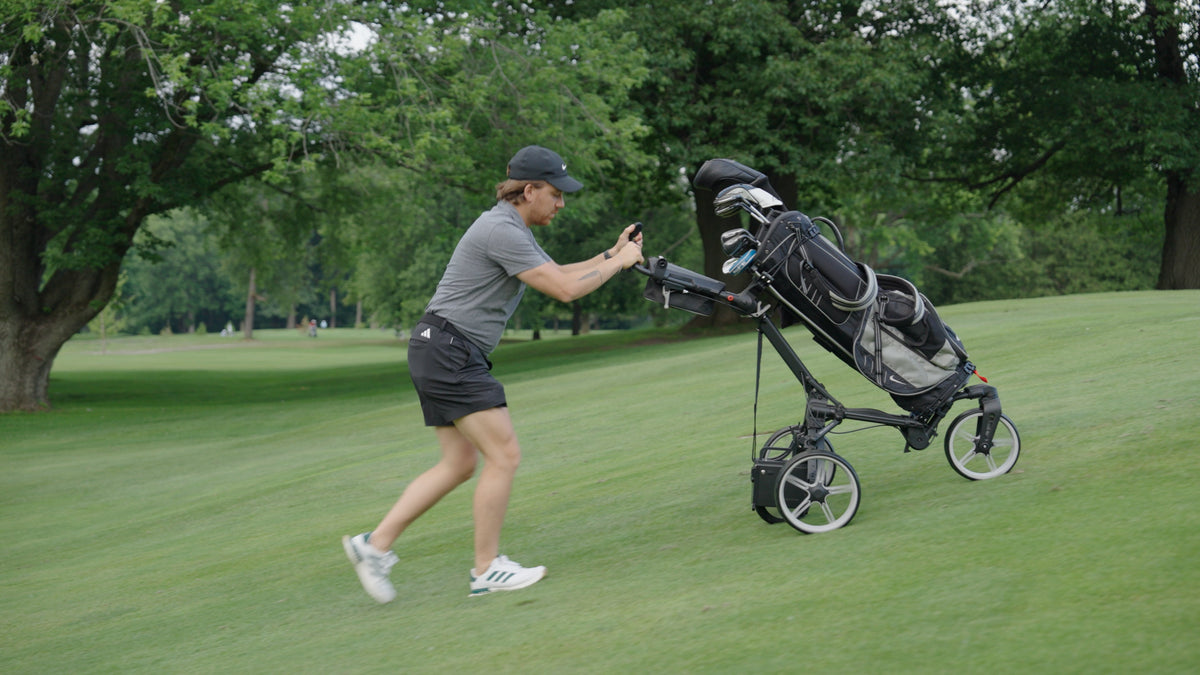
- Your course is hilly. Pushing 25 to 35 lb of cart and bag up steep fairways is where most of the effort in a walking round goes. A motor takes that load off your legs, shoulders and lower back.
- You walk 18 holes (or 36). Fatigue builds over a full round. If your swing feels different on the back nine than on the front, a motor helps you finish the way you started.
- You want to keep walking for years. Many golfers switch to riding carts simply because pushing became a chore. An electric caddy lets you keep walking instead of riding.
- You play often. The more rounds you play, the lower the cost per round. A $749 unit used for 40 rounds a year for three years works out to about $6 a round.
- You pay cart fees today. If you ride some of the time because walking is too tiring, the savings on cart fees can offset the purchase.
- You carry a heavy bag. Cart bags full of balls, water, rain gear and a rangefinder add up. The heavier the load, the more a motor helps.

Photo: Samuel Girven on Unsplash
When is a push cart the better choice?
A manual push cart still wins in several cases, and we would rather you buy the right thing than the most expensive thing:
- Flat courses. On level ground a good three-wheel cart rolls easily. The gain from a motor is real but smaller.
- Nine-hole rounds. If you mostly play nine, fatigue is less of a factor.
- Zero-maintenance preference. A push cart never needs charging, and there is no battery to store over winter.
- Weight and trunk space. A manual cart is the lightest thing you can put in the car. Any motor adds weight, and full electric caddies are often bulky when folded.
- Budget. A $339 cart that you will use every week beats a $2,000 cart you cannot afford.
If you are on the fence, play a few rounds paying attention to how you feel on the closing holes. If the last third of the round feels like a slog, that is your answer.
What about a power-assist conversion?
This is the option many golfers do not know exists. Instead of replacing your push cart, you add a motorized wheel to it. You keep the cart you already like, its folding, storage and accessories, and you get the motor doing the pushing.
The tradeoff: power-assist conversions do not steer themselves. You walk with a hand on the handle, as you do now. If you want to send the cart down the fairway by remote or have it follow you, you need a full remote or follow caddy.
Here is how the main conversions compare, including our own:
- MGI E-Boost ($599): MyGolfSpy's Best Value pick in its 2026 electric cart rankings. It is the cheapest of the three. If price is your top priority, it is a strong choice.
- Alphard Club Booster V2Pro (around $950 list): a twin-motor conversion that weighs roughly 21 lb plus a 4 lb battery. More motor, more weight. We compare the two in detail in Caddie Wheel vs Alphard.
- Caddie Wheel ($749, our product): a 15 lb (6.8 kg) single drive wheel that clips on with a cart-specific bracket kit, included. It goes 36+ holes per charge, has a 4-speed remote, and carries a 12-month warranty. It drives straight and you guide the handle. It is designed and made in Montreal, Canada.
Keep your push cart. Lose the push.
The Caddie Wheel clips onto your existing cart and does the pushing for 36+ holes per charge. $749 with the bracket kit for your cart included, plus a free carry bag, remote holder and portable remote charger. Rated 4.8/5 from 500+ golfers.
Shop the Caddie Wheel Or get the Clicgear 4.5 bundle ($949) →
Electric caddy vs push cart: how do you decide?
Most golfers fall into one of three groups. Find yours:
Still unsure whether your cart can take a motor? Our list of compatible push carts covers Clicgear, Bag Boy, Big Max, CaddyTek, Sun Mountain, Axglo and more, and our guide to which push carts can be motorized explains what makes a cart a good fit.

The 4-speed remote sits on the handle, so you set your walking pace without letting go of the cart.
What does owning an electric caddy actually involve?
Before you buy any motorized cart, it helps to know the day-to-day reality:
- Charging. Plug the battery in after a round, or every other round if your battery covers 36 holes. Charge fully before your first round.
- Battery life. Lithium batteries wear over hundreds of charge cycles. The Caddie Wheel battery is rated for about 400 cycles. Hills, a heavy bag and wet grass all shorten range per charge.
- Weather. Most electric caddies are water-resistant, not waterproof. The Caddie Wheel battery handles light rain only.
- Folding and transport. Full electric caddies are heavier and often bulkier folded. With a conversion, you remove the unit before folding the cart, so the cart folds as it did before.
- Off-season storage. Store the battery indoors, partly charged, over winter.
Common mistakes when choosing between an electric caddy and a push cart
- Buying on features you will not use. GPS screens and follow modes are great if you want them. If you just want the push taken away, you are paying for extras.
- Ignoring your trunk. Measure your car before buying a full electric caddy. Folded size matters more than most people expect.
- Throwing away a good push cart. If your current cart is in good shape and on a compatible list, a conversion keeps it working for you.
- Skipping the first charge. MyGolfSpy calls showing up without an initial charge a rookie mistake. Charge before your first round.
- Installing on an unsupported cart. Conversion kits are made for specific frames. Installing a Caddie Wheel on a cart that is not on our compatible list voids the warranty, so check first.
- Forgetting to try it. If you can, talk to someone who already uses one. You can talk to a Caddie Wheel user before you decide.

Photo: Jakub Velička on Unsplash
Our verdict: is it worth it?
For golfers who walk 18 holes on anything but a flat course, yes, taking the push out of walking is worth paying for. The bigger question is how much you need to spend to get there.
- If you want the cart to follow you or drive itself by remote, buy a full electric caddy. The Alphard Cybercart was MyGolfSpy's 2026 Best Overall electric cart and the Stewart Q Follow its Best Follow pick. They do things a conversion cannot.
- If you want the lowest price for power assist, the MGI E-Boost at $599 is hard to beat.
- If you want to keep your current push cart, a light 15 lb unit and 36+ holes per charge, we think the Caddie Wheel is the best fit. We are biased, so read the reviews from Caddie Wheel owners and decide for yourself.
- If you play flat nine-hole rounds and feel great at the end, keep pushing. Your push cart is already the right tool.
Frequently asked questions
Is an electric golf caddy better than a push cart?
It is better if fatigue affects your round. An electric caddy removes the effort of pushing, which matters most on hills and over 18 holes. A push cart is lighter, cheaper and needs no charging, so it is the better pick for flat courses, short rounds and golfers who enjoy the exercise of pushing.
How much more does an electric caddy cost than a push cart?
A quality push cart costs about $200 to $400. Full electric caddies run from about $1,400 to $2,800 in 2026, with follow models at the top. Power-assist conversions that attach to a push cart you already own cost about $600 to $950, which is the cheapest way to get motorized help.
Can I turn my push cart into an electric caddy?
Yes, if your cart is supported. Power-assist kits like the Caddie Wheel clip a motorized wheel onto your existing cart using a bracket made for that model. Popular Clicgear, Bag Boy, Big Max, CaddyTek and Sun Mountain carts are covered. Check the compatible carts list before ordering, because unsupported carts void the warranty.
Do electric caddies steer themselves?
Only some. Remote control caddies steer from a handheld remote, and follow-me caddies track a sensor you wear. Handle-controlled carts and power-assist wheels such as the Caddie Wheel drive straight while you guide the handle. If hands-free steering matters to you, choose a remote or follow model.
How far does an electric caddy go on one charge?
Most lithium electric caddies cover at least 18 holes, and many are rated for 27 to 36. The Caddie Wheel is rated for 36+ holes per charge. Real range drops with steep hills, a heavy bag, wet grass and cold weather, so charge after every round or two to be safe.
Is an electric caddy worth it for a casual golfer?
It depends on how often you play and how you feel at the end. If you play twice a month on a flat course and finish fresh, a push cart is enough. If you play weekly or your course is hilly, the cost per round of an electric caddy or a conversion drops quickly and the comfort gain is large.
Ready to stop pushing?
Add the Caddie Wheel to the cart you already own for $749, or start fresh with MyGolfSpy's 2026 runner-up push cart, the Clicgear 4.5, plus a Caddie Wheel for $949. 12-month warranty and free first-install support, made in Montreal.
Shop the Caddie Wheel Or get the Clicgear 4.5 bundle ($949) →
Share:
Golf Push Cart Electric Conversion Kits: How to Turn Your Push Cart Into an Electric Caddy
5 Best Compact Electric Golf Trolley