
A battery powered golf push cart is just what it sounds like: a motorized caddy that carries your clubs for you. This frees you up to walk the course without the physical drag of pushing or carrying your bag. Think of it as giving your trusty push cart a quiet, electric assistant to handle the hills and long walks, blending the health benefits of walking with the pure convenience of a caddy.
Your Guide to Effortless Golf
Imagine walking up to the tee on a crisp morning, taking in the lush fairways without that nagging fatigue from wrestling a heavy bag up a steep incline. A battery powered golf push cart makes that a reality. It perfectly splits the difference between a manual push cart and a full-sized riding cart, offering a unique blend of benefits for today's golfer.
But this technology isn't just about taking it easy; it's about sharpening your game. When you conserve physical energy, you can keep your focus and stamina sharp through all 18 holes. For many players, that directly translates to better performance on the back nine.
The Smart Upgrade for Walkers
The concept is brilliantly simple. It takes the familiar design of a push cart—a frame you already know and love—and integrates a motor and battery. It’s a lot like adding a small electric motor to a bicycle; you still get all the exercise and enjoyment, but you’ve got a helper for the toughest parts of the ride.
This kind of smart upgrade has really struck a chord with golfers, and the market growth shows it. In 2023, the global electric golf push cart market was valued at a cool USD 150 million and is on track to more than double by 2032. You can find more details on this trend over at Dataintelo. This surge makes one thing clear: golfers are shifting towards technology that makes the game more accessible and enjoyable for everyone.
By taking the physical toll of pushing a cart out of the equation, golfers can redirect that energy toward what really matters: strategy, focus, and hitting the perfect shot. It’s a small change that can have a huge impact on your score and your love for the game.
Who Benefits Most from an Electric Push Cart?
While pretty much anyone who walks the course will feel the difference, these carts are an absolute game-changer for certain players. They are especially helpful for:
- Senior golfers who want to keep walking the course without the physical strain.
- Players on hilly courses who need a little help conquering those challenging slopes.
- Competitive golfers looking to save every last ounce of energy for their swing.
- Fitness-focused players who love the health benefits of walking but don't want to overdo it.
Basically, if you love the idea of walking but find the cart itself is becoming a burden, this technology was made for you. It bridges the gap between manual labor and full automation, putting control and comfort back in your hands.
Before we go any further, it helps to have a good handle on the basics. If you're new to carts in general, check out our guide on what is a push cart. Building on that foundation will help you truly appreciate the powerful advantages an electric model brings to the table.
How Electric Push Carts Actually Work
You might think a battery-powered golf push cart is some kind of complex machine, but the way it works is actually pretty straightforward. It all comes down to three key parts working together: the battery, the motor, and the control system.
Think of it like a souped-up remote-control car, but one that’s built to haul your clubs for 18 holes and then some. Each component has a specific job, and once you get how they connect, you'll see just how simple and smart the technology is.
It all starts with the battery—that’s your fuel tank, holding all the juice. The control system is the driver; whether it's a dial on the handle or a remote, it tells the motor what to do. Finally, the motor is the engine, taking that electrical energy and turning it into the physical force that spins the wheels.
This simple setup places the electric push cart in a perfect middle ground between hoofing it with a manual cart and riding in a full-blown golf cart.
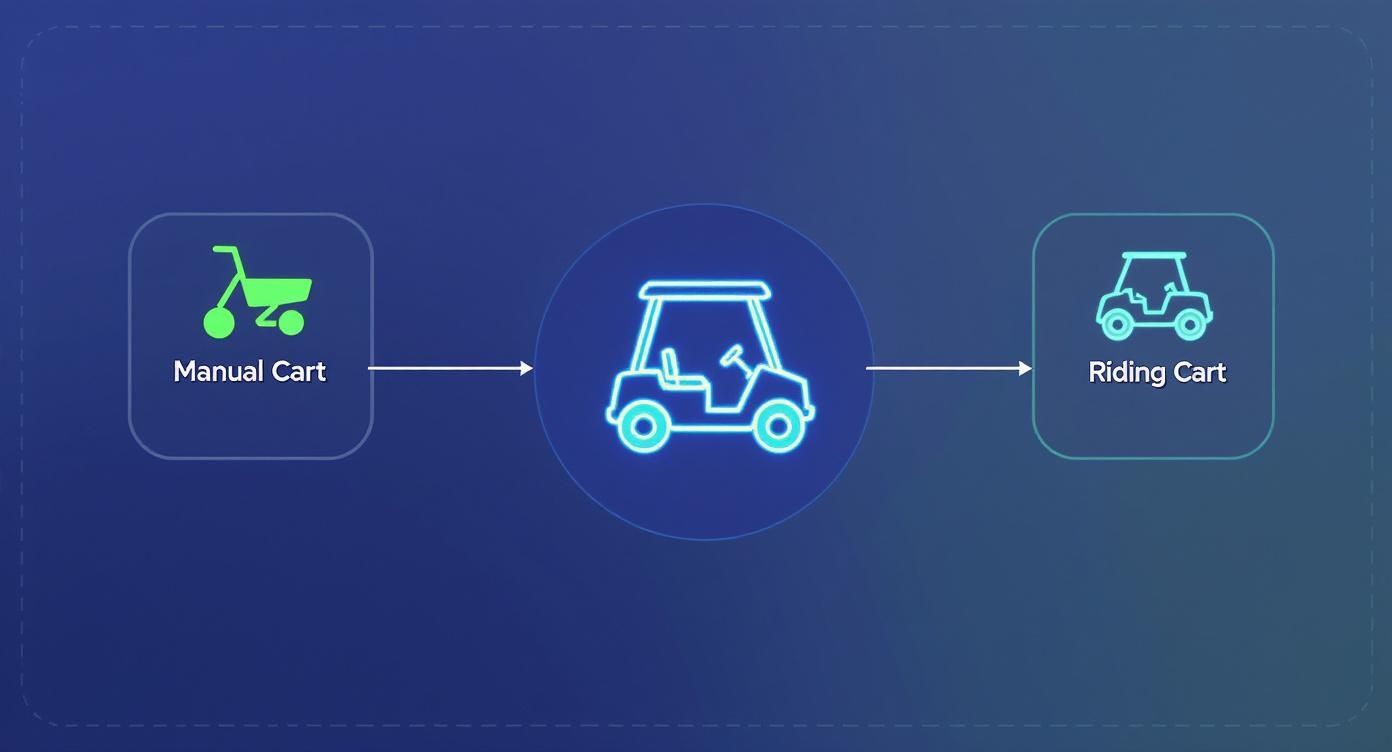
As you can see, you get the health benefits of walking the course without the back-breaking work of pushing your gear uphill. It's the best of both worlds for the modern golfer.
The Heart of the Cart: The Battery
The battery is without a doubt the most important part of the whole setup. It single-handedly determines how far your cart can go on a single charge. The first electric models used clunky lead-acid batteries, the same kind you'd find under the hood of your car. They worked, but they were incredibly heavy and a pain to maintain.
Thankfully, technology has come a long way. Today, the gold standard is the lithium-ion battery. These are the same sleek, powerful batteries that run your smartphone and laptop, and they've completely changed the game for electric push carts. They’re lighter, last longer, and are far more efficient.
This shift is why electric carts are exploding in popularity. In fact, lithium-ion systems are now the dominant force, accounting for over 48% of the global golf cart market in 2024. A good modern battery can easily power you through 36 holes without breaking a sweat.
Before we move on, let's quickly compare the old tech with the new. Understanding the difference really highlights why lithium-ion is the only way to go for a new cart.
Lithium-Ion vs Lead-Acid Batteries
| Feature | Lithium-Ion Battery | Lead-Acid Battery |
|---|---|---|
| Weight | Lightweight and compact | Heavy and bulky |
| Lifespan | 5+ years, many charge cycles | 2-3 years, fewer charge cycles |
| Maintenance | Virtually maintenance-free | Requires regular water checks |
| Performance | Consistent power output | Power fades as it discharges |
| Charge Time | Faster charging (a few hours) | Slower charging (often overnight) |
| Upfront Cost | Higher | Lower |
While lead-acid batteries have a lower initial cost, the superior lifespan, performance, and convenience of lithium-ion batteries make them a much better long-term investment for any serious golfer.
The Engine Room: The Motor
If the battery is the fuel, the motor is the engine—it's what actually gets the work done. Tucked away near the axle or built right into the wheels, these quiet electric motors are engineered to deliver smooth, steady power. When you're looking at specs, there are two terms you need to know:
- Wattage (W): Think of this as the motor's raw power. A higher wattage helps the cart carry heavier bags and keep its speed up on flat ground.
- Torque: This is the twisting force that really matters on the course. High torque is what gives a battery-powered golf push cart the muscle to climb steep, grassy hills without even hesitating. A motor with good torque won't bog down when the course gets tough.
The key is to match the motor's power to the kind of course you play most often. A flat course doesn't demand much, but if your home track has serious elevation changes, a high-torque motor is non-negotiable. For a deeper look, check out our guide on how to choose the best electric motor for your golf cart.
The Brains of the Operation: The Control System
The control system is how you communicate with your cart. It’s the bridge between your command and the motor’s action, handling everything from speed adjustments to steering. These systems can range from dead simple to surprisingly sophisticated.
A great control system should feel intuitive, allowing you to manage the cart's movement without breaking your focus on the game. The goal is to make the technology disappear, so all you notice is an easier walk.
Here are the most common types of controls you'll find:
- Handlebar Controls: This is the most basic setup. You'll find a simple dial or a few buttons on the handle to set the speed. You still steer it like a normal push cart, but the motor provides all the forward momentum.
- Remote Control: A small handheld remote changes everything. It gives you the freedom to send your cart ahead to the next tee while you walk to the green, or guide it around a bunker from 20 yards away. It's a massive convenience.
- Follow Technology: This is the top-tier option. You clip a small sensor to your belt or put it in your back pocket, and the cart follows you autonomously at a consistent distance. It's the closest you can get to having a real caddy without the weekly paycheck.
Essential Features to Consider Before You Buy
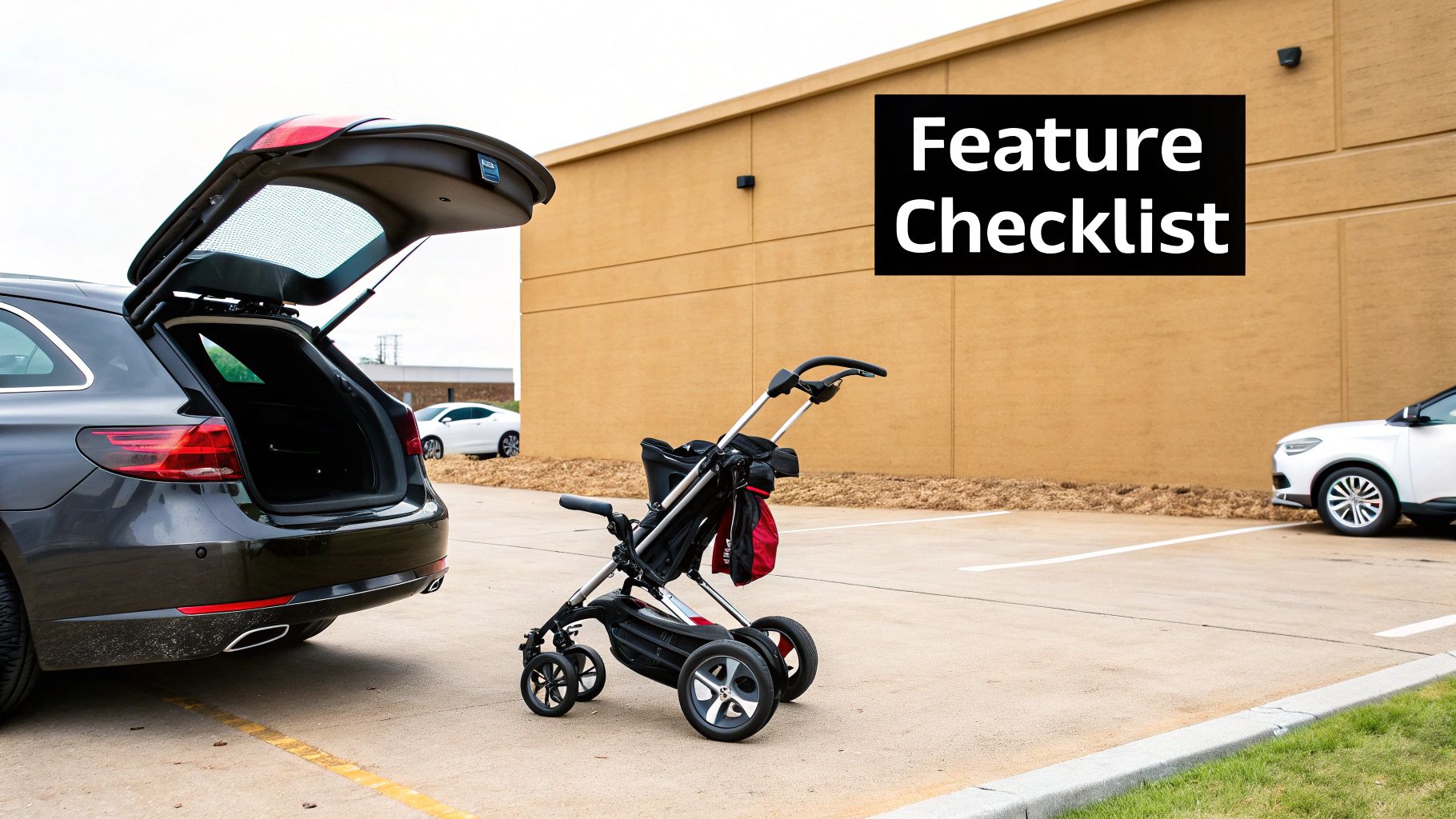
Choosing the right battery powered golf push cart is a lot like picking the perfect club for a tricky shot—it all comes down to matching the gear to the course and your personal style. With so many models out there, it’s easy to get overwhelmed. The key is to zero in on a few essential features that will help you find a cart that truly improves your round.
Think of this as your pre-purchase checklist. By figuring out what you really need for each of these features, you can confidently invest in a cart that feels less like another piece of equipment and more like a trusted caddie.
Battery Life: The Fuel for Your Round
This is the big one. The single most important feature is how long the battery lasts, which is almost always measured in the number of holes it can cover. A battery that dies on the 15th green is worse than useless; it instantly becomes 30-40 pounds of dead weight you have to wrestle for the rest of the round.
You’ve got to match the battery life to how you play.
- 18-Hole Battery: This is the standard for most entry-level models. It's a solid choice for golfers who typically play one round at a time and are good about charging their gear after every single use.
- 27-Hole Battery: This option gives you a comfortable buffer. It’s perfect if you occasionally squeeze in an extra nine or just want the peace of mind knowing you have power to spare, especially on a long, hilly course that drains the battery faster.
- 36-Hole Battery: This is the top-tier choice for the serious golfer. If you’re known for marathon golf days, play in tournaments, or simply want to charge your cart less often, a 36-hole battery is the best investment you can make.
And don’t forget, the terrain makes a huge difference. A hilly, wet course will chew through power much faster than a flat, dry one. It's always a smart move to pick a battery with a little more juice than you think you’ll need.
Motor Power: Conquering Your Home Course
Not all motors are created equal. A cart that glides effortlessly across flat Florida fairways might start to gasp for air on the rolling hills of a course in the Northeast. The motor’s real test is how it handles the unique challenges of your home course.
The key here is torque—that’s the motor's climbing power. A high-torque motor will keep a steady pace up steep inclines without slowing down or straining, even with a heavy tour bag strapped on. If your course has any real elevation changes, a powerful motor isn’t a luxury; it’s a necessity.
A cart’s motor should make hills disappear. The right motor ensures a consistent walking pace, allowing you to conserve energy and focus on your next shot, not on whether your cart will make it to the top of the fairway.
This focus on efficiency is driving huge growth in the market. The global push pull golf cart market, which includes these electric models, is projected to expand from USD 420 million in 2025 to USD 740 million by 2035. Electric versions are expected to dominate this space, capturing a 61% market share as more golfers see the value. To dig deeper into this trend, you can review the full push pull golf cart market analysis.
Portability and Weight: Getting to the Course
Let's be real—your cart’s usability doesn’t start at the first tee. It starts in your garage. How easily can you hoist it into your car? How small does it fold down? The answers to these questions will make a huge difference in your day-to-day experience.
Pay close attention to two numbers:
- Total Weight: This is the combined weight of the frame, wheels, motor, and battery. Most electric carts fall somewhere between 30 and 40 pounds. Make sure you can comfortably lift and maneuver that weight.
- Folded Dimensions: Check the cart's size when it’s collapsed. Get out a tape measure and check your trunk space to be sure it will fit easily next to your clubs and other gear.
Some models have a slick one-step folding mechanism, while others might take two or three. A simple, intuitive folding system can save you a ton of time and frustration before and after every round.
Advanced Features: Must-Haves vs. Nice-to-Haves
Beyond the core components, modern electric carts are loaded with extra features designed for convenience and control. Figuring out which ones you'll actually use will help you narrow down your choices and avoid paying for tech you don't need.
Here’s a quick rundown of the most common bells and whistles:
| Feature | What It Does | Best For |
|---|---|---|
| Remote Control | Lets you steer the cart from a distance using a handheld remote. | Golfers who want to send their cart ahead to the next tee or navigate around bunkers. |
| Downhill Braking | Automatically slows the cart on descents to maintain a safe, controlled speed. | Players on hilly courses who need extra safety and control on those steep declines. |
| Follow Mode | Uses a sensor to autonomously follow you as you walk, completely hands-free. | The ultimate convenience for players who want a true caddy-like experience. |
| Accessory Hubs | Includes handy features like USB ports, GPS holders, and umbrella mounts. | Tech-savvy golfers who want to keep their devices charged and easily accessible during a round. |
By carefully weighing these features against your personal needs and home course conditions, you can find a battery powered golf push cart that will be a reliable partner on the course for years to come.
Weighing the Pros and Cons of Going Electric
Deciding whether a battery powered golf push cart is the right move for you means taking a clear-eyed look at both the game-changing perks and the practical realities. This isn't just about buying a new toy; it's about investing in a better, more enjoyable way to play golf. To make a smart choice, you need a balanced view of what you stand to gain versus what you’ll need to manage.
The single biggest advantage is the massive reduction in physical fatigue. Let’s be honest—lugging a 30-pound bag up and down hills for four hours takes a toll. That’s energy that should be going into your swing and your mental game. An electric cart completely removes that burden, letting you walk the course and arrive at each shot feeling fresh and ready.
This saved energy almost always translates directly into better performance, especially on the back nine where tired swings and mental mistakes love to show up.
The Clear Advantages of Motorized Assistance
The benefits go well beyond just feeling less tired at the end of the day. An electric cart helps you keep a steady—and often quicker—pace of play, since you're no longer dragging your feet up inclines. For golfers who play on hilly or tough courses, this tech turns a grueling trek into a pleasant walk, making the game more accessible and a lot more fun.
- Improved Focus and Performance: When you save physical energy, you preserve mental sharpness. Better focus leads to smarter decisions and, hopefully, lower scores.
- Conquer Any Terrain: Those steep hills that used to feel like a cardio workout? They become effortless. This opens up more courses and makes your home track far more enjoyable.
- Better Pace of Play: With the cart moving at a consistent speed, you can walk more efficiently between shots, which helps keep your group on schedule.
The real win with an electric cart is the ability to walk the course and get all the health benefits without the physical penalty. It lets you pour your energy into the game itself, not just into hauling your gear from point A to point B.
Think about it—freeing yourself from the grunt work of pushing a heavy bag can be a huge factor in optimizing your personal performance on the course. It’s all about creating the best possible conditions for you to play your best golf.
Practical Considerations and Drawbacks
Of course, no piece of technology is perfect. The most obvious trade-off is the initial cost. Electric push carts are a significant investment, often costing several hundred to over a thousand dollars more than their manual cousins. That upfront expense is a major hurdle for many golfers.
Then there’s the weight. While the cart moves itself on the course, you still have to lift it into and out of your car. Most electric models weigh between 30 and 40 pounds, which can be a real challenge for some. It’s a crucial thing to consider for your pre- and post-round routine.
Finally, you have the battery to think about. It needs to be managed. You have to get into the habit of charging it after every round. Forgetting to plug it in can turn your next outing into a frustrating manual slog with a much, much heavier cart. It just requires a little bit of consistent diligence.
In the end, the decision comes down to how you weigh these factors. If the benefits of less fatigue, better focus, and easier walks on hilly courses align with your golfing goals, then the practical issues of cost, weight, and battery charging become small, manageable parts of a massively improved golfing experience.
Maintenance and Long-Term Battery Care
A battery powered golf push cart is a smart investment in your game, and luckily, protecting that investment is incredibly straightforward. With just a little routine care, you can keep your cart running like new for years and avoid any frustrating surprises on the course.
Think of it like taking care of your clubs. A quick wipe-down after a round and proper storage make a world of difference, right? The same idea applies here. Just a few minutes of preventative maintenance ensures your electric caddy is always ready to go when you are.
Maximizing Your Battery Lifespan
The lithium-ion battery is the heart of your electric cart. Its health directly dictates how well your cart performs, especially on those back-nine hills. The good news is that modern lithium-ion units are low-maintenance, but they do thrive on good habits.
The most important rule? Avoid extremes.
Never store your battery completely dead or leave it sitting at 100% charge for weeks on end. The best practice is to get it on the charger soon after you finish your round. Consistent use and regular charging cycles are what keep it in peak condition.
Here are a few essential tips for long-term battery health:
- Charge After Every Use: Make it a habit to plug in the battery after each 18-hole round, even if it has power left. This prevents deep discharges that can shorten its lifespan.
- Use the Right Charger: Stick with the manufacturer-provided charger. Third-party chargers might not have the correct voltage or safety features, which could seriously damage the battery.
- Store in a Cool, Dry Place: Extreme heat and cold are the enemies of battery longevity. Always store your battery indoors at room temperature, away from direct sunlight or freezing conditions.
Properly caring for your battery can easily extend its effective life by an extra season or more. A healthy battery doesn't just guarantee you'll finish your round—it delivers consistent power up every hill, every time.
For a deeper dive, our comprehensive guide offers more detailed golf cart battery charging tips for max longevity, covering everything you need to know to get the most out of your power source.
Simple Cart Maintenance Routines
Beyond the battery, the cart itself needs a little TLC to keep it rolling smoothly. Over time, dirt, grass, and moisture can build up in moving parts. A simple cleaning and inspection routine is all it takes to prevent issues.
After every few rounds, take a couple of minutes to wipe down the frame with a damp cloth. Grab a brush to clear any mud or clippings from the wheels and tire treads. This isn't just about appearances; clean wheels spin more freely and give you better traction on the course.
Here’s a quick checklist for routine cart care:
- Inspect the Wheels and Axles: Check for any tangled grass or string and make sure the wheels spin without resistance.
- Check Brakes and Locking Mechanisms: If your cart has a parking brake, give it a quick test to ensure it engages securely.
- Tighten Loose Hardware: Do a periodic check of any nuts and bolts on the frame, ensuring everything feels snug.
- Clean the Frame: A simple wipe-down prevents dirt from building up in folding joints and other moving parts.
The Smart Upgrade: A Drop-On Motor
What if you love your current push cart but want the power of an electric model? You don't have to buy a whole new setup. Conversion kits, like the Caddie Wheel, offer a brilliant and cost-effective solution.
These systems are designed for pure simplicity. A "drop-on" motorized wheel replaces one of your cart's standard rear wheels, instantly electrifying it. The battery and motor are built right into the wheel itself, so there's no complex wiring or bulky battery packs to strap onto the frame.
Installation is usually tool-free and takes just a few minutes. This approach lets you keep the familiar feel of your favorite push cart while adding the hill-climbing power and fatigue-reducing benefits of a battery powered golf push cart. It's an elegant way to upgrade your game without starting from scratch.
Of course. Here is the rewritten section, crafted to sound like an experienced human expert and match the provided examples.
Your Top Questions Answered
Even after you've done your research, a few questions always pop up. That's totally normal, especially when you're about to invest in a piece of gear that can genuinely change your game.
I've put together this section to give you quick, no-nonsense answers to the most common questions I hear from golfers about making the switch to a battery powered golf push cart. Let's clear up those final details so you can buy with total confidence.
How Long Does a Battery Typically Last on a Single Charge?
This is the big one, and for good reason—no one wants to run out of juice on the 16th hole. The answer is almost always measured in holes, not hours, which gives you a much better feel for real-world performance.
Most entry-level models with modern lithium-ion batteries are built to handle a full 18 holes. If you step up to mid-range or premium carts, you'll often find extended-life batteries that can go for 27 or even a full 36 holes on one charge.
The 36-hole battery is the gold standard for serious golfers. It's perfect if you like to play back-to-back rounds or just want a safety net in case you forget to charge it overnight.
Keep in mind that the course itself plays a huge role here. Hilly terrain and soft, wet ground make the motor work harder, which will drain the battery faster. Because of this, grabbing a model with a higher-capacity battery is always a smart bet.
Are Electric Push Carts a Pain to Transport and Store?
Not like they used to be. Manufacturers have made portability a huge priority lately. The vast majority of electric carts are designed to fold down into a surprisingly compact size, usually with a simple one- or two-step motion. They'll fit easily into a standard car trunk right alongside your clubs.
The one thing you have to account for is the weight. With a motor and battery, an electric cart typically weighs between 30 and 40 pounds, which is a noticeable step up from a manual cart. Before you pull the trigger, check the specs for two key numbers:
- Total Weight: Can you comfortably lift that much into and out of your trunk without throwing your back out?
- Folded Dimensions: Will it actually fit in the space you have available?
Some models let you remove the battery before lifting, which helps a bit. But that total weight is something you'll deal with every time you play, so be honest with yourself about what you can handle.
Can I Convert My Current Push Cart to an Electric One?
Yes, you absolutely can! This is one of the best-kept secrets for golfers who want to get motorized without buying a whole new cart. Conversion kits are a fantastic, cost-effective way to make the upgrade.
These kits are brilliantly simple. Most of them involve swapping out one of your cart's rear wheels for a self-contained motorized wheel that has its own battery and motor built right in. The installation is designed to be a breeze—often, you don't even need tools.
This "drop-on" approach is an amazing option if you already have a high-quality push cart you love. You get to keep the frame you're used to and just add the hill-climbing power of a battery powered golf push cart.
What's the Difference Between a Remote Control and Follow Mode?
Both of these features give you a hands-free experience, but they work in completely different ways. Figuring out which one fits your style is key.
A remote-controlled cart is like driving a toy car. You use a small handheld remote to steer it forward, backward, left, and right. This is awesome for sending your cart ahead to the next tee while you walk over to the green, or for navigating it around a bunker from a distance.
On the other hand, a "follow" cart is true automation. You clip a small sensor to your belt or put it in your back pocket, and the cart just... follows you. It keeps a safe, consistent distance behind you as you walk down the fairway. Follow tech is usually found on the more premium models, while remote control is a pretty common feature on mid- to high-end carts.
Ready to upgrade your current push cart with effortless power? The Caddie Wheel offers a simple, drop-on motorized wheel that turns your manual cart into a hill-conquering machine. Conserve your energy for the game and enjoy a better walk. Learn more and order yours today at https://caddiewheel.com.
Share:
Your Practical Guide to Golf Cart Fuses
Your Guide to a Golf Cart Sand Bottle