
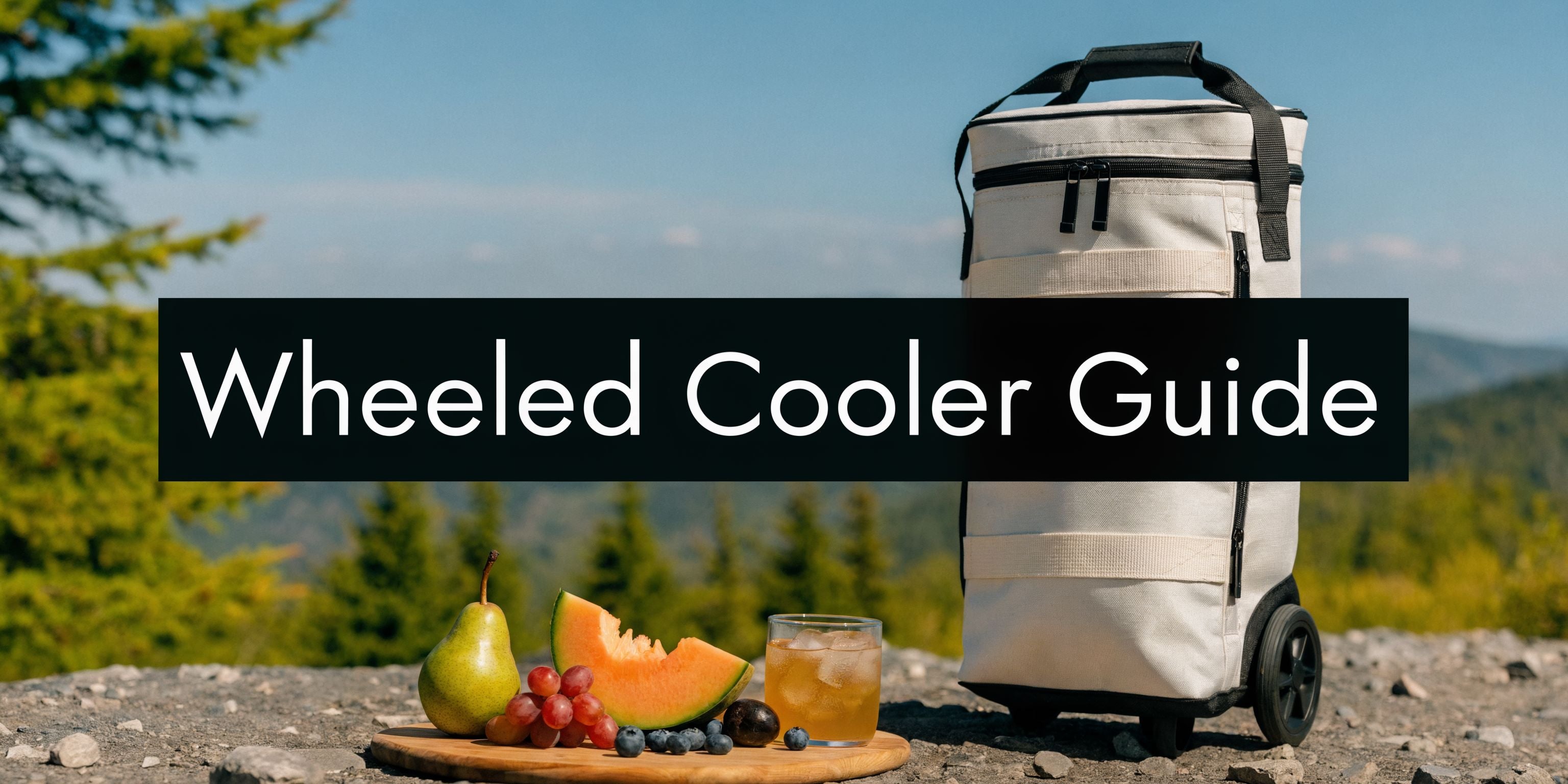
You know the moment. The drinks are packed, the ice is melting a little faster than you hoped, and the walk from the car suddenly feels much longer than it looked. A cooler that felt manageable in the driveway turns awkward on sand, bumpy on grass, and brutal by the time you reach the first tee, the picnic spot, or the campsite.
That is why the cooler bag on wheels has become such a practical upgrade. It is not just a cooler with extra parts. It is a different way to move weight. When you stop carrying the load and start rolling it, the whole outing gets easier.
Most first-time buyers focus on insulation first. That matters, of course. In use, portability decides whether you enjoy the cooler or fight it. Wheel size, handle angle, body shape, and where the weight sits all change the amount of effort your body has to supply. On a smooth sidewalk, almost any rolling cooler feels fine. On a golf course path, beach access point, gravel lot, or uneven park trail, the design details matter a lot more.
The End of the Awkward Cooler Carry
A lot of people buy their first cooler bag on wheels after one irritating trip too many.
Maybe it was a beach day where the cooler dug into your hand the whole walk. Maybe it was a family picnic where one arm carried the drinks while the other tried to manage chairs, towels, and a folding table. Or maybe it was a golf round where you wanted cold water for the back nine but did not want to turn your push cart into a deadlift.

The frustration is not just weight. It is awkward weight. A cooler is bulky, the load shifts as ice melts, and the shape forces your body to compensate. Your wrist twists. Your shoulder tightens. You stop halfway, set it down, and switch hands.
A wheeled design changes that equation. Instead of lifting the full load, you tilt and roll it. That sounds simple, but it is a big shift in practical effort. Wheels move the work from your grip and upper body into forward motion. A good handle lets you guide the cooler instead of wrestling it.
This is one reason the category has expanded so quickly. The global wheeled coolers market is projected to reach $14.2 billion in 2025, and the same report ties that growth to demand for portability in outdoor recreation. It also notes that nearly 50% of the 87.99 million campers in 2023 were Millennials and Gen Z, groups that prioritize convenience and durability in gear choices (wheeled coolers market projection and camper demographics).
Why rolling feels easier
Think of a loaded cooler like a suitcase full of books. If you carry it, your body supports the entire load every step. If you roll it, the wheels support most of that load, and your body mainly guides direction.
That is the core idea behind the physics of portability. The best cooler bag on wheels reduces lifting, reduces strain, and keeps the load more stable over imperfect ground.
A cooler becomes far more usable when it asks for steering instead of carrying.
Where people usually get confused
Many shoppers assume all rolling coolers solve the same problem. They do not.
Some are great for airport-style pavement and miserable on grass. Some hold ice well but tip easily when packed unevenly. Some look light in the store and become frustrating once loaded with drinks, food, and ice.
The right choice starts with understanding the machine itself.
Anatomy of a Modern Wheeled Cooler Bag
A modern cooler bag on wheels is best thought of as an integrated mobility system. The insulated body keeps contents cold, but the frame, wheels, and handle decide how hard the cooler is to live with.
The easiest analogy is a car. The insulated compartment is the body. The wheelbase and structure underneath act like the chassis. If the chassis is weak or badly balanced, even a nice body feels unstable.
Soft-sided, hard-sided, and hybrid builds
These three formats dominate the category, and each behaves differently in practical situations.
| Type | What it feels like in use | Best fit |
|---|---|---|
| Soft-sided | Lighter, easier to store, often has exterior pockets | Day trips, park use, lighter loads |
| Hard-sided | More rigid, better impact resistance, often stronger insulation | Long outings, rougher handling, heavier drink loads |
| Hybrid | Mixes soft storage flexibility with added structure | People who want balance between portability and protection |
A soft-sided cooler bag on wheels usually appeals to first-time buyers because it feels familiar. It behaves more like luggage. It may collapse a bit for storage, fit into a trunk more easily, and offer more pockets for utensils, napkins, or sunscreen.
A hard-sided wheeled cooler is more like a rolling chest. It resists compression better, protects contents better, and usually feels more planted when fully loaded. The tradeoff is bulk. You gain structure but lose some flexibility.
A hybrid model tries to split the difference. Some have semi-rigid walls, reinforced bottoms, or molded wheel housings attached to a softer upper body.
The parts that matter most
The cooler bags market was valued at $4,403.1 million in 2022 and is forecast to expand at a 4.6% CAGR from 2024 to 2031, with growth tied to leak-proof designs, durable materials, and integrated convenience features (cooler bags market growth and design trends). That broad growth makes sense when you look at how much the designs have evolved.
The key parts to inspect are:
- The wheel setup Bigger wheels usually roll over obstacles more easily. Small wheels can feel fine indoors and frustrating outdoors.
- The handle system A telescoping handle changes the pulling angle. A side handle matters when lifting into a trunk.
- The base and frame A reinforced base helps the cooler keep its shape and stay upright.
- The insulation package Foam thickness, wall structure, and lid design all affect cold retention.
- The closure Zippers, latches, and lid openings affect both leak control and convenience.
Why these parts work together
A cooler with excellent insulation but poor wheels can still be a bad buy. A cooler with rugged wheels but a floppy frame may drag awkwardly once the contents shift.
That is why experienced buyers do not judge a rolling cooler by capacity alone. They ask a more useful question: How will this feel after ten minutes of practical use?
A simple way to evaluate build quality
Pick up the front edge slightly, as if you were about to pull it. Notice what happens.
- Does the body twist?
- Do the wheels wobble?
- Does the handle flex?
- Does it feel nose-heavy or balanced?
Those small signals tell you a lot. A well-designed cooler bag on wheels feels composed before it even moves.
How to Choose Your Perfect Rolling Cooler
Most buying mistakes happen because people shop by storage size and color first. In practice, the smarter order is this: terrain, load, insulation, then extras.

If your cooler cannot move comfortably where you intend to go, the rest of the specs matter less.
Start with the ground you roll over
This is the most overlooked factor.
A major gap in product marketing is uneven-terrain performance. Product claims often promise smooth rolling, but the underlying issue is that standard spinner-style wheels often struggle on grass or sand. The same source points to a 25% rise in outdoor recreational demand post-2025, which makes this missing detail more important for buyers choosing gear for non-paved settings (uneven terrain performance gap in wheeled soft coolers).
Smooth pavement
If you mostly use the cooler for parking lots, sidewalks, sports sidelines, or paved paths, you can get away with smaller wheels and a lighter frame.
You will likely appreciate:
- Compact size
- Easy trunk loading
- Quick access pockets
Grass, gravel, and golf paths
On uneven terrain, many buyers discover the difference between “rolls” and “rolls well.”
On uneven terrain, the wheel has to climb over small obstacles repeatedly. Larger, wider wheels do that with less stopping and less wrist correction. A narrow wheel tends to sink, stall, or bounce.
Sand
Sand is the hardest common surface. Small hard wheels dig in. Spinner wheels are usually poor here. A beach-friendly cooler needs wider contact with the ground and enough structure that the cooler does not fishtail behind you.
If you expect beach use, treat wheel design as a primary feature, not a bonus feature.
Choose size by outing, not by maximum capacity
A bigger cooler is not automatically better. It gets heavier fast, takes more ice, and becomes harder to lift into a car.
Think in terms of trip pattern:
- Solo use or a short round of golf A compact model keeps drinks and snacks cold without making every turn awkward.
- Couple or small family outing Mid-size works well when you want lunch, drinks, and a little spare room.
- Group day at the beach or tailgate Large capacity helps, but only if the wheelbase and handle are up to the load.
A half-empty oversized cooler also wastes internal space and can lead to more shifting during movement.
Understand insulation without getting lost in jargon
Manufacturers use many terms, but the core question is simple: How long does it stay cold for your use case?
A few practical rules help:
- Rigid walls usually retain cold longer than very flexible walls.
- Better lid sealing reduces warm air exchange.
- Thicker foam usually helps, especially in the lid and base.
- Frequent opening shortens practical performance more than shoppers expect.
If you mainly need cold drinks for an afternoon, a well-made soft-sided rolling cooler may be enough. If your trips run long in heat, more structure becomes valuable.
Pay close attention to handle geometry
Handles do more than extend.
A good telescoping handle should let the cooler trail behind you at an angle that keeps the wheels planted. Too short, and you kick the back of the cooler. Too tall or too flexy, and the load wobbles.
This matters even more for golfers who may want to pair a cooler with another rolling setup. If that is your use case, it helps to review examples of how golfers think about cart-mounted beverage storage in this guide to a golf cart bag cooler.
Materials that survive real use
Many buyers look at exterior fabric and stop there. Instead, inspect the stress points.
Look for:
- Reinforced wheel mounts
- Strong zipper tracks
- A wipe-clean liner
- A base that does not sag when lifted
- Stitching around handles and anchor points
A cooler bag on wheels fails early when its mobility parts and soft parts age at different speeds. For example, the insulation may still be fine while the wheel housing loosens or the zipper starts separating.
Smart extras that matter
Some extras are useful. Some are clutter.
Worth having:
- Exterior dry pockets
- Easy-clean interior
- Drain feature on larger rigid models
- Compression straps or tie-down points
- Stable top opening for fast access
Less important unless you know you want them:
- Decorative attachments
- Novelty gadgets
- Complicated lid systems that slow access
A quick buyer filter
If you are stuck between two models, ask these questions in order:
- Will it roll well where I intend to go?
- Can I lift it when fully packed?
- Will the insulation match the length of my outings?
- Does the handle feel stable and comfortable?
- Are the materials likely to survive repeated loading and unloading?
That sequence prevents the classic mistake of buying a cooler that looks great in a product photo but becomes annoying after the second trip.
Matching Your Cooler to Your Adventure
A cooler bag on wheels makes sense in many settings, but the best one for a beach day is not always the best one for family travel or a golf outing. Context changes everything.

The beach day
At the beach, the winning features are mobility and stability.
Sand exposes weak wheels immediately. A cooler that glides through a parking lot can become a dead weight once the path turns soft. Wide wheels, a firm base, and a body that stays upright matter more than extra pockets.
You also want a cooler that is easy to wipe down after salt, sunscreen, and grit. Beach use is messy. A fussy interior is a bad match.
The park picnic
A park setup usually rewards convenience over extreme ruggedness.
If your walk is short and the surface is mostly grass or pavement, a lighter soft-sided rolling cooler often feels better than a large hard box. It is easier to get out of the trunk, easier to tuck next to a blanket or folding chair, and less intrusive when space is tight.
A top-access opening is useful here. You are opening it often for drinks and snacks, so quick access beats expedition-level insulation.
The family road trip
On family travel days, the cooler often does double duty. It works as food storage and as a portable station for drinks, fruit, or sandwiches during stops.
What matters most:
- A shape that fits in the car
- A lid you can open without unpacking half the trunk
- Handles that make lifting manageable
- Leak resistance
A model that stands upright and stays balanced while rolling through rest areas or hotel parking lots is easier to live with than one that has slightly more capacity but awkward dimensions.
Here is a quick visual walkthrough before the next set of use cases.
The tailgate
Tailgates reward capacity, but only up to the point where the cooler becomes annoying to unload.
A big cooler is great when several people share it. But if one person has to drag it from a distant parking spot, wheel quality and handle comfort become just as important as storage space. A stable footprint helps too, since the cooler often ends up serving as a grab-and-go station.
For group use, choose the largest cooler you can still load and steer confidently on your own.
The walking golfer
Golf is a special case because the cooler becomes part of a moving system.
You are not just rolling the cooler from car to destination. You may be moving it over several miles, over slopes, cart paths, rough edges, and turf. That changes what “portable” means. A compact, stable cooler with predictable movement often beats a larger one that constantly pulls off line or adds drag to your setup.
For golfers, the best cooler is usually the one that disappears into the round. It keeps drinks cold, stays secure, and does not demand extra energy.
Integrating a Cooler Bag on the Golf Course
Golf exposes weaknesses in rolling gear faster than most other outings. A cooler that seems fine in a store can become awkward once you add hills, side slopes, path transitions, and a full round’s worth of movement.

The biggest mistake is treating the cooler as an afterthought. On a course, it affects balance, steering, fatigue, and pace.
Keep the size modest
For golf, smaller is often smarter.
A cooler packed for one or two players can stay out of the way, fit more easily into common push cart baskets or accessory zones, and put less strain on the cart when turning. A larger cooler may hold more, but it can also make the whole setup top-heavy or rear-heavy.
If you use a push cart, think about the cooler as cargo. Cargo should sit low, stay centered, and avoid interfering with wheel clearance or folding points.
Secure it so it cannot swing
A cooler that shifts while walking creates more than annoyance. It changes how the cart tracks.
Use straps or existing mounting points so the cooler cannot:
- slide side to side
- swing while crossing a slope
- bounce against the frame
- block brake access or storage access
The goal is to make the cooler move as if it were part of the cart.
Pay attention to weight distribution
The physics of portability really shows up in this context.
When weight sits too high, the cart feels tippy. When it sits too far back, the handle feels heavier and the front end may wander. When it sits off-center, every push and turn requires correction.
Golfers who want ideas for practical mounting and storage layouts can compare common approaches in this guide to a golf push cart cooler.
Why motorized assist matters
There is a clear content gap around electric-assisted wheeled coolers and related mobility setups. The available material notes 40% growth in electric outdoor gear sales and points out that mainstream brands still focus heavily on manual models, despite interest from users such as seniors and golfers who want less strain (electric-assisted outdoor gear trend and unmet demand).
That gap matters on the course.
A loaded cooler increases rolling resistance. It also increases the effort needed on hills, in longer transitions, and late in the round when fatigue builds. Motorized assistance does not just make the setup easier. It changes the penalty of bringing refreshments along in the first place.
A practical setup checklist for golfers
- Choose compact first Bring what you plan to drink, not a party-sized load.
- Mount low when possible Lower placement helps stability and makes turns feel cleaner.
- Test turning radius Walk a few tight circles before the round. Make sure the cooler does not clip a wheel or frame.
- Check access You should be able to reach the zipper or lid quickly without unstrapping the whole system.
- Walk a slope before teeing off If the cart pulls sideways or feels tail-heavy, adjust the cooler position.
Golf gear works best when each piece supports the walking experience. If the cooler adds enough drag that you notice it every hole, the setup needs revision.
Pro Tips for Packing and Maintenance
A good cooler bag on wheels performs best when you pack it with intention. Many people judge a cooler too quickly when the issue is poor loading, warm contents, or sloppy cleanup after the trip.
Pack for temperature, not just space
Cold retention starts before the first drink goes in.
A premium rolling cooler with about 2 inches of polyurethane foam insulation can maintain ice for up to 48 hours in 90°F ambient conditions, and the same source notes that this level of performance can be double that of many soft-sided bags (premium rolling cooler insulation performance). That kind of result depends on smart packing, not just the cooler itself.
Use these habits:
- Pre-chill the cooler If possible, cool the interior before loading. Starting with a hot shell wastes ice.
- Load cold items only Warm drinks melt ice fast.
- Use enough ice A practical rule from the same product guidance is a 2:1 ice-to-contents ratio for strong cold retention in demanding conditions.
- Keep air gaps small Empty space warms faster than tightly packed contents.
- Open it less often Every open lid invites heat inside.
The cheapest way to improve cooler performance is better packing discipline.
Golfers who want to compare portable beverage storage ideas can also review this overview of a golf bag cooler.
Pack with rolling in mind
Temperature is only half the job. Mobility matters too.
Put heavier items low and close to the wheel side if the cooler design allows it. That helps the unit feel steadier while rolling. Avoid stacking all the weight high on one end, which can make the cooler tip or sway.
For mixed contents, place:
- drinks and ice low
- delicate food above
- dry items in exterior pockets if available
Clean it before odors settle in
The fastest way to ruin a cooler is to close it up damp after a trip.
Do this every time:
- Empty all melted ice and debris
- Wipe down the liner
- Clean seams and corners where residue hides
- Leave the cooler open until fully dry
- Dry the wheels and axle area if they picked up sand or mud
Protect the moving parts
Rolling coolers often fail at the motion points first.
Check these regularly:
- Wheels for trapped grit
- Axles or mounts for looseness
- Telescoping handles for sticking
- Zippers for salt, dust, or food buildup
A cooler bag on wheels can last a long time if the rolling hardware stays clean and the fabric is not stored wet.
Store it the right way
Store the cooler dry, slightly open if possible, and out of prolonged direct sun. If the handle telescopes, collapse it gently rather than forcing it. If the wheels are removable, clean them before long storage.
That kind of simple care protects insulation, liner, odor control, and smooth rolling all at once.
Your Next Step to Effortless Cooling
The best cooler bag on wheels is not the one with the longest feature list. It is the one that fits your ground, your load, and your routine.
If you spend time on beaches, parks, campsites, or golf courses, portability is not a side detail. It is the feature that shapes the whole experience. Good insulation keeps drinks cold. Good wheel and handle design keeps your day from turning into a carrying workout.
The smart way to buy is to think like a user, not a spec sheet reader. Consider where you roll, how far you move it, how often you lift it, and whether the cooler becomes more helpful or more annoying once fully packed. That mindset prevents most regrets.
A cooler should remove friction from an outing. It should not add another chore. When the size is right, the wheels suit the terrain, and the load stays balanced, the cooler fades into the background and does its job.
That is the fundamental upgrade. Not just colder drinks, but less effort getting them where you want them.
If you walk the course and want to reduce the effort of hauling extra gear, including a stocked cooler, Caddie Wheel is worth a look. It adds lightweight electric power assist to many standard golf push carts, helping you keep refreshments on board without turning every hill into extra work.
Share:
Power Wheels Motor Replacement: Restore Speed!
2026 Review Golf Push Carts: Best Buyer's Guide