
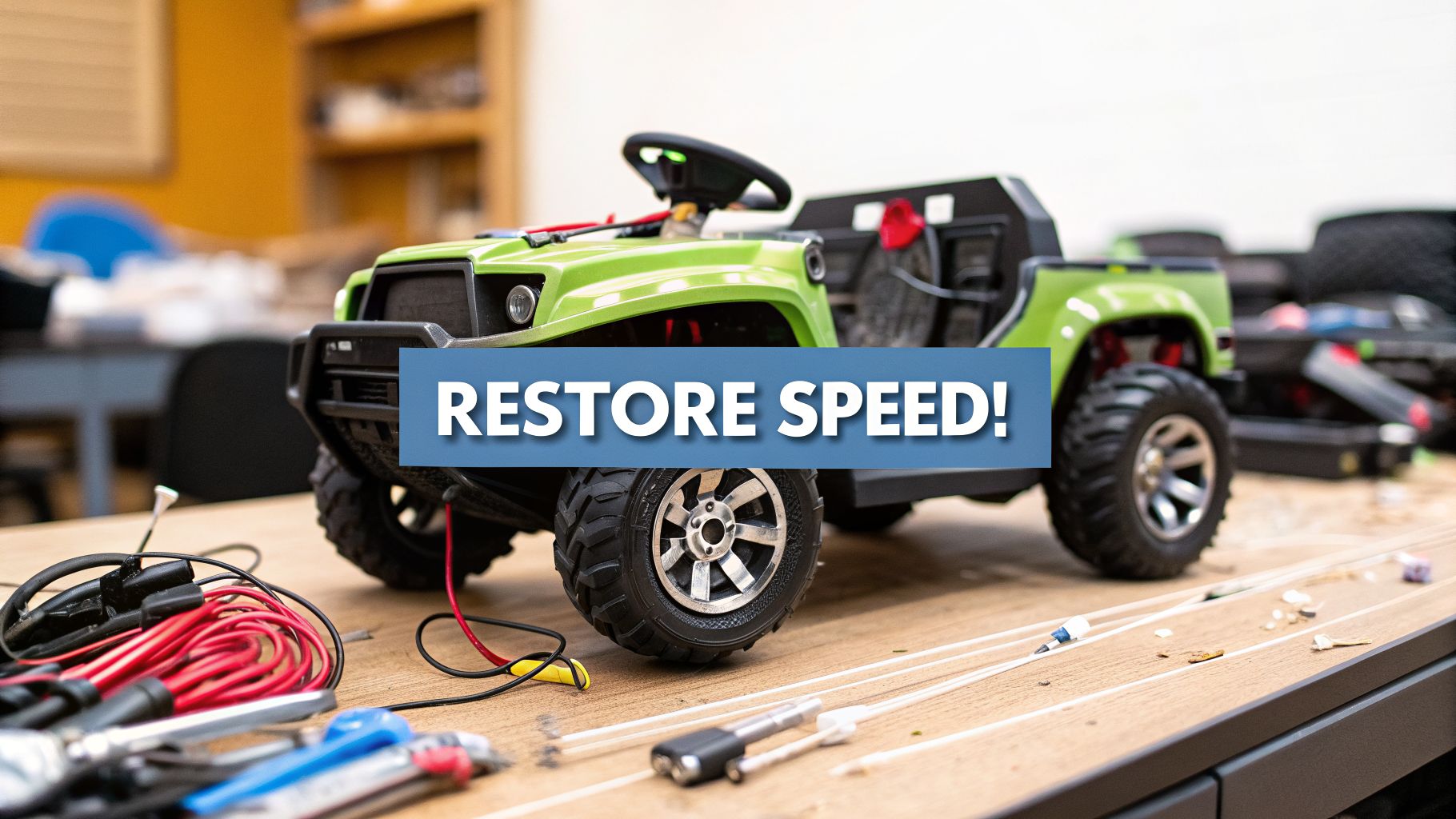
It's a frustrating moment for any parent. That familiar whir of your child's favorite ride-on has faded to a sad groan, and the toy is barely inching along. Before you jump online and order a Power Wheels motor replacement, it’s smart to take a step back and confirm the motor is actually the problem.
A proper diagnosis can save you from a frustrating—and expensive—wild goose chase.
Diagnosing a Failing Power Wheels Motor

Pinpointing the source of a Power Wheels problem is the most important first step. I’ve seen countless parents order a new motor, only to discover the real issue was a loose wire, a tired battery, or a finicky switch. By listening and looking for specific clues, you can confidently figure out if the motor is the true culprit.
Often, the most common signs of motor failure are pretty obvious. Your kid might complain that their Jeep or Mustang is way slower than it used to be, or maybe it struggles to get going at all. This sluggish performance is a classic sign of a worn-out motor that just can't produce the power it once did.
Listen for Warning Signs
Believe it or not, your ears are one of your best diagnostic tools. A healthy Power Wheels motor has a consistent, smooth whirring sound. When a motor starts to go, that sound changes dramatically.
Pay close attention to these new noises:
- Grinding or Clicking: This usually points to trouble inside the gearbox where the motor connects. You could be dealing with stripped plastic gears or a damaged pinion gear on the motor shaft itself.
- Loud Whining: A high-pitched whine that gets more intense under load often suggests the motor's internal bearings are failing.
- Intermittent Buzzing: If you hear a buzz when the pedal is pressed but get no movement, the motor might be seized up or receiving inconsistent power.
Key Takeaway: Any new sound is a direct signal from the vehicle's powertrain. A new grinding, whining, or clicking noise almost always means it’s time to open up the gearbox and take a look at the motor.
Power Wheels Motor Failure Symptom Checklist
To make things easier, here’s a quick checklist to help you identify the problem based on what you’re seeing and hearing.
| Symptom | What It Means | Recommended Action |
|---|---|---|
| No movement, no sound | Likely an electrical issue before the motor (battery, switch, or wiring). | Check battery charge and all wire connections first. |
| Vehicle is slow or weak | The motor is likely worn out and losing torque. | Perform a visual inspection and prepare for a replacement. |
| Grinding or clicking noises | Almost certainly a problem with the gears in the gearbox. | Open the gearbox to inspect the gears and motor pinion. |
| Burning smell | The motor has overheated and is likely fried. | Immediately disconnect the battery and inspect for melted wires. |
| Intermittent stopping | Could be a loose wire, a failing switch, or a dying motor. | Check all connections; if they're secure, the motor is suspect. |
This table should help you narrow down the possibilities before you start taking things apart.
Conduct a Visual and Olfactory Inspection
Sometimes, the best evidence is something you can see or even smell. Carefully inspect the motor area for any obvious red flags. A distinct burning smell is a major warning sign. This odor often means the motor has seriously overheated and its internal windings are toast. In fact, some sources suggest a burning smell is linked to as many as 40% of motor failure cases in these toys.
Look closely for any frayed or melted wires connected to the motor. Bad connections can cause overheating and spotty power delivery, which will eventually destroy the motor. As you dig in, having a basic grasp of the motor control circuitry can help you spot electrical problems that go beyond just the motor itself.
And if you want to get really technical, many of the same diagnostic principles apply to larger electric vehicles. We cover some of those in our guide on how to test a golf cart motor, and you might find it surprisingly helpful.
Gathering Your Tools and the Right Motor
Before you start unscrewing a single thing, let's get organized. There’s nothing worse than getting halfway through a project, with parts scattered everywhere, only to realize you’re missing a crucial tool.
Taking a few minutes now to gather your gear and double-check you have the correct replacement motor will make this whole process a lot smoother. Trust me, it beats a last-minute trip to the hardware store.

The good news is you don’t need a professional mechanic’s garage. Most of this stuff is probably already in your toolbox.
Your Essential Tool Checklist
Make sure you have these items laid out and ready to go before you even think about popping off a wheel. Each one has a specific job to do, and having them handy will save you a ton of hassle.
- Screwdriver Set: You'll definitely need a Phillips head and probably a flathead screwdriver to get the vehicle's body panels off and crack open the gearbox.
- Wrenches or a Socket Set: These are for removing the wheels, which is your first major step to get to the gearbox and motor assembly.
- Pliers: A pair of needle-nose pliers will be your best friend for unplugging those stubborn little wire connectors and gripping small parts without dropping them.
- Wire Strippers and Crimpers: If your new motor doesn’t come with plug-and-play connectors, you’ll need these to prep the wires for a solid connection.
A multimeter is an absolute game-changer for any electrical work. Even a cheap one can confirm if the old motor is actually dead by testing its continuity. It can also tell you if power is reaching the motor in the first place, saving you from replacing a part that wasn't even broken.
Selecting the Correct Replacement Motor
This is the most critical part of your prep work. Grabbing the wrong motor can lead to a sad kid, a damaged gearbox, or a ride-on that’s dead on arrival. You have to match the size, voltage, and performance specs to your particular Power Wheels model.
While the basic idea is similar for any electric vehicle—something you can read about in our guide on choosing an electric motor for a golf cart—these little ride-on toys have their own specific needs.
First, find your Power Wheels' model number. It's usually on a sticker under the hood or somewhere near the battery compartment. That number is your golden ticket to finding compatible parts. Once you have it, you can zero in on three key specs.
1. Motor Size: The two most common sizes you'll encounter are 550 and 775. The vast majority of standard Power Wheels vehicles use 550 motors. The 775 is a larger, more powerful motor often used for performance upgrades, but be warned: it requires a gearbox that's built to handle it.
2. Voltage: This is completely non-negotiable. You must match the motor's voltage to your vehicle's battery. If you put a 12V motor in a ride-on with a 24V battery system, you’ll burn it out in seconds.
3. RPM and Pinion Gear: The motor's RPM (Revolutions Per Minute) dictates its speed. A stock motor typically runs around 15,000 RPM. Just as important is the small gear on the motor's shaft, called the pinion gear. The new one must have the exact same number of teeth as the old one to mesh properly inside the gearbox.
Removing the Old Motor and Gearbox
Alright, you’ve got your tools lined up and the shiny new parts are waiting. Now for the fun part—getting your hands dirty and pulling out that old motor. This is really where the project starts.
We're going to take off the drive wheel, crack open the gearbox, and then finally get the motor out. Don't let it intimidate you; it's a pretty straightforward process. Just work methodically, keep your parts organized, and you'll have it done before you know it.
First Up: Getting the Wheel Off
Your first job is to get that drive wheel off. The whole motor and gearbox assembly is tucked away right behind one of the rear wheels (or both, if you have a dual-motor setup). Go ahead and lay the Power Wheels on its side so you can get a clear shot at the axle.
This is where you'll probably hit your first snag: the dreaded push nut.
These little metal caps are a real pain. They’re pressed on at the factory and are designed as a one-way trip—easy to put on, but a nightmare to take off. The trick is getting them off without bending the axle or cracking the plastic wheel hub in the process.
The best method I've found is to use two flathead screwdrivers. Wedge one under each side of the push nut and gently pry upward, wiggling it back and forth. It’ll eventually pop off, but it will almost certainly be bent beyond reuse, so make sure you bought a replacement. Some folks even use this as a chance to thread the axle and switch to a more reliable nyloc nut for future repairs.
Opening the Gearbox Assembly
With the wheel gone, the entire plastic gearbox assembly should slide right off the axle. This housing contains all the gears and the motor itself. It’s time to get inside.
You’ll see a handful of Phillips head screws holding the two halves of the casing together. Before you go any further, do these two things:
- Take a photo: Seriously, snap a quick picture of the gearbox before you open it. It’s an absolute lifesaver when you’re trying to remember which gear goes where.
- Keep screws safe: Use a magnetic tray, a cup, or even just a piece of tape to keep all the screws together. They have a way of disappearing.
Once you've removed all the screws, carefully pry the two halves of the gearbox apart. The gears inside will be loose, so be ready. I like to lay them out on a shop towel in the exact order they came out. This is also the perfect moment to inspect them for any stripped teeth or hairline cracks. Plastic gears are cheap, and replacing them now is way easier than taking this all apart again later.
With the gearbox open, you'll finally have a clear view of the motor sitting in its cradle. You’ll see two wires connected to it. Just pull their spade connectors straight off the motor’s terminals. If they’re a bit stubborn, a gentle wiggle with a pair of needle-nose pliers will do the trick.
The motor should now lift right out. Give it a quick look first, as some are held in by a small clip or screw. And just like that, the old motor is out. You're now officially ready for the next phase of your power wheels motor replacement.
Installing Your New Power Wheels Motor
Alright, the old motor is out of the gearbox. Now for the fun part: getting the new one in and bringing that Power Wheels back from the dead. This is where a little patience goes a long way.
We’re going to focus on getting the motor seated perfectly, dealing with that tiny but all-important pinion gear, and wiring it up so the wheels spin the right way. Getting this right means you won't be tearing it all apart again in a week.
Seating the Motor and Pinion Gear
First things first, drop the new motor into its cradle inside the gearbox housing. It should sit snug and flush, without any rocking. A wobbly motor is a recipe for stripped gears, so make sure it feels solid before moving on.
Now, let's talk about the single most critical piece in this whole operation: the pinion gear. It's that little metal gear on the motor's shaft, and it's what makes everything else go.
- Count the Teeth: Before you do anything else, count the teeth on the old pinion and the new one. They must match. If your gearbox needs a 19-tooth pinion, a 21-tooth version simply won't work. The gears will either fail to engage or grind themselves into plastic dust on the first ride.
- Get It Secure: Slide the pinion gear onto the new motor shaft. If it has a tiny set screw, here’s a pro tip: add a single drop of blue Loctite or a similar thread-locking compound. This is a cheap insurance policy against vibrations shaking it loose.
A loose pinion gear is one of the most common reasons for a repeat failure after a Power Wheels motor replacement. The motor will spin, but the wheels won’t move. A dab of thread-locker is a simple step that prevents you from having to do the entire job twice.
While you're at it, this is a great time to check for other worn parts. The push nuts holding the wheels on are often a one-time-use part and get mangled during removal. Some folks even get creative and thread the axles to use sturdier nyloc nuts or shaft collars. You can find some great ideas for these kinds of upgrades on sites like Instructables.com.
This graphic breaks down the removal process into its three main stages, which you've just completed.

Finalizing the Wiring and Connections
With the motor and pinion gear locked in, it's time to reassemble the gearbox. Pop the plastic gears back into place—this is where that photo you took earlier comes in handy—and screw the housing together.
Slide the whole gearbox assembly back onto the axle. You're almost there. Now, for the wiring.
This is a detail you really want to get right: polarity. If you hook the wires up backward, the motor will just spin in reverse. The car will go backward in forward gear and vice-versa. It won't break anything, but it’s definitely annoying to fix.
Take the two wires from the vehicle's harness and connect them to the terminals on the end of the motor. If you’re using the standard spade connectors, make sure they have a firm, snug fit. A loose connection can cause sparks, power loss, and even melt the plastic.
For a rock-solid connection that will never fail, soldering the wires is the ultimate solution, but it does require some skill and the right tools.
Once the wires are connected, put the wheel back on and secure it with a new push nut. Now, don't just hand it back over yet. There’s one last thing to do. Give it a quick test to make sure your repair was a success.
Deciding Between a Stock vs. Upgrade Motor
Alright, now for the fun part of any Power Wheels motor replacement—deciding what you're actually putting back in. Are you just trying to get the little car running again for the weekend, or are you secretly looking to give it a bit more oomph?
Your choice here is what really shapes the project.
Sticking with a stock motor is the most straightforward path. It’s a simple one-for-one swap that guarantees it’ll play nice with your existing gearbox and wiring. This brings the ride-on back to its factory performance, and honestly, for most parents just trying to fix a broken toy, it's the perfect no-fuss solution.
But if the word "faster" has been bouncing around in your head, an upgrade can be pretty tempting. This is where you can seriously dial up the fun, but it definitely comes with some trade-offs to think about.
Understanding Your Upgrade Options
Diving into motor upgrades isn't a one-size-fits-all deal. You can go for a mild boost or a full-blown performance overhaul, and each path has its own set of requirements. It's smart to know what you're getting into before you click "buy."
The Power Wheels world has more or less settled on the 550-size motor as its standard. Most stock vehicles ship with a 550 motor that spins at about 15,000 RPM. For a noticeable but still manageable bump in speed, a "Performance 550" motor can often handle up to 18 volts and deliver a solid 10-15% speed increase. If you're curious about the specifics, you can find some great insights on motor upgrades from MLToys.com.
For those who want a serious jump in power, the Performance 775 motor is the next big step. These motors are physically larger, churn out way more torque, and can handle higher voltages for a speed boost that’s genuinely impressive. While a stock motor might top out at 15,000 RPM, a popular upgrade like a Traxxas Titan 775 can get closer to 21,000 RPM. All that extra power is a blast, but it also puts a lot more stress on the rest of the vehicle.
Before you jump into a high-performance upgrade, it's worth taking a look at how stock motors compare to some of the common aftermarket choices. The differences in power and compatibility are significant.
Stock vs. Upgrade Motor Comparison
| Motor Type | Typical RPM | Voltage Compatibility | Performance Gain | Key Consideration |
|---|---|---|---|---|
| Stock 550 | ~15,000 RPM | 12V | None (Baseline) | Easiest direct replacement; guaranteed compatibility. |
| Performance 550 | ~18,000 RPM | 12V-18V | 10-15% speed boost | A good middle-ground upgrade. May need better wiring. |
| Performance 775 | ~21,000 RPM | 18V-24V | 30%+ speed boost | Requires gearbox, wiring, and potentially battery upgrades. |
As you can see, the leap to a 775 motor is substantial. It's not just a simple swap; it's the start of a more involved modification project that requires you to upgrade other components to handle the new power.
The Real-World Trade-Offs of More Speed
More speed is a ton of fun, but it doesn't come for free. When you upgrade a motor, you’re introducing new challenges that have to be managed to keep things safe and prevent parts from breaking.
- Decreased Battery Life: A faster, more powerful motor pulls more current. That means your battery is going to drain noticeably quicker.
- Gearbox Strain: Those stock plastic gearboxes were built for stock motors. A high-torque 775 motor can chew up and spit out those plastic gears in a matter of minutes if you don't upgrade to a more durable metal version.
- Wiring and Safety: More power creates more heat. You’ll likely need to upgrade the factory wiring, fuses, and switches to handle the increased electrical load without melting something or creating a fire hazard.
Think about the bigger picture. A full performance upgrade can be an incredibly rewarding project, but it often snowballs into something bigger. If you're curious about more advanced mods, our guide on Power Wheels conversion kits can give you a good idea of what's possible.
As you look at different upgrades, you might also get a kick out of exploring other innovations in the world of powerful toys. At the end of the day, it's all about balancing your child's safety and your budget with the undeniable thrill of a little extra speed.
Common Questions About Motor Replacement
As you get your hands dirty with a Power Wheels motor replacement, a few questions will almost certainly come up. Let's tackle them now so you can keep things moving and avoid getting stuck mid-project. These are the most common things we see DIYers wonder about.
Can I Put a Faster Motor in Any Power Wheels?
The short answer is yes, but you need a solid plan. If you're just looking for a little more zip, swapping the stock 550 motor for a "performance" 550 version is a pretty straightforward upgrade. It usually gives you a nice bump in speed without needing to overhaul the whole system.
But if you’re dreaming of a serious speed boost—like jumping to a bigger 775 motor or upping the voltage—you've got to think about the entire system. That much power will overwhelm the stock parts. You'll need a tougher gearbox, thicker wiring, and likely a new electronic speed controller that can handle the extra juice without melting down. Always double-check component compatibility before you buy.
We strongly recommend replacing both motors if your vehicle has two, even if only one is on the fritz. A brand-new motor is much stronger than a worn-in one, which creates a serious imbalance. The vehicle might pull to one side, cause uneven wear on the tires and gearboxes, and ultimately put a lot of extra strain on your shiny new motor.
My New Motor Runs Backward. What Did I Do Wrong?
Relax, you didn't break anything! This is probably the most common head-scratcher after a motor swap, and luckily, it's an incredibly simple fix. It just means the motor's electrical polarity is reversed.
First, disconnect the battery to be safe. All you have to do is swap the two wires connected to the motor's terminals. Move the wire that was on the left post to the right one, and the right one to the left. That’s it. This reverses the motor’s spin and will get the wheels rolling in the right direction.
What Does the Turn Count on a Motor Mean?
The "turn" or "T" count you see on a brushed motor (like "21T") tells you how many times wire is wound inside it. This number is a great indicator of how the motor will perform.
Here’s a simple rule of thumb to remember:
- Lower Turn Count: Fewer wire turns generally mean higher RPM (more top speed) but less torque (the "oomph" to get going from a standstill).
- Higher Turn Count: More turns give you lower RPM (less top speed) but much more torque, which is fantastic for climbing hills or quick take-offs.
For a great all-around Power Wheels upgrade, a motor like the popular Traxxas Titan 550 (a 21-turn motor) is a fan favorite. It offers a fantastic mix of extra speed without giving up too much of that crucial starting power.
At Caddie Wheel, we believe in making things easier. While we specialize in effortless golf, we love the spirit of a good DIY project. Learn more about our simple, powerful electric golf caddie at https://caddiewheel.com.
Share:
Optimize Your PowerDrive Club Car Charger
Cooler Bag on Wheels: The Ultimate Buyer's Guide for 2026