
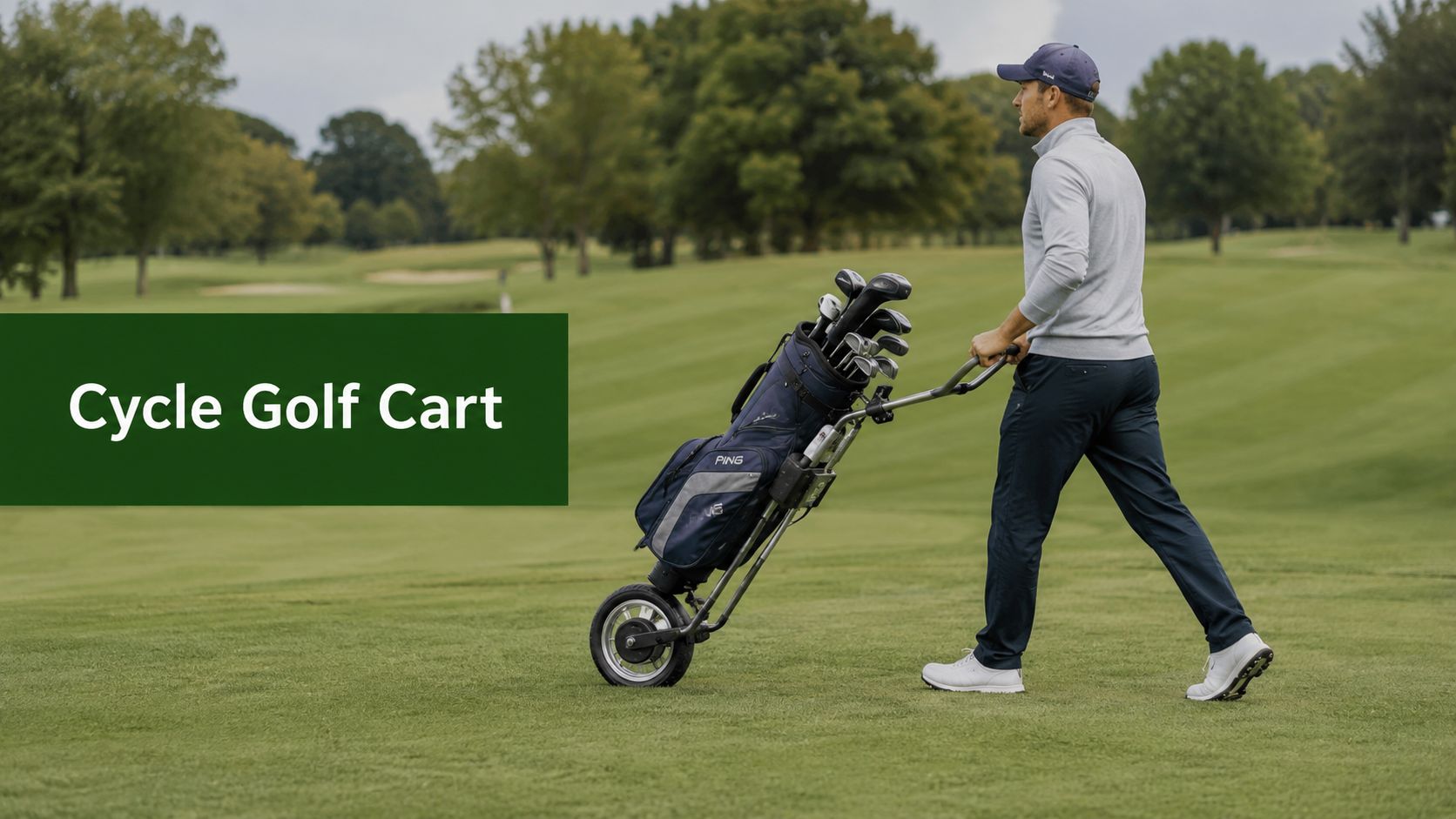
You know the feeling. The front nine is fine, then the back nine turns into a tug-of-war with your push cart. Every slope feels steeper. Every long walk between shots takes a little more out of your legs. By the time you reach an uphill par 4 late in the round, you're not just thinking about the shot. You're thinking about the bag, the wheels, and the push.
That's where a Cycle Golf Cart starts to make sense.
Not the full riding cart. Not a whole new electric trolley, either. I'm talking about the upgrade path that a lot of walking golfers overlook. You keep the push cart you already like, then add motorized assist so the cart helps move itself. It's a practical middle ground for golfers who still want to walk but don't want to spend the round wrestling their gear.
That timing fits a bigger shift in golf mobility. The golf cart market is projected to reach USD 5.1 billion by 2035, and one market analysis estimated the electric segment at about 62% in 2025, which points to a clear move toward battery-powered solutions across the category, not just ride-on carts (golf cart market projections from Global Market Insights).
The End of Uphill Battles on the Golf Course
I've played with plenty of golfers who love walking but hate what pushing does to their round.
One friend is the classic example. He's not looking for a ride cart, and he doesn't want to give up the exercise. But on a hilly course, you can see the tradeoff by the 12th hole. His tempo gets quicker. He starts parking the cart short of where he really wants it because he's tired of dragging it around. By the closing stretch, the cart has become part of the challenge.
That's the problem a Cycle Golf Cart tries to solve.
Walking stays. The grind goes down.
The idea is simple. You still walk the course. You still get to play the game at walking pace. But instead of shoving a loaded push cart up every incline, you add powered assistance to the cart you already own.
That matters more than many golfers realize.
For some players, fatigue is just annoying. For others, it changes how often they can walk, how many holes they can comfortably finish, and how much they enjoy the day. Industry discussion around golf walking products keeps circling back to one practical question: will this help me walk more holes with less pain while still letting me walk? That's the core issue for older golfers, players with knee or back limitations, and anyone who likes walking but doesn't like fighting the cart.
You don't need the cart to replace walking. You need it to stop punishing you for choosing to walk.
Why this category is getting attention
A full electric trolley can work well. So can a riding cart. But there's a gap between those two options. Many golfers already have a push cart they trust. It folds the way they like, fits in the trunk, and handles their bag well. Replacing the whole setup can feel unnecessary.
A Cycle Golf Cart sits in that gap. It upgrades what you already have. For the golfer staring at a steep fairway and thinking, “I still want to walk, just not push this thing uphill all day,” that's a very sensible answer.
Defining the Modern Cycle Golf Cart
A Cycle Golf Cart is best understood as an electric-assist upgrade for a standard push cart.
In plain English, it's usually a motorized wheel system with a battery and control setup that attaches to the push cart you already own. Instead of buying a complete all-in-one electric caddie, you convert your current cart into a powered one.

Think of it like an e-bike conversion
The easiest comparison is a bicycle.
You can buy a brand-new e-bike from scratch. Or you can take a bike you already enjoy and add an electric-assist kit that gives it powered help. A Cycle Golf Cart works much the same way. The cart is still your cart. The upgrade adds propulsion.
That distinction clears up a lot of confusion because golfers often lump all powered walking carts into one bucket. They're not all the same.
- A full electric caddie is a complete unit you buy as one product.
- A Cycle Golf Cart is an upgrade system that adds power to an existing push cart.
- A riding golf cart is a different category entirely.
If you want a broader look at how powered walking systems fit into the market, this guide to electric golf walking carts is a useful companion read.
What it usually includes
Most systems in this category revolve around three core parts:
- Motorized wheel: This is the drive unit. It provides the push so you don't have to.
- Battery pack: This powers the wheel and determines how much course you can cover before recharging.
- Control unit or remote: This lets you adjust speed, stop, reverse, or brake depending on the setup.
What it is not
This isn't a mini ride-on vehicle.
It isn't meant for speed, road use, or replacing a golf cart path vehicle. It's built to help a walking golfer move a bag around the course with less strain. That's why the smart way to judge one isn't by flashy top-end performance. It's by whether it tracks cleanly, handles slopes calmly, and stays easy to use over a full round.
The best upgrade is the one that disappears into the round. You notice your energy, not the device.
Benefits for Every Type of Walking Golfer
The biggest mistake people make with this category is assuming it's only for one kind of player.
It isn't just for seniors. It isn't just for golfers with aches and pains. It also isn't only for gear lovers who want the latest gadget. A Cycle Golf Cart solves different problems for different golfers, and that's why it has become more interesting.

For the golfer who wants to keep walking
A lot of players don't want a ride cart. They want the rhythm of walking. They like seeing the course, talking between shots, and staying loose.
What they don't like is the repetitive strain of pushing a loaded bag over uneven ground. That's especially true late in the round, when hills and long transfers start to wear them down. Coverage of motorized walking-assist products points to the same practical appeal: they can reduce physical strain and may affect pace of play and whether older or physically limited golfers can comfortably complete more holes, which ties directly to the question of walking with less pain while staying active (discussion of motorized walking assistance in golf).
For older golfers and players managing soreness
At this point, the benefit quickly becomes obvious.
If your knees complain on climbs, if your back tightens when you lean into the handle, or if your shoulders feel it by the 15th hole, powered assist can make walking feel realistic again. It doesn't remove the course. It removes a chunk of the strain.
That can mean the difference between:
- Playing more comfortably: The round feels manageable instead of draining.
- Finishing stronger: Your body still has something left at the end.
- Choosing to walk more often: You stop saving walking only for flat, easy days.
For fitness-minded golfers
Some golfers hear “motorized” and assume it cancels the health benefit.
That misses the point. The value isn't in standing still. The value is in walking without grinding yourself down by pushing weight the whole time. You still walk tee to green. You still cover the course on foot. The assist takes away the least enjoyable part of the workload.
For many players, that means they'll choose walking more often instead of taking a ride cart just to avoid the push.
Walking golf is still walking golf, even when the bag stops fighting you.
For competitive players
This group often notices a different benefit. Mental freshness.
When the course is demanding, wasted energy adds up. A tough push uphill won't ruin your swing on its own, but repeated effort can chip away at focus, patience, and decision-making. A Cycle Golf Cart helps conserve effort for the things that matter: the shot shape, the wind, the yardage, and the club.
That's why this upgrade isn't just about comfort. For the right golfer, it's about preserving quality through the entire round.
How Electric Assist Wheels Power Your Round
The technology sounds fancier than it feels in use.
On the course, a good assist system should feel simple. You want the cart to move smoothly, respond predictably, and stay under control on slopes and turns. That's it.

The motorized wheel does the pushing
The wheel is the heart of the system.
Instead of you applying force through the handle, the powered wheel creates forward motion. On flat ground, that means less effort. On inclines, it means the cart keeps moving without you leaning your body into it.
Many golfers get distracted by the wrong question. They ask how fast it goes. On a golf course, speed isn't the main issue. Independent technical specs for commercial electric golf carts commonly place them around 20 to 25 km/h, and that benchmark matters because it shows the design priority is control and maneuverability, not speed (technical golf cart speed reference).
For an assist wheel, that matters even more.
What you actually want from the drive system
- Smooth low-speed movement: Jerky starts are annoying and can pull the cart off line.
- Reliable traction: Wet grass, side slopes, and path edges all test grip.
- Braking control: You need confidence when the cart is heading downhill.
- Predictable response: The cart should do what you expect, every time.
If you want a plain-language look at the motor technology often used in these systems, this guide on the brushless motor hub helps decode the term.
The battery provides staying power
The battery determines how long the assist can keep doing useful work, especially on demanding terrain.
A flat course is easier on any battery. Hills change the math because the system needs more torque and draws more current. That's why two rounds on different courses can feel very different from the same setup.
On-course rule: If your home course climbs a lot, judge battery performance by hills, not by ideal flat-ground expectations.
The remote makes it practical
The remote is what turns powered assist from a novelty into something helpful.
You don't want to wrestle with settings while your group is waiting. A practical controller gives you straightforward commands, usually forward movement, speed adjustment, reverse, and braking. The point is quick control with very little thought.
A short product demonstration makes the experience easier to visualize:
When the system is working well, you stop thinking about the technology after a few holes. The cart just follows the pace of your round.
Installation and Battery Maintenance Explained
Most golfers ask two practical questions before anything else.
Will it fit my cart, and will it become another thing I have to fuss with?
Those are fair questions. The good news is that the appeal of this category comes from keeping things straightforward. The whole point of the upgrade path is simplicity.

Installation is usually about compatibility first
The first job is making sure the system works with your push cart's frame and wheel layout. Many assist products are built for common three-wheel and four-wheel push cart styles, but you still want to confirm fit before buying.
At a high level, installation usually looks like this:
- Check the frame attachment point. The system needs a secure place for its mounting hardware.
- Attach the bracket. This creates the connection between your cart and the powered wheel.
- Drop or lock the drive unit into place. The design varies, but the goal is a quick, repeatable setup.
- Connect the battery and test controls. Make sure movement, stopping, and direction all respond properly.
For a product-specific example of this upgrade category, this guide to a golf push cart electric conversion kit shows how the bracket-and-wheel approach works.
Battery care is simple if you respect hills
Battery maintenance sounds technical, but the habits are basic.
Recharge it regularly. Store it in a cool, dry place. Don't leave it fully drained for long periods. Those habits are especially important if you play a course with a lot of elevation.
That's because grade changes battery demand. Technical golf-cart battery guidance notes that current draw rises sharply with the grade, so a battery on a hilly course has to deliver stronger sustained power without dropping off too hard. The same guidance explains why a higher-capacity setup matters for slopes and why repeated deep discharge can shorten battery life (golf cart battery guidance for hilly terrain).
What golfers often misunderstand about battery life
“Enough battery for a round” never means exactly the same thing for every player.
Course terrain matters. Bag weight matters. Stop-and-start use matters. If you play a rolling course and often climb long cart-path sections, your battery will work harder than someone playing a flatter layout.
A few habits help:
- Charge after play: Don't wait until the next round if you can avoid it.
- Store with care: Heat, moisture, and neglect are rough on batteries.
- Match your setup to your course: Hills call for more battery confidence than flat municipal tracks.
Buy battery capacity for your hardest usual round, not your easiest one.
A Practical Checklist for Choosing Your Upgrade
If you're shopping for a Cycle Golf Cart, don't start with marketing language. Start with your own round.
Think about your course, your push cart, your bag weight, and what annoys you most today. Some golfers need hill help. Some want easier walking without replacing familiar gear. Some only want a cleaner, cheaper step into electric assist than buying a whole new trolley.
The shortlist that matters
Use this checklist when comparing options.
| Feature | What to Look For | Why It Matters |
|---|---|---|
| Compatibility | A system that fits your current push cart style securely | A smart upgrade only works if it integrates cleanly with the cart you already use |
| Battery support | Enough practical capacity for your usual terrain, especially if you play hills | Steep courses draw more power and expose weak battery setups quickly |
| Speed control | Smooth low-speed adjustment, plus reliable stopping and reversing if offered | Golf courses reward control, not raw speed |
| Installation | A mounting system that doesn't require complicated tools or permanent hassle | If setup feels annoying, you'll use it less |
| Portability | Manageable weight and an easy pack-away process | The round starts in your garage and trunk, not on the first tee |
| Braking and handling | Stable behavior on slopes, paths, and uneven turf | Downhill confidence matters as much as uphill help |
| Support and warranty | Clear product guidance and basic warranty coverage | Motorized gear is easier to own when replacement parts and support are straightforward |
What a good fit usually looks like
A strong option in this category should feel like an upgrade, not a project.
That means it should attach without drama, operate with simple controls, and solve the exact reason you started looking in the first place. If your issue is uphill fatigue, the product should address that directly. If your issue is replacing a push cart you already love, the conversion approach should preserve what already works.
One example in this category is Caddie Wheel, which is built as a motorized wheel attachment for standard push carts with a drop-on design, snap-in bracket, variable-speed remote, and a battery the company says supports up to 36 holes per charge, with a 12-month warranty based on publisher information.
The right choice is the one that helps you keep walking without turning every round into a pushing contest.
If you like your current push cart and just want help on hills, longer rounds, and tired legs late in the day, Caddie Wheel is worth a look. It's designed around the upgrade idea many golfers want: add electric assist to the cart you already own, keep walking, and make the round easier to enjoy.
Share:
How to Conserve Battery Power on Any Device
Powerstride Golf Cars: The 2026 Explainer for Golfers