
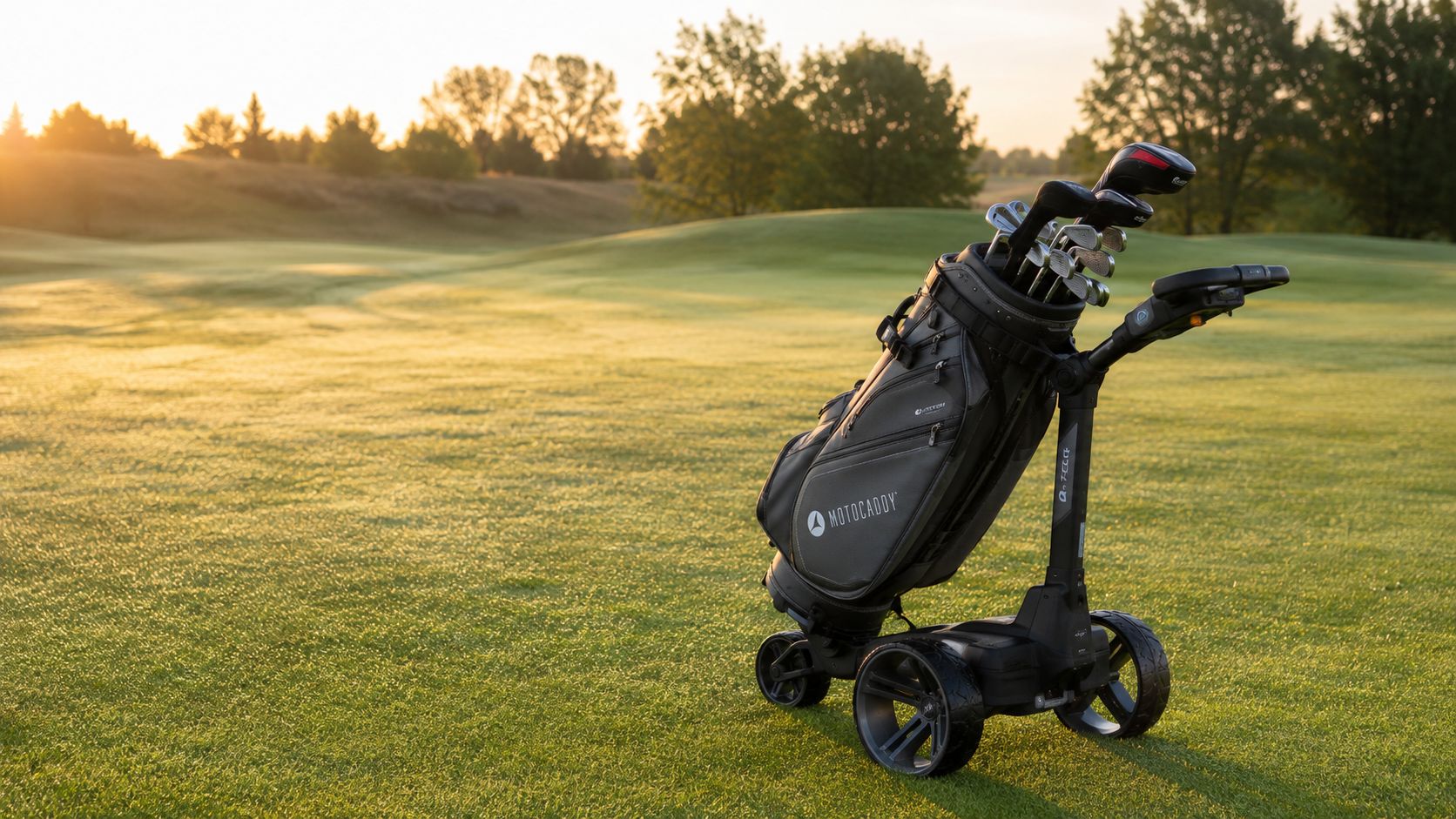
You're usually looking at motorized golf help for one of two reasons.
Either the back nine has started to feel longer than it used to, or you're tired of choosing between walking for the health benefits and riding because your legs, back, or shoulders are done by the turn. That's where the category gets interesting. “Motorized golf” no longer means just one thing.
Some golfers buy a full electric golf car from a local dealer. Others keep walking and add power to equipment they already own. Powerstride Golf Cars is a useful case study because it represents the traditional side of the market: a real local dealer with a Palm Desert location, service contact, and the kind of setup many buyers still prefer when they want a complete cart solution.
Introducing the World of Motorized Golf Carts
If you've ever finished a round thinking your swing held up better than your energy, you already understand why motorized assistance matters. Golf exposes every weakness in your setup. A heavy bag, a hilly course, a hot day, and a long walk between holes can wear you down before your short game does.
That's why golfers often start searching for names like Powerstride Golf Cars. In practical terms, Powerstride looks less like a manufacturer and more like a local dealer operation. Its dealer listing points to a physical Palm Desert location and direct phone contact, which tells me this is the classic showroom-and-service model many golfers still like when they want to see equipment in person and talk through setup decisions with a dealer (Golf Cart Resource dealer listing for Powerstride Golf Cars).

The category is broader than most golfers think
A lot of buyers go in assuming the decision is simple. Buy a cart or don't. But that's not how the market behaves anymore.
Today you're usually choosing between:
- A complete electric golf car bought through a dealer
- A modern power-assist setup that motorizes equipment you already own
- A course-provided riding cart, which solves transportation but not ownership or flexibility
That middle lane matters. It's why golfers exploring the wider market often end up comparing dealer solutions with newer alternatives like a golf power cart guide that focuses on powered walking rather than full vehicle ownership.
Full-cart ownership is closest to buying a car. Add-on power is closer to motorizing a bike you already like riding.
Why the dealer model still appeals
The dealer model hasn't stuck around by accident. It works well for golfers who want one-stop buying, delivery, setup, and service. It also matters because battery systems and controller settings can be customized, and those choices affect how a cart feels under load, especially when someone upgrades from lead-acid to lithium.
That's the practical lens I'd use for Powerstride Golf Cars. Not “Which brand badge is on the front?” but “What kind of ownership experience are you signing up for?” For some golfers, a local dealer is exactly the right answer. For others, it's more machine than they need.
How a Motorized Golf Car Actually Works
A motorized golf car is basically a small purpose-built EV. The parts are simpler than people expect, but the way those parts are matched makes a huge difference in how the cart drives, climbs, turns, and holds speed.
At the center is the battery feeding power through a controller to an electric motor. That motor sends torque through the drivetrain to the wheels. The chassis, steering, and suspension determine whether the whole thing feels planted or sloppy.

The six parts that matter most
Here's the simplest way to think about it.
| Component | What it does | What buyers often miss |
|---|---|---|
| Chassis | Supports the whole vehicle | A weak platform can feel rattly and unstable |
| Electric motor | Creates motion | Motor feel depends on controller tuning too |
| Battery pack | Stores energy | Battery type changes weight and usable performance |
| Controller | Meters power delivery | This shapes smoothness, punch, and hill response |
| Transaxle | Transfers power to the wheels | Poor matching can waste available torque |
| Steering and suspension | Keeps the cart controlled | Ride comfort and confidence come from this more than people think |
Why dealers are common in places like Palm Desert
The dealer footprint is easy to understand once you look at where demand sits. North America accounted for 52.86% of global golf cart market share in 2025, with the U.S. holding the largest regional share, according to the Powerstride location page's cited market context (Powerstride Palm Desert location information). That lines up with what golfers see on the ground. Carts aren't only for courses. They're used in resorts, gated communities, campuses, airports, and industrial settings too.
A Palm Desert dealer sits right in the middle of a market where golf and resort transport overlap.
For buyers, that means a dealer like Powerstride isn't just selling to one kind of user. Some shoppers want a course cart feel. Others want neighborhood use, resort movement, or utility duty.
How power delivery really feels on course
Most golfers judge a cart by speed first. I'd judge it by how it starts, how it climbs, and how it carries load.
A well-set-up electric cart should do three things:
- Pull away smoothly without a jerky launch
- Hold pace on inclines without feeling strained
- Stay predictable in tight turns around paths, curbs, and staging areas
This video gives a useful visual reference point for the kind of vehicle setup many buyers picture when they think about dealer-sold golf cars.
If a cart feels weak on the second hill of the day, the issue usually isn't just the motor. It's often the battery, controller calibration, or both.
That's why local dealers still matter. On a full cart, the drivetrain is a system, not a single spec.
Full Carts vs Add-On Power A Comparison
This is the decision most golfers need help with. Not “Which cart is best?” but “Do I need a full cart at all?”
A dealer-sold electric cart and an add-on power system solve different problems. One gives you a complete motorized vehicle. The other keeps you walking while removing the push and strain. Neither is automatically better. The right answer depends on how you play, where you store gear, and what kind of golf experience you want.
The car-versus-bike way to think about it
Buying from a dealer like Powerstride Golf Cars is the more traditional route. You're buying the whole machine. It's the cleanest answer if you want seated transport, neighborhood-style use, or a dedicated electric vehicle for golf environments.
An add-on power kit is a different philosophy. You keep the push cart you already like and add motorized assistance to it. That preserves the walking side of the game while reducing effort.
Comparison table
Comparison: Full Electric Cart vs. Add-On Motorization Kit
| Feature | Full Electric Cart (e.g., from a dealer) | Add-On Power Kit (e.g., Caddie Wheel) |
|---|---|---|
| Ownership model | Buy a complete vehicle | Upgrade equipment you already own |
| On-course experience | Ride seated | Walk the course with powered assistance |
| Storage needs | Needs garage or dedicated space | Usually easier to store with regular golf gear |
| Transport | Often requires larger vehicle or trailer planning | Easier to move with your existing push cart setup |
| Setup | Dealer delivery or in-person purchase | Usually DIY-friendly |
| Service model | Dealer service and parts support | Product-specific support |
| Best for | Golfers wanting full vehicle convenience | Golfers wanting to walk with less strain |
| Budget fit | Typically a bigger purchase decision | Usually the more flexible entry point |
| Fitness trade-off | Less walking built in | Keeps walking central to the round |
| Use beyond golf | Can serve neighborhood or property use depending on setup | Primarily for walking golf |
What works for different golfers
A full cart makes sense if your priority is comfort, carrying capacity, or multi-use ownership. It's often the right move for private property use, gated communities, or players who don't want to walk the course at all.
An add-on system works better if you still want the rhythm of walking. That includes golfers who are managing fatigue, trying to protect joints, or want to save energy for the swing rather than spend it pushing.
The wrong choice is usually the one that solves someone else's problem. Buy for your round, your storage space, and your body.
What doesn't work well is buying a full cart when you don't have space for it, or buying a walking solution when your real need is seated transport from the first tee onward.
Understanding Key Performance Specs and Batteries
A golfer who buys on looks first usually asks battery questions too late. Dealer carts like the ones sold through Powerstride can look similar across trim packages, but the true difference shows up on the second hill, the back nine, and the third season of ownership. That is why I look at the electrical system before I look at seats, wheels, or accessories.

For a full-cart buyer, voltage is one of the clearest signs of what the machine is built to do. A battery guide notes that 36V carts typically reach about 12 to 14 mph, while 48V carts commonly reach about 20 to 25 mph and are better suited to hills, longer distances, and heavier loads (battery voltage guide for golf cart fleet selection). Those numbers matter less as bragging rights than as a clue about torque reserve, passenger capacity, and how much the cart will bog down under real use.
The practical split is straightforward. A 36V setup can be enough for flatter ground, lighter loads, and shorter routes. A 48V setup usually feels better on hills, with two passengers, or on courses and properties with frequent starts and stops. If you are comparing a dealer-sold cart against an add-on unit for a push cart, this is also where the "buying a car" versus "motorizing your bike" difference becomes clear. Full carts need enough battery system behind them to move the whole vehicle and its load. Add-on systems ask less from the battery because they are assisting a walking round, not replacing it.
Battery chemistry changes ownership just as much as voltage.
Lead-acid still earns its place because the upfront cost is lower and replacement habits are familiar. The trade-off is extra weight, more maintenance, and more noticeable drop-off as charge falls.
Lithium costs more at the start, but it usually gives a lighter, more responsive cart with steadier output through the round. That matters in a dealer-model cart, and it matters in smaller direct-to-consumer systems too. Golfers who want a plain-language overview of that decision can also read this battery golf cart guide.
Here is the simple way I frame it for buyers:
- Choose lead-acid if lower purchase price matters more than weight and long-term convenience
- Choose lithium if you want less maintenance, more consistent performance, and a lighter overall setup
- Pay extra attention to battery support if your course is hilly, your rounds are long, or you expect to keep the unit for years
Battery behavior also affects features people tend to treat as separate. Range confidence, hill climbing, accessory use, and even how well electronics behave all depend on battery condition. If your course uses cart tracking or pace systems, the broader guide to golf course GPS technology gives useful context on how course-side tech fits into the riding experience.
The dealer model has one clear advantage here. A seller like Powerstride is delivering a complete vehicle, so buyers should press on battery age, charger type, controller pairing, and whether a future lithium conversion is realistic. That is a different buying conversation from an add-on motor, where the battery is part of a lighter-duty system and the stakes are lower if your needs change later.
The mistake I see most often is buying battery capacity for the brochure instead of for the route. Match the pack to your terrain, load, and ownership horizon, and the rest of the cart makes a lot more sense.
Compatibility Installation and Course Rules
Once you know which path fits, the next issue is practical ownership. How hard is it to get running, how well does it fit your existing gear, and will your course allow it?
The full-cart route and the add-on route diverge significantly. With a full cart, most of the setup work happens before delivery or at the dealership. With a power-assist upgrade, the key question is compatibility.
Installation is very different depending on what you buy
A dealer-sold full electric cart usually arrives as a finished machine. The work on your side is mostly storage, charging, and learning the controls. You may need to think through trailer use, parking space, or whether your home setup is friendly to vehicle charging and protection from weather.
An add-on system is usually more like gear setup than vehicle ownership. You check whether your push cart fits the bracket or mount, install the unit, test control response, and make sure the balance feels right.
If you're considering that route, start with a compatibility check rather than a product page. This compatible carts guide is the kind of thing I'd want to review before buying any push-cart motorization system.
Course rules matter more than golfers expect
A lot of golfers assume that if equipment is safe, it's automatically allowed. Courses don't always see it that way.
Before showing up with any motorized setup, check:
- Walking policy. Some courses welcome walking aids, while others separate walking traffic from cart traffic more strictly.
- Path rules. Clubs may require certain motorized equipment to stay on paths near greens, tees, or wet areas.
- Speed and control expectations. Staff care less about labels and more about whether a device behaves predictably.
- Battery charging access. For long days, events, or replay rounds, charging options can matter.
If you manage or play courses that are modernizing operations, this guide to golf course GPS technology is worth reading because it shows how many facilities now think in terms of traffic flow, tracking, and operational control.
Ask the course before you buy if your club has strict equipment policies. That five-minute call can save a bad purchase.
Safety matters more than novelty
Whether it's a full cart or an add-on system, look for stable behavior first. I'd rather have boring and predictable than flashy and twitchy.
Good signs include:
- Controlled braking that doesn't feel abrupt
- Straight tracking without constant correction
- Reasonable reverse behavior in tight spaces
- Clear user controls that don't require fiddling mid-round
What doesn't work is equipment that demands too much attention. Golf already gives you enough to think about.
Buying Tips Maintenance and Common Questions
You get to the first tee, look around, and realize the purchase decision had less to do with brand names than with how you play. The golfer who wants a full-time vehicle, a place for two people, and local service support is solving a different problem than the walker who likes a push cart but wants help on hills. This is the main distinction here. A dealer such as Powerstride represents the traditional buy-the-whole-car model. An add-on system represents the upgrade-what-you-already-own model.
That distinction matters because the wrong format creates annoyance every round. Full carts take more space, cost more up front, and make sense only if you will use the vehicle often enough to justify ownership. Add-on power units ask less financially and physically, but they depend on already having a push cart setup you like and a course that allows them.
What to inspect before spending money
Start with the use case, not the paint color or the feature list. I tell golfers to answer one question first. Do you want to ride, or do you want to keep walking and remove the push?
If the answer is ride, a dealer route like Powerstride can be the better fit because you can inspect the cart in person, ask about service turnaround, and compare new versus used inventory. If the answer is walk, a lighter direct-to-consumer upgrade often makes more sense because you are not paying for seats, body panels, and full-cart hardware you may not need.
Use this buying screen before you spend anything:
- Match the format to your rounds. Frequent neighborhood use, family use, or multi-passenger needs point toward a full cart. Solo walking rounds point toward an add-on system.
- Check storage with a tape measure. Garage depth, trailer room, and trunk space decide a lot of purchases before the first round.
- Ask who fixes it. Dealer service is convenient when the shop is good. Direct-to-consumer products can be simpler to own, but warranty support may involve shipping parts or doing basic setup yourself.
- Review battery replacement cost. The purchase price is only part of ownership.
- Buy for your course conditions. Flat fairways, steep climbs, and soft ground place very different demands on motors and tires.
- Consider used inventory carefully. A used full cart can be good value, but only if the batteries, charger, brakes, and frame condition have been checked properly.
One practical note on Powerstride. It is more useful to view the business as a dealer and service outlet than as a cart manufacturer. That makes the comparison clearer. You are choosing between buying a complete vehicle from a traditional seller or motorizing the walking setup you already own.
Maintenance that actually prevents headaches
Maintenance is where ownership costs separate themselves.
A full electric cart has more to inspect and more parts that age out. Batteries, tires, suspension parts, brake components, lights, chargers, and body hardware all need occasional attention. None of that is surprising, but it is real. If you want the simplest routine, fewer parts usually wins.
For either format, the basics are straightforward:
- Charge on the recommended schedule. Random charging habits shorten battery life and create avoidable range problems.
- Keep tires at proper pressure. Underinflated tires make motors work harder and make steering feel lazy.
- Clean terminals and connection points. Corrosion often looks like a bigger mechanical failure than it is.
- Inspect bolts, clamps, and controls. Small looseness turns into rattles, tracking issues, or intermittent power.
- Store it dry and covered. Moisture and neglect ruin electrical parts faster than normal use does.
Comfort counts too, especially for golfers trying to walk more often instead of defaulting to a seat. If foot fatigue is part of the problem, this guide to best insoles for golf is a useful companion read.
Common questions golfers ask
Should I buy from a dealer or upgrade what I already own?
Buy from a dealer if you want a complete vehicle, local in-person support, and the option to carry passengers or extra gear. Upgrade what you already own if walking is still central to your game and you mainly want to cut the strain.
Is lithium worth it?
Usually, yes, if lower weight, steadier power delivery, and less battery maintenance matter to you. The catch is price. Golfers who play less often may not recover the extra cost in practical value.
Is used better value than new?
Sometimes. A well-kept used cart from a reputable dealer can be a smarter buy than a cheap new cart with weak support. Condition matters more than the sales tag.
What is the biggest buying mistake? Buying the wrong category. Golfers often shop full carts when they really want walking assistance, or shop add-ons when they need a neighborhood vehicle.
Will my course allow it?
Ask before buying. Approval often depends on how the equipment behaves on the course, not just what the seller calls it.
Is Powerstride Golf Cars a manufacturer?
It is better understood as part of the traditional dealer model. That means sales, local inventory, and service are the main value, rather than being the original builder of a unique cart platform.
If you want motorized help without committing to full cart ownership, Caddie Wheel is worth a look. It fits the modern upgrade model well. You keep the walking experience and add power where it helps.
Share:
What Is a Cycle Golf Cart? a Complete Explainer for 2026
Hippo Golf Cart: Upgrade Your Game in 2026