
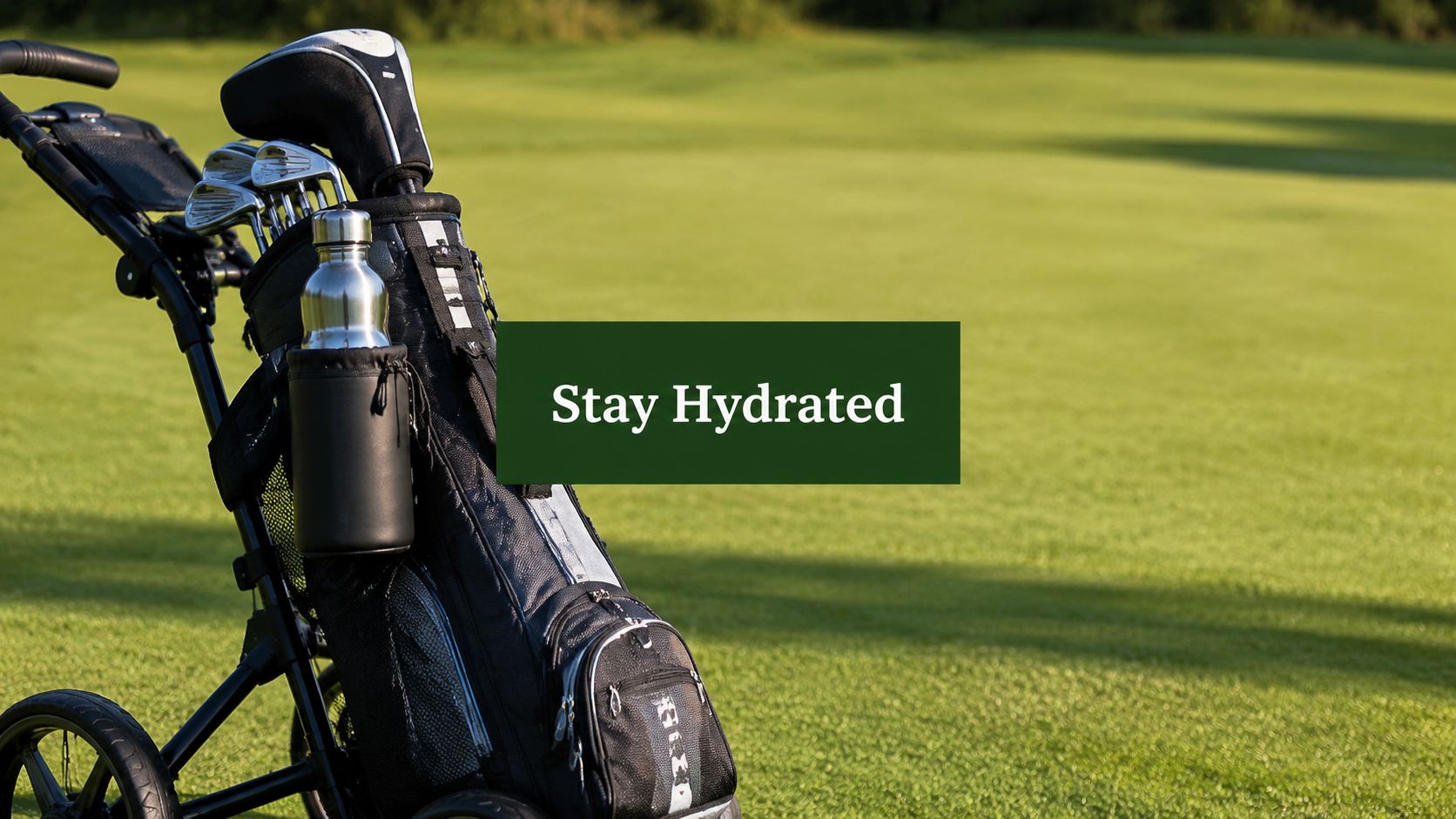
It's usually the back nine when this gets annoying enough to fix. Your bottle is jammed into a side pocket, the cart hits a bump, and now you're either fishing for it every hole or watching it lean like it's about to launch into the rough. If you walk, the problem gets worse. Add a motorized wheel setup, a remote holder, or one of those oversized insulated bottles, and most off-the-shelf advice stops being useful.
A good drink holder for golf bag use isn't just about carrying water. It's about easy access, stable weight distribution, fewer distractions, and keeping your setup clean when your push cart has more going on than a simple frame and two wheels. That's where the details matter. Mount style, holder depth, bottle width, insulation, and placement all decide whether the thing helps or becomes one more accessory you regret buying.
Why Your Golf Game Needs a Better Drink Holder
By the 14th hole on a hot day, a bad hydration setup starts costing you patience. You reach down for a drink and find a warm bottle crammed into a pocket, a can rattling against clubs, or nothing there because it bounced off two holes earlier. That's not a minor gear issue. It breaks rhythm, adds small bits of frustration, and makes walking feel harder than it should.
A dedicated drink holder for golf bag use fixes a few problems at once. It keeps your drink upright, visible, and easy to grab without digging through storage. It also protects other gear. I've seen scorecards get soaked, rangefinders knocked around, and extra gloves pick up condensation because a bottle was sharing the wrong pocket with everything else.
Why this matters more now
Golf bags and push carts carry more accessories than they used to. Golfers now expect cleaner organization, easier access, and features that support walking comfort. That lines up with broader buying habits. The global golf bag market was valued at approximately USD 1.02 billion in 2023 and is projected to reach USD 1.75 billion by 2032, reflecting strong demand for convenience-focused features, according to GM Insights on the golf bags market.
That matters because drink storage is no longer an afterthought. It's part of how golfers judge a bag or cart setup as a whole.
Practical rule: If you have to stop walking, bend awkwardly, or move another piece of gear just to take a sip, your drink setup is costing you more than you think.
What a better holder actually does
A solid holder helps in practical ways:
- Keeps access simple: You can grab the bottle one-handed and keep moving.
- Prevents spill problems: Upright storage beats a loose bottle pocket every time.
- Reduces bag clutter: Your beverage gets its own space instead of fighting for room with balls, tees, and layers.
- Supports longer walking rounds: When water is easy to reach, you tend to drink more consistently.
If you're refining the rest of your walking setup, it also helps to look at other useful add-ons beyond drink storage. This roundup of golf push cart accessories for 2025 is a good place to compare what improves a round versus what just adds bulk.
Decoding the Main Drink Holder Types
Not all holders solve the same problem. Some are built for a coffee cup or slim can. Some are meant for a heavy bottle that would tip a shallow holder in two holes. Others are closer to a small insulated sleeve with a mount attached. If you pick the wrong category, the fit issue shows up immediately.

Standard cup and can holders
This is the simplest style. Open top, shallow body, usually rigid plastic or wire-frame construction. It works fine for a sports drink, coffee cup, or slim bottle that you'll finish quickly.
Best for: golfers who ride sometimes, walk sometimes, and want fast access over maximum security.
The trade-off is stability. A standard cup holder doesn't love tall bottles. Once the center of gravity rises, the holder starts relying too much on smooth terrain and careful movement. On a bag that leans at an angle, that gets shaky fast.
Dedicated bottle holders
A bottle-specific holder is deeper and more supportive. It usually wraps more of the bottle body and may include stretch sides, a retaining lip, or a strap. This is the category that makes sense if you carry a larger reusable bottle or one of the wider insulated models that don't fit ordinary cup rings.
Best for: walking golfers who carry the same bottle every round and want it locked in.
This style solves the problem that older generic holders often missed. The key design idea has been around a long time. The first U.S. Patent for a pivoting “Golf bag drink holder” was granted on September 14, 1993, establishing the principle of keeping a bottle upright during transport, as shown in U.S. Patent US5244114A.
The holder doesn't need to look fancy. It needs to keep the drink upright when the bag or cart isn't.
Advanced insulated holders
These are the most useful for golfers who treat hydration as part of the whole-round setup, not a convenience item. They often combine a mounting system with insulation, padding, and a wider interior that works better with modern bottles.
Best for: long walking rounds, hot climates, or anyone who starts with a cold drink and wants it that way much later.
The downside is bulk. Insulated holders take up more space and can interfere with bag pockets, hand position on the cart handle, or folding mechanisms if you mount them carelessly.
Quick comparison
| Holder type | Works best with | Main upside | Main weakness |
|---|---|---|---|
| Standard cup/can | Cans, cups, slim bottles | Fast access | Poor fit for large bottles |
| Dedicated bottle | Reusable water bottles | Better security | Less flexible for mixed drink types |
| Advanced insulated | Oversized bottles, all-round hydration | Better temperature retention | Bulkier setup |
If you carry a large water bottle every round, skip the shallow cup holder category. That's the mistake I see most often.
Mounting Systems and Push Cart Compatibility
The holder itself matters, but the mount decides whether it stays useful. A strong cup ring with a weak attachment point still fails the first time your cart bounces across a cart path edge or a dry fairway seam. Such failures require golfers with upgraded walking setups to pay closer attention, especially if they use powered assistance.

Clamp mount versus strap mount
A clamp-style holder is usually the cleaner choice on a push cart frame. If the clamp matches the tube well, it stays put and resists twisting. That's what you want for heavier bottles.
A strap-on holder is more forgiving. It works better when the frame shape is awkward, the bag blocks clean clamp access, or you want to mount to soft-sided areas. The downside is movement. Straps can slide, especially when the bottle weight shifts during turns.
Here's the practical split:
- Choose clamp mount if your cart has exposed round or slightly oval tubing and you carry a heavier bottle.
- Choose strap mount if you need flexibility or you're mounting to the bag body rather than the cart frame.
- Avoid weak plastic joints if the holder hangs far from the frame. Being far from the frame intensifies small wobbles.
Check the frame before you buy
Before buying any drink holder for golf bag or cart use, inspect three things:
-
Available mounting space
Look for a section that isn't blocked by bag straps, brake cables, folding hinges, or accessory trays. -
Bottle clearance
Make sure the bottle won't hit the wheel, your leg, or the bag when you walk. -
Bag access
Don't mount the holder where it blocks your most-used pocket or interferes with pulling a mid-iron.
A lot of golfers skip that last one. Then they end up with a holder that technically fits but sits exactly where they need to reach for tees, rangefinder, or jacket pocket.
Working around motorized push cart add-ons
Generic buying guides usually prove inadequate in such situations. Once you add a motorized wheel conversion, your clean mounting space shrinks. You may have a motor housing near the rear axle area, a remote holder on the handle, and extra bracket hardware on the frame. Suddenly, a holder that works on a plain push cart becomes a nuisance.
If your cart uses a powered wheel system, placement has to respect the moving parts and control layout. Keep the holder clear of:
- Motor and bracket hardware
- Remote cradle or control access
- Folding joints
- Wheel travel and turning arc
The safest position is usually on the upper side frame or near the handle support, not low and rearward where accessory collisions happen.
One useful reference if you're comparing layouts is this guide to a cup holder for golf push cart setups. It's especially relevant when you want a holder that plays nicely with push cart accessories instead of competing with them.
Mount for the roughest part of the round, not the calmest. If it only works on flat turf, it doesn't work.
A note on electric-assist compatibility
This is also the one place where a self-leveling design can make sense. Caddie Wheel offers an electric power-assist system for standard push carts, and its accessory setup includes a self-leveling drink holder option. That kind of design is useful when your cart angle changes more than a standard manual push setup.
Still, even a self-leveling holder won't solve bad placement. If it crowds the remote, blocks the handle, or sits in the path of folding hardware, it's the wrong mount point.
Choosing the Right Materials and Insulation
Material choice looks like a cosmetic detail until you've used the holder for a month. Then the trade-offs show up. Cheap plastic rattles. Fabric collapses under a heavy bottle. Thin insulation turns cold water into warm water by the middle stretch of the round.

What each material does well
Rigid plastic is still the practical default for many golfers. It's easy to wipe down, doesn't hold moisture, and gives the bottle a firm seat. If you're carrying canned drinks, sports drinks, or a standard bottle, plastic works well. The weakness is flexibility. If your bottle runs wide, the holder will not adapt.
Fabric and neoprene-style holders do the opposite. They flex, collapse for storage, and handle odd bottle shapes better. They also tend to make less noise on the cart. But if the stitching or rim support is weak, the bottle can sag outward, which makes grabbing and reinserting it less smooth.
Insulated designs are the best fit for players who walk in heat, start with ice, or carry one bottle for most of the round. Bulk is the price you pay. Better temperature control usually means thicker walls and a larger footprint.
Buy for your round, not for the shelf
Here's the easiest way to consider it:
- Mild weather and quick rounds: rigid plastic is often enough.
- Odd-shaped or oversized bottles: flexible fabric or neoprene is easier to live with.
- Hot climates and long walks: insulated holders earn their space.
If you're also comparing what goes inside the holder, there's been more attention lately on larger, design-forward drinkware in golf. This piece on Drinktanks custom golf drinkware is useful because it reflects a real shift toward bottles and tumblers that don't fit the old narrow-holder assumption.
Insulation isn't only about cold drinks
Golfers usually think insulation means keeping water cold, but it also helps with condensation control. That matters more than people admit. A sweating bottle makes grips damp, scorecards curl, and soft goods feel clammy if they share storage space.
If your bag setup already includes extra cold storage, compare the holder with a full cooler option instead of doubling up. This guide to a golf cart bag cooler helps sort out when a cooler pocket makes more sense than an insulated single-drink holder.
Use the smallest amount of insulation that matches your normal round. More bulk than you need just creates new fit problems.
Installation Guide and Pro Usage Tips
Most aftermarket holders go on in a few minutes. The trick isn't getting them attached. The trick is getting them attached where they stay stable, remain easy to reach, and don't interfere with the rest of your setup.

Quick-fit setup
Start with the cart or bag fully loaded, not empty. A holder can seem perfectly placed on a bare frame and become a problem once the bag, towel, rangefinder case, and outerwear are all in place.
Use this order:
-
Pick the actual bottle first
Don't install around a guess. Use the bottle or cup you carry most often. -
Test the reach
Stand in your normal walking position and simulate grabbing the drink with your lead hand. -
Attach loosely at first
Clamp or strap it just tight enough to hold while you check clearance. -
Turn and fold-check the cart
Make sure nothing hits the wheel, hinge, remote mount, or bag pockets. -
Tighten fully and shake-test
Give the cart a few hard pushes and a side-to-side wobble before taking it to the course.
Placement tips that help on course
Right-handed golfers often prefer the holder on the left side of the handle area because it keeps the dominant hand freer for scorekeeping, club handling, or remote use. Left-handed players often like the opposite. There's no universal rule, but there is a wrong one. Don't mount it where your hand naturally rests during long walks.
A few habits help immediately:
- Keep the holder above axle height: lower positions pick up more bounce.
- Leave pocket clearance: especially for balls, tees, and a rangefinder pocket.
- Check club pull space: long irons and wedges shouldn't snag on the bottle.
- Retighten after the first round: new clamps and straps often settle slightly.
Smart fixes for awkward bottles
Some bottles are just difficult. Wide base, narrow middle, oversized lid, or a handle that catches the rim. If the holder is close but not perfect, small adjustments usually solve it.
For loose fit:
- Add a thin rubber sleeve around the bottle body.
- Use a foam shim inside one side of the holder.
- Choose a deeper holder instead of over-tightening a weak clamp.
For top-heavy bottles:
- Lower the bottle deeper into the holder if possible.
- Use a retention strap if the model includes one.
- Avoid side-mounted positions on sloped bag panels.
A holder that needs a two-second adjustment before every sip is in the wrong spot, even if it's technically secure.
Extra stability on rough courses
If your home course has cart path crossings, steep transitions, or firm uneven lies, secure the mount more aggressively than the product instructions suggest. A friction strip between the clamp and frame helps. So does mounting to a less tapered section of tubing instead of the first convenient spot you find.
The best installations feel boring. No rattling, no swinging, no bottle drama when you hit a bump.
Common Mistakes to Avoid During Purchase and Use
Most drink holder problems are predictable. Golfers usually don't buy a bad product as much as they buy the wrong fit for their bottle, cart, or walking habits.
The mistakes that cause the most trouble
-
Buying for a standard bottle when you carry an oversized one
If you use a wide insulated bottle, a shallow cup ring won't suddenly become secure because you want it to. -
Ignoring mount quality
A sturdy holder attached to a flimsy clamp is still flimsy. The mount matters as much as the cup itself. -
Placing it where it blocks something important
Common victims are the rangefinder pocket, the top apparel pocket, the handle grip, and club access. -
Mounting too low on a powered or accessory-heavy cart
Low rear positions often collide with wheel hardware, folding points, or other add-ons. -
Overlooking cleanup
Sugary residue, trapped moisture, and course dust build up fast. Fabric can smell bad, and metal hardware can age poorly if you never wipe it down.
A final buying checklist
Before you click buy, ask yourself four things:
| Question | Why it matters |
|---|---|
| What do I actually drink from on course? | Bottle width and height decide the holder category |
| Where can this mount cleanly? | A good holder with no real mounting space won't help |
| Will it interfere with folding or accessories? | This is critical on modern push cart setups |
| Do I need insulation or just support? | Bulk only makes sense if you'll benefit from it |
The golfers who get this right usually keep it simple. They match the holder to one primary bottle, mount it where they can reach it naturally, and avoid adding bulk where the cart already carries enough gear. That's how a drink holder for golf bag use goes from minor accessory to something you notice every round because nothing goes wrong.
If you want to upgrade a standard push cart without replacing the whole setup, Caddie Wheel is worth a look. It adds electric power assist to many three- and four-wheel push carts, and for golfers dialing in a cleaner walking rig, that kind of modular setup can make it easier to build around the cart you already like.
Share:
Heated Golf Gloves: Ultimate Guide 2026
Your Guide to What Is Portable Charger for 2026