
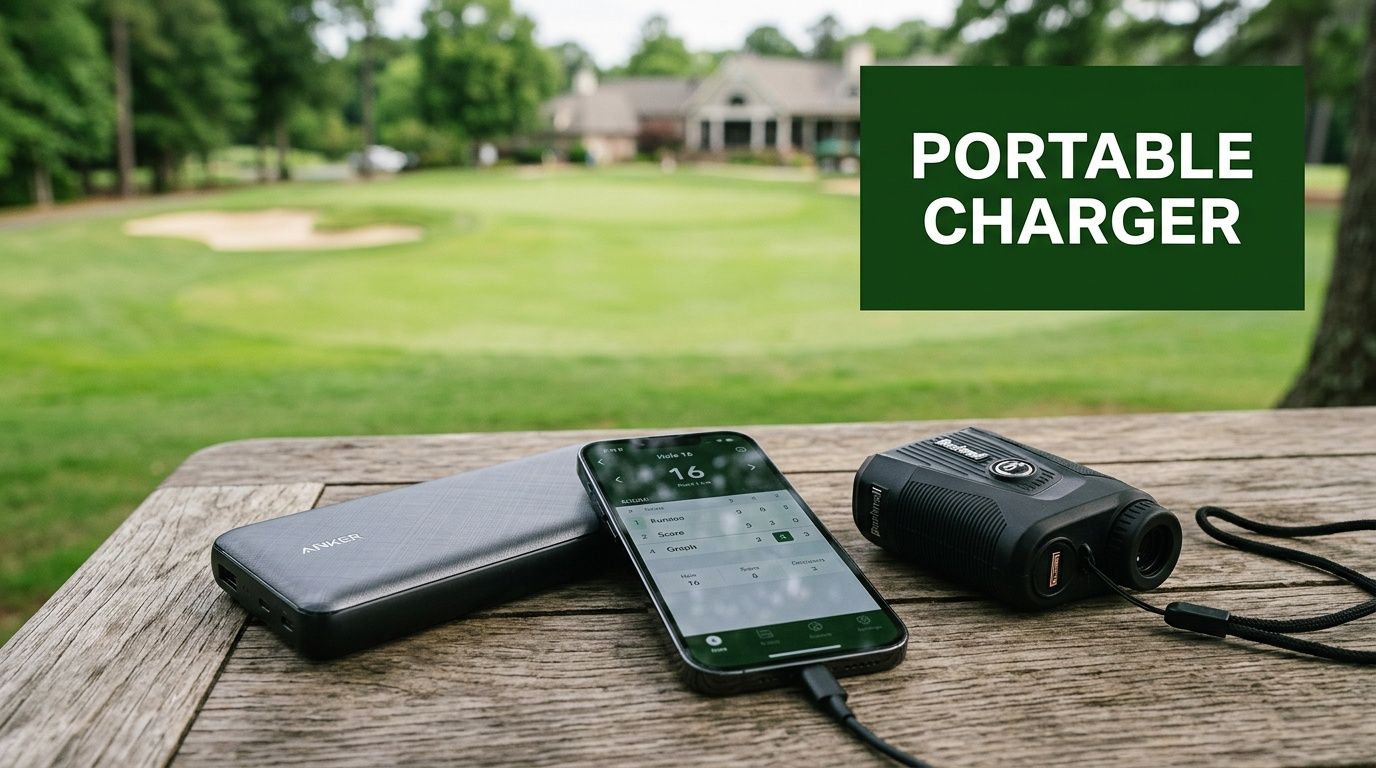
Your phone is at 9%. Your GPS app is open. Your scorecard app is still running. You're on the back nine, and your watch, rangefinder, or push-cart accessory may need power before you make it back to the clubhouse. The same thing happens in airports, on road trips, at tournaments, and during long practice days. Modern gear is portable. Battery life often isn't.
That's why people keep asking a basic question that deserves a clear answer. What is a portable charger? It's more than a gadget tossed into a bag. It's backup power you carry with you, so your devices can keep working when there's no wall outlet nearby.
For golfers, that question matters even more than most general tech guides admit. On the course, power isn't just about texting or checking email. It can support your phone, GPS watch, rangefinder, and in some setups, equipment tied to your walking round. If you've ever had a useful device die halfway through a day outside, you already understand why portable power has moved from “nice to have” to part of the kit.
The Modern Necessity of On-Demand Power
A few years ago, a dead phone battery was annoying. Now it can disrupt directions, payment, messaging, tee time details, digital scorekeeping, weather checks, and emergency contact. For golfers, it can also interrupt yardage tracking, swing video, and course apps right when you need them most.
Portable chargers have grown because our daily habits changed. We carry more rechargeable devices, use them more often, and expect them to last all day. That shift shows up in the market too. The global portable charger market reached USD 13.01 billion in 2025 and is projected to grow at a 6.8% CAGR from 2026 through 2032, driven by reliance on rechargeable electronics, according to Stellar Market Research's portable charger market report.
Why this matters on a golf course
Golf is a good example of modern battery dependence because a round lasts a long time and often happens far from easy charging access. You might start with a full phone and still end up low by the closing holes if you're running GPS, music, group texts, and scoring apps at once.
A portable charger solves a simple problem. It lets you bring your own outlet.
Practical rule: If a dead battery would change your plans, delay your round, or force you to shut off a useful feature, a portable charger isn't extra gear. It's protection against interruption.
There's also a planning side to it. Smart golfers already think about conserving power before they need backup. If you want practical ways to stretch device life during a round, this guide on how to conserve battery power on the course is a useful companion.
The real shift
Portable chargers used to feel like emergency accessories. Now they're everyday equipment for people who work, travel, and spend time outdoors. That includes golfers who want their tech to stay available for the full round, not just the front nine.
The good news is that portable charging isn't hard to understand once you strip away the jargon. Start with the core idea. A portable charger stores electricity ahead of time, then passes that stored power into another device when you need it.
How a Portable Charger Actually Works
A portable charger works like a battery reservoir you fill before you leave home, then tap later when your phone, earbuds, rangefinder, or golf gear runs low. The key idea is simple. It does not make new electricity. It stores power in advance and passes that stored power to another device when you need it.
Inside the unit are battery cells, usually lithium-based, plus a small control board. The cells hold energy. The control board manages how that energy enters, sits safely, and leaves through the charging ports in a form your device can use.

The basic flow
A simple four-step view makes this easier to follow:
- You charge the portable charger first. Wall power fills its internal battery cells through the input port.
- It stores that energy until later. The charger holds that power much like a water tank holds water for later use.
- You connect your device when you need a recharge. That could be a phone, earbuds, GPS unit, or on the course, equipment that depends on battery power.
- The charger delivers power in a controlled way. Its electronics regulate voltage and current so the receiving device gets power safely.
That control step matters more than it sounds. Your devices do not just need power. They need the right kind of power, delivered at the right level. The charger's circuitry acts like a traffic controller, helping prevent overheating, overcharging, and unstable power flow.
Two parts that often confuse shoppers
One point of confusion is whether a portable charger is producing energy on demand. It is not. It is closer to carrying a filled thermos than carrying a miniature power plant. Once the stored energy is used up, the charger itself needs to be recharged.
A second point of confusion is the ports. The port used to refill the charger is the input. The port used to send power to your phone or other gear is the output. On some newer models, one USB-C port handles both jobs. On others, the ports are separate. If you are comparing models and want a clearer sense of what battery numbers mean in real use, this guide on how to test battery capacity in practice can help.
A portable charger is a stored-energy backup with safety controls and ports that move power where you need it.
Why this matters for golfers
This matters even more on a golf course because the device that needs charging is not always just a phone. A golfer may need backup power for GPS use, scoring apps, or a battery-powered system such as a Caddie Wheel battery. That changes the buying decision. You are not only asking, "Will this top up my phone?" You are asking whether the charger can deliver enough stored energy, through the right port, for the gear your round depends on.
Wireless charging follows the same basic rule. The power bank still stores energy first, then transfers it to your device without a cable. The method changes. The stored-energy handoff does not.
Decoding Capacity and Power Metrics
Many buyers get tripped up. You look at a portable charger box and see terms like mAh, W, PD, and maybe wireless labels. Some of it sounds technical, but the core ideas are simple if you use the right analogy.
Think of capacity as the size of a water tank. Think of power output as how fast the faucet can run.

Capacity means stored energy
When you see mAh, that refers to battery capacity. In shopping terms, it tells you how much energy the charger can store. A bigger number usually means more recharging ability.
But this is the part many people miss. The advertised number on the box is not the same as what your phone receives.
According to this explanation of rated versus advertised capacity, a portable charger's rated capacity is typically 50% to 70% of its advertised mAh capacity because the internal cells operate at 3.7V and that energy must be converted to 5V for USB output. In practical terms, an advertised 10,000 mAh power bank often yields about 5,000 to 7,000 mAh usable.
That's not fraud. It's conversion loss.
Why the number shrinks in real life
Electricity has to be converted before your device can use it. That conversion takes energy. Wireless charging usually loses even more along the way.
So if you buy a power bank assuming every bit of the printed capacity goes directly into your phone, you'll expect too much from it. This gap is one reason many buyers feel disappointed with otherwise decent chargers.
For a deeper hands-on look at evaluating battery performance, this guide on how to test battery capacity helps translate specs into real-world expectations.
Power output means charging speed
Capacity answers “how much.” Watts answer “how fast.”
A charger with higher output can refill compatible devices more quickly. That matters if you only have a short break between holes, flights, meetings, or car stops. It matters even more for devices that draw more power, such as tablets and some laptops.
A few useful labels to recognize:
- USB-C PD means Power Delivery, a common fast-charging standard for modern phones, tablets, and many laptops.
- Quick Charge is another fast-charging system used by some devices and adapters.
- Wireless charging trades some efficiency for convenience.
Buying shortcut: Don't judge a portable charger by advertised mAh alone. Check usable capacity expectations, output type, and whether your device can actually use the charger's faster modes.
What to look for on a spec sheet
A good spec sheet tells you three things:
| Spec | What it tells you | Why it matters |
|---|---|---|
| Capacity | How much energy is stored | More total backup power |
| Output | How fast power leaves the charger | Faster charging for compatible devices |
| Input | How fast the charger itself refills | Less waiting before your next trip |
Once you understand those three, most product listings become much easier to read.
Power Banks vs Portable Power Stations
People often use “portable charger” as a catch-all term, but there are two very different categories hiding under that label. One fits in a pocket. The other is closer to a compact backup power box.
Power banks
A power bank is the version generally understood. It's small, rechargeable, and meant for personal electronics such as phones, earbuds, smartwatches, tablets, and sometimes lightweight USB-C laptop use.
Its strengths are obvious. It's easy to carry, easy to pack, and usually simple to use. For a day on the course or a long travel day, this is the standard choice.
Portable power stations
A portable power station is much larger. These units usually offer more port types and can support gear that a small power bank can't handle. They're better suited to camping, event setups, car travel, and situations where you need to power several devices or equipment types from one source.
They're portable in the sense that you can move them. They are not “slip it in your pocket” portable.
If your goal is keeping a phone, watch, earbuds, or rangefinder alive through the day, a power bank is usually the right tool. If your goal is broader backup power for multiple categories of gear, you're probably looking at a power station.
Power Bank vs Portable Power Station at a Glance
| Feature | Power Bank | Portable Power Station |
|---|---|---|
| Typical size | Pocketable or bag-friendly | Larger carry unit |
| Best for | Phones, earbuds, watches, tablets | Multiple devices, larger electronics, longer off-grid use |
| Port types | Usually USB-A and USB-C, sometimes wireless | Often multiple USB ports plus broader output options |
| Ease of travel | Very convenient for daily carry | Better for car transport or base-camp style use |
| Setup | Plug and charge | More options, more planning |
| Golf use | Great for personal devices on the course | Better for extended outings or broader equipment needs |
| Cost | Usually lower | Usually higher |
Which one fits golfers
Most golfers don't need a full power station for a normal round. A well-chosen power bank usually covers the common needs: phone, watch, wireless earbuds, and small accessories. A power station makes more sense if you're traveling, practicing for long stretches, or supporting several devices in one place.
The key is matching the tool to the job. Carrying a giant unit for simple phone charging is overkill. Bringing a tiny power bank when you need more serious output can leave you short.
Choosing a Charger for Everyday Devices
Most buying mistakes happen because people shop for a portable charger in the abstract. A better approach is to shop for the devices you use.

Match the charger to the job
If you mainly need backup for a smartphone, compact size may matter more than maximum capacity. You want something easy to carry and quick to connect between uses.
If you also charge a tablet, watch, or earbuds from the same pack, look for more capacity and more than one output option. If you want to charge a laptop, the conversation changes again. You'll want a higher-capacity model and a USB-C PD output that your laptop can accept.
A practical way to decide:
- For phone-first use, prioritize portability, reliable cable output, and enough reserve for a full day away from outlets.
- For multiple small devices, check the number of ports and whether the charger can handle charging more than one item comfortably.
- For tablets and laptops, focus on USB-C PD support and output capability, not just the biggest mAh number on the package.
- For convenience-focused use, consider a model that combines cable charging with wireless charging.
Wireless charging is getting better
Wireless charging used to be mostly about convenience. It's still convenient, but it's also becoming more capable. According to GMI Insights coverage of the power bank market, the Qi2 25W wireless-charging standard launched in 2025 and can deliver wireless charging speeds that are 70% faster with improved magnetic alignment.
That matters for buyers who want less cable clutter without giving up as much speed as older wireless setups often did.
A good portable charger should fit your routine, not just your budget. The best one is the model you'll actually carry, use, and trust when battery anxiety starts creeping in.
A quick visual overview can help if you're comparing styles and features:
Simple buying checklist
Before you buy, ask yourself these questions:
- Which device matters most? Start with your most power-hungry or most essential device.
- Do you need speed or just emergency backup? Faster charging usually matters more than people think.
- Will you carry it in a pocket, golf bag, or travel bag? Size affects whether you'll bring it regularly.
- Do you want wireless as a backup or as a main feature? Convenience is useful, but cable charging is still the safest baseline for broad compatibility.
That short list will narrow the field fast.
The Golfer's Guide to On-Course Power
Generic tech articles usually stop at phones and tablets. Golfers need a more specific answer, because a round can involve several battery-powered tools at once.
Your phone may be running GPS and scoring. Your watch may track distance and activity. Your rangefinder might need a top-up before the second loop of the day. Some golfers also rely on battery-powered cart accessories or related equipment that have very different charging demands than a phone.

Why golf changes the buying decision
On the course, convenience matters. So does reliability. You don't want a charger that works fine at a desk but feels awkward in a golf bag, disconnects too easily, or only makes sense for tiny devices.
For many golfers, a standard power bank is enough for personal electronics. But once you move toward charging equipment tied to cart systems or larger battery packs, the stakes change. You're no longer just picking “a charger.” You're matching voltage and charging behavior to a specific battery setup.
That's the point many broad buying guides skip.
A key rule for golf cart battery charging
When selecting a charger for a golf cart battery, the output voltage must explicitly match the pack voltage, either 36V or 48V, to prevent damage and support proper charging, according to this guide to choosing and using a golf cart battery charger.
That rule is simple but critical. A charger that's fine for a phone has nothing to do with a charger that's safe for a larger golf cart battery system. These are different categories of equipment.
Don't treat golf cart battery charging like phone charging. Once voltage-specific battery packs enter the picture, compatibility stops being optional.
What golfers should look for
A smart on-course power setup usually comes down to use case:
- For phone and watch support, choose a compact, dependable power bank with the right cable or wireless option.
- For long practice days or travel rounds, carry enough reserve to recharge the devices you use most, not just the one you notice first.
- For battery-powered golf equipment, verify exact compatibility before charging anything larger than standard personal electronics.
- For mixed-use bags, keep everyday USB charging separate from specialized battery chargers so there's less room for error.
If you want a golf-specific walkthrough of charging equipment on the go, this article on how to use a portable charger on the course adds practical setup advice.
Safety and Maintenance Tips for Longevity
Portable chargers are simple to use, but they last longer when you treat them like batteries, not like indestructible bricks. Heat, neglect, and bad storage habits shorten their useful life.
Daily habits that help
A few basic practices go a long way:
- Avoid extreme heat: Don't leave a charger baking in a parked car or exposed on a hot cart for long periods.
- Use decent cables: A poor cable can make a good charger seem unreliable.
- Recharge before long storage: Don't toss a fully drained charger into a drawer and forget it.
- Check ports for wear: Dirt, bent connectors, and loose cable fit can cause charging trouble that looks like battery failure.
Travel rules matter
Air travel adds another layer. Lithium battery devices have stricter handling rules than many travelers realize. According to The Hill's report on flying with portable chargers, the FAA has long banned portable chargers in checked bags, and a 2025 airline rule change also forbids placing them in overhead compartments or closed carry-on luggage during flights because of incidents involving lithium batteries.
That means “in your carry-on” may not be specific enough anymore. Keep your charger where you can access it, and check your airline's current rules before you fly.
Bring your portable charger in the cabin, keep it accessible, and don't assume every airline handles lithium batteries the same way.
One final maintenance mindset
Use the charger regularly. Top it up before trips, rounds, and event days. Test it with the cables and devices you carry. A portable charger only helps when it's charged, compatible, and easy to reach.
If you want a simpler way to enjoy walking rounds with less strain, Caddie Wheel offers lightweight electric power assist for standard push carts, with a quick-install design and a high-capacity battery that supports up to 36 holes per charge. It's a practical option for golfers who want easier on-course movement and a more relaxed round without switching to a bulky full cart setup.
Share:
Best Drink Holder for Golf Bag: 2026 Buyer's Guide
Hand Warmers for Golfers: A Complete Course Guide