
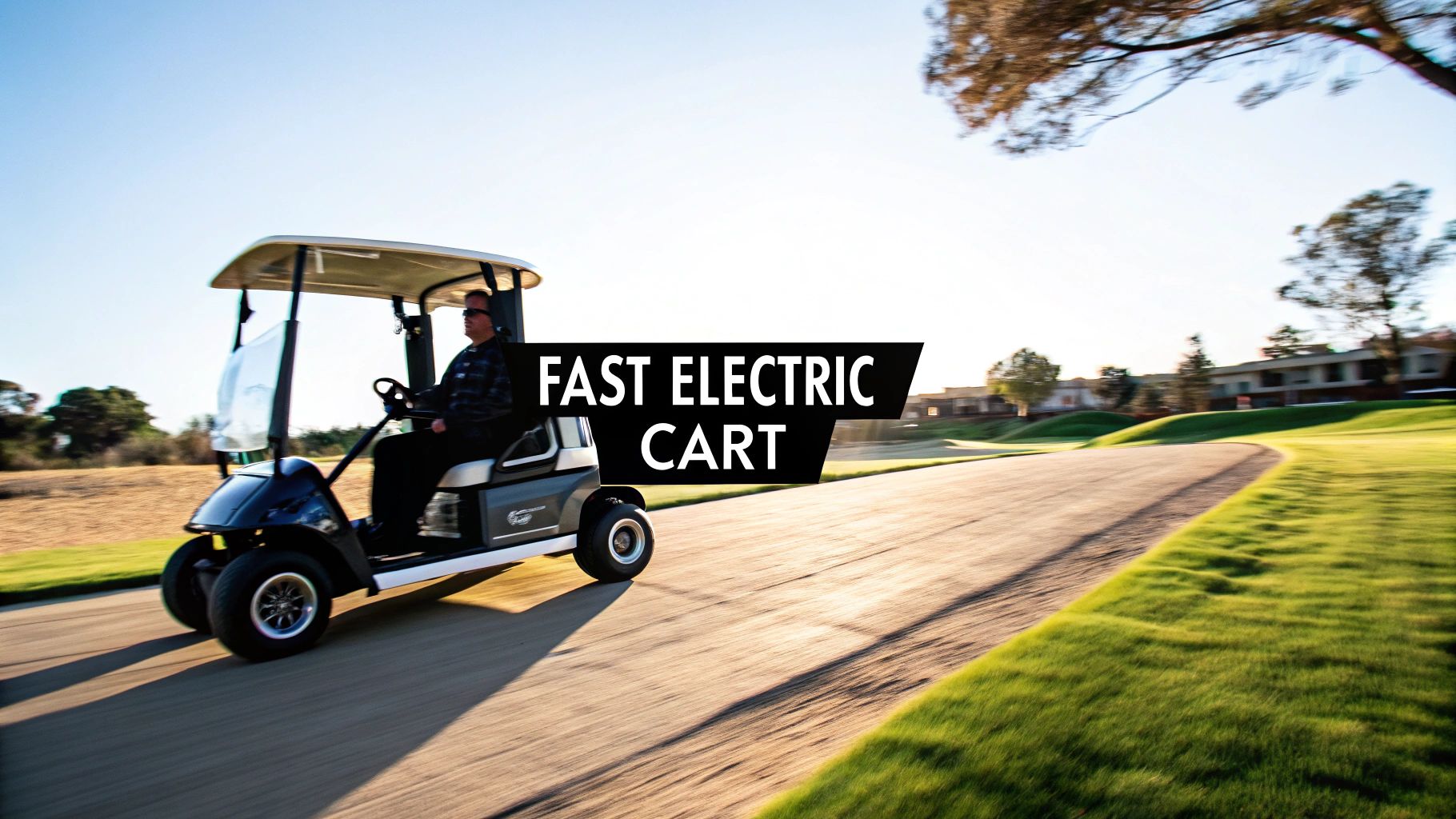
It’s absolutely possible to make your electric golf cart fast. In fact, it often comes down to upgrading a few key components that were intentionally designed to limit its performance right out of the factory. A stock cart is built for safety and gentle cruising, not raw speed, but a few smart changes can safely unleash its true potential.
Why Your Stock Golf Cart Is So Slow
If you’ve ever floored the pedal on a standard golf cart and felt… well, underwhelmed, you’re not alone. Most factory-direct electric golf carts are deliberately engineered to be slow, with top speeds typically capped between 12 and 15 mph.
This isn't a flaw. It’s a conscious design choice that prioritizes safety, battery longevity, and predictable handling on a manicured golf course. But when you’re using it for neighborhood travel or as a utility vehicle, that leisurely pace can feel painfully restrictive.
The sluggishness really comes down to a careful balance between three core components working together to keep things tame.
The Restrictive Speed Controller
Think of the controller as the cart's brain. It’s the gatekeeper that decides how much power from the batteries actually makes it to the motor. Factory controllers are programmed with extremely conservative settings, creating a hard ceiling on your speed and acceleration.
They’re designed to prevent the motor from drawing too much current, which is great for protecting the batteries and extending your range, but it completely suffocates performance. This electronic governor is the number one reason your cart feels so timid off the line.
A Motor Built for Torque, Not Speed
The standard motor in most electric golf carts is a workhorse, not a racehorse. These motors are wound specifically for high torque, giving them the grunt needed to climb hills and haul passengers without breaking a sweat.
But all that focus on low-end power comes at the expense of top-end speed. It’s engineered to do its job efficiently within that 12-15 mph range, but it simply wasn’t built with the RPM capability for higher speeds.
The demand for faster, more versatile carts is exploding. The global golf cart market is projected to grow from USD 2.30 billion in 2025 to USD 3.68 billion by 2035, with electric models expected to hold a massive 95.3% market share. This boom is driven by carts modified for higher speeds in communities and commercial settings. Discover more insights on the expanding golf cart market and its trends.
The Weight and Inefficiency of Lead-Acid Batteries
Finally, let's talk about those traditional lead-acid batteries. They are a major speed limiter. Not only are they incredibly heavy—adding hundreds of pounds to the vehicle—but their voltage also sags dramatically under a heavy load.
The moment you push the accelerator, the voltage drops, which signals the controller to pull back power. This creates a sluggish, delayed response and stops the motor from ever reaching its full potential. To build a truly fast electric golf cart, tackling these three bottlenecks is the first and most critical step.
Choosing the Right Speed Upgrades
Okay, so you've figured out what’s holding your cart back. Now for the fun part: swapping out those stock parts for something with a little more juice. Turning a gentle cruiser into a zippy neighborhood vehicle is all about a systematic approach. You can't just throw parts at it and hope for the best.
The single biggest impact you can make right out of the gate is upgrading the speed controller. Think of the stock controller as a cautious manager, programmed to prioritize battery life above all else. A high-performance controller with a higher amperage rating is like bringing in a new manager who’s not afraid to push for results. This upgrade lets more current flow from the batteries to the motor, which directly translates to faster acceleration and a higher top speed.
This handy flowchart breaks down the troubleshooting process and shows you where to look when your stock cart feels slow.
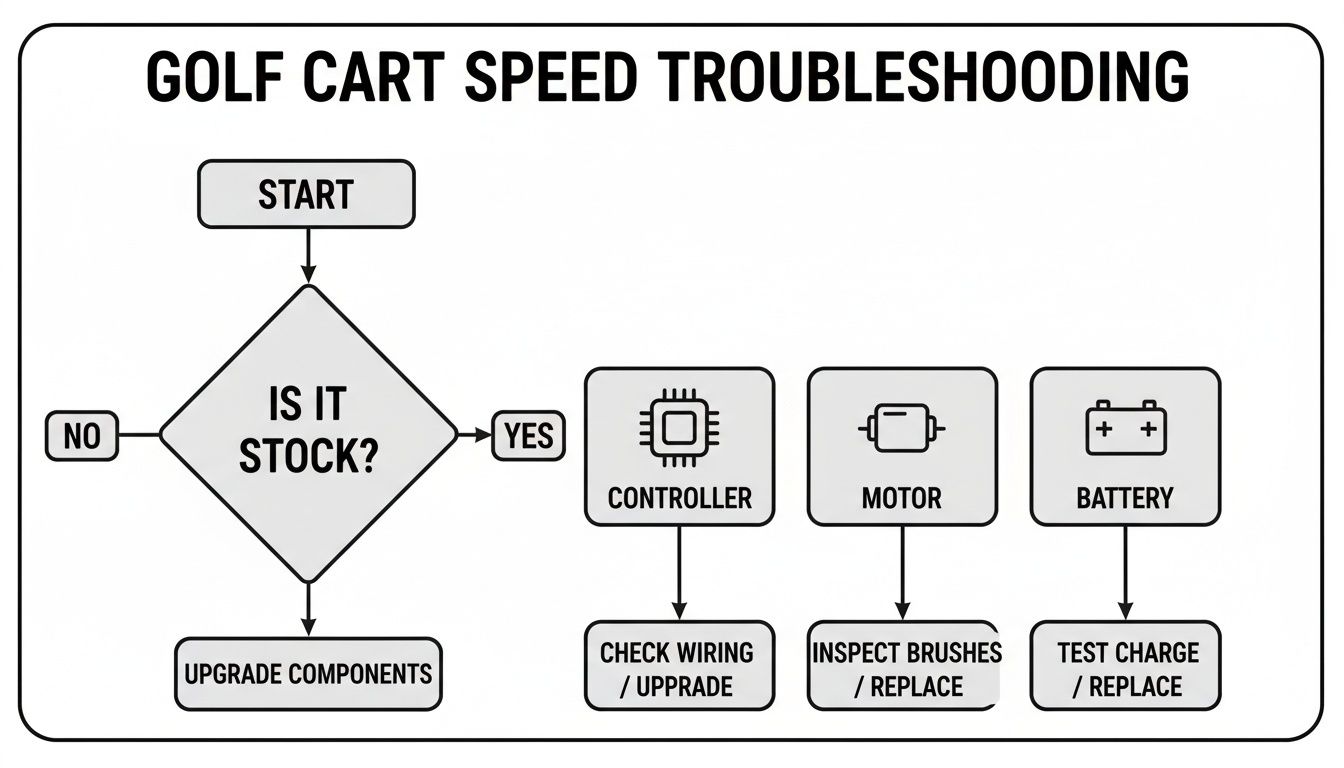
As you can see, the controller, motor, and batteries are almost always the main culprits behind sluggish performance.
Upgrading Your Motor for More RPM
Once you've installed a more powerful controller, your stock motor becomes the next bottleneck. It was built for low-end torque to get you moving, not for high revolutions per minute (RPM). To really unlock the power your new controller can deliver, you’ll need a high-speed motor to match.
You'll generally run into two types: AC (Alternating Current) and DC (Direct Current) motors. AC motors are often more efficient and offer regenerative braking, but modern DC motors can pack an incredible amount of torque. The right choice really comes down to your local terrain. If you're dealing with steep hills, a high-torque motor is non-negotiable. But if your area is mostly flat and you just crave pure speed, a high-RPM motor is the way to go.
Pro Tip: Your motor and controller must be compatible. Installing a beast of a motor without a controller that can feed it enough power is like putting a race engine in a car with a tiny fuel line. You're just starving it of the power it needs to perform.
Don't Overlook Mechanical Speed Boosts
While the electronics are the heart of the build, don't forget about the mechanical side of things. One of the simplest and most effective ways to gain a little extra speed is by installing larger tires. Just moving from standard 8-inch wheels to 10-inch or 12-inch low-profile tires can add 2-4 mph to your top end.
It's simple physics. A larger tire covers more ground with each revolution, so for the same motor RPM, the cart is physically moving faster. It’s a straightforward mechanical advantage that perfectly complements your electrical upgrades.
Just be aware that larger tires also increase the load on the motor. This can slightly reduce your torque, which is another reason why it’s best to upgrade your motor and controller first. When all the components are paired correctly, you create a balanced system where each part supports the others—and that’s how you build a truly fast electric golf cart. To see how this fits into the bigger picture, it's interesting to explore broader innovations in golf technology.
The Power Source That Unlocks True Speed
You can have the beefiest motor and the smartest controller on the market, but they're completely useless if your batteries can't keep up. If there’s one upgrade that truly changes the game for a fast electric golf cart build, it’s ditching old-school lead-acid batteries for a modern lithium-ion (Li-ion) setup.
This single change knocks out multiple performance bottlenecks all at once.
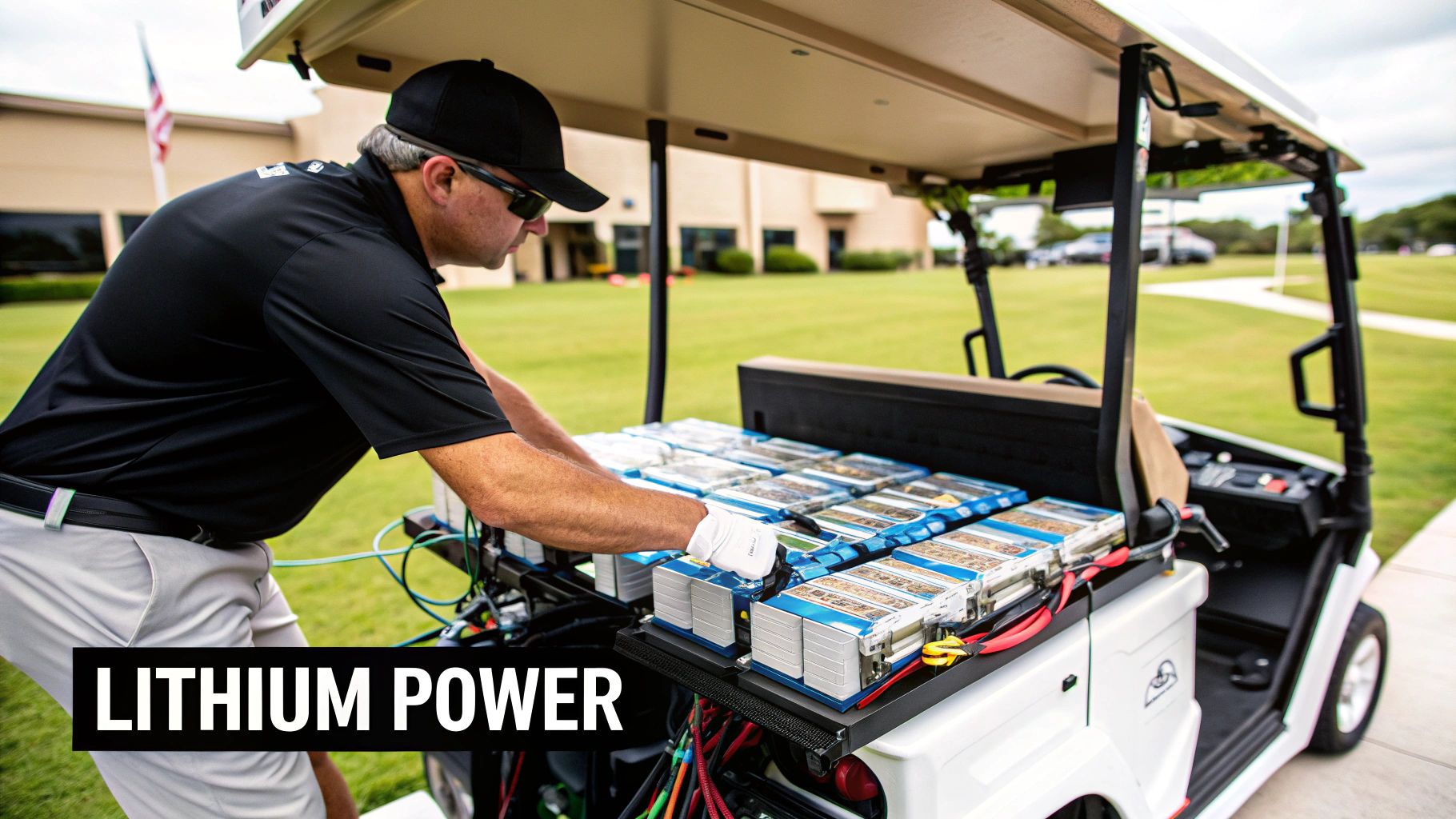
For starters, lead-acid batteries are anchors. They can easily add 300-400 pounds of dead weight to your cart. Making the swap to a lithium pack can slash that weight by up to 75%. This huge reduction instantly boosts your power-to-weight ratio, giving you that quicker, punchier acceleration and putting way less strain on the motor.
Then there’s the issue of voltage sag. With lead-acid batteries, the moment you step on the pedal, the voltage plummets, starving the controller and motor of consistent power. It’s the reason acceleration can feel so sluggish. Lithium batteries, on the other hand, hold a rock-steady voltage from a full charge right down to empty. No more speed sag—just snappy, responsive power every time you ask for it.
Choosing the Right Voltage and Capacity
Once you decide to go with lithium, you'll have two main choices to make: voltage (V) and amp-hours (Ah). Getting this right is key to balancing your cart's speed and range.
-
Voltage (V): Think of voltage as the horsepower. More voltage lets the motor spin faster, which means a higher top speed. A 48V lithium system is a fantastic jump from lead-acid and can get you to 25-30 mph when paired with the right components. If you’re chasing maximum performance, a 72V system is the undisputed king, capable of pushing a cart to 40 mph and beyond.
-
Amp-Hours (Ah): This is your fuel tank. The higher the amp-hours, the farther you can go on a single charge. A 100Ah lithium battery gives most people plenty of range for a few rounds of golf or neighborhood cruising. But if you plan on taking longer trips, you might want to consider a higher capacity.
Properly maintaining these advanced power systems is just as important as choosing them. If you're new to this kind of tech, it's worth learning how to charge lithium batteries safely and efficiently to protect your investment.
To put the performance difference in perspective, here's a quick breakdown:
Lead-Acid vs. Lithium-Ion Battery Performance for Fast Carts
| Feature | Lead-Acid Batteries | Lithium-Ion (Li-ion) Batteries |
|---|---|---|
| Weight | Very heavy (300-400 lbs) | Lightweight (70-100 lbs) |
| Voltage Stability | Significant voltage sag under load | Stable voltage, minimal sag |
| Acceleration | Sluggish and delayed response | Quick, instant torque |
| Maintenance | Requires regular watering and cleaning | Virtually maintenance-free |
| Lifespan | 3-5 years (approx. 500 cycles) | 10+ years (3,000-5,000 cycles) |
| Charging Time | 8-12 hours | 2-4 hours |
As you can see, the advantages of lithium are undeniable for anyone serious about speed and performance.
An upgraded power source is the foundation of a fast cart. For a deeper dive into battery care, you can check out our guide on battery golf cart care. When you match your battery's capabilities with your motor and controller, you create a balanced, high-performance system that’s not just fast but also reliable.
Boosting Your Pace of Play with an Electric Caddie
Speeding up your round isn't just for those in a riding cart. For golfers who prefer to walk, a faster pace of play is all about maintaining a brisk, steady stride without gassing out by the back nine.
This is where a well-tuned electric push cart—especially one powered by a Caddie Wheel—becomes a true performance tool. It completely changes the dynamic of your walk, turning a physically draining trek into an effortless glide across the fairway.
It all begins with smart energy management, for both you and your caddie. Your first move should always be to balance your golf bag properly. A lopsided bag makes the motor strain, sucking the battery dry and slowing you down before you even make the turn. Distribute the weight of your clubs so it’s centered over the cart’s axle. This simple adjustment minimizes motor stress and leaves you with more power for the full 18 holes.
Mastering Hilly Terrain
Hilly courses are the ultimate test for battery life and your walking speed. The biggest mistake golfers make is cranking their electric caddie to full speed on a steep climb. Instead, dial it back and find a moderate, sustainable pace that the motor can handle without struggling.
Think of it like riding a bike—you wouldn't try to sprint up a massive hill in your highest gear. The same logic applies here. Ease up on the throttle and let the caddie do the hard work at a steady clip. This little bit of patience will conserve precious battery power for the rest of the course.
The real secret for walkers is that speed isn't just raw velocity; it's about efficient movement. A motorized caddie can slash a golfer's physical exertion by over 30%. That means you can keep a quick pace from the first tee to the eighteenth green without feeling that familiar end-of-round fatigue.
Smart Power Management Strategies
Your electric caddie’s battery is its heart and soul, so you need to treat it right. A few smart power management habits will ensure you have enough juice to keep your pace up for the entire round.
-
Avoid the Stop-and-Go: Try to walk at a smooth, constant speed instead of constantly stopping and starting. Every time you accelerate from a dead stop, you’re pulling a significant amount of power from the battery.
-
Use Downhill Momentum: When you’re heading down a slope, cut the motor's power or use the braking feature as little as possible. Let gravity give you a free ride—it’s a simple way to save energy and extend your caddie’s range.
-
Stay Charged: This one might sound obvious, but it’s the most common mistake. Always, always start your round with a 100% charged battery. A partially charged battery will lose its power far more quickly once it's under load on the course.
By putting these simple strategies into practice, your dream of an electric golf cart fast enough for your walking game becomes a reality. To dive deeper into getting the most from your gear, check out our complete guide on electric caddie golf carts.
Staying Safe and Street-Legal
Pushing your electric golf cart to higher speeds is a blast, but it comes with a whole new level of responsibility. Once you’ve built a cart fast enough to leave stock models in the dust, you simply can't ignore safety. The original brakes, tires, and frame were only designed for a leisurely 15 mph cruise around the course, not the 25+ mph you’re now capable of hitting.
The first, and most critical, upgrade on your list should be the braking system. Stock drum brakes just won't cut it when you need to stop a heavier, faster cart in a hurry. Upgrading to hydraulic disc brakes—at least on the front wheels—is a non-negotiable step. It gives you the reliable stopping power you'll need in an emergency.
Beyond braking, you have to start thinking about basic vehicle safety features. You're essentially equipping a small vehicle for the road, so visibility and passenger protection are paramount.
Essential Safety Upgrades for Fast Carts
To handle higher speeds, your cart needs to be seen by others and keep its occupants secure. Before you take your speedy creation for a spin, here's a checklist of the absolute must-haves:
- Headlights and Taillights: These are essential for visibility during early morning or evening drives, making sure other drivers can see you clearly.
- Turn Signals and Brake Lights: On the road, you have to communicate your intentions. These are crucial for preventing confusion and potential accidents.
- A Loud Horn: Your quiet electric motor won't alert anyone. You need a real horn to get the attention of pedestrians and other drivers.
- Rearview and Side Mirrors: Eliminating blind spots is critical when you’re moving at speed and sharing the road with much larger vehicles.
- Seat Belts: This one’s a no-brainer. Installing seat belts for every passenger is a fundamental safety measure to prevent injury in case of a sudden stop or collision.
These upgrades aren’t just suggestions; they are the foundation for making your souped-up cart safe for any real-world use.
Understanding Street-Legal Requirements
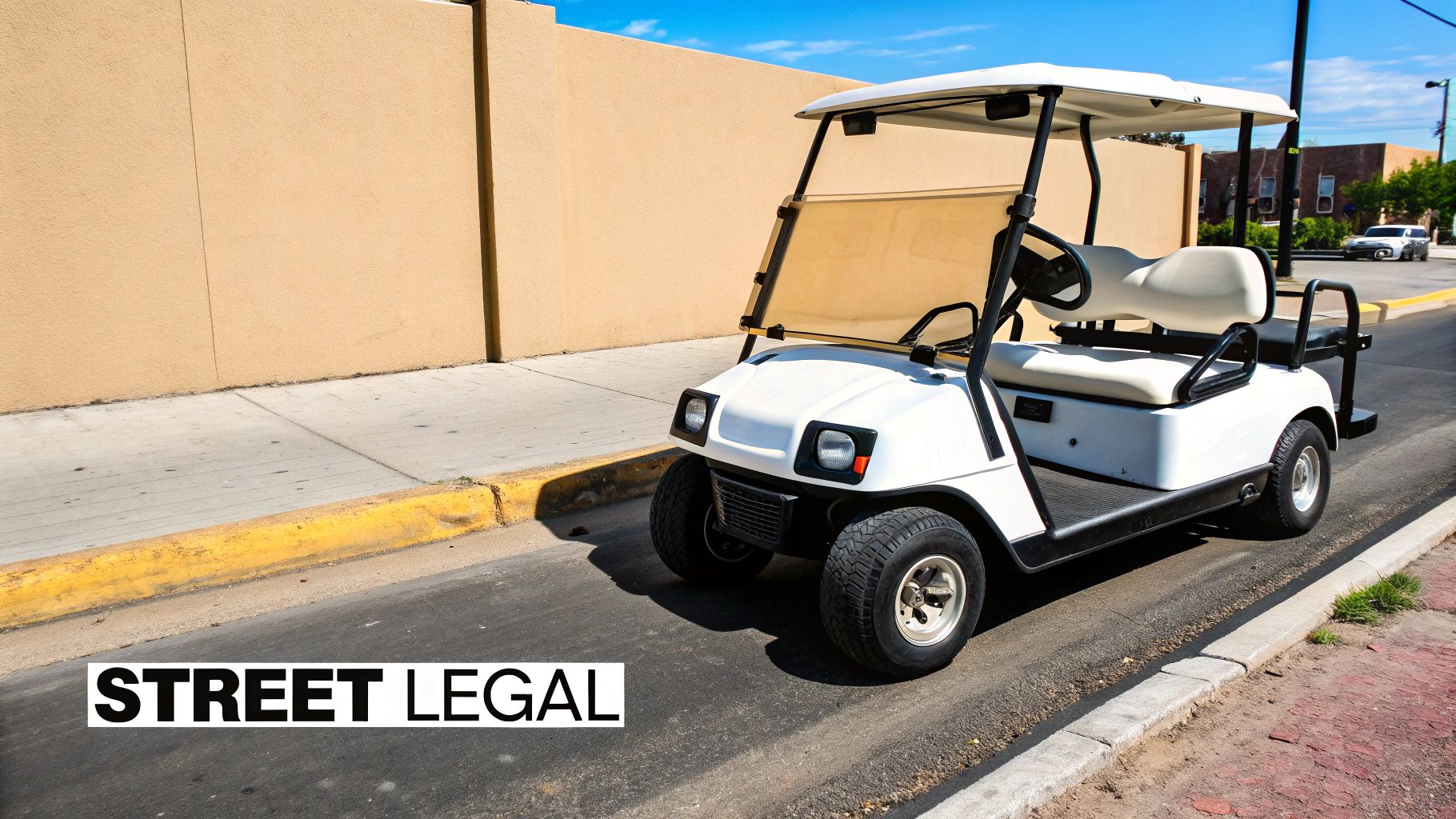
Taking your modified cart onto public roads introduces a whole different set of rules. You can't just drive it off the golf course and into traffic. In most places, a modified cart must be reclassified as a Low-Speed Vehicle (LSV) to be operated legally on streets with posted speed limits, typically 35 mph or less.
To qualify as an LSV, a vehicle must be capable of reaching a top speed between 20 and 25 mph. It must also be equipped with all the safety features mentioned above, registered with the DMV, insured, and display a license plate.
The growing popularity of these vehicles is actually reshaping local transportation. By 2035, electric golf carts are expected to capture a whopping 78.6% of the market, with faster models playing a key role in neighborhoods and commercial areas thanks to their low operating costs. You can learn more about the rise of high-performance electric carts and their market impact.
Before you hit the road, always check your specific state and city ordinances. The process usually involves getting a vehicle identification number (VIN), passing an inspection, and getting proper insurance and registration. If you skip these steps, you could be looking at hefty fines and legal trouble. Building a fast electric golf cart is a rewarding project, but making sure it's both safe and street-legal is what makes it truly usable.
Common Questions About Golf Cart Speed
Once you start tinkering with your electric golf cart to get a little more speed, the questions start flying. It's a fun project, for sure, but it's also surprisingly easy to get lost in the details or, worse, make an expensive mistake. We’ve pulled together some of the most common questions we get from cart owners to give you clear, straightforward answers.
Getting it right from the start will save you a ton of time, money, and headaches down the line.
What Is the Easiest Way to Make My Electric Golf Cart Faster?
For a lot of the big names like Club Car or E-Z-GO, the simplest first move is a software tweak. A "speed code" or a "speed chip" reprograms the factory controller, basically telling it to ignore the built-in speed limit. This little change can often push your top speed from 14 mph up to around 19 mph in just a few minutes, all without picking up a single wrench.
Another surprisingly simple win is just going with bigger tires. Swapping your standard 8-inch wheels for some larger 10 or 12-inch low-profile tires can tack on another 2-4 mph to your top end. It's pure mechanics—the larger circumference means the cart covers more ground with every rotation.
And don't forget the basics. Properly inflated tires cut down on rolling resistance, and healthy, fully charged batteries deliver the juice you need. Sometimes, the quickest improvements come from simple maintenance.
Will Speed Upgrades Drain My Battery Faster?
Yes, they absolutely will. It's a trade-off you can't avoid. A high-performance motor and an upgraded controller are built to pull a lot more power from your batteries to deliver that extra speed and torque. That increased power draw is going to shorten your range per charge, sometimes significantly.
This is exactly why upgrading to a lithium battery is almost a must-have for any serious high-speed build.
A lithium battery pack is a game-changer. It doesn't just handle high power demands more efficiently; it also packs way more energy into a smaller space. This often means you can get even more range than you had with your old lead-acid batteries, all while enjoying your cart's new speed.
Should I Upgrade the Motor and Controller Together?
For the best results, you should always think of the motor and controller as a matched set. They're a team, and they need to work together smoothly. A powerful new motor is going to be constantly asking for more amperage than your stock controller was ever designed to deliver.
If you only upgrade the motor, you're basically starving it for power. The stock controller becomes a bottleneck, leaving a massive amount of speed and torque on the table. Upgrading them together ensures the whole system is balanced, letting the motor hit its full potential and giving you the performance you paid for. It’s the only way to build a cart that’s both fast and reliable.
Can I Legally Drive My Fast Golf Cart on the Street?
This is a big one, and it depends entirely on your local and state laws. To drive on most public roads, your cart will likely need to be classified as a Low-Speed Vehicle (LSV). That designation comes with a whole list of requirements that a standard golf cart just doesn't meet.
An LSV has to have a top speed between 20-25 mph and come equipped with a bunch of safety features, including:
- Headlights, brake lights, and turn signals
- Seat belts for all passengers
- Rearview and side-view mirrors
- A windshield and a horn
Before you even think about taking your modified cart on the road, you need to do your homework and check your local regulations. This usually means getting the vehicle registered, insured, and inspected to make sure it meets all the LSV standards.
At Caddie Wheel, we believe in smarter, not harder, movement on the course. Our lightweight electric power assist wheel transforms your push cart, letting you walk 18 or even 36 holes without fatigue. Learn more and upgrade your walking game today at caddiewheel.com.
Share:
Discover price of electric golf carts: What to Know in 2025
Ultimate Guide to review golf carts: Pros, Cons, and Picks