
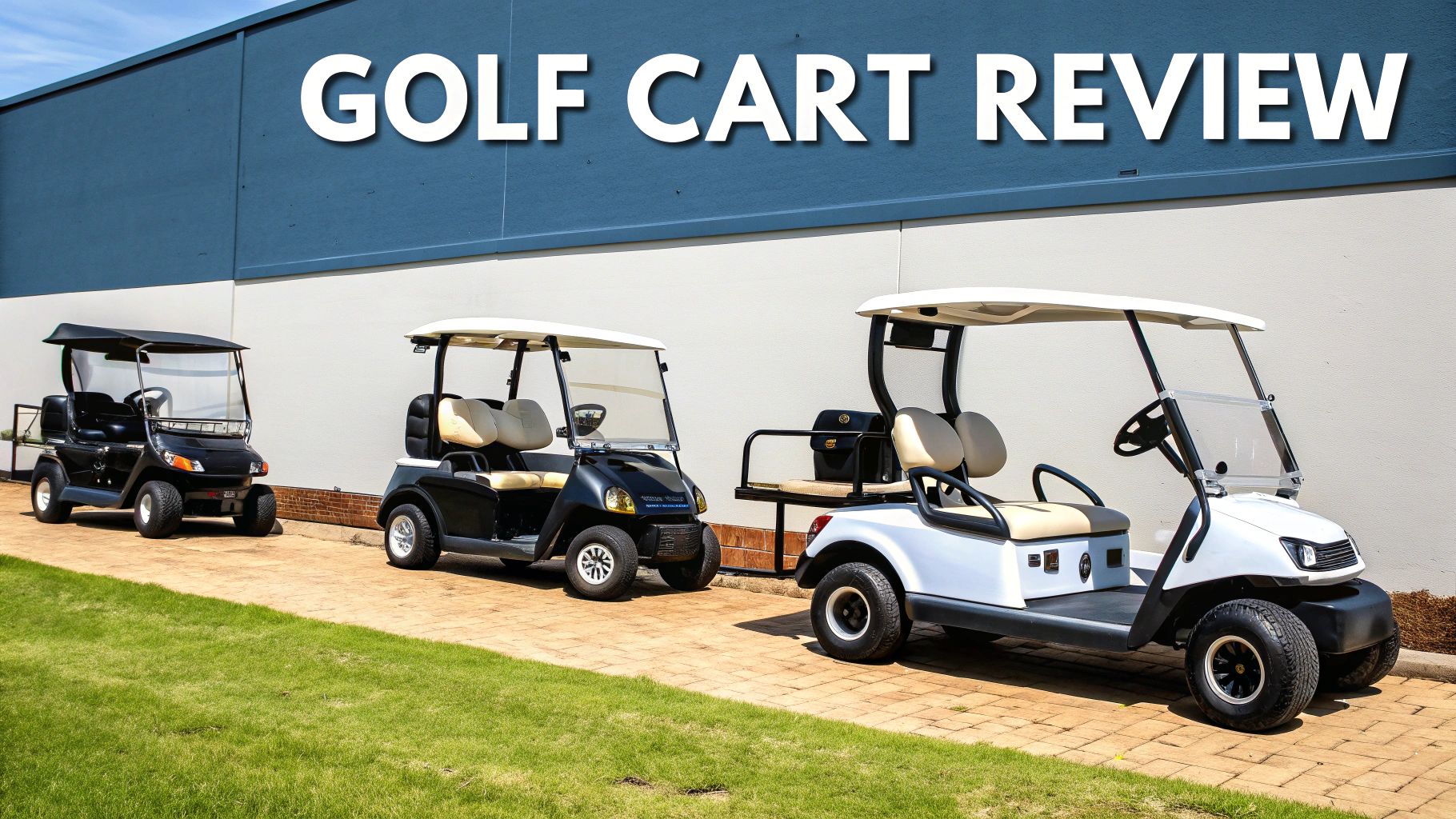
When you start looking into golf carts, you’ll quickly realize the market has branched out in three very different directions: you’ve got your powerful gas carts, the quiet and clean electric models, and a newer, innovative option—power-assist wheels for your push cart. Each one solves a different problem, so the right choice really boils down to what you need, whether that's managing a huge property or just making a walk on the course a little easier.
Navigating the Modern Golf Cart Landscape
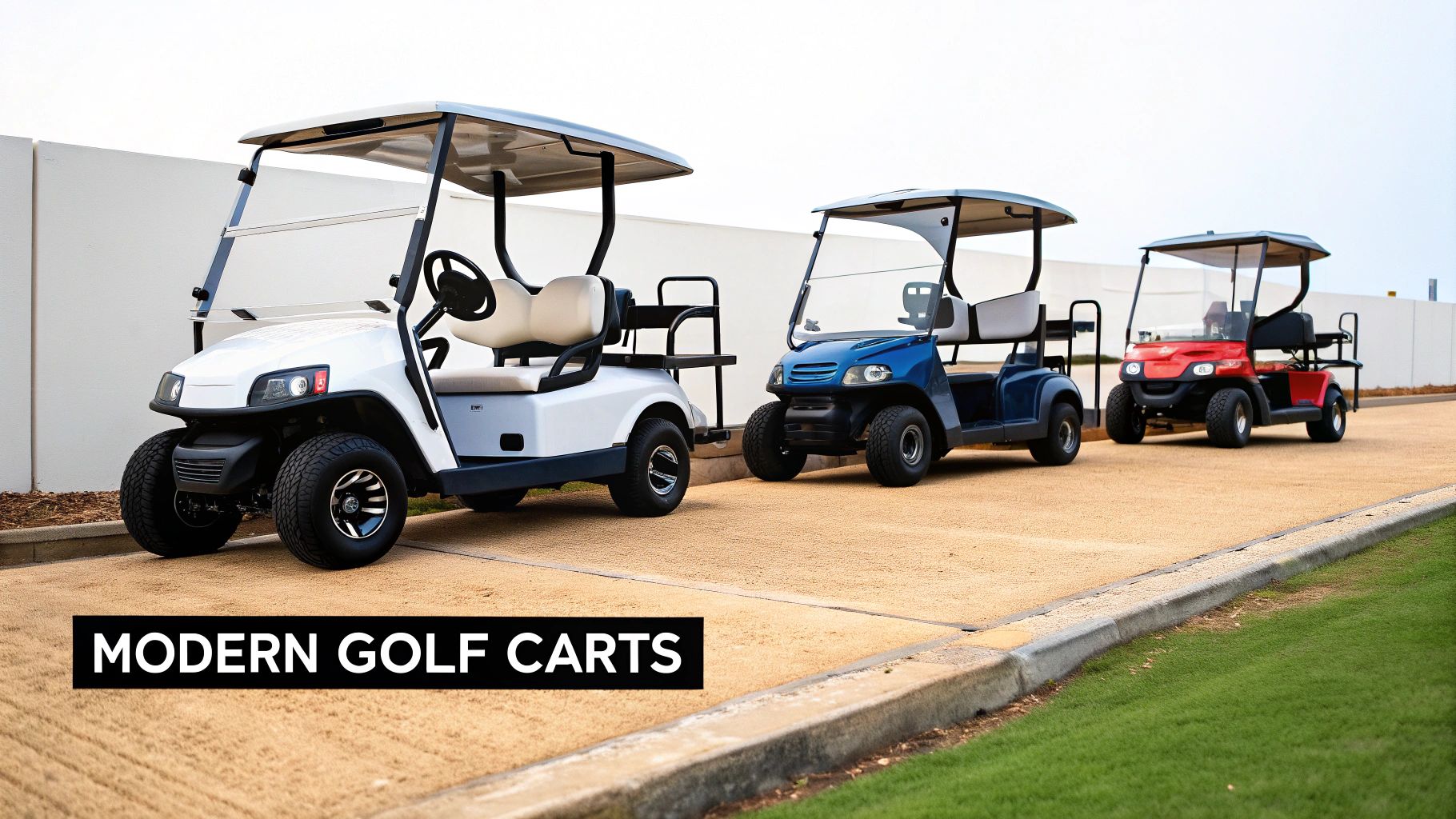
The classic golf course vehicle isn't what it used to be. Today's options are way more diverse and technologically advanced, moving far beyond the fairways and into private communities, sprawling resorts, and commercial properties. Getting a handle on this new landscape is the first step toward making a smart buy.
This guide will break down the three main categories defining the market today, giving you the real-world context you need to compare them properly.
- Traditional Gas-Powered Carts: These are the workhorses. They’re known for their impressive range and the convenience of a quick refuel.
- Modern Electric Riding Carts: Quiet, efficient, and surprisingly powerful thanks to major leaps in battery technology.
- Power-Assist Wheels: This is a game-changing category that motorizes your manual push cart, blending the health benefits of walking with effortless propulsion.
An Expanding Market
The explosion in options is a direct reflection of a booming industry. The global golf cart market is a massive sector, projected to climb from US$2.853 billion in 2025 to a staggering US$4.178 billion by 2032. This isn't just about golf courses upgrading their fleets; it's also driven by widespread adoption in gated communities and for all kinds of short-range transportation. You can read more about these market trends and their drivers to see just how big this is getting.
Today, a "golf cart" can mean anything from a rugged, gas-powered utility vehicle to a lightweight, whisper-quiet motor you attach to your push cart. The key is to match the technology to your intended use case.
A Three-Way Comparison
To help you find the perfect fit, we're going to compare these three solutions across the criteria that actually matter. This isn't just a list of features; we're focusing on how each type performs in the real world.
| Category | Gas-Powered Cart | Electric Riding Cart | Power-Assist Wheel |
|---|---|---|---|
| Primary Use | Large properties, commercial use | Golf courses, neighborhoods | Walking golfers on course |
| Power Source | Gasoline engine | Rechargeable battery pack | Single rechargeable battery |
| Noise Level | Loud | Nearly silent | Very quiet |
| Maintenance | Regular (oil, filters) | Minimal (battery care) | Very Low (battery care) |
As we dig deeper, you'll see how advancements in battery tech and motor efficiency have created more choices than ever. By understanding the core differences in power, maintenance, and the overall user experience, you can confidently navigate the market and pick the ideal ride for your needs.
Choosing the Right Golf Cart for Your Needs
Before you even start comparing models, the first step is figuring out what you actually need. The "best" option is a moving target—it depends entirely on you. A big gas cart that's perfect for a huge property is totally wrong for a golfer who wants to walk the course. Likewise, a power-assist wheel won't do much for a family cruising around the neighborhood.
Think of this as your personal filter. A quick self-assessment will help you ignore the noise and focus on the comparisons that matter. Let's break it down into three common scenarios to see where you fit.
Scenario One: The Dedicated Walking Golfer
Is your main goal to enjoy the health benefits of walking the course, but without the back-breaking work of shoving a 30-pound bag up every hill? If that sounds like you, your focus gets very narrow, very fast.
Forget traditional riding carts, both gas and electric. They're just not in the picture. Your world revolves around your push cart and finding a way to make it work for you. This is exactly where power-assist wheels come into play. They were designed for one job: to motorize the push cart you already own.
You still get the rhythm and exercise of walking, but you can ditch the grueling effort of pushing your gear over long distances or up steep inclines. For a lot of us, it’s the perfect sweet spot between a fully manual round and sitting in a cart all day. If you're still deciding on the base cart itself, our complete guide on how to choose a golf push cart is a great place to start.
Scenario Two: The Course and Community Cruiser
Maybe your golf cart needs to pull double duty. You might live in a gated community where a cart is the easiest way to get around—to the pool, a neighbor’s house, or the first tee. You need something quiet, efficient, and easy for the whole family to use.
This is the sweet spot for electric riding carts. Their near-silent operation won't annoy the neighbors, and the lack of smelly emissions is a huge plus. The instant torque from an electric motor is also a game-changer for getting up the steep hills you find on so many modern courses and in residential communities.
When you're using a cart for both the course and the community, it really comes down to user experience. The quiet, smooth ride of an electric cart is something gas models just can't match, making it the top choice for social and recreational use.
And don't worry about range. Modern lithium-ion batteries have pretty much solved that old problem, often delivering 40+ miles on a single charge. That’s more than enough for a couple of rounds of golf plus your daily errands around the neighborhood.
Scenario Three: The Heavy-Duty Workhorse
Finally, we have the user who needs a machine that just won't quit. Think of a groundskeeper on a massive course, a ranch owner, or someone managing a large commercial property. Their priorities are simple: maximum range, raw power, and the ability to refuel in minutes, not hours.
This is where gas-powered golf carts still reign supreme. Sure, they're louder and need more maintenance like oil changes and new spark plugs. But their operational range is undeniable. A gas cart can run all day long on a tank of fuel and be refilled in two minutes, completely eliminating downtime.
How to Make Your Call
To simplify things, just ask yourself these three questions in order:
- Where will I use it most? Are you staying strictly on the golf course, or will you be driving it around a neighborhood or across a large property?
- What’s my fitness goal? Do you want to walk the course and get your steps in, or would you rather ride and save your energy?
- What’s the terrain like? Is your environment mostly flat, or are you dealing with serious hills that demand more power and torque?
Answering these questions will point you straight to one of the three scenarios. It narrows your focus and makes the detailed comparisons that follow much more useful, ensuring you end up with something that perfectly fits your lifestyle.
Comparing Electric vs Gas vs Power-Assist Carts
Deciding between gas, electric, or a power-assist setup isn’t just a matter of preference; it’s about finding the right machine for your specific game and lifestyle. Each option brings its own unique set of strengths and weaknesses to the course. We’re going to dig deeper than a simple features list and give you a real-world breakdown of how each one performs where it counts.
To really know which cart is right for you, you have to look at the core differences in power, maintenance, noise, and what they’ll cost you over the long haul. This comparison will clear things up and show you which option genuinely fits your golfing routine, property needs, or community rules.
This infographic is a great starting point, boiling the decision down to key factors like your local terrain, how you plan to use the cart, and your budget.
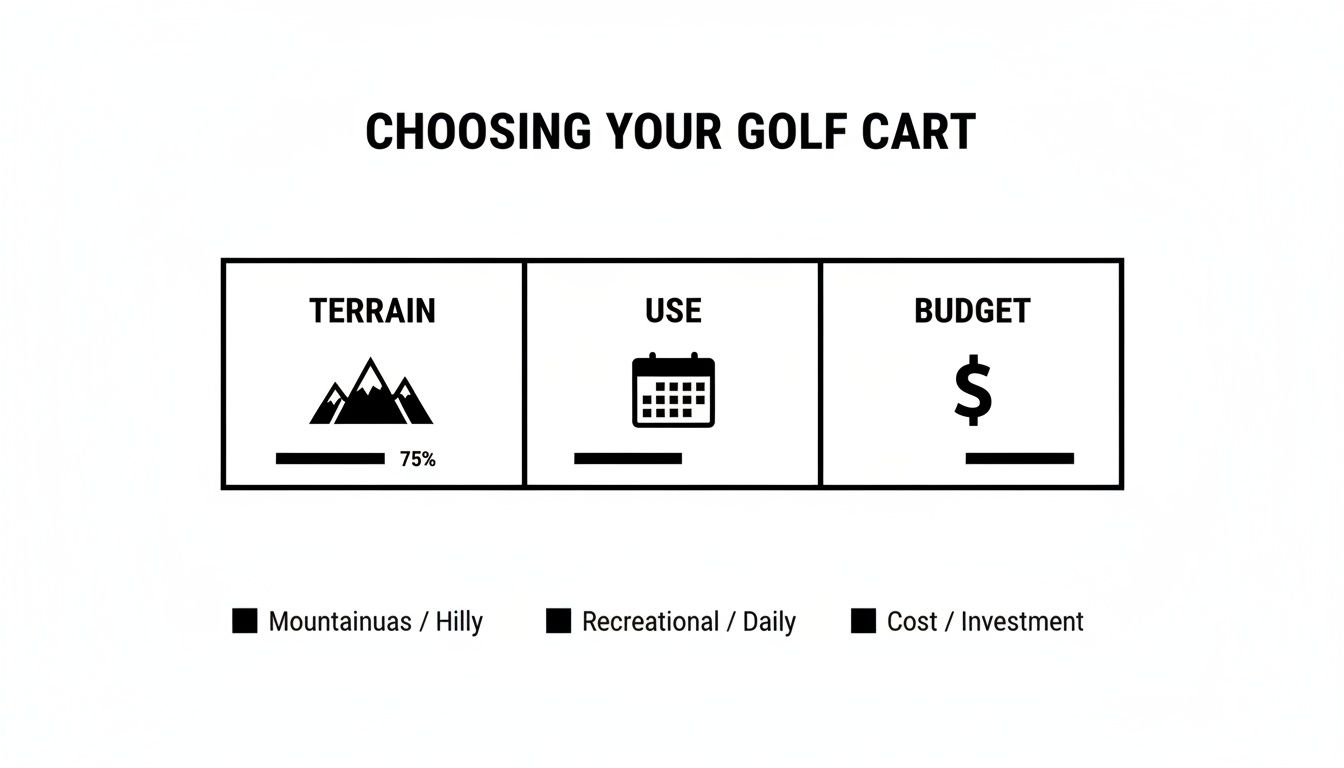
As you can see, your perfect match depends heavily on whether you’re tackling steep hills, using it for daily errands, or trying to stick to a specific price point.
To make this even clearer, let's break down the key differences between these three technologies.
At-a-Glance Comparison of Golf Cart Technologies
This table offers a quick snapshot of how each cart type stacks up in the most critical areas.
| Feature | Electric Riding Cart | Gas Riding Cart | Power-Assist Push Cart |
|---|---|---|---|
| Upfront Cost | Moderate to High | Moderate to High | Low |
| Power Delivery | Instant torque, quiet acceleration | Consistent, sustained power | Gentle, steady push assistance |
| Hill Performance | Excellent from a standstill | Strong, maintains speed | Makes pushing a heavy bag uphill feel effortless |
| Range | 40-50+ miles (Lithium) | 100+ miles per tank | 18-36+ holes per charge |
| Noise Level | Near-silent | Loud engine noise | Virtually silent |
| Maintenance | Minimal (battery, tires) | Regular (oil, spark plugs, filters) | Very low (charging, cleaning) |
| Best For | Quiet communities, courses, smooth rides | Large properties, commercial use, long distances | Walkers, hilly courses, golfers wanting exercise |
| Primary Drawback | Limited range, long recharge times | Noise, emissions, and frequent upkeep | Slower pace, no passenger capacity |
This comparison highlights the fundamental trade-offs. Now, let's dive into the specifics of what these differences mean for you.
Power and Hill-Climbing Performance
How a cart delivers power is one of its most defining traits. It’s not just about top speed, but how it handles a tough climb on the back nine when you’re loaded down.
Gas Carts are the undisputed workhorses. Their internal combustion engines deliver steady, reliable power that doesn't quit. They can haul heavy loads and cover long distances without any drop in performance, making them perfect for big properties or commercial fleets where pulling power is a must.
Electric Riding Carts, on the other hand, are all about instant torque. The second you step on the pedal, you get 100% of the motor's power. This gives them surprisingly quick acceleration and fantastic hill-climbing ability right from a dead stop, which often catches people used to gas models off guard.
Power-Assist Wheels are in a category of their own. Their job isn’t to carry you, but to make your walk easier. A quality system like the Caddie Wheel provides just enough torque to make a 30-pound golf bag feel like it’s floating, effortlessly gliding up steep fairways that would otherwise leave you winded. The goal is to eliminate physical strain, not to maximize speed.
Range and Battery Life
How far can you go before you need to refuel or recharge? It's a critical question, and the answer varies wildly between these options. The last thing you want is to be stranded halfway through your round or a day of chores.
Gas carts have a simple and obvious edge here. One tank of gas can last for a very long time—often well over 100 miles—and a refill takes just a few minutes. For anyone who can't afford downtime for charging, they're the clear winner.
Electric riding carts have come a long way. Older lead-acid batteries might get you 20-25 miles, but modern lithium-ion batteries can easily push past 40-50 miles on a single charge. It takes a few hours to recharge, but for most golfers and community residents, that’s more than enough for a full day. For a deeper look, check out our guide to understanding the world of the battery golf cart.
Power-assist wheels are measured in holes, not miles. A standard battery will get you through 18-27 holes, while an extended-life version can power through 36 holes or more. That's plenty of juice for even the most die-hard golfer's longest day.
Long-Term Maintenance and Costs
The sticker price is just the beginning. Over the life of your cart, maintenance and fuel will dramatically change the total cost of ownership. This is where you can find a lot of hidden expenses.
Gas carts demand the most attention. Like a car, they need routine oil changes, new spark plugs, and clean filters. While each task isn't overly expensive, the costs add up, not to mention the constant expense of gasoline.
Electric carts are much simpler. With no oil, spark plugs, or exhaust to worry about, routine maintenance is almost non-existent. It’s mainly about keeping an eye on battery health and tire pressure. The "fuel" is cheaper, too—charging with electricity costs a fraction of filling a gas tank.
Power-assist wheels are the easiest of all. The self-contained motor and battery require little more than proper charging and an occasional wipe-down. Their simple design translates directly to reliability and virtually zero ongoing maintenance costs.
User Experience and Noise
The final—and maybe most important—point is the experience of actually using the cart. This covers everything from how loud it is to how it feels to operate and its impact on your surroundings.
Gas carts are noisy. There’s no getting around it. The sound and smell of an engine can be disruptive on a quiet course or in a peaceful neighborhood. For utility work, however, this is usually a non-issue.
Electric riding carts offer a smooth, nearly silent ride. This quiet operation is a huge selling point in communities and on golf courses, creating a much more relaxed atmosphere. They’re incredibly simple to drive and produce zero emissions.
A power-assist wheel elevates the experience of walking the course. It runs silently, preserving the peace and quiet of a morning round. It removes the physical burden without taking you out of the game, offering a unique blend of exercise and convenience that neither riding option can match.
The market for these carts is growing worldwide, with regional tastes highlighting these very differences. North America is the largest market, holding about 58.5% of the market share, where consumers are increasingly prioritizing upgraded electric models for community use.
Deep Dive into Power-Assist Caddie Wheels
For a lot of us, walking the course is a huge part of what makes golf great. It’s your chance to get some exercise, soak in the scenery, and really connect with the rhythm of the game. But let’s be honest—pushing a heavy bag up and down hills can turn that pleasant walk into a real grind.
This is exactly where power-assist caddie wheels come into the picture. They hit that perfect sweet spot, giving you all the benefits of walking without the back-breaking effort. It’s a simple idea that’s completely changed the game for many golfers: transform your trusty manual push cart into a self-propelled caddie.
What to Look For in a Power-Assist Wheel
As you start exploring your options, you'll quickly realize that not all power-assist systems are built the same. While the core technology is similar, the small differences in performance and features can make a massive difference in your experience out on the course. If you focus on a few key specs, you’ll find a model that feels like it was made just for you.
Here are the essential features to keep an eye on:
- Motor Torque and Power: This is what’s going to get your cart up those hills. A motor with plenty of torque delivers smooth, consistent power, so your bag feels weightless even on the steepest inclines.
- Battery Capacity: You’ll typically see battery life measured in holes—18, 27, or 36. Be realistic about your needs. An 18-hole battery is fine for a casual round, but a 36-hole option gives you peace of mind for those long days or back-to-back rounds.
- Ease of Installation: The best systems are designed for a quick, tool-free setup. Look for models you can pop on or off in a couple of minutes, giving you the freedom to convert your push cart whenever you feel like it.
- Remote Control Functionality: A responsive, easy-to-use remote is a must. You'll want simple controls for forward, reverse, and braking. An ergonomic remote that clips right onto your belt or cart handle is a huge convenience.
- Push Cart Compatibility: This is a big one. While many units claim to be universal, always double-check if it fits your specific push cart. Most manufacturers provide a list of compatible carts, and checking it beforehand can save you a major headache.
Beyond just the tech specs, think about how a power-assist wheel can reduce the physical load during a round. It's a smart way to manage your energy and ties into broader strategies to prevent sports injuries for golfers of all ages.
Matching Features to Your Golfing Style
The right setup for you really depends on how and where you play. A golfer who sticks to flat courses on the weekends has very different needs from someone who’s out there every week tackling hilly, challenging tracks.
Let's break down how two different types of golfers might prioritize their features.
| Feature Priority | Weekend Golfer (Flat Courses) | Avid Golfer (Hilly Courses) |
|---|---|---|
| Motor | Standard torque is plenty to keep you moving on flat ground. | High torque is non-negotiable for climbing hills without a struggle. |
| Battery Life | An 18-hole battery is usually more than enough for one round. | A 27 or 36-hole battery offers confidence for tougher, more draining courses. |
| Remote Features | Basic forward and stop functions are all you really need. | Advanced features like braking control and variable speed are essential. |
| Durability | Standard build quality will hold up just fine for occasional use. | A rugged, all-weather design is a must for frequent play. |
Looking at it this way, it’s clear your personal golfing habits should steer your decision.
The true advantage of a power-assist wheel isn't just about making things easier; it’s about conserving your energy. When you stop wasting strength pushing your cart, you can save it for your swing. That means you’ll stay sharper, both mentally and physically, right through the 18th hole.
Ultimately, adding a power-assist system is an upgrade to your existing gear that pays you back in pure enjoyment and better performance. If you want to dive even deeper into this technology, our guide on the benefits of a power push cart for golf has even more insights. By weighing these key features, you can find the perfect caddie wheel to transform your walk and elevate your entire game.
Getting Your Power-Assist Wheels Up and Running
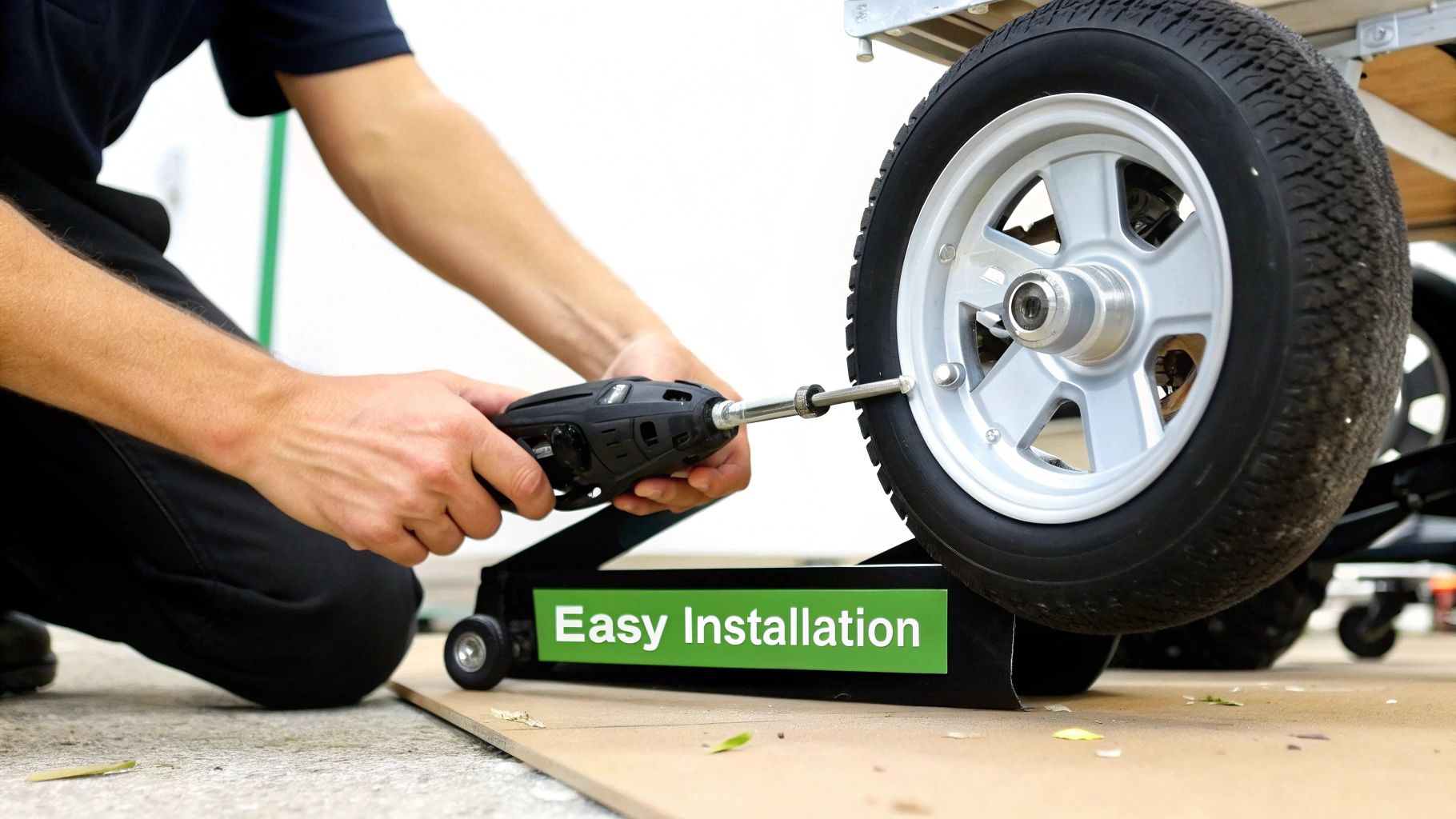
One of the biggest questions golfers have when looking at power-assist options is, "How hard is this thing to set up?" The thought of a complicated garage project is enough to turn anyone off, but the reality is that converting your push cart is surprisingly simple. Most of these systems are designed as easy DIY projects you can knock out in under an hour.
The whole point is to get you on the course faster, not stuck tinkering with tools. By breaking the process down into a few quick steps, you’ll see just how easy it is to upgrade your cart. This simple approach makes the benefits of a motorized caddie accessible to everyone.
The Installation Process, Step by Step
While every manufacturer has its own specific instructions, the basic installation for a power-assist wheel follows a pretty logical path. You won’t need a specialized tool chest or a degree in engineering to get it done.
Here’s what you can generally expect:
- Check Your Cart's Compatibility: Before you do anything else, make sure your push cart is a match. Manufacturers always provide a detailed list of compatible models. If you don't see your cart, don't panic—you might just need a specific adapter bracket.
- Mount the Bracket: This is the foundation of the whole system. The bracket attaches directly to your cart's rear axle or frame, usually with just a few screws and bolts. Tighten it down, and you're ready for the main event.
- Attach the Motorized Wheel: With the bracket secure, the motorized wheel unit just clicks or slides right into place. The best systems, like the Caddie Wheel, are designed for a "drop-on" installation that literally takes seconds.
- Pair the Remote: The final step is syncing the handheld remote to the motor. It’s usually a one-button process, just like pairing a Bluetooth speaker, to establish a secure link.
This streamlined setup means you can easily switch between manual and powered modes. If you’re playing a hilly course, pop the wheel on. If it’s a flat track, leave it in the car. It’s that flexible.
The best power-assist systems are engineered for convenience from start to finish. The goal is a hassle-free upgrade, not a complex modification project. A well-designed wheel should feel like a natural extension of your existing gear.
What if My Cart Isn't Officially Supported?
Finding out your push cart isn't on the official compatibility list is a bit of a bummer, but it’s not always a dead end. Many manufacturers offer adapter kits specifically designed to fit a much wider range of carts and axle types.
- Contact Customer Support: Your first move should be reaching out to the manufacturer directly. Their support team is your best resource and can often point you to the right adapter or let you know if one is in the works.
- Measure Your Axle: Sometimes, a bracket designed for a different cart model will fit yours perfectly. Get a tape measure and check your cart’s axle diameter and width. Compare those numbers to the specs for supported models—you might find a match.
By taking these extra steps, you can often find a solution that works. Manufacturers want to get this technology into the hands of as many golfers as possible, so they're usually happy to help you find the right fit for a better round.
Here’s the rewritten section, crafted to sound like an experienced human expert while adhering to all the specified requirements.
So, Which One is Right for You?
After breaking down all the options, it’s pretty clear there's no single "best" choice for everyone. The right cart really boils down to your specific needs—how you play, where you live, and what you plan to do with it. Let's cut through the noise and match the right gear to the right person.
Instead of just giving you a generic recommendation, my goal here is to help you pick the solution that genuinely fits your life. This is about making a smart investment that’ll make your time on the course—or around your property—that much better for years to come.
For the Die-Hard Walker Who Plays Hilly Courses
If you love walking the course but your back and legs are screaming by the 12th hole, the decision is easy. A power-assist wheel like the Caddie Wheel is exactly what you need. It keeps all the good stuff about walking—the exercise, the rhythm, the feel for the game—while taking the grunt work out of it.
This is the perfect blend of exercise and smart assistance. You’ll save your energy for the shot, not for wrestling your bag up a steep fairway. It’s a simple upgrade that turns a tough walk into a relaxing stroll.
For facility managers running large communities or resorts, outfitting your property with a fleet of low-maintenance, lithium-ion electric carts is a no-brainer. They offer the best mix of cost-effectiveness, user satisfaction, and quiet operation, creating a premium experience for everyone.
For the Golfer Living in a Golf Community
Does your cart need to handle a Sunday morning round and a trip to the community pool in the afternoon? Then a modern electric riding cart is your best bet. Its quiet hum is a huge plus in residential neighborhoods, and the instant torque means it has no problem climbing hills on or off the course.
With today’s lithium-ion batteries, you’ll have more than enough range to cover a full day of activities, from 18 holes to an evening cruise to visit neighbors. The smooth, silent ride just makes for a better all-around experience.
For the Heavy-Duty User on a Large Property
When you need pure, unapologetic power and all-day range, the gas-powered cart is still king. For commercial use, big farms, or sprawling estates, nothing beats its ability to run from sunup to sundown on a single tank and refuel in minutes.
Sure, it's louder and needs more maintenance, but its raw power and hauling capacity are essential for tough jobs. In any situation where utility and endurance are more important than a quiet ride, the gas cart is the most practical and reliable tool for the job.
Got Questions? We’ve Got Answers.
When you’re digging into the details of golf carts and power-assist wheels, a few questions always seem to pop up. Getting straight answers is the best way to feel good about your purchase, making sure the gear you choose is a perfect match for your game. Here are some of the most common things we get asked.
How Long Do Electric Golf Cart Batteries Last?
This is a big one, and for good reason—the battery is the heart of any electric cart. For the old-school traditional lead-acid batteries, you can typically expect them to last 3-5 years. Their lifespan really depends on how you use and maintain them.
But the game has changed with modern lithium-ion batteries. These powerhouses often last 8-10 years or even more, making them a fantastic long-term investment. Things like your charging routine, how often you play, and even the climate you're in will affect how long they last. For anyone going electric, it's also smart to know how to safely store lithium-ion batteries to maximize their life and ensure safety.
Can a Power-Assist Wheel Fit Any Push Cart?
While a lot of power-assist kits are built to be widely compatible, they aren't quite "one-size-fits-all." Before you buy, it’s absolutely crucial to check the manufacturer's specs against your push cart's axle type and frame.
Most fit issues come down to funky axle shapes or parts of the frame that get in the way. Always take a moment to measure your cart’s axle and double-check it against the kit’s requirements. It's a simple step that can save you a world of frustration.
Taking a quick measurement beforehand is the best way to guarantee a perfect fit and a headache-free installation.
Are Gas or Electric Carts Cheaper Long-Term?
The initial price tag doesn't tell the whole story. While a gas cart might seem a little cheaper upfront, electric carts almost always win the race when it comes to the total cost of ownership over time.
The long-term savings really come from two places:
- Fuel Costs: Charging up with electricity is way cheaper than filling a tank with gas. You'll notice the savings every single time you plug in instead of pumping.
- Maintenance: Electric carts have so many fewer moving parts. You can forget about oil changes, spark plugs, filters, and belts. That adds up to a huge savings in both cash and time spent in the shop.
Ready to make walking the course feel effortless? The Caddie Wheel transforms your push cart with powerful, quiet assistance, letting you save your energy for the game.
Share:
How to Make Your Electric Golf Cart Fast A Pro's Guide
A Golfer's Guide to Electric Remote Golf Carts