
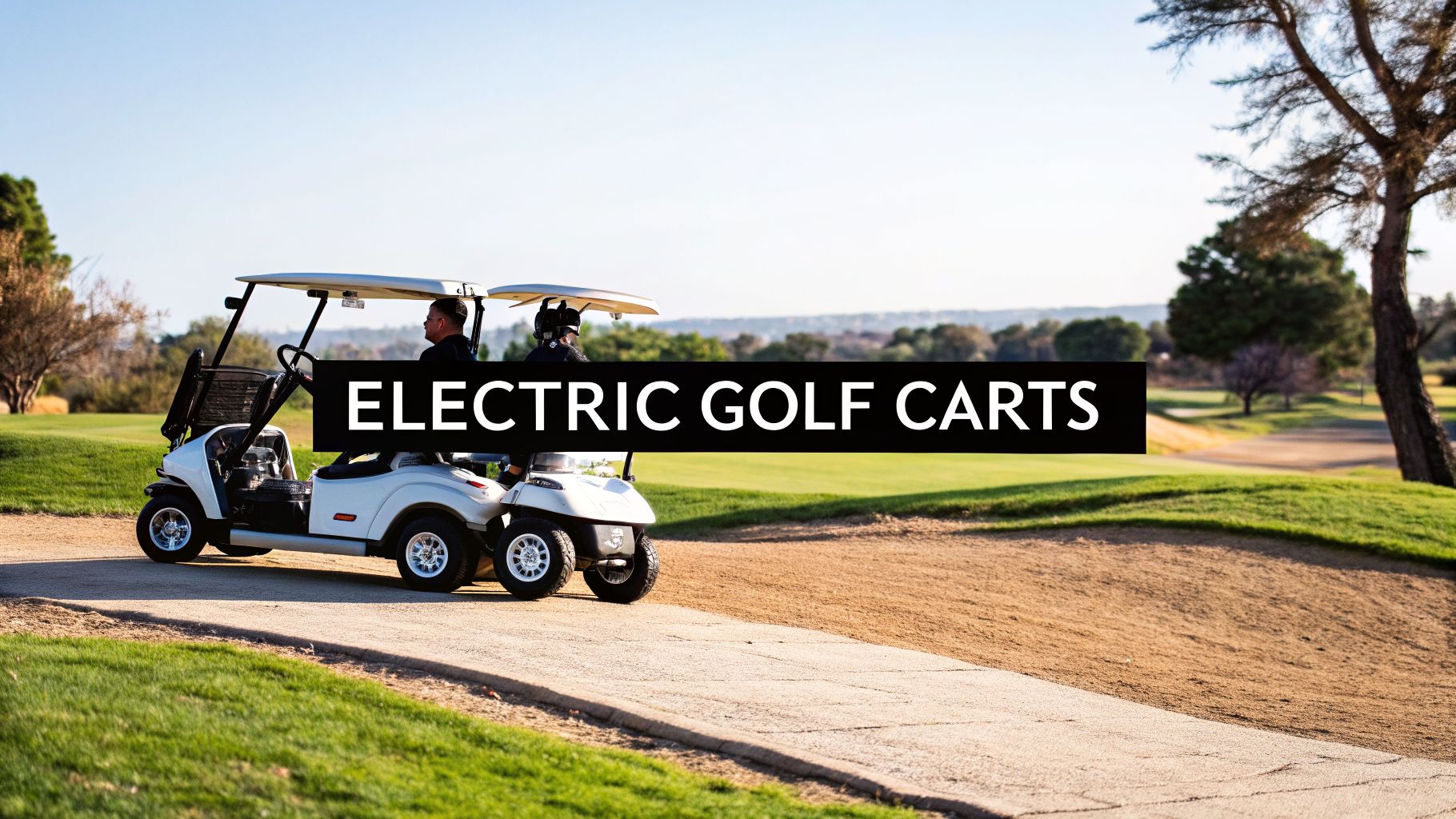
When you hear "electric golf cart," what comes to mind? For most people, it’s the traditional riding cart you see zipping down the fairway. But there's another, rapidly growing category: motorized push-cart assists that let you walk the course without the strain.
While a riding cart offers a comfortable seat between shots, a motorized push cart lets you enjoy the health benefits of walking without lugging a heavy bag. The right choice for you really boils down to how you want to experience the game.
Your Guide To The Electric Golf Cart Market
That walk from the 18th green can feel a whole lot longer than the one from the 1st tee. It’s no surprise that as more golfers choose to walk the course for fitness and enjoyment, the hunt for the right kind of electric assistance is on the rise.
But the market can be a bit confusing, splitting into two very different categories that serve completely different needs. This guide is here to help you sort through it all. We'll break down the pros and cons of each, helping you figure out which type of electric solution truly fits your game, your budget, and how you want to feel on the course.
The Booming Electric Cart Industry
This isn't just a small trend; it's an industry that's exploding. The global golf cart market was valued at USD 6.01 billion in 2025 and is projected to climb to an incredible USD 10.12 billion by 2032.
That’s a massive jump, reflecting a steady growth rate of 7.73% each year. This boom is fueled by a wider demand for low-speed electric vehicles, which are popping up everywhere from golf courses to gated communities and commercial campuses.
This growth is changing how people get around, both on and off the course. The key is understanding how this evolution affects you as a buyer. If you're leaning toward a traditional riding cart, you might be interested in our detailed guide to buying a power golf cart: https://caddiewheel.com/blogs/golf-content/your-guide-to-buying-a-power-golf-cart.
The core decision comes down to this: Do you want to ride between shots, or do you want to walk the course effortlessly? Answering this one question will immediately point you toward the right type of electric golf cart solution.
Beyond Your Personal Cart
While individual golfers like you are driving a lot of this demand, it’s worth noting the commercial side of things. Fleets of electric carts are a huge operational asset for golf courses, and understanding the principles of effective golf course management sheds light on why courses make the purchasing decisions they do.
But for the rest of this guide, we’re going to focus on what matters most to you—the individual golfer looking to find the perfect match for your game.
Riding Carts vs. Electric Assists: Which Is Right For You?
When you start looking for "electric golf carts for sale," you’ll quickly discover the market is split into two very different paths. On one side is the traditional riding cart—a classic sight on just about every course. On the other is a modern alternative that's picking up serious steam: the motorized push-cart assist.
The real question isn’t which one is better, but which one is better for you. Your decision really comes down to your mobility, fitness goals, budget, and the kind of day you want to have on the golf course.
The Traditional Electric Riding Cart
We all know the classic electric riding cart. It’s a two- or four-seat vehicle built for maximum comfort and getting around the course quickly. It takes walking completely out of the game, which makes it a fantastic choice for golfers with serious mobility issues or those who just want to save every ounce of energy for their swing.
But that convenience comes with some big trade-offs. Riding carts are a major purchase, often costing thousands of dollars upfront. They also demand a lot of storage space, like a dedicated spot in a garage, and you'll likely need a trailer to get it to the course. On top of that, many courses have "cart path only" days or are designated as walking-only, which can really limit where you can actually use it.
The Modern Push-Cart Assist
A motorized push-cart assist is a much more flexible and personal solution. The best way to think of it is as an e-bike for your golf bag. These clever devices attach right to your existing push cart, turning it into a self-propelled caddy that you can guide with a simple remote.
The beauty of this option is that you still get all the health benefits of walking the course, but without the physical grind of shoving a 30-pound bag up and down hills for four hours. It strikes a perfect balance—you get the electric power to conquer any terrain while staying active and connected to the game in a way riding just doesn't allow. You get the best of both worlds: effortless movement and healthy exercise.
This simple decision tree can help you visualize the choice.

As the chart shows, it all boils down to your priorities—whether you’re after low exertion and speed or prefer the exercise and freedom of walking with a little help.
Making The Right Decision For Your Game
So, how do you make the final call? Let's break it down with a few key points to think about.
- Mobility and Fitness: If physical limitations make walking 18 holes a non-starter, a riding cart is the obvious choice. But if you want to stay active and just find pushing a heavy cart tiring, an electric assist is the perfect fit.
- Budget: This one is a biggie. A push-cart assist costs a fraction of what a full-sized riding cart does. For players keeping an eye on their wallet, it’s an affordable way to get electric power without a huge financial commitment.
- Storage and Portability: Do you have room for a car-sized vehicle in your garage? Do you have a truck or trailer to haul it? If the answer is no, a compact electric assist that fits easily in your trunk is a much more practical choice.
The core difference lies in how you interact with the course. Riding carts transport you over the landscape, while electric assists help you walk through it, preserving the traditional feel of the game.
Ultimately, choosing between a riding cart and an electric assist will reshape your entire golf experience. A riding cart prioritizes speed and rest. An electric assist like the Caddie Wheel, on the other hand, enhances the walk, cuts down on fatigue, and keeps you connected to the rhythm and flow of the game.
Comparing The Key Features Of Electric Golf Carts
Once you've decided whether you're a rider or a walker, it's time to dig into the details that really matter. Scrolling through listings for electric golf carts for sale can be a dizzying experience, with a laundry list of specs that might not seem important at first. Think of this as your personal buyer's checklist—a guide to the critical factors that separate a good purchase from a great one.
Whether you're looking at a full-sized riding cart or a modern push-cart assist, these five pillars will make or break your experience: power, battery, portability, controls, and price. Let’s break down what you need to look for in each.
Power And Performance
Not all electric motors are built the same. The power and performance of your cart will directly impact how it handles your home course, especially if it’s one of those tracks with punishing hills. A traditional riding cart usually comes with a heavy-duty motor designed to haul two people and their gear up steep inclines without breaking a sweat.
An electric push-cart assist, on the other hand, needs a different kind of muscle. Its main job is to manage the weight of a single golf bag across all sorts of terrain. A quality model like the Caddie Wheel is engineered with plenty of torque to glide up hills effortlessly, so you never have to strain. It also includes braking control, which is a must-have for maintaining a safe, steady pace on the way back down.
Battery Life And Technology
The battery is the heart of any electric cart. In the golf world, you’ll mainly find two types: old-school lead-acid and modern lithium-ion. Lead-acid batteries have been around forever. They’re cheaper upfront, but they’re also incredibly heavy, need regular maintenance (like topping off water levels), and have a much shorter lifespan.
Lithium-ion batteries are the new gold standard for a reason. They're significantly lighter, charge way faster, last much longer, and require zero maintenance. While they might cost more initially, their reliability and longevity make them a much smarter investment in the long run. For a deeper dive, check out our guide on how to choose the right battery golf cart.
When you're comparing models, always look at the battery's capacity, which is usually measured in holes-per-charge. A powerful assist like the Caddie Wheel will give you up to 36 holes on a single charge, giving you more than enough juice for back-to-back rounds.
A cart’s battery isn’t just about how long it lasts—it’s about reliability. A premium lithium-ion battery gives you peace of mind, knowing your cart won’t quit on you at the furthest point from the clubhouse.
Portability And Storage
This factor is one of the biggest differentiators between riding carts and electric assists. A traditional riding cart is a big piece of machinery. It needs its own dedicated parking spot in a garage and often requires a trailer or truck to move it to and from the course.
Electric push-cart assists, however, are built for convenience. Since they're compact conversion kits that attach to your existing push cart, they are incredibly easy to handle. They fit comfortably in the trunk of just about any car, making them the perfect solution for golfers who value flexibility and want to avoid the logistical headaches of a larger vehicle.
Controls And Ease Of Use
How you actually drive the cart is another critical feature. Riding carts have a familiar setup with a steering wheel, pedals, and a dashboard. They’re simple enough to operate but can feel clunky in tight spaces.
Electric assists offer a more nimble and personal control system, usually through a handheld remote. This lets you manage the cart's speed and direction from a few paces away. You’ll want to look for simple, intuitive controls. The Caddie Wheel, for instance, uses a minimalist remote with clear buttons for forward, reverse, and braking, letting you focus on your next shot, not on fiddling with complicated settings. Thinking about the bigger picture of what equipment helps your game is a key part of choosing the right golf gear.
To make it even clearer, here’s a quick side-by-side look at how these two options stack up.
Feature Comparison Full Carts vs Electric Push-Cart Assists
This table breaks down the key differences to help you see at a glance which option best fits your needs as a golfer.
| Feature | Traditional Electric Riding Cart | Electric Push-Cart Assist (e.g., Caddie Wheel) |
|---|---|---|
| Primary Use | Riding the course; for players unable to walk | Walking the course without physical strain |
| Power & Hills | High power for 2+ people and gear | Optimized torque for one bag on steep hills |
| Battery Type | Often lead-acid (heavier, more maintenance) | Typically lithium-ion (lighter, longer life) |
| Portability | Low; requires garage storage and a trailer/truck | High; fits in a car trunk, easy to transport |
| Controls | Steering wheel, pedals, and dashboard | Handheld remote with simple functions |
| Price Range | High ($5,000 - $15,000+) | Low ($500 - $800) |
| Maintenance | Regular checks, battery watering (lead-acid) | Minimal; charge the battery and go |
| On-Course Footprint | Large; restricted to cart paths | Small; goes wherever you walk |
As you can see, the choice isn't just about riding versus walking—it's about a completely different approach to convenience, cost, and how you experience the game.
Price And Long-Term Value
Finally, let’s talk money. The price tag on a new electric riding cart can easily soar into the thousands, and that’s before you factor in ongoing costs for maintenance, charging, and eventual battery replacement. It’s a huge investment that really only makes sense for those who absolutely must ride.
This is where the financial genius of electric assists truly shines. They offer a powerful, modern solution for a tiny fraction of the cost, making them one of the best value-for-money upgrades in golf. This trend toward more efficient and affordable electric options is changing the entire market. In fact, the industry is seeing a massive shift, with electric models holding an 81.81% market share in 2025 and projected to hit 85% by 2026 as golfers increasingly move away from gas-powered carts.
Enter The Caddie Wheel: A Smarter Electric Solution
After weighing the options between full-sized electric caddies and simple push-cart conversion kits, it’s obvious there’s a gap in the market. A lot of walkers find themselves stuck in the middle. They want a break from shoving a heavy bag up and down hills but aren't ready for the price tag and logistical headache of a dedicated electric cart.
This is exactly where the Caddie Wheel comes in. It’s the perfect compromise, giving you powerful electric assistance without forcing you to buy a whole new piece of equipment. At its heart, the Caddie Wheel is an elegant piece of engineering that turns your trusty push cart into a self-propelled caddy. You get the best of both worlds—all the health benefits of walking, combined with the effortless glide of electric power.

Upgrade Your Cart In Minutes
Let's be honest, one of the biggest turn-offs with new golf tech can be a frustrating setup. The Caddie Wheel sidesteps that problem completely with a dead-simple, tool-free installation. Its smart design uses a snap-in bracket that lets you attach the motorized wheel to your cart in just a couple of minutes.
That means no engineering degree or garage full of tools required. You just snap it on and you're ready to walk the course with a fraction of the effort. This simple approach works with most standard three- and four-wheel push carts, making it a no-brainer upgrade for almost any golfer.
Intuitive Control At Your Fingertips
Real convenience on the course comes from technology that just works without getting in your way. The Caddie Wheel nails this. It’s controlled by a simple handheld remote that gives you total command without pulling your focus from the game.
With clearly marked buttons, managing your cart is a breeze:
- Forward: Set a pace that matches your stride.
- Reverse: Easily back out of a tight spot near the green.
- Braking: Stay in complete control on those steep downhill paths.
This straightforward system ensures you’re thinking about your next shot, not fumbling with your gear. The whole point is to make the technology feel invisible, letting you enjoy a smoother, more relaxed round.
The Caddie Wheel isn't just about adding a motor; it's about removing a burden. By eliminating the physical strain of pushing your cart, you conserve precious energy, helping you stay mentally sharp and physically fresh through all 18 holes.
And this idea is catching on. The global golf cart market, valued at $1.41 billion in 2021, is projected to hit $2 billion by 2030, with electric models leading the way. While traditional riding carts have their place, a growing slice of the golf community—which has ballooned by 20% since COVID—is looking for electric assists to make walking better, not replace it. You can dig into these trends in this detailed market analysis.
Power That Lasts All Day
There's nothing worse than your tech dying on you mid-round. The Caddie Wheel was built to go the distance, armed with a high-capacity lithium-ion battery that delivers serious stamina. On a single charge, it can power your cart for up to 36 holes—more than enough for even the most hardcore golfer’s marathon day.
This lasting power means you can tackle any course with confidence, never worrying about getting stranded. When it’s time to juice up, the included portable charger makes it quick and easy to get ready for your next tee time. It's this focus on real-world, practical performance that makes it such a smart investment for anyone searching for electric golf carts for sale.
Taking Care of Your Electric Caddy: Installation and Maintenance

Upgrading to an electric caddy or a motorized assist is a fantastic way to improve your game, but like any good piece of equipment, a little care goes a long way. The great news? Getting it set up and keeping it in top shape is far easier than you might think.
From a quick, tool-free setup to basic battery care, these practical tips will make sure your cart is always ready for that first tee time.
Getting the Caddie Wheel Set Up
With a modern solution like the Caddie Wheel, the installation is designed to be ridiculously simple. You don't need to block out an afternoon or dig through a toolbox. You can have it attached to your existing push cart and ready to roll in just a few minutes, right out of the box.
Here’s all it takes to turn your standard push cart into a powerful electric caddy:
- Attach the Bracket: First, secure the custom-designed snap-in bracket right onto the axle of your push cart. It’s built to fit most three- and four-wheel models and locks on tight.
- Drop and Lock: Next, just line up the Caddie Wheel with the bracket and drop it into place. You’ll hear a satisfying click as it locks securely, letting you know it's good to go.
- Power On and Play: That's it. Turn on the unit, grab your remote, and you’re ready to walk the course without breaking a sweat.
This simple setup is a core feature—it was designed so any golfer can upgrade their cart without needing to be a tech wizard. The whole point is to get you on the course faster.
Keeping Your Electric Caddy in Great Shape
Once you’re set up, a few basic habits can dramatically extend the life of your equipment and guarantee it performs reliably every single round. The most important thing to focus on is the battery, which is the heart of your whole system. Think of it like the engine in a car—it needs proper care to run smoothly for years.
The number one rule is to always follow the manufacturer’s charging guidelines. Overcharging or using the wrong charger can slowly kill your battery's health. A quality lithium-ion battery, like the one in the Caddie Wheel, is pretty low-maintenance, but smart charging practices are key.
Proper battery care isn't just about longevity; it's about reliability. A well-maintained battery ensures you have the power you need to conquer the 18th hole with the same confidence you had on the 1st.
To keep your entire system in top shape, just follow this simple checklist:
- Smart Charging: Always charge your battery after each round, but don't leave it plugged in for days after it’s full.
- Temperature Control: Store your cart and battery in a cool, dry place. Extreme heat or cold can permanently damage battery cells and zap their capacity.
- Keep It Clean: Every so often, wipe down the battery terminals and connections to prevent corrosion, which can mess with the power flow.
- Check Tire Pressure: For both riding carts and push carts, properly inflated tires reduce drag. This helps the motor work more efficiently and saves battery life.
These simple steps will protect your investment, making sure your electric caddy remains a dependable partner on the course for countless rounds to come.
Your Final Checklist Before You Buy
Alright, you've sifted through the options, weighed the features, and you’re getting close to a decision. Before you pull the trigger on one of the many electric golf carts for sale, let's run through one last mental checklist. Think of it as a final gut check to make sure you're picking a solution that will genuinely make your time on the course better.
This isn’t about specs anymore—it’s about you. Answering these questions honestly will point you directly to the right piece of equipment for your game, your budget, and your body.
Key Questions to Ask Yourself
- How do I want to experience the course? This is the big one. Are you after the health benefits and pure satisfaction of walking the fairways? Or do you need to ride because of mobility issues? Your answer here immediately cuts the field in half.
- What is my home course like? A flat, easy-walking track is a completely different beast than a hilly course with long, steep climbs. Make sure whatever you choose has enough power to handle your typical round without bogging down.
- What’s my true budget? Don't just look at the sticker price. You have to factor in the long-term costs of maintenance, charging, and storage. An electric push-cart assist gives you a high-performance experience with a much lower total cost over its lifetime.
- Do I have the space? A full-sized cart needs a garage and maybe even a trailer to get it to the course. An assist like the Caddie Wheel? That fits right in your car trunk. Practicality is everything.
Your final decision should be about empowerment. Choose the solution that reduces fatigue, keeps you fresh through the back nine, and ultimately helps you enjoy the game more. For most walking golfers, that solution is a high-quality electric assist.
The Caddie Wheel really stands out here as an affordable, powerful, and ridiculously convenient choice that makes the walking experience better, not different. It perfectly fits the needs of golfers who want to stay active without the physical punishment of lugging a heavy bag for four hours.
If you're still on the fence about the costs, our guide on the price of electric golf carts offers a detailed breakdown.
In the end, the best investment is the one that gets you out on the course more often and with a bigger smile on your face. Choose wisely, and you'll find your new electric assistant is one of the best additions you've ever made to your game.
Still Have Questions? We’ve Got Answers.
Even with all the specs and models laid out, you probably have a few more questions rattling around. That’s a good thing—it means you’re close to making a smart decision. This section tackles the most common questions we hear from golfers looking at electric golf carts for sale, so you can feel completely confident when you pull the trigger.
We'll cover everything from setup to on-course performance, giving you the straight-up answers you need.
How Tough Is It to Install an Electric Push-Cart Assist?
A lot of golfers get hung up on this, imagining a complicated mess of tools and technical steps. The good news is that modern designs have made installation a total breeze. Most high-quality electric assists are designed to be a simple, tool-free process that takes just a few minutes.
The Caddie Wheel, for instance, was built around a drop-on design with a snap-in bracket. You can attach it to most standard three- or four-wheel push carts almost instantly. There’s no need for an engineering degree—it’s a quick, one-time setup and you're good to go.
Will a Motorized Push Cart Conquer Hilly Courses?
Absolutely. In fact, that's one of their main jobs. The best electric assist models are specifically engineered to eat hills for breakfast. They come with powerful motors designed to tackle steep, challenging terrain without skipping a beat.
A motor like the one on the Caddie Wheel delivers more than enough juice to glide up sharp inclines, saving your legs and your energy for the next shot.
Here's a pro tip: Don't just look at uphill power. Make sure the remote offers solid braking control. Managing your speed on the way down is just as critical as the power you have on the way up, giving you total command no matter where you are on the course.
How Long Does the Battery Really Last on an Electric Push Cart?
Battery life is a huge deal, and it varies a lot from model to model. Some of the lower-end options might have you sweating on the back nine, but the premium electric assists are built to eliminate that "range anxiety" completely.
A high-capacity battery, like the one packed into the Caddie Wheel, is designed to last for up to 36 holes on a single charge. That’s more than enough power for a full day of golf, and it even comes with a portable charger to top it off between rounds.
Is Buying an Electric Assist Actually Cheaper?
Yes, and the difference is massive. When you browse new electric golf carts for sale, you’ll see that a full-sized riding cart can easily set you back several thousand dollars. It’s a major purchase, not to mention the long-term maintenance costs that come with it.
An electric assist kit, like the Caddie Wheel, lets you motorize the push cart you already own for a tiny fraction of that cost. It's an incredibly smart way to get all the perks of electric power without the huge financial hit of buying a whole new vehicle.
Ready to make walking the course feel effortless? The Caddie Wheel transforms your current push cart with powerful, quiet, and reliable electric assistance. Experience the difference for yourself and start enjoying the game more.
Share:
The Modern Golfer's Guide to a Robot Golf Caddy
The Ultimate Guide to Electric Golf Pull Carts