
Picture this: you're strolling down the fairway, totally dialed in on your next shot, and your golf bag is just... following you. It glides along behind you like a perfectly trained caddie, silent and effortless. This isn't some futuristic dream; it's what an electric golf push cart that follows you actually does, and it’s changing the game for walkers.
Your Hands-Free Caddie: The Rise of Follow Golf Carts
Walking the course is a huge part of golf’s soul, but let’s be honest—lugging or pushing a heavy bag for four-plus hours can wreck your focus and your back. A follow-me electric cart solves this problem in the most elegant way possible. Think of it as your own personal robot caddie, one that dutifully trails you down every fairway and up every hill without you lifting a finger.
This simple idea is a game-changer. It means you save your energy for what matters: your swing. You can walk freely, soak in the course, and keep your mind on your strategy, not on shoving a cart around. It perfectly settles the classic debate between walking or riding a golf cart by giving you the best of both worlds.
Why Follow-Me Carts Are Gaining Popularity
This isn't just a niche gadget for tech lovers; it's a fast-growing movement in the golf world. The boom is being driven by players who love the health benefits of walking but are tired of the fatigue that comes with it.
The numbers back it up. The global market for electric golf push carts is already big, valued at around $500 million in 2025, and it's expected to grow at a healthy 8% each year through 2033. This isn't just about convenience; it's a fundamental shift in how people want to experience their round.
The appeal is pretty straightforward:
- Less Physical Strain: Say goodbye to wrestling a heavy cart up hills or through thick rough. This is a massive relief, especially on tough courses or during long tournaments.
- Better Focus, Better Scores: When you're not physically drained from pushing your gear, all that mental and physical energy can go directly into your game. It’s amazing what you can do when your only job is to play golf.
- More Enjoyment: Walking the course becomes a purely pleasant experience again. You get to appreciate the scenery and the company without feeling like you're doing chores between shots.
In this guide, we’ll get into the nuts and bolts of how this tech works, stack up the different options, and help you figure out if a hands-free caddie is the right move to step up your game.
It might feel like some kind of sorcery, watching a golf cart trail its owner down the fairway without anyone touching it. But it's not magic—it's just a brilliant blend of sensor tech and smart engineering.
Think of it like a bat using echolocation to navigate a cave or a modern car using parking assist to perfectly slide into a tight spot. Your cart isn’t enchanted; it’s just having a constant, high-tech conversation with you.
The whole system hinges on a small remote or fob you carry, usually clipped to your belt or back pocket. This little device is the key. It acts as a digital beacon, constantly sending out a unique, low-energy signal that tells the cart, "I'm over here!"
The Core Technology Breakdown
Your cart is outfitted with a set of sophisticated sensors—typically ultrasonic or Bluetooth-based—mounted on its frame. These sensors are the "ears," and they're always listening for that specific signal coming from your beacon. By measuring the signal's strength and the angle it's coming from, the cart’s internal computer triangulates your exact position in real-time.
This continuous stream of data lets the cart handle a few key tasks all on its own:
- Maintain Distance: It knows exactly how far away you are and adjusts its speed to keep a consistent, safe following distance, usually between three to five yards.
- Steer and Navigate: As you walk the fairway, the sensors detect the shift in your beacon’s location. They then tell the motorized wheels how to turn, allowing the cart to smoothly shadow your every move.
- Automatic Braking: The second you stop, the gap between you and the cart starts to close. The system recognizes this instantly and hits the brakes, preventing any accidental bumps.
The Brains Behind the Operation
All this information is crunched by an onboard "brain," which is a combination of a central processor and a gyroscope. The gyroscope is the unsung hero here. It's crucial for stability, helping the cart understand its balance and orientation, especially on hills or uneven ground. It's what keeps your cart from tipping over when it’s making a sharp turn or climbing an incline.
The real genius of 'follow-me' technology isn't just that the cart follows you. It's that it does it intelligently and safely, anticipating your movements to create a totally seamless, hands-free day on the course.
This simple chart shows how a hands-free caddie can directly improve the most important parts of your game.
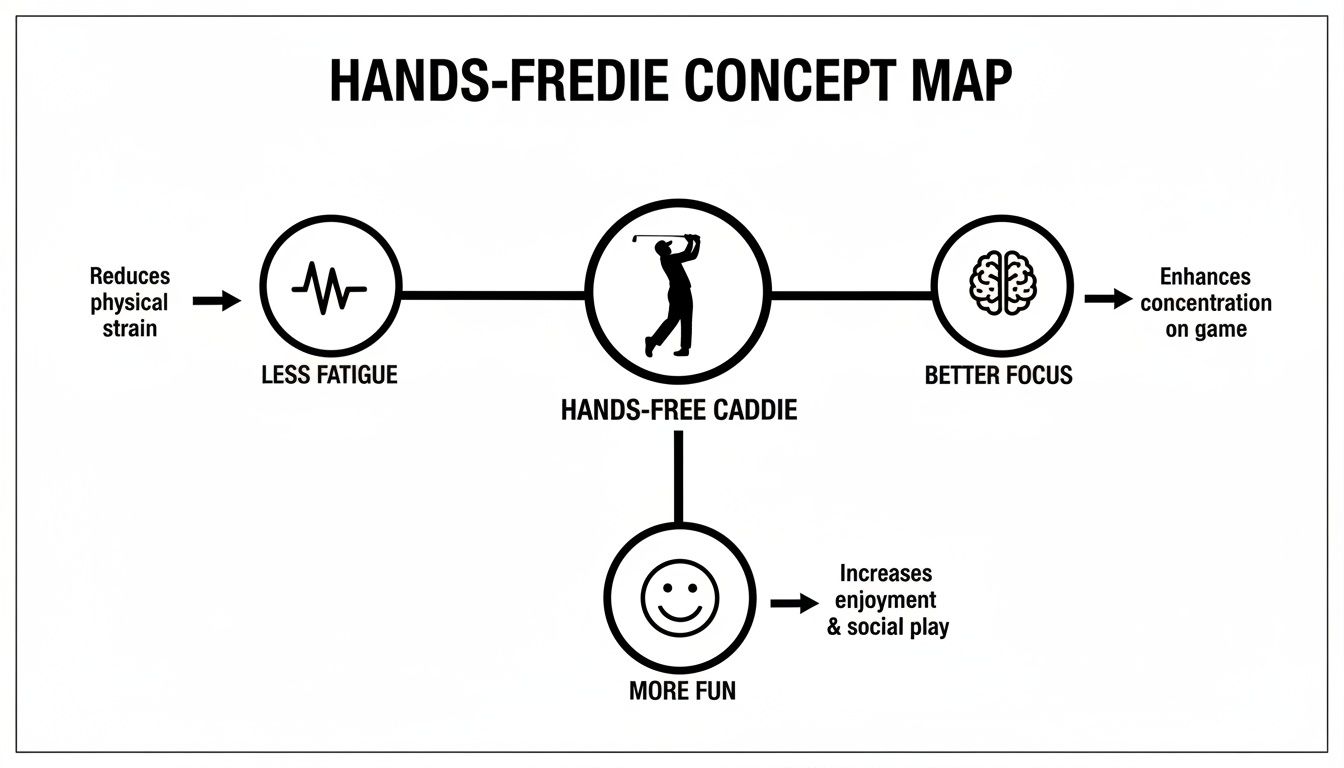
Ultimately, the goal of this technology is to take the physical and mental load off your shoulders. It means less fatigue, sharper focus, and a much more enjoyable round. If you want to dive even deeper into how these systems work, check out your guide to the robotic golf caddy.
Follow-Me Vs Remote-Controlled Carts
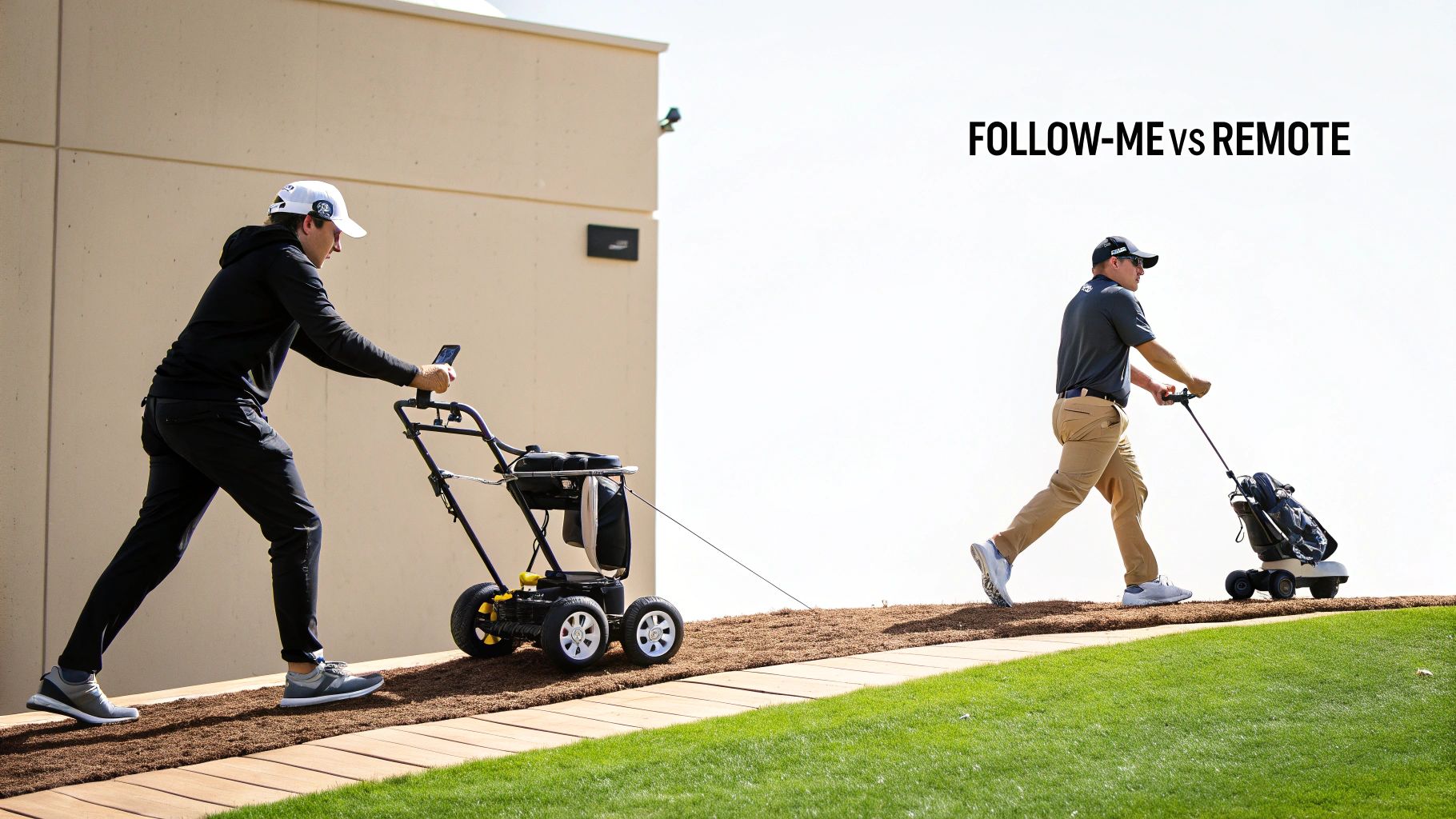
When you start shopping for an electric cart, you’ll quickly run into two categories that sound similar but deliver a totally different day on the course. Getting this distinction right is the key to making sure you end up with the cart you actually want.
First, you have the true electric golf push cart that follows you. This is the ultimate in hands-free convenience. It uses smart sensor technology to autonomously tag along behind you, keeping a perfect distance without you ever touching a button. You just clip on a small beacon, start walking, and your cart does the rest.
Then, there’s the remote-controlled cart. The best way to think of this one is as a sophisticated RC car built to carry your golf bag. It's motorized, sure, but it needs your constant attention and input through a handheld remote to steer, accelerate, and stop.
The Critical Differences in Operation
The real contrast boils down to one simple thing: automation versus manual control. A follow-me cart is a genuine “set it and forget it” system. It’s designed to fade into the background so you can focus 100% on your walk, the scenery, and lining up your next shot, knowing your bag is right there with you.
A remote-controlled cart, on the other hand, requires you to be an active pilot. You’re the one guiding it around bunkers, navigating cart paths, and parking it by the green. While it offers pinpoint control over its every move, it also means your attention is always split between playing golf and driving your cart. If you want to dive deeper into how these work, you can explore the ins and outs of remote control electric golf carts.
A follow-me cart lets you focus 100% on golf, while a remote-controlled cart requires you to be both the golfer and the driver. The choice depends on whether you seek total freedom or total control.
To make the decision even clearer, let's put these two types of carts head-to-head and see how they really stack up.
Follow-Me vs Remote-Controlled Carts: A Head-to-Head Comparison
This table cuts right to the chase, breaking down the key differences between a fully autonomous "follow-me" cart and its remote-operated counterpart. It's a quick way to see which style aligns better with what you're looking for on the course.
| Feature | True Follow-Me Cart | Remote-Controlled Cart |
|---|---|---|
| User Experience | Completely hands-free and autonomous. | Requires constant manual input via remote. |
| On-Course Focus | Maximized. Allows you to concentrate fully on the game. | Divided. You must actively steer and manage the cart. |
| Technology | Advanced sensors, AI, and beacon tracking. | Motorized wheels controlled by a radio frequency remote. |
| Ideal Golfer | The player who wants to walk unburdened and stay in the zone. | The player who enjoys tech and wants precise control over the cart’s path. |
| Price Point | Generally higher due to the complex autonomous systems. | More budget-friendly, offering a motorized middle ground. |
Ultimately, choosing between follow-me and remote-controlled comes down to personal preference. Do you want a caddie that follows your lead without a word, or do you prefer to be in the driver's seat? Knowing the difference is the first step toward a much more enjoyable walk on the links.
Evaluating Top Follow-Me Carts on The Market
Knowing how the tech works is one thing, but seeing it in action on the fairway is what really counts. The market for an electric golf push cart that follows you is heating up, and a few key players are starting to stand out with some truly unique designs.
Let's break down some of the top models that are catching golfers' eyes. Each one brings something a little different to the course, from mind-bending AI to rugged, no-nonsense simplicity. By comparing them, you'll get a much clearer picture of which cart is the right fit for your game and home course.
The AI-Powered Innovator: Robera
The Robera Follow Caddy is about as futuristic as it gets, leaning hard into artificial intelligence (AI) and visual sensors to create a golf companion that feels genuinely smart. Instead of just locking onto a beacon, it uses cameras to visually identify you and follow along, opening the door for some seriously advanced moves.
This thing is loaded with features aimed at making your walk completely effortless.
- Multiple Modes: It’s not just a one-trick pony. Robera has a standard "follow" setting, but it also includes a "Marching" mode where it can actually lead you, plus the usual remote and manual push options.
- Obstacle Avoidance: This is the big one. Its AI brain can spot and steer around things like sand traps or even other golfers, a feature you won't find on most other follow carts.
- Anti-Tipping System: It’s built like a tank for stability, engineered to handle slopes up to 25 degrees without breaking a sweat or losing its balance.
The Robera is for the golfer who geeks out on the latest tech. Its AI guidance and obstacle avoidance are a peek into the future of hands-free golf, but be prepared—that level of innovation comes with a premium price tag.
The All-Round Performer: Follow M8
The Follow M8 from Green Eagle Golf hits that sweet spot between high-tech cool and practical, on-course reliability. It uses the more traditional beacon-based follow system but has polished it to a shine with a bunch of user-friendly options you can control with either a remote or a smartphone app.
Its defining feature is pure versatility. The Follow M8 gives you five distinct driving modes, including a true follow mode, a cruise control setting for maintaining a steady pace, and a manual push option for those just-in-case moments when the battery dies. This adaptability makes it a great fit for a huge range of golfers and course conditions.
The cart is also built to last, with an ultra-fast folding system that cuts down on moving parts that could wear out or break. And with a battery that can go for up to three full rounds (approximately 54 holes), it’s a true workhorse. It might not have the fancy visual AI of the Robera, but its solid feature set and bomb-proof construction make it a top contender for any serious walking golfer.
Key Feature Comparison
| Feature | Robera Follow Caddy | Follow M8 |
|---|---|---|
| Follow Tech | AI & Visual Sensors | Beacon & Remote |
| Unique Feature | Intelligent Obstacle Avoidance | 5 Driving Modes |
| Battery Life | 27-36 Holes | Up to 54 Holes |
| Stability | 25-degree slope handling | Downhill Auto-Brake |
| Ideal User | Tech-focused, early adopter | All-around, practical golfer |
Is a Self-Following Golf Cart Worth The Investment?
An electric golf push cart that follows you around the course is a serious piece of kit, and it’s only natural to ask the big question: is it really worth the money? There’s no simple yes or no here; it really comes down to a personal cost-benefit analysis. For a growing number of golfers, though, the investment completely changes their relationship with the game.
The most immediate win is the massive reduction in physical strain. Walking 18 holes is fantastic exercise, but lugging or pushing a 30-pound bag up hills and through the rough is a real energy-sapper. By the time you hit the back nine, that fatigue starts creeping into your swing, leading to sloppy shots and higher scores. A follow-me cart just wipes that burden off the map.
This hands-free freedom lets you conserve 100% of your physical and mental energy for what actually matters: playing golf. Instead of figuring out the best way to wrestle your cart up a steep fairway, you can spend that time reading the green or planning your next approach shot. The result is often better consistency, especially late in a round when mental mistakes tend to pop up.
The Tangible Benefits Versus The Costs
While the advantages are pretty clear, the drawbacks are just as straightforward. The biggest hurdle is the initial cost—these carts are a significant financial commitment, no doubt about it. There’s also a small learning curve as you get comfortable with the technology and learn to trust it to navigate the course on its own. And, like any complex electronic device, there’s always the potential for technical hiccups down the line.
To put the benefits in perspective, let's look at the real-world impact. According to industry polls, golfers who use them report 28% less fatigue after playing 18 holes. Even more telling, an impressive 72% of buyers end up making repeat purchases for themselves or family. This sky-high satisfaction rate is why major resorts are adding them to their fleets, with some having over 500 units rolling on their courses daily. You can explore more data on the electric golf push cart market to see the trends for yourself.
Ultimately, a follow-me cart is an investment in your physical well-being and your focus on the course. It transforms walking the course from a chore into a pure, unburdened pleasure.
Making Your Personal Decision
So, is a self-following golf cart the right move for you? It helps to ask yourself a few key questions:
- How often do you play? The more you walk the course, the faster you'll feel the return on your investment in pure enjoyment and better performance.
- What is your primary goal? If you're looking to reduce physical strain so you can play more often or need to keep your head in the game for competitive rounds, the value proposition is incredibly strong.
- Does it fit your budget? While it's a big purchase, it can be framed as a long-term investment in your hobby, much like a brand-new set of clubs.
By weighing these factors, you can decide if the freedom and focus that a hands-free caddie offers truly align with your personal golfing priorities.
Your Pre-Purchase Checklist For The Right Cart
Dropping a chunk of change on an electric golf cart that follows you is a big deal. Before you pull the trigger, running through a quick, practical checklist makes sure the cart you pick is a perfect partner for your game, not a source of frustration down the road. This isn't just about cool features; it's about how those features actually hold up where you play.
First thing's first: think about your home course. Is it a flat, wide-open parkland track? Or is it a hilly beast with some serious ups and downs? If you're constantly tackling hills, you absolutely need to prioritize models with a solid hill-hold brake, a low center of gravity for stability, and powerful dual motors that won't give up on you halfway up a steep fairway.
Next up, let's talk logistics. How are you getting this thing to the course? Weight and portability are two of the biggest factors people forget about until they're trying to wrestle a new cart into their car. Check the folded dimensions to make sure it fits in your trunk, and pay close attention to the total weight—can you actually lift it without throwing your back out? A cart that's a pain to transport is one you'll quickly stop using.
Battery Life and Support
Battery performance is completely non-negotiable. A cart is just dead weight if it konks out on the 15th hole. Look for clear specs on battery life, which is usually rated for 18, 27, or 36 holes. Be honest about your habits—do you ever play more than 18 in a day? For a deeper dive on this critical piece of the puzzle, check out our complete guide to a battery powered golf push cart.
A great warranty and responsive customer support can be just as important as the cart’s features. Look for a minimum 12-month warranty and check user reviews for feedback on the company’s service.
Finally, set a realistic budget. Before you make the final call, it’s smart to look at all your options, including whether to buy brand new or explore alternatives like refurbished golf carts. A good checklist helps you balance what you're willing to spend against the features you truly need, leading to a confident purchase that actually improves your time on the course.
Got Questions? We’ve Got Answers.
Even after you get the hang of how these things work, a few questions always seem to come up when golfers start seriously looking at a follow-me cart. Let’s tackle the big ones head-on so you can feel confident in your decision.
How Do They Handle Hills and Obstacles?
This is probably the #1 question, and for good reason. Most quality follow-me carts were built with hilly courses in mind. They’re usually packed with powerful dual motors and have electronic braking systems to keep them from getting away from you on a downhill slope.
The really premium models, like the Robera, even have AI-powered obstacle avoidance to intelligently steer around a bunker or another player’s cart. Most others rely on you to give them a nudge in the right direction with the remote if a hazard pops up.
What Happens If The Battery Dies Mid-Round?
It's a fair concern, but honestly, it’s not something you’ll likely ever have to worry about. Most modern carts give you at least 27 to 36 holes of juice on a single charge—more than enough for a long day on the links.
And in the very unlikely event the battery does give out, every single one of them is designed to switch to a freewheeling manual mode. You can just push it like a regular cart, so you'll never be left stranded.
The core design principle of a follow-me cart is reliability. From long-lasting batteries to manual override modes, they are built to ensure your round is never interrupted by a technical issue.
Once you get past these common worries, it's clear these carts are designed for the real world of golf. They offer incredible hands-free assistance but always have a dependable backup plan ready to go.
Ready to make walking the course easier without replacing your favorite push cart? The Caddie Wheel offers a powerful, lightweight electric assist that attaches in minutes. Click here to upgrade your game today!
Share:
The Best Lithium Batteries For Golf Carts Power And Performance
Transform Your Game With Electric Pull Carts Golf