
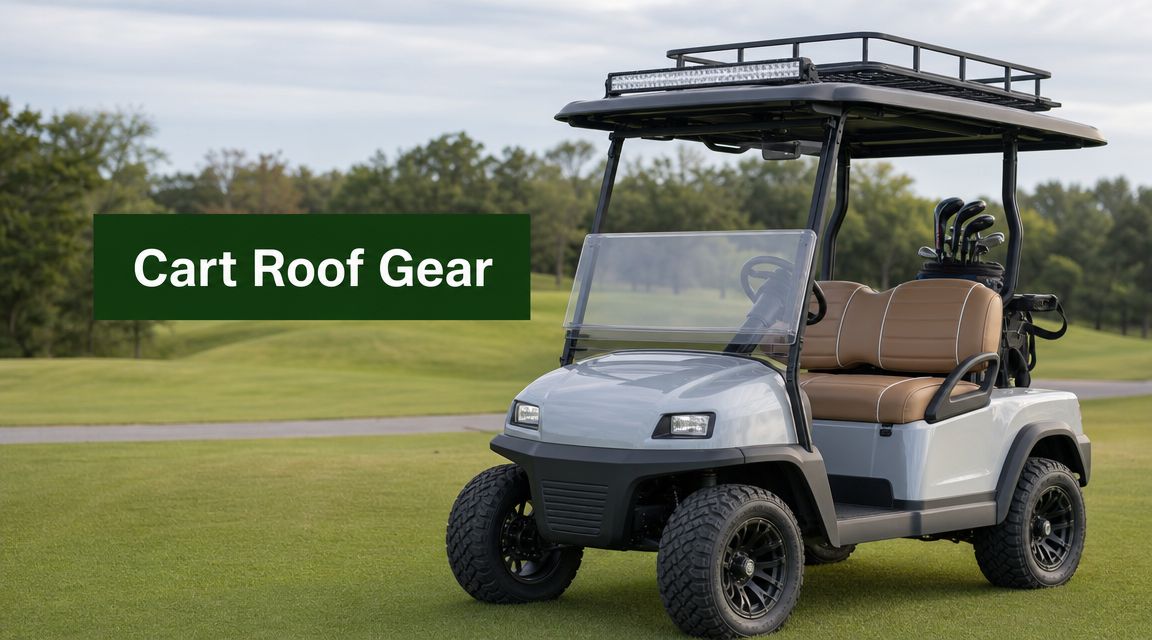
A stock cart roof usually feels fine on day one. The weak points show up after a few weeks of actual use, when a short neighborhood ride turns into wet seats, rear passengers sit outside the shade line, and someone starts grabbing the roof support because there is nowhere better to hold on.
Roof accessories fix those problems, but they also create new ones if the cart is set up carelessly. Extra weight up high changes how the roof and struts carry load. Long tops and racks amplify the forces. Light bars, speakers, enclosures, and storage all compete for the same mounting space. Clearance gets tight fast if the cart already lives in a low garage or rides on a trailer.
That is why roof accessories should be chosen like hardware, not decor. The right setup depends on roof material, support layout, frame design, intended use, and how much movement the mounting points can handle over time. A part that looks clean in a product photo can still cause roof flex, stress cracks, rattles, or loose fasteners if it asks more from the structure than the cart was built to take.
The market is large enough that owners have plenty of choices, but more options do not make the decision easier. They make fitment and load planning more important. Good results come from matching the accessory to the cart, the roof, and the way the cart is used.
Your Golf Cart's Roof Is More Than Just a Roof
A factory roof usually feels fine until you use the cart regularly.
A new owner buys a standard cart for the course and neighborhood. A month later, rear passengers are sitting half out of the shade, there's nowhere clean to mount extra lighting, and a light rain turns a short ride into a scramble. The roof that looked “good enough” at delivery starts to feel like the limiting part of the whole vehicle.
That's why roof accessories get attention so quickly. They solve problems you notice every week, not once a year. A longer top can protect rear riders. A rack can free up cabin space if used carefully. An enclosure can make the cart useful in weather that would otherwise park it. Even something simple like a mounted grab handle can make entry and exit easier for kids, older riders, and anyone climbing into a lifted cart.
What owners usually want from the roof
Most roof upgrades fall into a few practical goals:
- More coverage: Better shade, better rain protection, and less exposure for rear passengers.
- More utility: A place to mount light-duty accessories without cluttering the cabin.
- More comfort: Better airflow options, enclosure compatibility, and improved day-to-day usability.
- More confidence: Safer handholds, better visibility accessories, and less flimsiness than a stock setup.
The roof becomes valuable the moment your cart does more than shuttle two people around on a sunny day.
There's another reason this category matters. A separate forecast values the global golf accessories market at USD 398.5 million in 2025 and projects it will reach USD 693.7 million by 2035, with golf cart covers holding 27.6% share in 2025, according to Future Market Insights' golf accessories market report. That fits what custom shops see every day. Owners spend money on accessories that improve protection and extend usefulness, not just looks.
The Foundation Understanding Your Roof and Frame
Before you add anything overhead, look underneath. The frame and roof supports decide what your cart can handle.
Industry guidance on golf cart construction describes the frame as the structural foundation that supports the body, seats, suspension, and roof, and notes that modern frames are designed to accept add-ons such as roofs and roof racks, as explained in Tara Golf Cart's overview of frame durability and customization. That matters because most golf cart roof accessories don't really mount to “the roof” alone. They mount through the roof and into the struts, or directly to the support structure tied back to the frame.

What actually supports the load
Think of your cart like a small house.
The roof panel is the visible surface. The canopy struts are the posts holding it up. The frame is the foundation everything transfers into. If the panel is wide but the struts are light, or the frame allows more movement, accessory load gets amplified by bumps, turns, and vibration.
A stiffer steel or aluminum frame helps because it reduces flex at the attachment points. Less flex usually means fewer problems with bracket loosening, canopy misalignment, and long-term rattles.
Common roof types and what they mean
You don't need to memorize every roof style, but you do need to know which kind you have.
| Roof type | What it does well | Common limitation |
|---|---|---|
| Standard short roof | Basic front-seat shade and simple factory fitment | Limited rear coverage and fewer useful mounting areas |
| Extended roof | Better rear passenger coverage and better weather utility | More surface area can mean more movement if poorly supported |
| Low-profile top | Helps with overhead clearance and transport/storage concerns | Often gives up some visual bulk and sometimes some coverage footprint |
An extended top can be a good upgrade if you routinely carry rear passengers. A low-profile top makes sense if the cart lives in a garage, rides on a trailer, or has to clear a low door. Neither is automatically better. The right answer depends on use, not style.
Material matters less than support quality
Owners often focus on roof material first. In practice, support quality and mounting design usually matter more.
A roof panel can be solid, but if the struts are lightly built or the mounting points are poorly placed, the whole setup still moves around. On the other hand, a well-supported roof with properly placed hardware usually feels tighter and lasts longer, even with regular use on rough pavement or property trails.
Practical rule: If the roof already shakes on uneven ground before you add accessories, it won't improve after you add them.
That's the shop-floor test that saves a lot of money. Grab the roof edge and gently check for movement. Look at the strut junctions. Inspect where the hardware lands. If the base setup feels flimsy, fix that first.
A World of Upgrades Essential Roof Accessories
You find out what roof accessories matter the first time the cart gets used like a real vehicle instead of a weekend toy. A folding chair gets wedged under a seat, a passenger grabs the roof frame because there is nothing else to hold, and the first rainstorm shows exactly where your coverage stops.
That is how I sort roof upgrades in the shop. I do not start with what looks good in a catalog. I start with the problem the owner wants solved, then check what the roof structure can carry without rattling, cracking, or turning every garage entry into a clearance problem.

Utility and convenience
Utility accessories pay off fast if the cart sees neighborhood runs, campground duty, property work, or event use.
A roof rack or overhead basket helps with light, bulky gear that does not belong on laps or under seats. The trade-off is simple. Weight carried high puts more load into the roof, struts, and mounting points, and you will feel that load on rough paths and off-camber turns. I tell owners to treat roof racks as storage for jackets, bags, towels, or folding gear. Coolers full of ice, toolboxes, and anything dense belong lower on the cart.
Grab handles are one of the few small accessories I recommend often. They help rear passengers get in and out cleanly, especially on carts with lifted suspensions or rear seat kits. They also reduce the bad habit of people pulling on the roof edge, which is how a lot of tops get loosened over time.
Small fan mounts and accessory pods can make sense in hot climates, but only if they stay out of the driver's sightline and do not interfere with enclosure tracks or entry space. A compact setup that clears the windshield frame is usually better than a larger unit mounted wherever there happened to be room.
For owners who enjoy outfitting utility vehicles beyond golf, MODERN LYFE's accessory guide is a useful reminder that good accessory planning starts with workflow and repeated daily use, not impulse add-ons.
Protection and comfort
Protection accessories are where owners either build a cart they use year-round or waste money on parts they hate dealing with.
A longer roof improves rear passenger coverage, but its main advantage shows up in bad weather and midday sun, not in photos. Pair that with a track-style enclosure or side panel system and the cart becomes much more usable in cold wind, light rain, and shoulder-season conditions. The trade-off is setup hassle. Some enclosure systems are easy to live with. Others make entry slower, reduce ventilation, and end up folded in a garage corner after two weeks.
Sun shades, visor extensions, and drip-edge style add-ons help more than many owners expect. The small engineering detail that matters is where water and airflow go after they leave the roof edge. If runoff dumps right at the windshield gap, or if the added piece catches air and chatters at speed, the accessory solved one problem and created another.
If you are pairing roof upgrades with front weather management, Caddie Wheel's guide to golf cart windshield accessories is worth reviewing because roof and windshield parts need to work together. A roof can provide solid overhead coverage and still leave you with turbulence, water blowback, or awkward sightlines if the windshield setup is wrong.
My usual order of priority is practical:
- Shade and rain coverage first. Owners notice this every trip.
- Passenger access second. Handles and usable entry points matter on family carts.
- Seasonal enclosure parts third. Buy them only if you will install, remove, store, and maintain them.
Safety and personalization
This category is where roof accessories stop being harmless add-ons and start testing the structure.
A light bar can be useful on private property, large lots, and evening-use carts, but oversized bars create two problems. They add weight high on the cart, and they catch wind. That extra vibration works on every bracket and fastener, especially if the roof already has some movement in it.
Speaker mounts and roof-mounted audio setups can work well on a solid cart, but they expose weak roofs fast. If hardware starts loosening, plastic begins to creak, or the roof shimmies more after the install, the issue is usually not the speaker itself. The issue is that the roof support system was already near its limit.
Decorative trim, accent pieces, and roof-edge styling parts come last. Install them after the cart is quiet, weather-ready, and structurally sorted. A cart that looks finished but rattles over every bump gets old quickly.
Buy accessories that solve a recurring use problem. Leave the driveway-only upgrades for later.
Matching Accessories to Your Cart and Roof
A cart can look right in the driveway and still be wrong for daily use. I see it after installs all the time. The owner buys a roof rack, light setup, or extended top that fits the product page description, then finds out the cart no longer clears the garage door, the trailer gate, or the storage cover.
Fitment starts with the cart you own, the roof that is on it, and the places the cart has to go.

Start with the cart, not the accessory
E-Z-GO, Club Car, and Yamaha carts can look close enough to fool a first-time buyer. Their roof struts, canopy shapes, and mounting points often differ enough to turn a simple add-on into a return. The same problem shows up within one brand. A factory top and an aftermarket top may use different hardware spacing, different support thickness, and different edge shapes.
Use this order before buying anything that mounts to the roof:
- Confirm the exact cart model and year
- Identify whether the roof is factory or aftermarket
- Check where the accessory transfers load
- Measure total height, width, and overhang on the finished cart
That fourth step saves money. Product photos hide a lot. A basket that looks compact online can sit high once the brackets, light tabs, and rubber spacers are in place.
Clearance problems show up after the install
Storage and transport usually decide whether a roof accessory was a smart buy.
Low garages punish tall setups. Trailered carts have a different problem. Wind load rises fast once accessories sit above the roof line or extend past the sides, and that extra force gets fed back into the roof supports while you tow. A setup that feels solid at neighborhood speed can start shaking on the trailer before you hit the highway.
Manufacturers know buyers care about this. Buggies Unlimited even calls out additional overhead clearance on its low-profile Versa hard top listing. That matters because roof height is not just a comfort issue. It affects storage, transport, and whether the accessory package stays practical after the novelty wears off.
| Real-world situation | What usually works | What often causes regret |
|---|---|---|
| Garage with a low opening | Low-profile top, compact brackets, flush lighting | Tall rack systems, stacked lights, raised mounts |
| Trailer transport | Tight accessories with minimal side overhang | Wide baskets, tall cargo rails, anything that catches wind |
| Rear passenger use | Extended roof with proper support points | Short roof loaded up with add-on parts at the back edge |
| Neighborhood cruiser | Light accessories with clean mounting | Utility hardware that adds weight and rarely gets used |
Match the accessory to the job
A course cart, a campground cart, and a property work cart should not share the same roof setup.
Passenger carts do better with coverage, handholds, and clean entry space. Mixed-use carts need utility, but overhead weight should stay modest so the roof and struts are not doing more than they were built for. Style-focused builds can carry accent pieces, but only after the cart still fits the garage, clears the trailer, and drives without extra shake or noise.
If you want a broader list of upgrades before narrowing the roof package, this guide to cool accessories for golf carts to upgrade your ride helps put roof parts in the context of a full-cart build.
The right accessory is the one that fits the cart, fits the roof structure, and still makes sense six months later.
Installation and Maintenance Best Practices
A clean install is what separates a useful upgrade from a rattling nuisance. Most roof accessory complaints I see aren't caused by the accessory itself. They come from rushed mounting, poor alignment during assembly, or asking a lightly supported roof to carry more than it should.
Start with a dry fit. Set the brackets in place, confirm contact points, and look for interference with struts, enclosure tracks, rear seat supports, and folding windshields before anything gets fully tightened.

Use staged tightening, not brute force
A Madjax installation demonstration for an E-Z-GO T48 roof rack shows a sequence that's worth following: remove selected factory bolts, hand-tighten driver-side and passenger-side brackets first, place the rack on top, then fully torque the hardware only after all brackets are positioned, using through-bolted 8 mm class hardware, as shown in the Madjax roof rack installation video. That order matters.
If you fully tighten one side too early, you force the rest of the system to conform to a locked position. That can twist the canopy slightly, preload the brackets, and leave the accessory fighting the roof every time the cart moves.
Don't chase tightness first. Chase alignment first.
This video gives a useful visual example of careful accessory installation:
Know when reinforcement is the smarter move
Some setups need more support than the kit provides.
An independent owner discussion shows people fabricating angle brackets from the rear vertical supports to the seat rails for extra roof support, which highlights a real-world concern about flex and added load, as discussed in this Buggies Gone Wild forum thread on extra roof support. That doesn't mean every cart needs custom bracing. It does mean reinforcement is a legitimate solution when the roof spans farther or carries more than stock.
Consider extra support when:
- The roof is extended: More length means increased mechanical stress and more movement at the rear.
- The accessory adds load and wind resistance: Enclosures, handles, lights, and storage hardware all change how force hits the structure.
- You already see movement: If the canopy flexes by hand, road vibration will only make it worse.
Maintenance that actually prevents problems
Roof accessories don't need constant attention, but they do need periodic checks.
- Inspect hardware: Recheck bracket bolts and attachment points after early use and then periodically after rough driving.
- Watch for witness marks: Shiny rubbed spots, elongated holes, or shifting brackets tell you movement is happening.
- Check wiring routes: If you've added lights or powered accessories, make sure wires stay secured and away from pinch points.
- Listen while driving: New rattles almost always mean something changed.
Most failures start as a noise, a slight lean, or a bracket that won't stay centered. Catch those signs early and the fix is usually simple.
Safety Legality and Smart Buying Decisions
You bolt a rack, speakers, and a light bar onto the roof on Saturday. By Sunday night, the cart still runs fine, but now it barely clears the garage door, the roof shakes more on rough paths, and the steering feels a little busier in quick turns. That is how roof accessory mistakes usually show up. Not as one big failure, but as a series of small compromises the owner did not account for up front.
The best buy is the accessory that solves a real use problem without overloading the roof structure, crowding your clearance, or creating legal trouble for how the cart is driven. Roof-mounted parts always have more effect than low-mounted parts because they add weight higher up and farther from the frame. On a stock neighborhood cart, that matters more than many first-time owners expect.
What deserves a final check before purchase
Before ordering, stop looking at the accessory by itself and look at the finished cart as a system.
- Stability check: How much weight is going up high, and how far from the factory mounting points does that load sit?
- Fitment check: Is the part built for your exact roof style, strut layout, and cart model, or are you relying on a universal bracket to make it work?
- Clearance check: Measure the cart after the accessory is added on paper first. Garage doors, trailer openings, carports, and storage covers cause more buyer regret than the accessory itself.
- Road-use check: If your cart is street-legal or used in an LSV setting, confirm local rules for lights, mirrors, reflectors, and anything that changes visibility or overall width.
- Service check: Can you still remove the roof, access wiring, tighten hardware, or replace a windshield without disassembling half the add-on?
That last point gets missed a lot. A cheap accessory that blocks service access can cost more in labor later than a better-designed part costs today.
Buy in this order if you're unsure
New owners usually do better with a simple sequence:
- Correct any looseness, cracked mounts, or roof movement already present.
- Add weather protection or lighting that supports how the cart is used.
- Add convenience items only if the roof and struts can carry them without extra bracing.
- Leave appearance-driven accessories for last.
That order keeps money going into function first. It also lowers the chance that one cosmetic add-on forces a second round of brackets, reinforcement, or wiring cleanup. If you are still sorting through brands and seller types, this guide to the best golf cart accessories retailers of 2025 is a useful place to compare where different products are commonly sold.
One more smart buying note. Some owners start shopping roof gear when the goal is making golf easier with less strain. As noted earlier, Caddie Wheel fits a different use case by adding powered assist to a standard push cart rather than modifying a riding cart. That is a separate category, but the buying lesson is the same. Start with how you play, transport, and store your equipment, then choose accessories that fit that job.
Share:
Golf Cart Windshield Accessories Buyer's Guide 2026
Gyroscopic Remote Control: The Golfer's Edge