
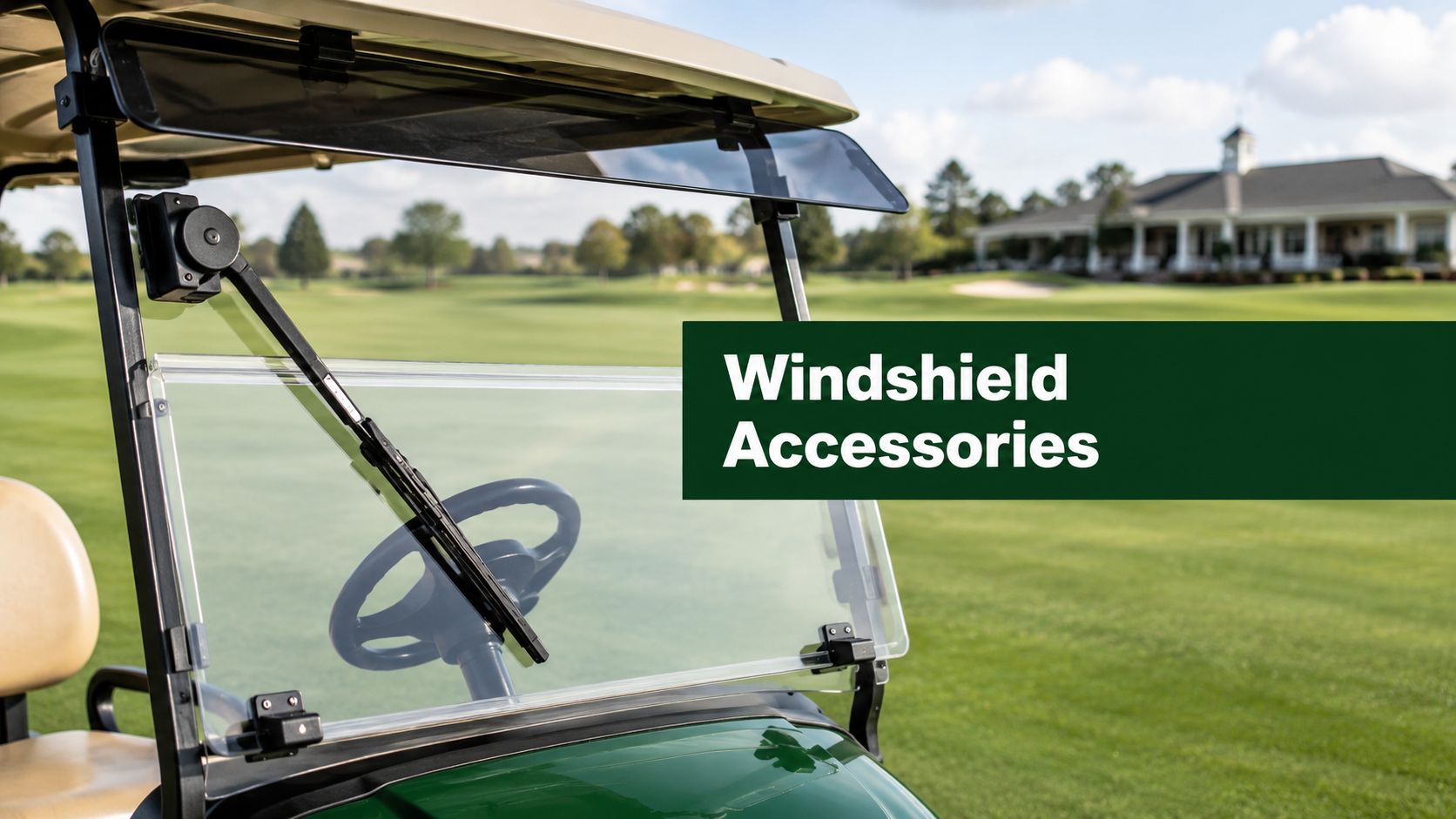
A lot of golfers end up shopping for windshield accessories after the round that finally annoyed them enough. It's usually not a dramatic failure. It's dust blowing in from the path on a breezy back nine, drizzle finding the gap between the roof and the screen, or morning glare bouncing off a basic panel so hard that you start ducking your own cart.
That's when golf cart windshield accessories stop feeling optional. They become part of how you make the cart easier to live with, easier to see through, and cheaper to maintain over time.
Why Your Golf Cart Needs More Than Just a Windshield
You notice it on the kind of round where the weather cannot make up its mind. The windshield keeps the main blast of air off your chest, but dust still curls in from the sides, mist clings to the panel, and glare hits hard enough that you start shifting in the seat to see around it.
That is the point where a plain windshield stops being the full solution. The panel covers only the opening in front of you. Daily use depends on everything around it: how the windshield opens, how tightly it mounts, how well it seals, and whether the add-ons match the way the cart is used.
Owners usually learn this after a few months, not at checkout. A cart that sees early tee times may need a visor more than dark tint. A cart used on humid afternoons benefits more from a folding design or venting than from a thicker fixed panel. If the brackets flex or the hardware loosens, even a good windshield starts to rattle, wear at the mounting points, and feel cheap long before the panel itself is worn out.
Most bad windshield setups do not fail because the panel is poor. They fail because the surrounding hardware, fit, and daily usability were treated as afterthoughts.
The practical upgrades are rarely flashy. Better edge seals cut down on chatter and reduce the grime that sneaks in around the frame. Stronger mounting hardware helps the windshield stay aligned over rough paths. Small storage pieces near the dash or windshield area keep a phone, scorecard, or rangefinder from bouncing around the cabin.
There is also a buying reality many owners miss. Windshields and their accessories are often chosen after the cart is already in service, which means compatibility mistakes are common. I see the same problems over and over: the wrong hinge style, hole patterns that do not line up, accessories that interfere with roof supports, and cheap clamps that crack after one hot season.
If you are planning broader upgrades at the same time, this guide to cool accessories for golf carts to upgrade your ride can help you sort windshield needs from the extras that only add clutter.
What accessories actually change on the course
- Comfort in mixed weather: The right setup cuts side draft, manages airflow better, and makes light rain less distracting.
- Usable visibility: A well-matched visor, cleaner mounting, and the right windshield configuration help you look through the panel instead of around it.
- Less wear over time: Good brackets, seals, and hardware reduce rattles, stress cracks, and the slow loosening that turns a solid cart into a noisy one.
- Better day-to-day function: Smart storage and small add-ons around the windshield area make the cart easier to live with, not just nicer to look at.
The Essential Windshield Accessory Lineup
A cart can look finished with a windshield and still be annoying to use. The usual complaints show up fast: glare in late afternoon, a top panel that chatters on rough paths, nowhere to put a phone, and hardware that loosens long before the windshield itself wears out.

Windshield styles
Start with the style that matches how the cart is used.
Folding windshields make sense for mixed conditions. On cool mornings or in light rain, close the upper half and keep the air off your hands and face. On warm rounds, flip it open and get airflow without pulling the whole windshield off. The downside is extra hardware. Hinges, latches, and center supports create more wear points, so cheap folding assemblies tend to rattle sooner.
One-piece windshields are the simpler option. They usually stay quieter because there is no middle hinge line working loose over time. They also give a cleaner sightline. The trade-off is flexibility. If the cart gets stuffy in summer, there is no quick vent setting.
Tinted windshields cut glare well on bright courses and open property use. They are less forgiving at dusk, in shade, or on neighborhood carts used near sunset. Light tint is usually the safer middle ground if the cart sees all-day use instead of midday-only rounds.
Add-ons that improve daily use
The best add-ons solve one clear problem.
- Wiper kits: Useful for carts that see rain, irrigation overspray, or early-morning film on the panel. They help, but only if the windshield surface is clean enough that you are not dragging grit across it.
- Visors: Good for overhead glare that tint alone does not control, especially if the sun sits high and the windshield angle pushes light straight into your eyes.
- Vents or vented designs: Worth it on enclosed-feeling carts where a full windshield traps heat and cuts airflow too much.
- Storage organizers: Handy for small items that usually end up on the seat or floor. Choose soft-sided organizers or well-padded mounts so they do not buzz against the frame.
Phone mounting deserves extra care. A bad mount blocks the lower sightline or shakes loose over bumps. This guide to using a phone holder golf cart mount does a good job showing where to place one without crowding the windshield area.
A surface treatment can also help if you are trying to reduce water spotting and improve cleanup. APEX Nano glass ceramic coating is one option owners use to make the panel easier to wipe down, though coatings do not fix scratches or poor-quality plastic.
Repair and maintenance parts
A lot of windshield money gets wasted on full replacements when the actual problem is hardware.
The panel may still be clear and structurally sound while the smaller pieces around it are failing first:
- Edge trim and extrusion
- Rubber bumpers
- Retention straps
- Mounting brackets
- Clips and clamp hardware
- Hinge replacement parts
These parts take the vibration, heat, and repeated opening cycles. Once they dry out, shrink, or loosen, the windshield starts shifting. That movement is what leads to noise, poor alignment, and eventually stress around the mounting points.
Shop rule: If the panel still sits square and visibility is acceptable, inspect the hardware before ordering a new windshield.
Why compatibility matters more than broad fit claims
Universal accessories have made shopping easier, but broad fit claims still cause trouble. In practice, "universal" often means the part fits several carts if the roof supports, frame angle, hinge layout, and mounting area are close enough.
That sounds minor until you install one.
A visor can hit the roof strut. A clamp-on mirror bracket can interfere with a folding windshield latch. A storage pouch can hang low enough to block switches or rub the panel. The right approach is simple: measure the mounting space, check where the windshield opens, and look at the hardware style before buying the accessory, not after it arrives.
Choosing the Right Windshield Material
Material choice changes everything: clarity, scratch resistance, durability, and how much abuse the windshield can take before it looks tired.
Acrylic and polycarbonate are not interchangeable
Most buyers end up choosing between acrylic and polycarbonate. Both can work. They just fail differently.
Acrylic usually wins on optical clarity and price. It tends to look crisp out of the box and often costs less. The downside is scratching. If you clean it with the wrong towel, wipe dust across it dry, or run it on rougher paths for years, it can haze up faster.
Polycarbonate is the tougher option. It handles impact better and is the safer pick if your cart sees rough property use, gravel, tools, dogs, kids, or branches. The trade-off is that it can show wear differently, and not every panel stays looking pristine if it's cleaned carelessly.
The broader market direction supports paying attention to material quality. A separate study projects the golf cart accessory market will reach USD 3.896 billion by 2035, with growth tied to customization and enhanced user experience, according to Market Research Future. Windshield material sits right in that decision.
Acrylic vs. Polycarbonate Windshields
| Feature | Acrylic (Plexiglass) | Polycarbonate (Lexan) |
|---|---|---|
| Clarity | Very clear and clean-looking | Clear, but quality varies by panel |
| Scratch resistance | Better than many buyers expect, but still needs careful cleaning | More prone to surface wear if cleaned poorly |
| Impact resistance | Adequate for normal course use | Better for harsher use and accidental knocks |
| Cost | Usually lower | Usually higher |
| Best fit | Golfers who want good visibility and lower cost | Owners who prioritize toughness and heavy use |
How to decide without overthinking it
Use the cart's real job, not your idealized version of it.
- Mostly golf course use: Acrylic often makes sense.
- Mixed use on property, paths, or rougher ground: Polycarbonate is usually the safer buy.
- You obsess over optical clarity: Lean acrylic.
- You've already cracked or damaged one windshield: Lean polycarbonate.
If you want to keep visibility better for longer, surface care matters almost as much as material. A good reference on protection options is this look at APEX Nano glass ceramic coating. Even if your cart windshield isn't automotive glass, the maintenance mindset carries over: reduce contamination, clean gently, and don't let residue sit.
Ensuring a Perfect Fit for Your Cart
Most windshield accessory complaints come down to fit, not product quality. Buyers order a panel or bracket set that's “close enough,” then spend the next month listening to squeaks, fighting alignment, or discovering the roof and windshield don't play nicely together.

Start with the cart, not the accessory
Before you shop, identify:
- Make and model
- Approximate year
- Roof style
- Existing windshield type
- Any added hardware near the front struts
That last point gets missed all the time. Light bars, mirrors, custom roofs, enclosures, speaker pods, and front-mounted brackets can all interfere with standard windshield mounting geometry.
A simple example: if your setup already has accessory hardware near the struts or front frame, you need to confirm clamp space before ordering. That also applies if your walking setup includes powered gear transported alongside your cart accessories. Products like Caddie Wheel use a drop-on motorized wheel and snap-in bracket for push carts, which is separate from golf cart windshield hardware, but it's still a reminder that added equipment changes how you organize transport and storage around your golf setup.
Model-specific fit usually saves headaches
Model-specific windshields tend to fit better, seal better, and install faster. If your cart is a common platform with easy-to-find parts, that's usually the smart route.
Universal windshields make more sense when:
- your cart is older,
- exact replacement parts are hard to source,
- or you need a temporary or removable solution.
Some aftermarket systems rely on flexible hardware instead of rigid direct fastening. Modern golf cart windshields often use strut clips, rubber clamps, and dedicated brackets, and some portable styles attach with three elastic cords, according to Golf Cart Garage. Those attachment methods can reduce stress on the frame and lower the chance of vibration-related cracking.
If a windshield has to be forced into place, stop. A tight fit is good. A stressed fit usually turns into a crack, a warped edge, or a noisy mount.
A quick fit checklist before you buy
- Measure frame width: Don't trust visual guesses.
- Check frame angle: Older carts can vary more than buyers expect.
- Inspect mounting points: Look for previous drilling, worn holes, or bent supports.
- Verify roof clearance: Some roofs sit lower or wider and affect hinge travel.
- Account for folding motion: A fold-down windshield needs room to open cleanly.
This walkthrough helps if you want to see how installers approach alignment and mounting in real life.
Where universal fit goes wrong
Universal products usually struggle in three places:
- Bracket spacing: The holes or clamps don't land where your cart needs them.
- Roof mismatch: The top edge interferes with the canopy.
- Hinge travel: The windshield opens, but not fully or not evenly.
Buyers with dash-mounted accessories should also check sightlines before adding anything tall or wide near the windshield base. A cluttered front area is annoying on the course and worse on neighborhood routes.
Maintenance for All-Weather Performance
The cheapest windshield is often the one you don't have to replace.
A lot of owners assume a worn windshield means the whole assembly is done. Usually it doesn't. The panel may still be usable while the surrounding parts are what failed: edge trim shrunk, a bumper went missing, a bracket loosened, or a hinge area started moving more than it should.
Clean it like a clear panel, not like a tailgate
The fastest way to ruin a windshield is dry wiping dust into it. That's how you turn light grit into a permanent haze.
Use water first. Then use a soft microfiber and a cleaner that won't attack the material. If you want a general cleaning framework that translates well to clear recreational panels, these boat windshield cleaning tips are useful because they focus on visibility, gentle materials, and avoiding scratch-causing habits.
Repair the small parts first
There's a strong maintenance case for component replacement over full replacement. Parts retailers emphasize extrusion kits, bumpers, and brackets as lower-cost fixes for common wear issues, as noted by Golf Cart King's windshield parts catalog.
That approach works because windshield systems usually degrade in layers.
- Loose edge trim: Often fixable without touching the main panel
- Rattling at speed: Commonly a bracket, bumper, or clamp issue
- Poor seal or shifted alignment: Usually a mounting problem first
- Minor hinge trouble: Sometimes isolated to hardware, not the windshield itself
Replace the part that failed, not the part that's easiest to blame.
What to inspect every few months
A quick hands-on check saves money and aggravation.
- Feel for play at the brackets: Any movement grows on rough paths.
- Look at the lower edge: That area collects stress and vibration.
- Check the hinge line on folding models: Small cracks don't stay small.
- Inspect rubber pieces: Hardened or flattened rubber stops doing its job.
- Store smartly: Don't stack heavy gear against the windshield when the cart is parked or trailered.
If your windshield is cloudy, noisy, or slightly crooked, don't assume the panel is finished. Start with the hardware and wear parts. That's usually where the practical fix lives.
Safety Rules and Street-Legal Requirements
A golf cart windshield for course use and a golf cart windshield for street use are not automatically the same thing.
If your cart is being built or used as a street-legal low-speed vehicle, windshield rules matter. In that context, the windshield isn't just a comfort accessory. It becomes part of compliance and occupant protection.

What AS4 and AS5 usually mean for buyers
For street-legal LSV builds, a clear windshield often needs to be AS4 or AS5 rated and commonly specified at 0.177-inch thickness to meet U.S. Department of Transportation expectations for impact resistance, according to Performance Golf Carts.
The practical takeaway is simple: if your cart is staying on the course, you have more flexibility. If it's going on public roads where LSV rules apply, you need to verify the windshield standard before you buy.
Common mistakes that create problems
- Assuming any clear panel is street legal
- Using dark tint that hurts low-light visibility
- Ignoring mount security
- Installing a panel that distorts your view through the centerline
Safety isn't just about the material stamp. A windshield has to stay secure, sit square, and give you a clean sightline. If it vibrates excessively, sits under tension, or obstructs vision, it's the wrong setup even if the panel itself looks impressive on paper.
Your Ultimate Golf Cart Accessory Buying Checklist
The best buying checklist is short enough to use while you shop and strict enough to stop bad purchases.

Run through these questions before you order
- Do you know your exact cart model? Year, make, and model come first.
- What weather annoys you most? Wind, glare, drizzle, dust, or cold air should decide the style.
- Do you want fixed protection or adjustable airflow? That decides one-piece versus folding.
- Is your cart used only on the course? If not, check legal requirements before shopping.
- Are you buying for clarity or toughness? That decides acrylic versus polycarbonate.
- Can the windshield coexist with your other accessories? Roofs, mirrors, dash add-ons, and front hardware all matter.
- Can you repair your current setup instead? Hardware may solve the issue without a full replacement.
If you're also updating the front interior area, it helps to think about the dashboard and windshield together so controls, storage, and visibility don't fight each other. A niche example is a carbon fiber Club Car dash panel, which shows how dash upgrades can affect the feel and layout of the whole driver area.
One last buying habit worth keeping
Read product descriptions skeptically. “Universal” should make you verify measurements, not relax. “Heavy duty” should make you inspect the hardware. “Easy install” should make you confirm whether your roof, brackets, and frame angle match the assumptions behind the kit.
For more places to compare parts and accessory options, this list of the best golf cart accessories retailers of 2025 is a solid next stop.
If you walk your rounds and want to reduce the strain of pushing your bag, Caddie Wheel offers electric power assist for standard push carts with a drop-on design and snap-in bracket. It's a practical option for golfers who want to keep walking while making the round easier on hills and over longer distances.
Share:
Golf Cart Parts USA: The Ultimate Buyer's Guide 2026
Best Golf Cart Roof Accessories for 2026