
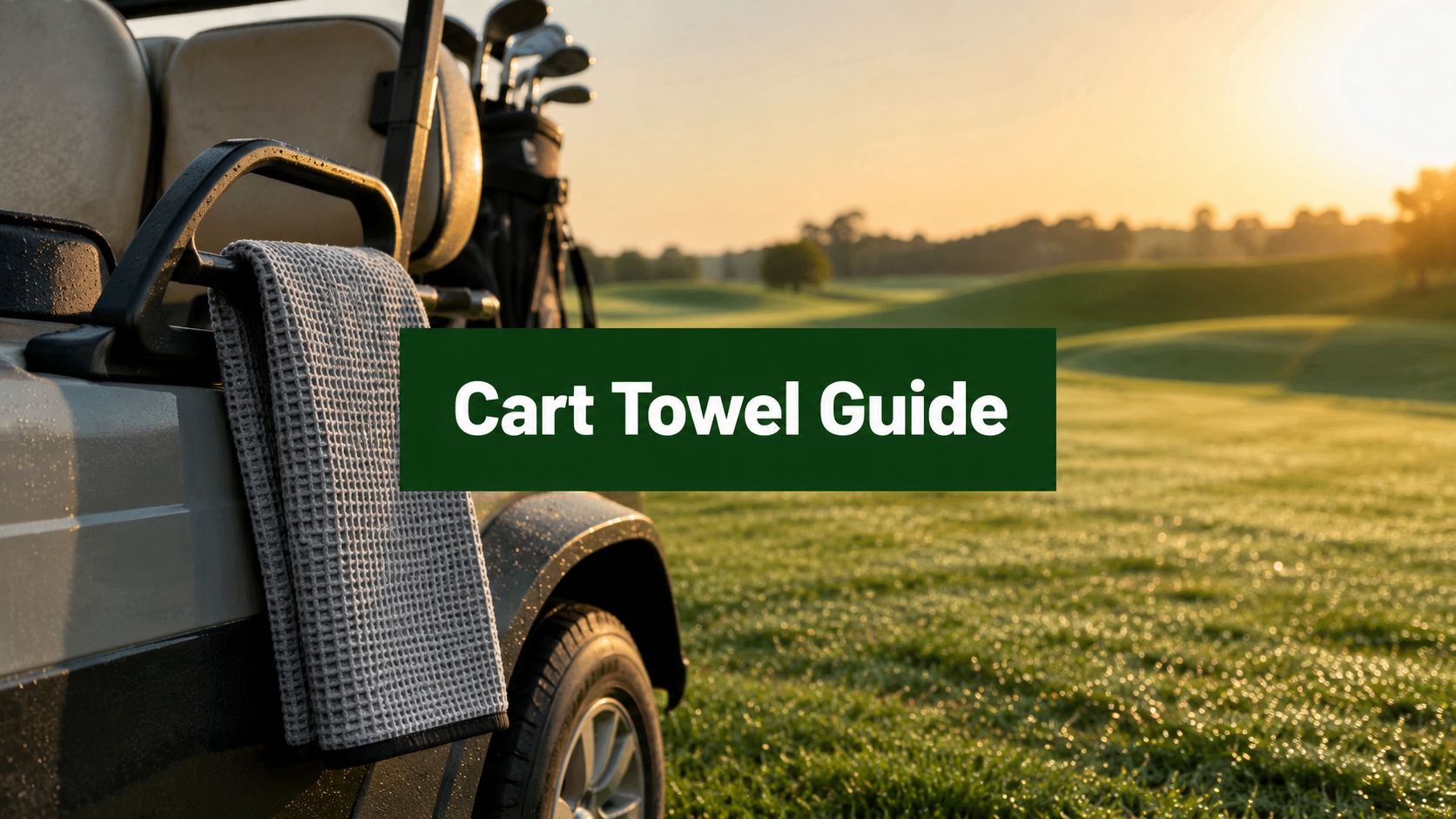
You know the moment. You've just played a smart shot from a damp fairway, the ball did its job, and now the clubface is packed with mud. You reach for your towel and find one of three things: it's soaked through, it's dragging near the wheel of your push cart, or it's gone because it slipped off somewhere back on the last hole.
That small annoyance changes the whole rhythm of a round. You stop thinking about the next shot and start messing with your gear. Hands get slick. Grips feel questionable. Club grooves stay dirty longer than they should. A towel seems minor until you play without a good one.
For walking golfers, that problem gets sharper. A towel on a push cart has to do more than clean. It has to stay put, stay reachable, and stay out of the way. That's why a proper golf cart towel deserves more attention than most golfers give it.
Why a Good Towel Is a Golfer's Best Friend
You're walking up to your ball after a wet approach shot. The clubface has a film of mud across the grooves, your lead hand is a little damp, and your towel is either bunched behind the bag, brushing a wheel, or missing from the cart entirely. That is when a towel stops feeling like a throw-in and starts feeling like part of your setup.
Golfers who ride can get away with a lot of small inconveniences. Push cart golfers usually cannot. If a towel swings too much, hangs too low, or takes two motions to reach, it interrupts the flow of the round. You feel it in small ways first. You clean the club less often. You wipe your hands on your shorts. You stop bothering with the ball unless it is really dirty.
A good cart towel solves those little frictions before they turn into habits.
The main job is simple. Keep the parts of the game that need to stay clean and dry in playable condition. That means clubfaces, grooves, hands, grips, and often the ball. The towel is a work cloth, not a decoration. For push cart players, it also has a second job. It must stay accessible without getting in the way.
That distinction matters because golfers sometimes lump every towel-shaped item together. A cleaning towel helps you manage moisture, grass, sand, and dirt during the round. A training aid towel is different. That type is used for drills, such as placing a towel under the arms or behind the ball to train contact or body motion. If you want a practical example from the gear side, this guide to elevating your golf game covers magnetic golf towels meant for on-course use, not drill work.
The round feels different when the towel is easy to use
A towel works like a caddie handing you the right cloth at the right moment. If it is there every time you need it, your routine stays calm. If it is awkward, you start skipping the very moments when it would help most.
Consider a normal stretch of holes. A wedge comes out of soft turf with dirt on the face. A bunker shot leaves sand on the club and fingers. Two holes later, sweat makes the grip feel less secure on a tee shot that asks for commitment. One reachable towel can deal with all of that, but only if it is dry enough to keep using and positioned where your hand finds it without a search.
Practical rule: If your towel is awkward to reach, you will use it less than you should.
That is why many walkers spend time refining cart setup instead of just clipping gear anywhere it fits. The towel belongs in that conversation with storage, bottle placement, and accessory hooks. If you are tuning your walking setup, this guide to golf push cart accessories that help on the course is a useful next step.
What a good towel changes during a round
A dependable towel helps with a few practical jobs:
- Clubface cleanup: Grass, mud, and sand on the face can change contact and reduce how well the grooves bite the ball.
- Hand drying: Dry hands make grip pressure easier to repeat from shot to shot.
- Ball wiping: A clean ball is easier to inspect on the green and simpler to line up with confidence.
- Routine: Easy access keeps you moving through the same pre-shot habits instead of improvising around gear problems.
Poor towels usually do not fail all at once. They fade as the round goes on. They get wetter, heavier, dirtier, and harder to manage on a moving cart. A good one keeps doing the boring jobs well, which is exactly why experienced golfers notice the difference.
What Makes a Golf Towel a 'Cart Towel'
You feel the difference on a walking round, usually by the third or fourth hole. A regular towel starts sliding around, twisting on its clip, or brushing the wheel when the path gets bumpy. Then you stop treating it like a tool and start managing it like a nuisance.
A cart towel is designed for that moving environment. The job is not only to clean a club or dry your hands. It also has to stay put, stay reachable, and avoid getting in the way while your push cart rolls over curbs, wet grass, and uneven ground.
That point gets missed in a lot of towel guides. A bag towel can work fine when it mostly hangs in one place. A push cart towel has a harder assignment. It needs to behave well in motion.

From rag to purpose-built gear
Golfers have always carried some kind of cloth for dirt, moisture, and sweat. What changed over time was the setup. Once towels started being clipped to carts and bags more deliberately, details like attachment points, shape, and how the fabric hangs began to matter a lot more.
The center opening found on many golf towels is a good example. It is not there for style. It helps the towel hang in a more balanced way, which reduces flopping and bunching when the cart is moving. For a push cart player, that can be the difference between a towel you use often and one you ignore because it keeps misbehaving.
Magnets and clips solve the same problem in different ways. The test is simple. Can you grab the towel, use it, and let it fall back into place without looking down or readjusting it every few minutes?
The features that change the experience
A cart-specific towel usually separates itself in three practical areas:
| Feature | Generic towel | Cart towel |
|---|---|---|
| Attachment | Clipped on as an afterthought | Built to hang securely and resist twisting |
| Access | Often tucked into a pocket or draped loosely | Placed where your hand can reach it during play |
| Behavior in motion | Swings, drags, or bunches up | Stays controlled on a moving push cart |
One point causes confusion, so it helps to separate the jobs. A cleaning towel is for clubfaces, golf balls, grips, and hands. A training aid towel is something else entirely, usually used for swing drills or setup practice. If you play with a push cart, you are choosing for cleaning and access first, not for training.
Some golfers prefer magnetic models because they like the quick on and off feel. If you want a product-focused look at that setup, this broader guide to elevating your golf game shows how magnetic towels fit into different routines.
A cart towel earns its spot when it disappears into your round. You reach for it, use it, and move on. No dragging, no hunting for it, no interference with the cart. That is what makes it a cart towel, not just a towel that happens to be along for the walk.
Key Features and Materials Decoded
Material changes how a towel behaves on the course. That's not marketing language. It's what you notice when one towel smears dirt around and another lifts it off the clubface.
For most golfers, the main decision comes down to cotton versus microfiber. Cotton feels familiar and absorbent. Microfiber is engineered differently. Its structure gives it more cleaning contact against fine debris like sand and turf grime.

Why microfiber gets so much attention
One golf towel guide explains that microfiber's smaller fibers create more surface area, which helps golfers “clean more with less effort,” and it recommends using a wet section for scrubbing and a dry section for finishing in Sunday Golf's guide to what golf towels are used for. That's a useful way to think about it on the course.
If you've ever tried to remove sandy grit from a wedge with a flat, tired towel, you already know the difference. Fine particles need a surface that can grab them instead of just pushing them around. That's where microfiber often feels more effective.
Cotton, microfiber, and weave choices
Here's the practical breakdown:
- Cotton terry: Familiar feel, solid absorption, often a good choice if you like a traditional towel texture.
- Microfiber: Better suited for fine debris, dries relatively quickly in normal play, and works well when you use one area wet and another dry.
- Waffle weave: Often easier to handle because the texture helps pick up grime while keeping the towel from feeling like a heavy blanket.
Not every golfer needs to obsess over fabric type, but it's worth matching the material to your habits. If you play in damp morning conditions, a towel that can handle moisture without turning sloppy is helpful. If you often clean mud and sand off wedges and balls, microfiber has a strong case.
One smart way to evaluate a towel
Instead of asking, “Is this premium?” ask three simpler questions:
- Does it lift dirt well?
- Can I keep part of it dry during the round?
- Will it still feel usable after repeated wiping?
Those same questions come up in other gear categories too. If you want a non-golf example of how microfiber is treated when cleaning performance matters, Boat Juice's microfiber solution is a useful reference point for understanding why people choose microfiber over ordinary cloth.
The best material is the one that fits your real conditions, not the one with the most buzzwords on the tag.
Sizing and Attachment Methods Explained
If you use a push cart, attachment matters as much as absorbency. Maybe more. A towel that cleans well but won't stay put becomes a distraction. It swings into the wheel, drags on wet ground, or disappears when you set the cart on a slope.
That's why I'd argue the smartest golf cart towel purchase starts with retention, not fabric. The first question isn't “How soft is it?” It's “Will this still be on my cart by the 18th green?”

Size affects more than cleaning area
Golf-cart towels are commonly sized for portability while staying large enough for actual use. Verified product specs note a common standard of 16 by 24 inches, while other options range from a 10" x 10" polishing towel to a 39" x 16" towel, with one larger microfiber option claiming it can hold up to 400% of its weight in water, as listed in Nomadix golf towel product specifications.
That tells you something useful. Bigger isn't automatically better for a push cart. More fabric means more surface to clean with, but it also means more movement, more folding, and more chance of interference.
Attachment choices for push cart users
The attachment system decides whether the towel works with your cart or fights it.
- Central hole with clip or carabiner: Usually the safest all-around option. The towel hangs from the middle, which helps it stay balanced and accessible.
- Grommet and hook: Simple, familiar, and easy to replace, though some setups let the towel swing more than you'd like.
- Magnetic attachment: Fast to grab and replace if your cart has a suitable metal contact point.
- Loop or strap systems: Can work well if you want the towel fixed tightly to one rail or handle area.
A central hole deserves extra credit on a push cart because it directly addresses loss and accessibility. You thread the clip through the center, and the towel stays anchored without flopping from one corner.
Here's a quick way to compare options:
| Attachment method | Best trait | Watch for |
|---|---|---|
| Central hole and clip | Balanced hang | Needs a reliable clip point |
| Grommet | Easy and familiar | Can swing from one side |
| Magnet | Quick access | Depends on cart surface |
| Strap or loop | Stable position | Less flexible to reposition |
A strong cart setup often depends on secure mounting in general, not just for towels. If you've dealt with shifting gear before, this guide on golf push cart straps and secure setup is relevant for the same reason.
A short demonstration helps if you want to see attachment ideas in action.
On-course habit: Mount the towel where your hand naturally goes after you return a club. If you have to look for it, the position is wrong.
For most push cart players, a medium-size towel with a secure central attachment is the sweet spot. It cleans enough, stays manageable, and doesn't become part of the problem.
Choosing the Right Towel for Your Game
By the time golfers shop for a towel, many of them are shopping for three different things at once. They want something that cleans clubs, doesn't get lost on the cart, and maybe also matches what they think the search term means. That last part creates confusion.
Some golfers mean a cleaning towel attached to a bag or cart. Others have seen the “towel drill” in swing instruction and assume it's the same category. It isn't. Verified guidance on search intent confusion notes that some results treat a towel on the ground as a training drill for reducing casting, while others discuss cleaning towels, as shown in this YouTube reference on golf towel drill confusion.

First decide what job the towel has
A simple way to choose the right golf cart towel is to match it to your actual round.
If you need a cleaning towel for play, you care about attachment, material, size, and how easy it is to keep one section damp and another section dry.
If you need a training aid, you're in a different lane entirely. That towel may never go on your cart at all. It may live in your garage, on the range, or in a lesson bag.
A practical matching guide
Use this quick framework:
- You walk and play in mixed conditions: Choose a towel that stays attached securely and can handle dirt and moisture without becoming a tangled mess.
- You prefer a minimal setup: A smaller towel or a two-piece approach can work well, especially if you only want quick club and ball cleaning.
- You often play wet morning rounds: Lean toward a material and size that can absorb moisture while still leaving you a dry section.
- You lose towels regularly: Prioritize attachment method over everything else.
- You searched “golf towel” but meant the swing drill: Don't buy a cart towel thinking it will solve a practice problem.
Some golfers need one towel for play and another for practice. Mixing those jobs usually leads to the wrong purchase.
Don't ignore how it fits your cart routine
A towel can be good on its own and still be wrong for your setup. That's especially true if you walk with a push cart and prefer a clean, uncluttered frame. The right model should fit how you reach for clubs, where you store balls and tees, and how much hanging fabric you're willing to manage.
If you're upgrading your entire walking setup, not just the towel, this list of golf cart accessories to upgrade your ride can help you think about the towel as part of a system instead of a one-off purchase.
The best choice usually isn't the flashiest towel. It's the one that matches your habits so well that you stop thinking about it.
Care and Maintenance for Lasting Performance
A golf cart towel lives a rough life. It deals with mud, grass, sand, sweat, spilled drinks, wet grips, and whatever is hiding at the bottom edge of a cart after a long round. If you don't clean and dry it properly, even a good towel turns into a sour, heavy rag.
The fix is simple. Build a small routine after each round.
Keep the towel usable, not just clean-looking
Start with the obvious step. Don't leave a used towel bunched up in the car trunk or stuffed into a side pocket overnight. Shake it out, let it air for a bit, and wash it before grime settles deeper into the fibers.
For regular care, this routine works well:
- Shake off debris first: Sand and dried grass come out more easily before washing.
- Separate very dirty towels: If one side is caked with mud, rinse it first so you're not grinding grit through the whole towel.
- Wash according to material: Microfiber and cotton don't always behave the same way, so follow the fabric guidance from the maker when available.
- Dry thoroughly before storage: A towel that feels only slightly damp can still smell bad by the next round.
A few habits extend the towel's life
These small choices make a real difference:
- Use zones on purpose: Keep one section wetter for club cleaning and another section drier for hands or finishing.
- Don't overload it in one round: If the towel becomes saturated and filthy, it's no longer helping much.
- Inspect the attachment area: Holes, loops, clips, and stitched edges take repeated stress on a push cart.
- Store it open when possible: Airflow matters more than most golfers think.
If you want a broader read on cleaning and preserving microfiber fabric, these microfiber towel care tips are a useful companion reference.
A towel lasts longer when you treat it like gear, not like laundry you forgot on the cart.
A well-chosen golf cart towel does more than wipe clubs. It supports your routine, keeps your hands and equipment in better shape, and removes one more source of friction from the round. That's a small advantage, but golf is full of small advantages. The players who enjoy walking the course most tend to respect the little things.
If you enjoy walking but want your push cart setup to feel easier and less tiring from the first hole to the last, Caddie Wheel is worth a look. It adds lightweight electric power assist to standard push carts, helping you conserve energy while keeping the walking experience you already enjoy.
Share:
Is Getting Fit for Golf Clubs Worth It? Your 2026 Guide
Golf Push Cart Basket: The Ultimate Buyer's Guide