
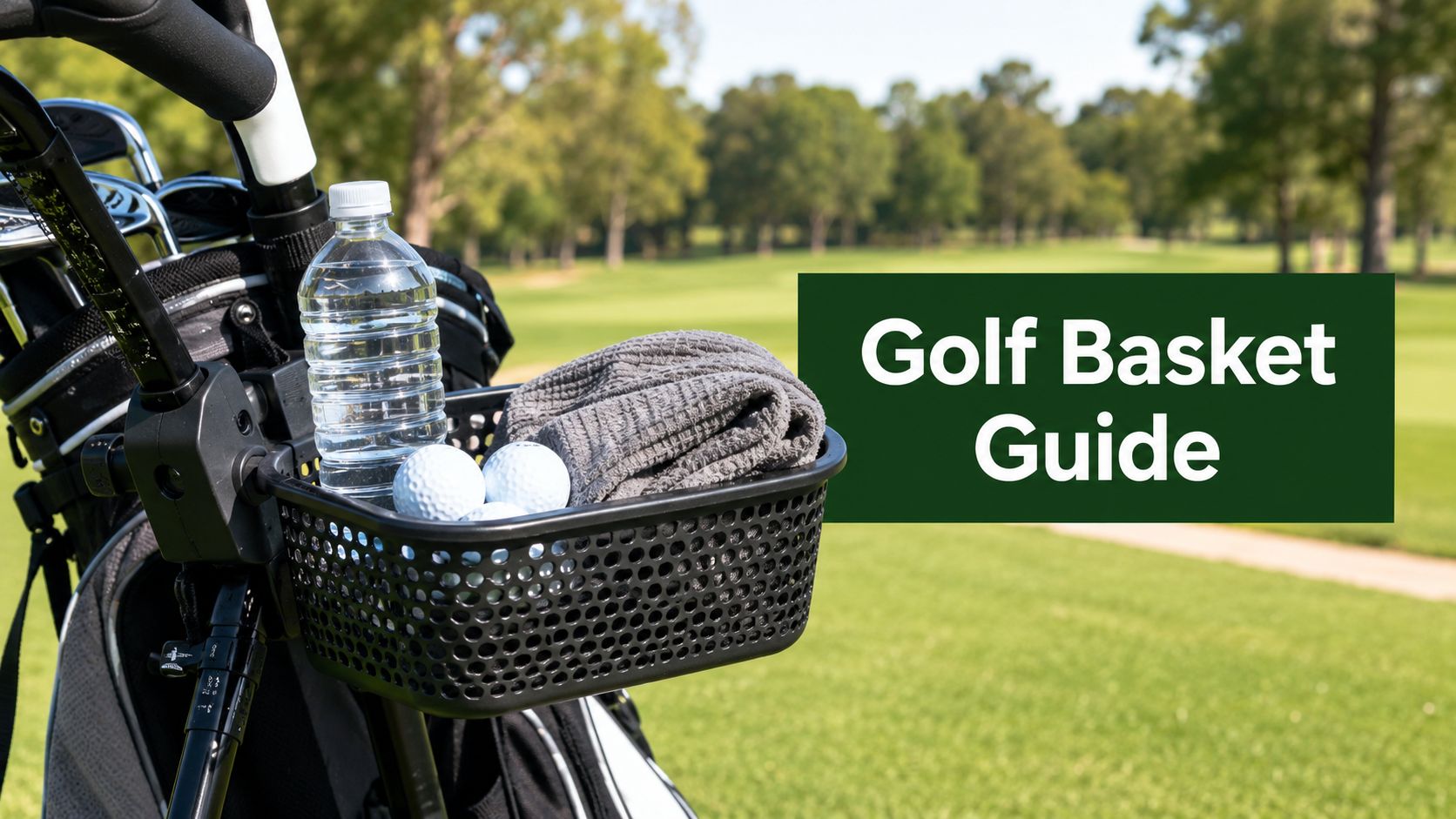
You feel the problem by the third or fourth hole. Your rangefinder is buried behind a towel. Your glove is stuffed into the scorecard pocket. The water bottle keeps shifting around, and your pullover ends up draped over the handle because there's nowhere else to put it.
That's when a golf push cart basket stops feeling like an accessory and starts feeling like part of the cart. A good basket keeps the things you touch during a round in one place, easy to reach, and out of the way of your swing thoughts. A bad one turns into a swinging, rattling pile of clutter that makes the cart harder to manage.
Walking golf keeps growing. The global push-pull golf cart market reached USD 440 million in 2025 and is projected to rise to USD 467 million in 2026, according to Fact.MR's push-pull golf cart market report. More walkers means more golfers trying to get practical about how they carry snacks, layers, rain gear, and the small items that never seem to have a proper home.
The mistake I see most often is treating the basket like dead space. It isn't. It changes how the cart handles, how quickly you can get to your gear, and over time, how much wear your bag and straps take. Buy it that way, and you'll choose better.
Why Your Push Cart Needs a Dedicated Basket
A dedicated basket solves a simple on-course problem. You need quick access to the things that don't belong in the bag's full-length club dividers or zippered apparel pockets. Water, a banana, a laser, sunscreen, a light vest, maybe a few tees and an extra glove. Those items get used often, and they shouldn't force you to stop and dig every time.
Without a basket, golfers improvise. They hang things from the handle. They wedge a bottle beside the bag. They overload a tiny console tray. That works on flat pavement in the parking lot. It stops working when the cart hits rough turf, a side slope, or a sharp turn around a bunker.
A dedicated basket also cleans up your routine between shots. You park, pull the rangefinder, grab a drink, maybe swap gloves, and move on. Less fumbling means less distraction. That matters more than most golfers admit.
What changes during a round
The value isn't just storage volume. It's accessible organization. The best setups separate “play-now” items from “leave-it-in-the-bag” items.
- Immediate-use gear goes in the basket. Think drinks, a towel, snack, light outer layer, rangefinder case.
- Protected gear stays in the bag. Wallet, keys, spare balls, valuables, electronics you don't need every hole.
- Weather gear sits where you can reach it before it starts raining, not after your grips are already wet.
Keep the basket for items you'll touch during the next few holes, not the next few months.
Golfers who walk a lot usually figure this out the hard way. They don't need more total storage. They need better placement.
Understanding Basket Types and Materials
Some baskets come with the cart. Some sit low like a tray. Others strap onto the frame after the fact. If you don't know which type you're looking at, it's easy to buy a basket that technically fits but never feels right in use.

Built-in, lower tray, and add-on baskets
Integrated baskets are part of the original cart design. These usually sit in the smartest spot for that frame, so access and balance tend to be better. The downside is limited flexibility. If the stock basket is small or awkward, you may not have many upgrade options.
Lower storage trays sit closer to the axle area or lower frame rails. From a handling standpoint, these are often the calmest option because they keep cargo lower on the cart. They're excellent for jackets, drinks, and bulkier items that don't need to ride high.
Aftermarket add-on baskets give you the most freedom. They can also create the most trouble. If the mount points aren't stable or the basket sits too far out from the frame, the cart can start feeling top-heavy or tail-heavy depending on placement.
If you've ever looked at storage on mobility equipment, the same basic principle applies. A basket works best when it's part of the machine's balance, not just hanging from it. That's why it helps to look at examples outside golf too, such as a storage solution for your mobility aid, where access, mounting, and load placement matter just as much as capacity.
For a closer look at basket options made specifically for golf cart use, Caddie Wheel also has a helpful guide on a basket for golf cart setups.
What different materials do well
Material changes everything. Not just appearance, but drain-out, rigidity, rattle, and how the basket ages after repeated folding and transport.
| Material | What it does well | Where it falls short |
|---|---|---|
| Mesh | Light, drains well, folds easily | Can sag, stretch, and catch on sharp edges |
| Rigid plastic | Holds shape, easy to wipe clean | Can crack, can trap water, may rattle if mounting is loose |
| Metal wire | Strong, breathable, good for heavier items | Can scuff gear, may vibrate on rough paths |
| Heavy fabric | Quiet, flexible, often nicer for delicate items | Holds moisture longer, can wear at seams and corners |
How to choose the material
If you play in mixed weather, mesh or wire usually makes more sense than a closed fabric basket. If you carry fragile items or want a quieter ride, fabric or a lined basket is easier on your gear.
Wire wins for structure. Fabric wins for forgiveness. Mesh wins for simplicity.
What doesn't work well is choosing by looks alone. A sleek basket that twists under load or rubs your bag every round becomes annoying fast.
Key Features That Define a Great Basket
The right basket isn't the one that holds the most stuff. It's the one that holds the right stuff, stays secure, and doesn't make the cart feel worse.

One commonly cited golf-cart basket size is about 18.12" x 10.25" x 17.56", large enough to hold a small cooler, as noted in Golf Sidekick's golf cart dimensions guide. That's useful as a fit reference, but it also tells you something more important. A basket with real cargo volume can change how the cart behaves if you fill it carelessly.
Capacity that matches actual use
A roomy basket sounds great until golfers start treating it like a dump bin. Then it becomes full of loose items stacked on top of each other. You don't need maximum volume unless you routinely walk with layers, drinks, and extra accessories.
Look for shape as much as size:
- Wide and shallow works well for easy access.
- Deep and narrow holds more vertically but can make you dig.
- Tapered baskets often clear the frame better but may waste usable space.
If you carry a cooler, use the basket dimensions to check whether it fits without bulging into wheel clearance or handle movement.
Attachment matters more than most golfers think
The attachment system decides whether the basket becomes part of the cart or just rides along loosely. Straps are common and simple. Clips are fast but only if they match the frame diameter well. Proprietary mounts usually feel the cleanest when they're available for your exact cart.
Here's what to look for:
- No side-to-side wobble when you push down on one corner
- No twisting when the cart folds and unfolds
- No strap creep after a few rounds
- No hard edge contact against the bag body or stand mechanism
A basket that shifts a little in the garage usually shifts a lot on a cart path.
Drainage, edge finish, and durability
Golf gear gets wet. Morning dew, light rain, spilled sports drinks, muddy towels. If a basket can't drain or dry out, it turns into a mildew pocket or a grime trap.
Check the basket for these details:
- Drain openings or open weave so water doesn't pool
- Rounded or covered edges that won't scrape a premium bag
- Reinforced seams or welds at the corners
- Mount hardware that won't loosen every time you fold the cart
A great basket doesn't call attention to itself. It stays put, stays quiet, and keeps your gear where you expect it.
Accessibility beats feature overload
Extra pockets, cup holders, and molded slots can help. They can also become clutter if they force you to reach around the handle, brake, or bag straps.
The best golf push cart basket lets you grab your common items with one hand while the other steadies the cart. That's the test I'd use before anything else.
Ensuring Compatibility With Your Push Cart
Compatibility is where many basket purchases go wrong. A basket can look universal online and still interfere with wheel clearance, folding geometry, or the lower bag cradle once you mount it.

A push cart basket is a load-bearing accessory, and adding items raises the cart's center of mass, which can increase tipping tendency on slopes, based on the representative push-cart design details discussed at Sunrise Golf Carts. That's why fit isn't only about whether the clamps physically attach. It's about whether the cart still behaves properly once the basket is loaded.
Three-wheel and four-wheel carts behave differently
Three-wheel carts often leave a more obvious central area for basket mounting, but they can feel more sensitive to uneven weight placement when the load sits high or off-center. Four-wheel carts usually feel more planted, yet some have tighter frame packaging that limits where a basket can sit without interfering with folding or bag straps.
A quick check before buying saves headaches:
- Measure the open frame area where the basket will sit
- Check folding path so the basket won't collide with wheels or hinges
- Watch the front wheel arc on tight turns
- Confirm brake access if your cart uses a foot brake or handle brake
Golfers comparing frame styles and upgrade paths can also review how to choose a golf push cart before deciding whether a basket should be built into the purchase or added later.
Universal versus brand-specific fit
Brand-specific baskets usually win on clean fit. They tend to mount closer to the frame, stay more stable, and fold with fewer surprises. Universal baskets are useful when you already own a cart and don't want to replace it, but they require more judgment.
What usually works:
- A universal basket mounted to straight frame sections
- Adjustable straps with wide contact surfaces
- Low-profile baskets placed below handle height
What often fails:
- Narrow hooks on oversized tubes
- Baskets mounted far behind the rear axle line
- Tall baskets that block access to the bag pockets
Here's a useful install example to study before you buy:
Oversized bags and electric-assist upgrades
This is one of the least discussed fit issues. A basket may fit the cart, but not the cart-and-bag combination you use. Cart bags with broad molded bases, staff-style bags, and oversized pockets can push into the basket zone or change how the bag sits in the lower cradle.
If you're moving from a manual setup to an assist system, check the rear and lower frame area carefully. Some golfers want to preserve their existing cart and add propulsion rather than start over. In that situation, the basket, bag, and drive hardware all need their own space. One option in that category is Caddie Wheel, which adds a drop-on powered wheel to many standard push carts rather than replacing the whole frame. The point isn't the brand. It's the layout. Once more hardware enters the system, basket placement has to get more deliberate.
The basket should fit the cart you push on a side hill, not the empty cart sitting level in your garage.
Simple Installation and Long Term Maintenance
Most basket installs are straightforward. You line up the mount points, attach straps or clips, tighten them evenly, then fold and unfold the cart once to make sure nothing binds. The mistake is rushing that last step. A basket that looks fine in the open position may pinch, twist, or rub once the cart is collapsed for the trunk.
Install it for stability, not just convenience
Start with the basket empty. Mount it centered. Then check three things by hand: side-to-side wobble, interference with bag straps, and access to the brake and handle. After that, load a few normal round items and roll the cart over rough pavement or turf.
If the basket shifts, fix it now. Don't tell yourself it'll settle in.
Prevent bag wear before it starts
A major underserved issue is abrasion from basket edges, straps, or mounting points against the golf bag over time, a concern highlighted in this video discussion of push cart bag wear and practical fixes. Premium bags show this quickly, especially around lower contact points and where the bag rocks slightly during transport.
To reduce wear:
- Pad hard contact points where basket frames or brackets sit near bag panels
- Retighten straps regularly so the basket doesn't creep into the bag
- Keep dense items low instead of stuffing them into an upper basket corner
- Remove trapped grit because sand between basket and bag acts like sandpaper
If your setup includes extra hardware, the mounting interface matters as much as the basket itself. Caddie Wheel's guide to a golf cart bracket is worth reviewing if you're trying to keep attachments secure without creating new rub points.
Clean for function, not appearance
Mesh and wire baskets need a rinse and brush-out. Fabric baskets need time to dry fully before storage. Plastic baskets should be wiped down and checked for cracks around fasteners.
The goal is simple. Keep the basket from becoming noisy, loose, abrasive, or waterlogged.
A Buyer's Checklist for Your Golfing Style
The market for push and pull carts is projected to grow from USD 0.29 billion in 2026 to USD 0.65 billion by 2035, according to Business Research Insights' golf push and pull cart market report. That means more golfers will be sorting through the same basket questions. The easiest way to buy well is to match the basket to how you walk and play.

The everyday walker
You play often enough that poor design gets irritating fast. Prioritize a basket with a stable mount, easy drainage, and enough room for layers and drinks without sticking too far out from the frame.
Best fit:
- Sturdy wire or rigid hybrid designs
- Low, centered mounting
- Quick one-hand access
The senior golfer
Ease matters more than extra capacity. You want less bending, less fuss, and less chance of the basket shifting mid-round.
Look for:
- Open-top access
- Simple attachment hardware
- No sharp edges or snag points
- Placement that doesn't interfere with getting the bag on and off
For golfers exploring more assistance on hilly courses or longer walks, it also makes sense to look at systems designed around powered walking setups, such as Solana EV's premium electric carts, and compare how their storage approach differs from a standard manual push cart.
The budget-conscious player
Don't chase features you won't use. A plain basket with a secure fit beats a fancy one that rattles, rubs, or blocks folding.
Use this filter:
- Universal fit only if the mount is solid
- Mesh or simple fabric for light-duty use
- Skip oversized baskets unless you know you need the room
Buy the basket for your normal round, not for the one rainy scramble where you packed everything you own.
A good golf push cart basket should make the cart quieter, cleaner, and easier to live with. If it makes the cart feel awkward, overloaded, or harder to fold, it's the wrong basket no matter how many pockets it has.
If you want to keep your current push cart but reduce the effort of pushing it, Caddie Wheel offers a power-assist option that attaches to many standard carts. It's a practical route for golfers who already like their setup and want less strain without rebuilding everything from scratch.
Share:
The Ultimate Golf Cart Towel Guide for 2026
Unlock Golf Cart Motor Prices: 2026 Cost & Value Guide