

When you hop into a golf cart, you're usually looking at a top speed of around 12 to 14 miles per hour (mph). This isn't by accident; it's a sweet spot designed for safety and efficiency on the course. But that's just the standard model you'll find at most clubs. The world of golf carts is surprisingly diverse, with souped-up, street-legal versions easily hitting 25 mph or more.
Your Quick Guide to Golf Cart Speeds
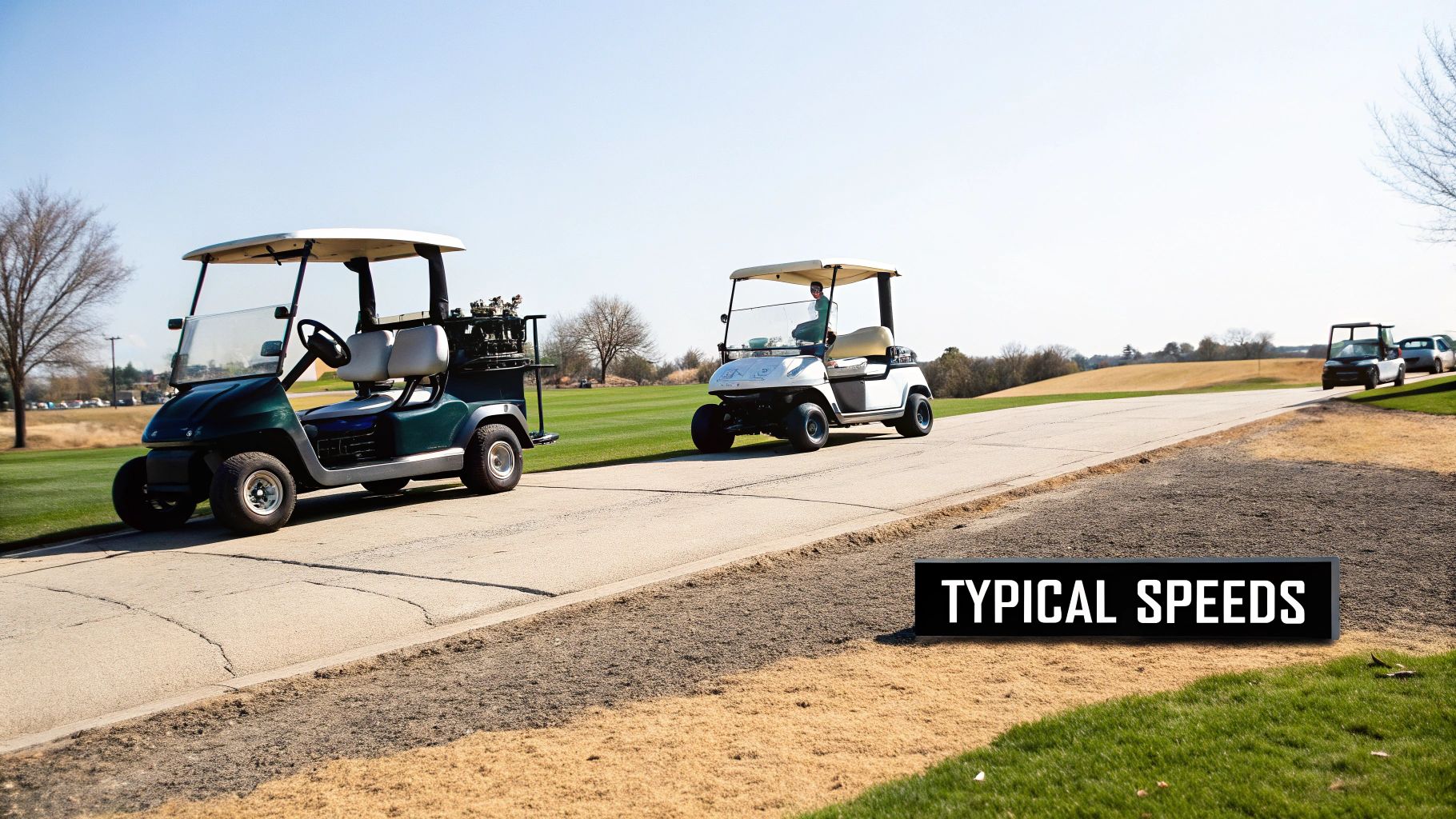
First things first, you need to know the difference between a standard course vehicle and one built for cruising around the neighborhood. That typical 12-14 mph limit is there for a reason—it strikes the perfect balance between keeping the pace of play moving and preventing ruts in those beautifully manicured fairways.
Big names in the industry like E-Z-GO and Club Car intentionally cap the speeds on their course models right in this range. It’s all about prioritizing safe handling and getting the most out of every battery charge. Of course, the environment you're in plays a huge role, too. A well-designed course layout can make all the difference in how you get around, as you can see at top-notch facilities like the Vila Sol Golf Academy & Driving Range.
To give you a clearer picture, let's break down what you can expect from different types of carts.
Typical Golf Cart Speeds At A Glance
This table gives you a quick side-by-side comparison of the most common types of golf carts and their average speeds, from the classic course cruiser to street-ready models.
| Cart Type | Average Speed Range (MPH) | Primary Use |
|---|---|---|
| Standard Electric Cart | 12 - 15 MPH | Golf course rounds |
| Standard Gas Cart | 15 - 19 MPH | Golf courses, large properties |
| Street-Legal (LSV) | 20 - 25 MPH | Neighborhoods, public roads |
| Powered Push Caddie | 3 - 5 MPH | Walking assistance on course |
As you can see, there’s a cart for just about every need, whether you’re zipping between holes or just need a little help carrying your bag up a hill.
Standard Speeds of Electric and Gas Carts
When you grab a brand-new golf cart off the showroom floor, it's not built to be a speed demon. It's engineered for a very specific job on the course, and its speed reflects that. The industry standard for a typical, unmodified golf cart lands squarely between 12 and 19 miles per hour.
That range isn’t just a random number; it's a sweet spot that balances a decent pace of play with the safety of everyone on the course. It’s fast enough to keep the game moving but slow enough to protect the delicate turf and prevent accidents. While this speed is perfect for a round of golf, it also reveals a core difference between the two main power sources: electric and gas.
Power Delivery: Electric vs. Gas
Think of an electric cart like a sprinter exploding out of the blocks. It gives you instant torque, that zippy, immediate jolt of acceleration the second you press the pedal. This is what makes electric carts feel so quick and responsive, especially from a dead stop.
A gas-powered cart, on the other hand, is more like a marathon runner. It might take a hair longer to get up to full speed, but it delivers consistent, unwavering power until the last drop of fuel is gone. This reliability is why many courses with seriously hilly terrain or long stretches between holes still lean on gas models.
The core difference lies in how they apply power. Electric carts excel in silent, instant acceleration ideal for quiet courses, while gas carts offer sustained power and longer range without needing a lengthy recharge.
This trade-off is a huge deal when you're deciding what to buy. Electric carts are loved for their quiet, efficient operation and typically reach speeds of 15-20 mph. In fact, some of the newer electric models packing lithium-ion batteries can even hit 25 mph right out of the box, making them perfect for street-legal use in many communities. You can discover more insights about electric vehicle speeds to see just how far the technology has come.
Pushing the Limits with Modified and Street Legal Carts
While a standard golf cart is perfectly happy cruising the fairways, some owners have bigger plans. For them, a golf cart isn't just for golf—it's a handy vehicle for getting around the neighborhood, the farm, or a planned community. This is where high-performance mods and street-legal conversions enter the picture, turning a simple cart into something much faster and more capable.
The most common way to get more speed is through a few key upgrades. Think of it like tuning a car: each new part adds a little more oomph. Swapping out the stock motor for a high-speed one, upgrading the electronic speed controller, and bolting on larger tires can completely transform how a golf cart performs.
These changes are more than just for looks. With the right mix of upgrades, a standard cart can leave its factory settings in the dust. You can dive deeper into the specifics in our detailed guide on how to make an electric golf cart faster.
From Course Cruiser to Road-Ready Vehicle
Taking a golf cart onto public roads involves more than just raw speed; it means meeting specific legal requirements. A cart that’s been modified for the road is often classified as a Low-Speed Vehicle (LSV). To earn that title, a cart has to be able to hit speeds between 20 and 25 mph but is legally forbidden from going any faster than 25 mph.
This legal status also demands a whole suite of safety features to make sure it can safely share the road with regular traffic. These non-negotiable add-ons usually include:
- Headlights, taillights, and brake lights
- Turn signals
- A proper windshield
- Seatbelts for everyone on board
- A rearview mirror
Turning a golf cart into an LSV is about more than just adding power. It’s about legally and safely bringing it into a new environment, equipped with everything needed to protect the driver and everyone else on the road.
With these modifications in place, a golf cart becomes a legitimate vehicle for local trips. Modified models with high-speed motors and bigger tires can reliably cruise at 19.5 to 23 mph, while purpose-built LSVs are legally capped right at that 25 mph mark.
Key Factors That Influence Golf Cart Speed
A golf cart's official top speed is really just a suggestion. Out in the real world, a bunch of different things can chip away at how fast your cart actually moves from tee to green. Think of it like a souped-up sports car—it’s not hitting its peak performance while stuck in a muddy field, and a golf cart is no different.
The motor, the battery's charge, the steepness of the hills, and how much weight you’re hauling all play a part. Knowing what to expect from these variables will help you understand your cart's true performance, whether you're tackling a tough course or just cruising the neighborhood.
The Engine Room: Motor And Battery
The heart and soul of any electric golf cart are its motor and battery. The battery's voltage—usually 36V or 48V—is a great indicator of its power potential. Think of it like water pressure: higher voltage pushes more power to the motor, which means more speed. All else being equal, a 48V cart will almost always have a little more zip than a 36V model.
But voltage is only one piece of the puzzle. The battery's state of charge is just as critical. A freshly charged battery is going to give you maximum power and acceleration. As that battery drains throughout your round, you'll start to feel your top speed and pickup get noticeably sluggish. This is exactly why a cart can feel brand new on the first hole and a bit tired by the eighteenth.
A golf cart’s power system is a team effort. High voltage provides the potential for speed, but a full charge provides the energy to achieve it. A weak link in either will slow you down.
You can dive deeper into this in our guide to electric golf cart speed control.
The Burden Of Weight And Terrain
Beyond the battery, two other major forces are constantly working against your cart: the total weight it's carrying and the ground it's driving on. Every extra passenger, golf bag, and cooler adds to the load the motor has to pull. It’s simple physics—a cart with just one driver is going to accelerate faster and hold a higher top speed than one packed with four people and all their gear.
Terrain has an even bigger impact. Driving up a steep hill forces the motor to work overtime, which will dramatically cut your speed. On the flip side, heading downhill can naturally push your speed up, sometimes even faster than the motor’s own limit.
How Conditions Affect Golf Cart Speed
To give you a clearer picture, here’s a quick look at how common situations on the course can slow down a standard electric cart that has a top speed of 15 mph.
| Condition | Typical Speed Impact | Example Scenario |
|---|---|---|
| Fully Loaded | -2 to -4 MPH | Four passengers with golf bags. |
| Steep Incline | -5 to -8 MPH | Climbing a significant hill on the course. |
| Low Battery | -3 to -6 MPH | Battery is below a 50% charge level. |
| Soft/Wet Ground | -2 to -4 MPH | Driving through thick or wet grass after rain. |
As you can see, stacking these conditions—like climbing a hill with a full cart and a low battery—can bring even a zippy cart to a crawl. Understanding these factors helps you manage your cart's performance and battery life for a full 18 holes.
Finding Your Perfect Pace with an Electric Caddie
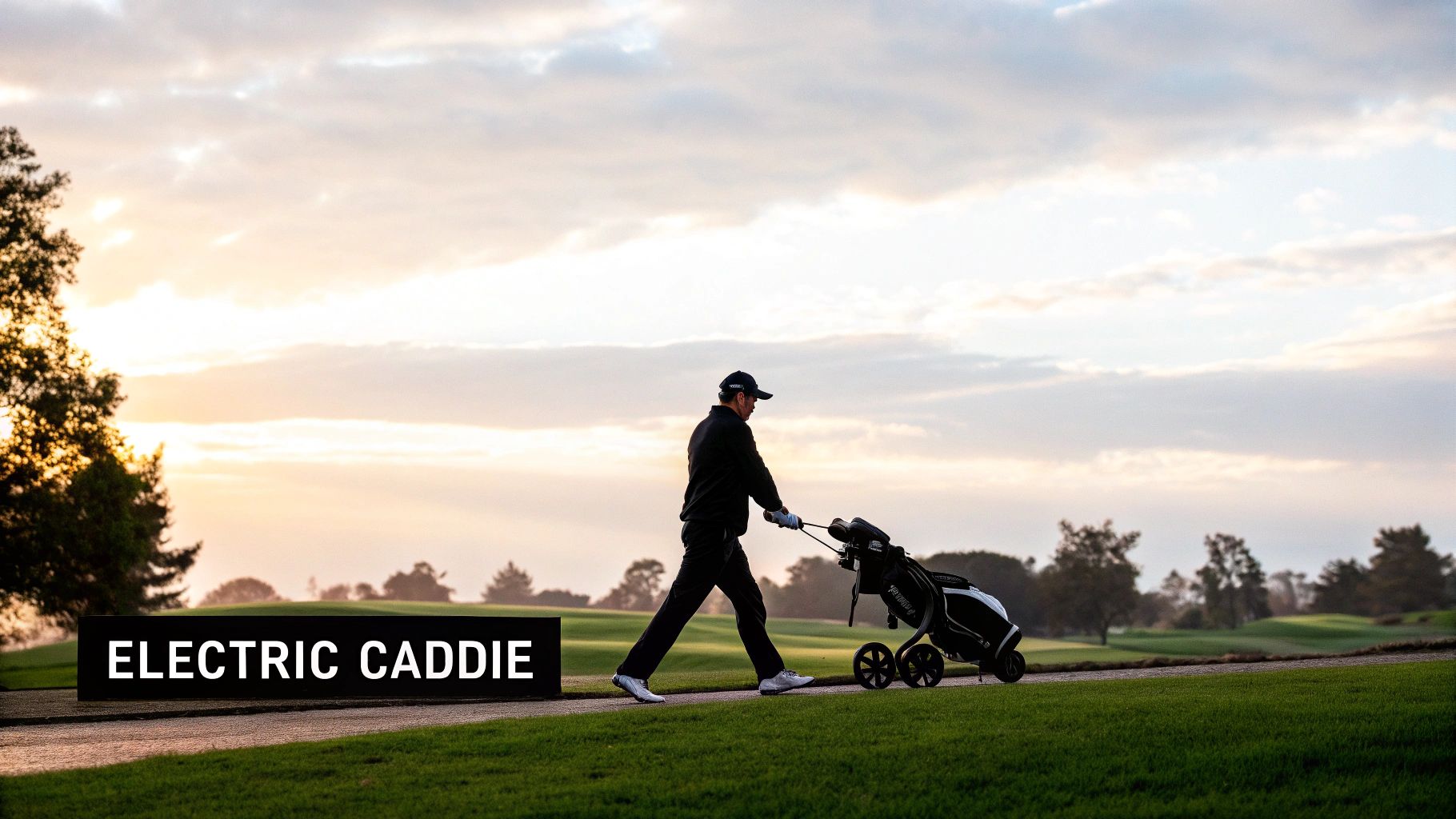
We've talked about the 12-25 mph world of riding carts, but now it’s time to shift gears. For a huge number of golfers, the real soul of the game isn't found in zipping from shot to shot, but in the rhythm of walking the course. That ideal pace is a steady 3-4 mph—a speed that connects you to the fairways in a way a riding cart just can't.
But let's be honest. Lugging a heavy golf bag for 18 holes can quickly turn that therapeutic stroll into a grueling march. Pushing or carrying that weight, especially over hilly terrain, drains the energy you should be saving for your swing. This is exactly where the electric caddie finds its sweet spot.
Enhancing the Walk, Not Replacing It
An electric caddie is designed to be the perfect walking partner. This isn't about how fast a golf cart can go; it’s about perfectly matching your personal pace. Think of it less like a vehicle and more like a powered assistant that just happens to carry all your gear.
This powered boost lets you keep your natural stride without any extra effort, whether you're climbing a steep fairway or heading down that final stretch. By shouldering the load for you, an electric caddie saves your physical and mental energy, keeping you fresh and focused from the first tee to the final putt. For a deeper dive, check out our complete guide to the electric golf caddy.
The goal of an electric caddie isn't to speed up the game. It's to preserve the timeless experience of walking the course while getting rid of the fatigue. You get all the health and tactical perks of being on your feet, without the backache.
At the end of the day, these brilliant devices cruise along at your ideal walking speed, giving you just enough power to make the journey feel effortless. They prove that for many of us, the best pace on the course isn't the fastest one possible—it's the one that feels the most comfortable and lets us play our best golf.
Of course. Here is the rewritten section, crafted to sound completely human-written and natural, following the provided style guide.
Your Common Golf Cart Speed Questions Answered
Alright, let's wrap this up by hitting some of the most common questions golfers have about cart speed. Getting these details right is about more than just curiosity—it’s about staying safe, legal, and getting the most out of your cart, whether you're on the back nine or cruising around your neighborhood.
What Is the Typical Speed Limit on a Golf Course?
Most golf courses draw the line right around 15 mph. Think of this less as a suggestion and more as a hard rule. It’s there for everyone's safety and to protect the course itself. A cart going too fast can be a hazard to other players, and a sharp turn can easily tear up the delicate turf you’re there to enjoy.
Don’t worry about accidentally speeding in a rental, though. The vast majority of course fleets are governed, meaning they’re electronically limited to stay under that 15 mph threshold.
Can I Legally Make My Golf Cart Faster?
You absolutely can, but whether it’s legal all comes down to where you plan to drive it. If you’re just souping it up for use on private property or the golf course, you’re generally in the clear. But the second you want to take that modified cart onto a public road, you enter a whole different world of regulations.
To be street-legal, your cart needs to be converted into a Low-Speed Vehicle (LSV). This is way more involved than just adding a speed chip. An LSV can’t go faster than 25 mph and must be kitted out with essential safety gear, including:
- Headlights and taillights
- Seatbelts
- Mirrors
- A valid vehicle identification number (VIN)
After the conversion, it has to be registered, titled, and insured just like a car.
The bottom line is this: Speed modifications are for the course unless you go through the full LSV conversion process. Cutting corners here isn't just risky; it can lead to some pretty hefty fines.
Does Driving at Top Speed Drain the Battery Faster?
Without a doubt. It’s the exact same principle as the gas mileage in your car—if you’re always flooring it, you’re going to burn through fuel much faster. Constantly pushing your electric golf cart to its maximum speed puts a huge strain on the motor, which in turn drains the battery much more quickly than if you were just cruising at a steady pace.
Hard acceleration and forcing the cart up hills at full tilt are also major energy hogs. If you want to get the most range out of a single charge, smooth and steady driving is always the winning strategy.
Ready to enjoy the walk without the work? The Caddie Wheel transforms your standard push cart with powerful, whisper-quiet electric assistance, letting you conquer any course with ease. Learn more and upgrade your game today at CaddieWheel.com.
Share:
A Golfer's Guide to Golf Carts and Batteries
Your Guide to Choosing the Best Golf Caddy Motor