
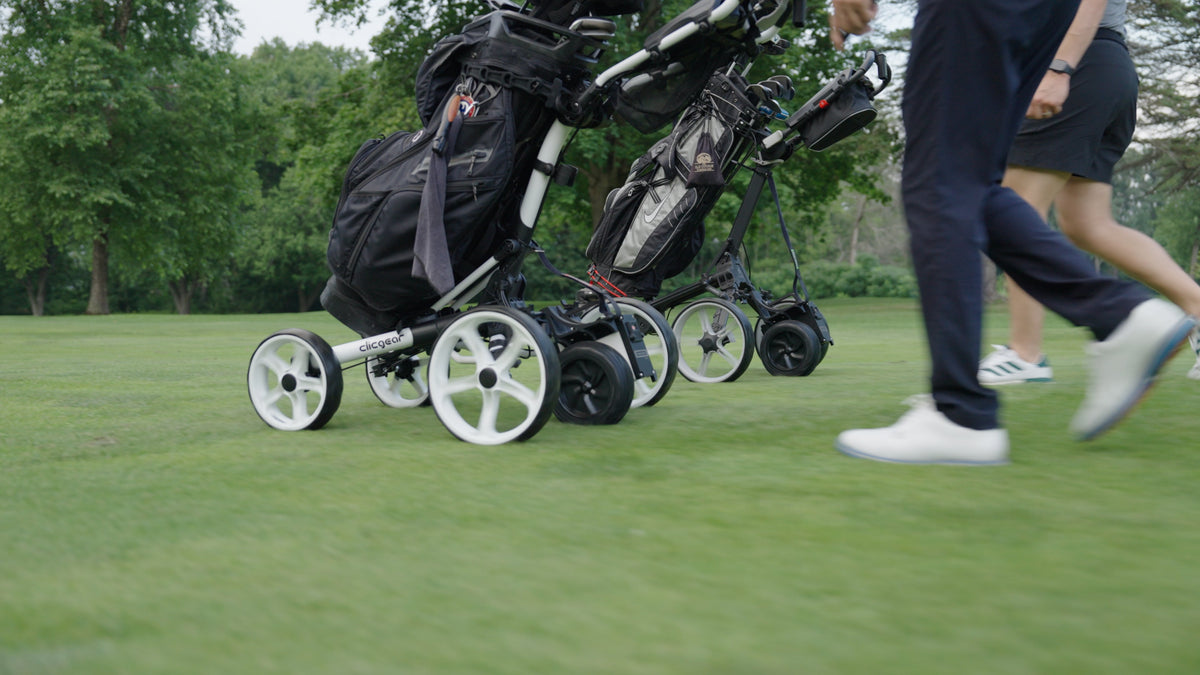
Quick answer: You can convert a golf push cart to electric in two ways. You can build your own setup from a hub motor, speed controller, battery and remote, or you can fit a ready-made conversion kit such as the Caddie Wheel, which bolts to your cart with a model-specific bracket. A DIY build can work if you're comfortable with wiring and lithium batteries. For most golfers, a kit is faster, safer and comes with a warranty.
This guide walks through both routes honestly: what parts a DIY build needs, where home builds usually go wrong, what a kit costs, and exactly how to install one on your cart.

Skip the wiring: convert your cart in an afternoon
The Caddie Wheel is a ready-made push cart conversion kit: motor, battery and remote in one unit, with the bracket for your cart included. $749, 12-month warranty, free first-install support.
Can you convert a golf push cart to electric?
Yes. A push cart already has the frame, wheels, bag mounts and fold. To make it electric you only need to add three things: something that drives a wheel, a battery to power it, and a way to control the speed. Everything else stays the same.
What changes is how much of that you build yourself. There are three common approaches:
- Full DIY build. You source a hub motor (often from an e-scooter or power wheelchair), a matching speed controller, a lithium battery, a throttle or remote, and mounting hardware, then design and fabricate the mount yourself.
- Single power-assist wheel kit. One self-contained motorized wheel with a built-in battery mounts under the cart with a bracket made for your model. The Caddie Wheel works this way.
- Twin-motor axle kit. You remove your cart's rear wheels and replace them with a motorized axle, such as Alphard's Club Booster.
DIY build vs conversion kit at a glance
| DIY build | Caddie Wheel kit | |
|---|---|---|
| Parts | Motor, controller, battery, charger, remote or throttle, wiring, fuses, mount; all sourced separately | One unit with motor, battery and remote, plus the bracket for your cart |
| Skills needed | Electrical wiring, soldering or crimping, metalwork for the mount, lithium battery handling | Basic hand tools and the installation guide for your cart |
| Time | Several weekends of design, ordering and testing | One afternoon for the first install; clip on and off after that |
| Cost | Varies widely with the parts you choose; extra for tools and redo parts | $749 including bracket kit |
| Warranty and support | None beyond individual parts | 12-month warranty and free first-install support |
| Weather and course use | Up to you to seal connections and protect the battery | Water-resistant battery, built for 36+ holes per charge |
What a DIY electric push cart build involves
If you enjoy building things, a home conversion is a real project, and plenty of golfers have done it. Builders on forums such as Endless Sphere typically work through the same list of decisions.
1. The motor
Most DIY builds use a hub motor, where the motor sits inside the wheel. Wheelchair and e-scooter hub motors are common choices because they're built for walking speeds. You'll need to choose between brushed motors (simpler to control, more wear) and brushless motors (more efficient, but each one needs its own controller). The motor wheel also needs enough weight on it to grip wet grass, which affects where you mount it.
2. The controller and remote
The controller sits between the battery and the motor and sets the speed. You then need a throttle on the handle or a wireless remote paired to the controller. Remote setups are where many builds stall: the parts come from different suppliers and rarely work together out of the box.
3. The battery
Lithium batteries give the best weight-to-range ratio, but they need a proper battery management system, the right charger, fuses and secure mounting. A loose or damaged lithium pack is a fire risk, so this is not the place to cut corners. Transport Canada's guidance on handling lithium batteries is a good starting point.
4. The mount
Every push cart frame is different, so a DIY mount is usually custom fabricated. It has to hold the motor at the right height, keep the wheel in contact with the ground on slopes, and still let the cart fold.
5. Weatherproofing and testing
Golf means dew, wet grass and the odd shower. Exposed connectors and controller boxes need sealing, and the whole setup needs testing on slopes before you trust it on the course.
None of this is impossible, but it adds up. If the goal is to stop pushing your cart rather than to enjoy the build, a kit gets you there faster.
Everything a DIY build needs, already matched
Motor, lithium battery, controller and 4-speed remote in one 15 lb unit, with a bracket made for your cart. 36+ holes per charge.
How to convert a push cart to electric with a kit, step by step

Here is the full process using the Caddie Wheel as the example. Other kits follow a similar order, though twin-motor kits also require removing your rear wheels.
- Identify your push cart model. Look for the model name on the frame, the handle console or your receipt. "Clicgear" isn't enough: the 3.0, 3.5+ and 4.0 use different brackets.
- Check compatibility. Find your cart on the compatible carts list. If it isn't listed, don't modify a bracket to fit; an unlisted install voids the warranty.
- Order with the right bracket. Choose your cart model at checkout and the matching bracket kit ships with your Caddie Wheel.
- Charge the battery fully before the first round.
- Fit the bracket to your cart. Follow the step-by-step installation guide for your model. Most installs take basic hand tools. The bracket stays on the cart from then on.
- Clip in the Caddie Wheel and pair the remote.
- Test on flat ground at the lowest of the 4 speeds. Walk beside the cart with a light hand on the handle to steer. Then try a gentle slope.
- Fold check. Unclip the wheel and fold the cart to make sure everything clears.
If anything doesn't line up, Caddie Wheel's first installation support is free, and a technician can be sent to your course.
What to expect after the conversion

This is the hill you stop pushing up. With the conversion done, you start the cart with the remote after each shot and walk beside it. A few things to know:
- Range: the Caddie Wheel battery lasts at least 36 holes on a full charge, so two rounds between charges. It can be recharged about 400 times.
- Steering: it drives straight. You aim with a fingertip on the handle, the way you already guide your cart, minus the pushing.
- Hills: step the speed up a level on climbs, and use your cart's own brake when you park on a slope.
- Rain: the battery is water resistant, so light rain is fine. Don't submerge it, and dry it after a wet round.
- Transport: the wheel unclips and rides in its own bag, so your folded cart is the same size it always was.
One customer who had moved to riding carts because of old back and shoulder injuries wrote that the Caddie Wheel "allows me to walk and exercise and not worry about exacerbating my old injuries." That is the point of a conversion: you keep walking, without the strain.
Don't have a compatible cart?
If your current push cart isn't on the list, or it's tired and wobbly anyway, buying a cart and conversion together is the simplest path. There's nothing to measure and nothing to check.
Clicgear 4.5 + Caddie Wheel bundle
The Clicgear 4.5, runner-up in MyGolfSpy's 2026 push cart test, paired with the Caddie Wheel and the matching bracket kit. $949, ready to go.
Common conversion mistakes to avoid
- Guessing the cart model. Close isn't good enough for brackets. Confirm the exact model before you order.
- Forcing a part to fit. Bending a bracket or drilling the frame can weaken the cart and void the kit's warranty.
- Skipping the flat-ground test. Get comfortable with the remote before you're on a slope next to a pond.
- Storing the battery badly. Keep it indoors over the winter, out of a hot car in summer, and charged according to the manual.
- Underestimating a DIY build. If you go the home-build route, budget time for testing and redoing parts, and treat the lithium battery with care.
Frequently asked questions
Can I add a motor to any golf push cart?
Not with every kit. Conversion kits mount with brackets made for specific cart models. The Caddie Wheel has brackets for more than 25 carts from Clicgear, Bag Boy, CaddyTek, Big Max, Axglo, Sun Mountain and others. Check the compatible carts list before you buy.
Is it cheaper to build a DIY electric push cart?
It can be, if you already own tools and choose budget parts. But a DIY build has no warranty, and redo parts, chargers and weatherproofing add cost. A ready-made kit such as the Caddie Wheel costs $749 with the bracket included and comes with a 12-month warranty.
How long does it take to convert a push cart to electric?
With a kit, the first install typically takes an afternoon with basic tools, and after that the wheel clips on and off. A DIY build usually takes several weekends of sourcing parts, fabricating a mount and testing.
How far will a converted push cart go on one charge?
It depends on the battery, terrain and load. The Caddie Wheel lasts at least 36 holes on a full charge. DIY builds vary with the battery you choose.
Will converting my push cart stop it from folding?
Not with a clip-on kit. The Caddie Wheel bracket stays on the cart, you unclip the wheel, and the cart folds as normal. DIY mounts need to be designed with the fold in mind.
Can I still push my cart manually after converting it?
Yes. With a single power-assist wheel, your cart keeps all its original wheels, so you can unclip the Caddie Wheel and push it as before if you ever want to.
Convert your push cart this week
The Caddie Wheel turns the push cart you already own into an electric caddy. $749 with the bracket kit for your cart, plus a free carry bag, remote holder and portable remote charger for a limited time.
Shop the Caddie Wheel Or get the Clicgear 4.5 bundle ($949) →
Related reading: Golf push cart electric conversion kits: the complete guide and Caddie Wheel vs Alphard.
Share:
12 Best Electric Golf Trolley Options for 2025
7 Best Remote Control Golf Push Cart Options for 2025