Quick answer: A golf push cart electric conversion kit adds a battery-powered motor to the push cart you already own, so the cart moves itself while you walk. Most kits cost far less than a new electric caddy, install in minutes, and come in two styles: a single power-assist wheel (like the Caddie Wheel) or a twin-motor rear axle that replaces your cart's back wheels.
If you walk your rounds and like your current cart, a conversion kit is usually the cheapest way to stop pushing. This guide covers how the kits work, what they cost compared with buying a new electric cart, how to check whether your cart is compatible, and what to expect on the course.

Power the push cart you already own
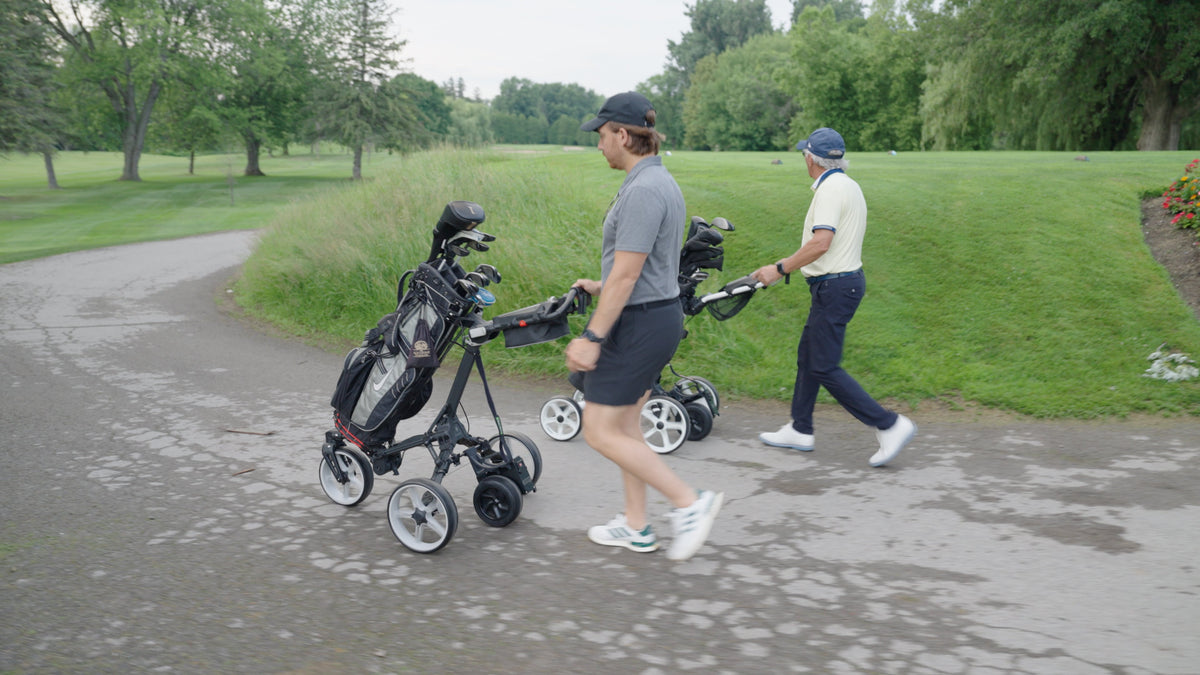
The Caddie Wheel clips under your push cart and drives it by remote. Every order includes the bracket kit for your cart, plus a free carry bag, remote holder and portable remote charger ($130 value) for a limited time.
What is a push cart electric conversion kit?
A push cart electric conversion kit is a motor, battery and controller that attach to a manual golf push cart and turn it into a powered caddy. You keep your cart's frame, bag straps, console and folding mechanism. The kit supplies the power.
There are two common designs:
- Single power-assist wheel. One motorized wheel mounts under the cart between the existing wheels and pushes it forward. Your cart keeps all its original wheels. The Caddie Wheel works this way.
- Twin-motor rear axle. You remove the cart's rear wheels and bolt on a motorized axle with two drive wheels. Alphard's Club Booster is the best-known example.
Both are controlled with a handheld remote that sets the speed. The main differences are price, weight, how the cart steers and how much of your original cart stays in use.
Why convert instead of buying a new electric cart?

Pushing 30 to 40 pounds of cart and clubs for four or five miles is the hard part of walking golf, and hills make it worse. There are three ways to fix that, and they cost very different amounts.
| Option | Typical price (USD) | Keeps your cart? | Best for |
|---|---|---|---|
| Single-wheel conversion kit (Caddie Wheel) | $749 including bracket kit | Yes, all of it | Golfers who like their current cart and want the lowest-cost upgrade |
| Twin-motor axle kit (Alphard Club Booster V2Pro) | $950 list, $849 on sale (Alphard) | Frame only; rear wheels removed | Golfers who want full remote steering |
| New electric push cart | Roughly $800 to $3,000+ | No | Golfers replacing their cart anyway |
Prices checked October 2026. For a tested list of complete electric carts, see MyGolfSpy's best electric golf push carts of 2026.
Converting makes the most sense when your push cart is in good shape. You have already paid for a frame, wheels and a fold you like, and a kit adds power without making you start over. It also keeps the cart light: the Caddie Wheel weighs 15 lb (6.8 kg) and comes off the cart for the drive to the course, so you are never lifting a 40 lb electric cart into your trunk.
Some brands sell motor kits that only fit their own carts. Alphard's Cybercart Motor Upgrade Kit, for example, lists at $1,199 and works only with its Cybercart Push+ (Alphard product page). A universal-fit kit is the better choice if you already own a Clicgear, Bag Boy, CaddyTek or similar cart.
How the Caddie Wheel works

The Caddie Wheel is a single motorized wheel with a built-in battery. A bracket kit made for your specific cart model holds it under the frame, between the rear wheels. You press a button on the remote and the wheel drives the cart forward at your walking pace.
- Battery: a full charge lasts at least 36 holes, so two rounds between charges. The battery can be recharged about 400 times.
- Speed: the remote has 4 speeds, so you can match flat fairways, climbs and a slower walk on the back nine.
- Steering: the Caddie Wheel is designed to drive straight. You keep a light hand on the handle to aim the cart, the way you already do, but without pushing.
- Weather: the battery is water resistant, so light rain is fine. Don't submerge it.
- Folding: unclip the wheel before folding your cart. It travels in its own bag.
The trade-off is honest and simple. A twin-motor axle can turn the cart by remote; the Caddie Wheel can't. In exchange, you keep your cart's original wheels and brake, the kit costs less and weighs about 10 lb less (15 lb versus roughly 25 lb with battery for the Club Booster V2Pro), and setup at the course is a clip-on rather than a wheel swap.
Lighter and lower-priced than a twin-motor kit
The Caddie Wheel is $749 with the bracket kit for your cart included. 36+ holes per charge, 4 speeds, 15 lb, and a 12-month warranty.
Will a conversion kit fit my push cart?
Fit is the most important question, and it is specific to your cart model. Conversion kits attach with brackets shaped for a particular frame, so a kit that fits a Clicgear 4.0 may not fit a Sun Mountain Speed Cart.
The Caddie Wheel fits more than 25 popular carts, and the bracket kit for your model is included when you order. Supported carts include:
- Clicgear 3.0, 3.5+, 4.0 and Model 8+
- Bag Boy Nitron, Quad Pro and Quad XL
- CaddyTek CaddyLite EZ-Fold V8, Explorer V8 and CaddyCruiser ONE
- Big Max Blade IP / IP 2
- Axglo V2
- Sun Mountain Speed Cart and Pathfinder
- KVV, Rovic, Stewart R1-S, Omada TriLite and more
See the full list on the compatible carts page. If your cart isn't listed, don't force a bracket onto it: an unlisted install voids the warranty. Contact the team instead, or get a cart and Caddie Wheel together with the bundle below.
Cart not on the list, or ready for a new one?
The Clicgear 4.5 + Caddie Wheel bundle pairs the Clicgear 4.5, the runner-up in MyGolfSpy's 2026 push cart test, with the Caddie Wheel, bracket kit already matched, for $949. It includes the same free carry bag, remote holder and portable remote charger.
How to install a push cart conversion kit
Installation depends on the kit. A twin-motor axle replaces your rear wheels, so it takes tools and more time the first time. The Caddie Wheel mounts with a bracket that stays on your cart, so after the first setup it clips on and off.
- Confirm your cart model. Check the model name on the frame or in your receipt, and match it to the compatible carts list.
- Order the right bracket kit. With the Caddie Wheel, you pick your cart at checkout and the matching bracket ships with it.
- Charge the battery fully before your first round.
- Fit the bracket to your cart's frame using the step-by-step installation guides for your model.
- Clip the wheel into the bracket and pair the remote.
- Test on flat ground at the lowest speed, then try a slope before you head out.
Caddie Wheel's first installation support is free, and a technician can be sent to your course if you get stuck.
What it's like on the course

The biggest change is how you feel on the back nine. You still walk the whole course, so you keep the exercise and the pace of a walking round, but you are no longer leaning into a loaded cart on every climb. One customer who had switched to riding carts because of old back and shoulder injuries put it this way in a review: "The caddie wheel is a great device as it allows me to walk and exercise and not worry about exacerbating my old injuries."
A typical hole looks like this: hit your shot, start the wheel with the remote, walk beside the cart with a fingertip on the handle, and stop it next to your ball. On hills, bump the speed up a level instead of pushing harder. Use your cart's own brake when you park on a slope.
If you play hilly courses, this matters even more. See our list of the most hilly golf courses in North America for the kind of walk a power assist is built for, and our guide to walking a golf course like a pro for pacing tips.
How to choose a push cart conversion kit
Use these questions to narrow it down:
- Does it fit your exact cart model? Check the maker's compatibility list before anything else.
- How far does the battery go? Look for at least 36 holes so a long round or a two-round day isn't a worry.
- How heavy is it to carry? Lighter is better if you lift it into a car every time you play.
- Do you need remote steering? If you want to send the cart ahead around doglegs, a twin-motor axle does that. If you are happy guiding it with a hand on the handle, a single wheel costs much less.
- What does setup involve at the course? Clip-on beats removing wheels every round.
- What support do you get? Check the warranty, and whether someone will help with the first install. The Caddie Wheel comes with a 12-month warranty and free first-install support.
Still comparing? Read our side-by-side of Caddie Wheel vs Alphard, our step-by-step guide to converting a push cart to electric, or talk to a current Caddie Wheel user before you buy. Customers rate Caddie Wheel 4.8 out of 5 across more than 500 reviews.
Frequently asked questions
How much does a golf push cart electric conversion kit cost?
Universal conversion kits range from about $749 for a single power-assist wheel like the Caddie Wheel (bracket kit included) to about $950 at list price for a twin-motor axle kit. Brand-specific upgrade kits cost about $1,200 and only fit that brand's cart. A complete new electric push cart usually costs $800 to $3,000 or more.
Can I put a motor on any push cart?
No. Conversion kits attach with brackets made for specific cart models, so compatibility depends on your cart's frame. Caddie Wheel has bracket kits for more than 25 popular carts from Clicgear, Bag Boy, CaddyTek, Big Max, Axglo and others. Check the compatible carts list before you order.
How long does the battery last on a conversion kit?
It depends on the kit, the terrain and the load. The Caddie Wheel battery lasts at least 36 holes on a full charge, which is two rounds, and it can be recharged about 400 times. Hilly courses and higher speeds use more charge than flat courses at a slow pace.
Is a single-wheel kit or a twin-motor kit better?
A twin-motor axle can steer the cart by remote, but it replaces your rear wheels, costs more and weighs more. A single power-assist wheel keeps your whole cart, costs less and clips on, but you guide the direction with a light hand on the handle. Pick based on whether remote steering is worth the extra cost to you.
What if my push cart isn't compatible?
If your cart isn't on the compatible carts list, the simplest option is to buy a cart and conversion kit together. The Clicgear 4.5 + Caddie Wheel bundle is $949 and ships with the bracket kit already matched to the cart, so there's nothing to check.
Can I use an electric push cart conversion kit in the rain?
Light rain is fine for most kits. The Caddie Wheel battery is water resistant, so a shower mid-round won't stop it, but it shouldn't be submerged or left standing in water. Dry it off after a wet round and store it indoors.
Will a conversion kit stop me from folding my cart?
You will need to remove most kits before folding. The Caddie Wheel unclips from its bracket, the bracket stays on the cart, and the cart folds as normal. The wheel then travels separately in its carry bag.
Do I still get exercise with a powered push cart?
Yes. You still walk every hole, so you get the same steps and time on your feet. What goes away is the effort of pushing a loaded cart, especially up hills, which is often what makes golfers give up walking.
Keep your cart. Lose the push.
The Caddie Wheel turns the push cart you already own into an electric caddy for $749, bracket kit included. Free carry bag, remote holder and portable remote charger with every order for a limited time.
Shop the Caddie Wheel Or get the Clicgear 4.5 bundle ($949) →
Share:
5 Most Hilly Golf Courses In North America
Electric Caddy vs Push Cart: Is It Worth It? (2026 Guide)