
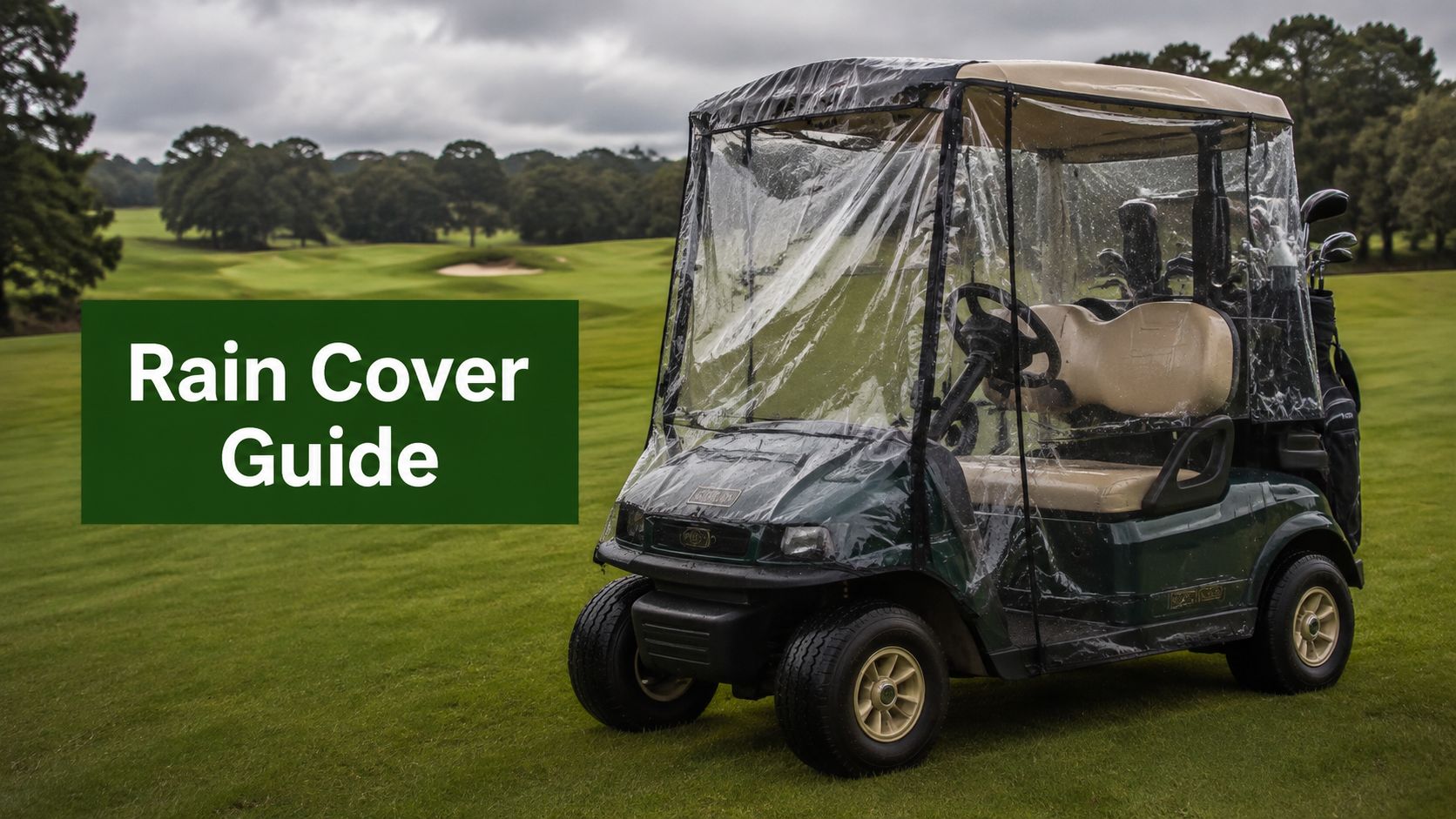
You're standing on the back nine, clouds are stacking up, the grips are already damp, and the cart's open sides suddenly feel like a bad decision. That's the moment a rain cover for golf cart stops being an accessory and starts being the difference between finishing comfortably and fighting your gear for the rest of the round. If you've ever watched water creep into a bag pocket, smear a scorecard, or make a zipper fight back in the wind, you already know the problem isn't just staying dry. It's staying playable.
The smart move is to treat rain protection like part of your on-course setup, not an afterthought. The market itself backs that up, with the global golf cart rain cover market valued at $60 million in 2020, reaching $90 million in 2025, and projected to rise to $160 million by 2033, according to the available market-sizing data, with North America dominating and Europe the fastest-growing region (HTF Market Insights report). That's not a niche hobby category. That's a real equipment-protection segment with steady demand.
Why a Rain Cover Matters on the Course
The first hard rain of the round changes everything. Your towel goes from useful to useless in minutes, the seat gets slick, and every exposed zipper, pocket, and seam starts working against you. A decent cover protects more than comfort, it protects the rhythm of the round, because once your clubs, electronics, and notes are wet, you start wasting time on cleanup instead of golf.
The difference between protection and clutter
A bad cover is worse than no cover. It flaps, leaks, catches on bag handles, and makes every reach for a rangefinder feel like a small fight. A good cover disappears into the background, does its job, and lets you keep moving without thinking about it every hole.
Practical rule: if the cover makes you stop and adjust it every few minutes, it's failing the real test.
That's why the decision isn't just “rain or no rain.” It's push cart versus full-size cart, universal versus model-specific, and whether the cover still works once you've added accessories like a motorized wheel or a rear-seat setup. A cover that protects a cart in the driveway but slows you down during play isn't doing its job. The only metric that matters is whether you can keep the round moving while the weather turns ugly.
The category is broad because the use cases are broad. Amazon's category depth reflects that, with search results showing 536 products for “rain covers for golf carts” and 328 products for “golf cart rain cover,” which tells you buyers are sorting through plenty of options, not waiting on a rare specialty item (Amazon golf cart rain cover search results). The challenge is choosing the one that fits how you play.
Measuring Your Cart the Right Way
Fit is where most buyers mess this up. They eyeball the roof, trust a product photo, and end up with a cover that's loose enough to flap or tight enough to leave the rear bench exposed. The fix is boring, but it works. Measure first, then buy.

Start with the cart type, not the product page
For a push cart, you're measuring the bag well, the handle height, and the wheel arch clearance. That tells you whether a hood-style cover will drape properly or pull itself loose once the cart starts rolling. For a full-size cart, the key numbers are roof length, roof width, and overall height. Independent patent and product specs point to common enclosure dimensions around 45-48 inches for roof width, 58-60 inches for two-passenger roof length, and longer four-passenger covers near 110-112 inches long, 48 inches wide, and 66-67 inches high (Formosa Covers product specifications).
Use three measurements and one sanity check
Measure the roof length, measure the roof width, and measure the cart's total height. Then compare those numbers against the stated roof and body measurements on the listing. If the cart is an extended four-passenger layout, be suspicious of anything that calls itself universal without showing full-length coverage. A 2+2 enclosure won't fit a 4-seater long roof that runs near 80 inches, and that's exactly the kind of mismatch that wastes money.
A snug fit matters because loose material flaps in the wind, pools water, and puts extra stress on zippers. Oversized universal covers trade flexibility for sealing, which is fine if you only need light weather protection, but not if you want the cart covered through a real round.
Measure in the garage, not in the parking lot. If you're guessing, you're already buying the wrong size.
If you want a measurement reference point for cart dimensions before you buy, use the guide at Caddie Wheel's golf cart dimensions resource and compare it against the product listing, not the marketing copy.
Material and Waterproofing Explained
The fabric name on the listing matters less than the build underneath it. A lot of covers sound tough because they say Oxford or polyester, but water resistance and true waterproofing are not the same thing. If the coating and seams aren't right, the first hard rain will find the weak point.
What actually keeps water out
The market standard for durable golf cart rain covers is usually 420D to 600D Oxford or polyester fabric with a waterproof coating. Lower-end guidance still points buyers toward at least 300D fabric plus sealed or taped seams and a PU or PVC inner coating if they want real rain protection. That's the filter, coating plus construction, not fabric weight alone.
A useful way to think about it is this. The shell gives the cover structure, the coating stops water penetration, and the seams decide whether the thing holds up in wind-driven rain. A zipper without a storm flap is a leak waiting to happen. So is a cover with good-looking fabric and sloppy seam tape.
What the useful extras are doing
Real product specs keep repeating the same features because they solve the same problems. Reflective strips help visibility when the light drops. Clear PVC windows let you see out without ripping panels open. Dual air vents reduce heat buildup and fogging. Zipper doors let you reach clubs or the bench without removing the whole enclosure.
If you want a simple material comparison point, the clear-panel approach used in accessories like clear vinyl 16 x 54 at B-Sew shows why transparency matters when visibility and protection need to coexist. The same logic applies to golf cart enclosures, the material has to let you see and still shed rain.
My rule: if the listing talks about fabric weight but says almost nothing about seam construction, keep scrolling.
For a deeper product-compatibility angle, compare material choices with Caddie Wheel's waterproof golf bag covers guide. The material lesson is the same. Good protection is built, not claimed.
Installation and Mounting Options
The easiest way to tell whether a cover will work is to install it once in wind. If it takes both hands, three adjustments, and a lot of cursing, it's too fussy. The best setups use a simple tension pattern, stay put, and still let you get to what you need during the round.

Strap it down evenly
Most covers rely on adjustable hem cords, buckle straps, elastic hems, and Velcro tabs. Start by centering the cover, then tension the bottom perimeter evenly instead of yanking one side tight first. That matters because uneven tension creates lift points where wind gets under the fabric and starts working the seams.
For a push cart, hood-style covers usually wrap the bag and anchor near the handle and wheel arches. That layout works if the cart stays within the intended geometry, but a motorized wheel like Caddie Wheel changes the attachment zone at the rear of the cart, so the straps need to clear the drive unit instead of pinching it. If the cover can't sit flat around the wheel and bag frame, you'll end up with drag and loose corners.
Keep vents and zippers aligned
For full-size carts, roof-edge anchoring is the key. Line the cover up with the roof first, then close the doors and zippers before you cinch the lower straps. That order keeps the fabric from twisting. Vent openings should stay open enough to relieve condensation without becoming a leak path.
Water hates smooth tension. Loose corners collect it, and tight corners tear first.
The only routine that matters is repeatable. Center the cover, close the openings, tension the bottom, then walk around the cart once and look for distortion at the door seams. If the zippers are fighting the frame, the cover is misaligned. If you're having to force the last strap, the fit is wrong, not the installation.
For a broader installation mindset, the same logic shows up in Caddie Wheel's rain-play tips, because wet-round success is really about minimizing fiddly gear.
Universal Cover vs Model-Specific Enclosure
Many overcomplicate the purchase. If your cart is a standard two-passenger model with a normal roof, a universal cover can be perfectly sensible. If your cart has an extended roof, rear seat kit, or accessories that change the outline, the universal label is usually doing more marketing than work.

When universal is enough
Universal covers make sense when you want one cover to move between carts, when budget matters, or when the cart is close to standard dimensions. The trade-off is obvious. You get flexibility, but you may also get extra material, less precise sealing, and more flapping in wind.
That's acceptable if the goal is occasional protection. It's a bad compromise if you're expecting a glove-like seal around doors, rear seating, or accessories. One guide on custom versus universal fit makes the same point in a different product category, and the principle holds here too, with trusted advice at The Sofa Cover Crafter reinforcing the same fit-versus-flexibility trade-off.
When model-specific wins
Model-specific enclosures are the better call when the cart is a four-seater, an extended-roof layout, or something with doors, seatbelts, and rear access that has to work cleanly. That's also where newer cart setups and mixed accessory footprints create problems. A universal cover might technically fit, but that's not the same as fitting well.
Decision rule: if seat count or roof length has changed since the cart left the factory, stop calling the cover universal.
The recurring failure point is simple. A 2+2 enclosure won't stretch to cover a 4-seater long roof near 80 inches, and a cover that barely reaches the rear bench is not a rain solution. It's a compromise that leaves the most exposed part of the cart exactly where the rain hits hardest.
Use the cart's layout to decide
Choose universal when the cart is standard, simple, and used lightly. Choose model-specific when the cart is longer, modified, or used often enough that loose fit will annoy you every round. If you've got accessories that change the footprint, the tighter enclosure wins almost every time.
Playing Through the Rain Without Slowing Down
A cover only earns its space if you can still use the cart like a golfer, not like a tent on wheels. If the zippers are buried, the clubs are hard to reach, or the clear panels fog up every time the humidity climbs, you'll stop using the cover and start leaving it in the garage.
Access beats theory
The best day-to-day setups let you reach clubs, scorecards, and a rangefinder without tearing the whole enclosure open. That's why door placement and zipper flow matter so much. If you have to crawl around the cart to get to one pocket, the design is working against pace of play.
A lot of buyers fixate on waterproofing and ignore how the cover behaves once the round starts. The trade-offs show up fast. Flapping panels pull your attention, pooling water on the roof adds weight, and straps that catch on bag handles get old in a hurry. Those annoyances stack up, especially when the weather stays marginal all afternoon.
Useability decides whether it stays in the bag
Whether the cover is worth the hassle for the way you play is the key consideration. If you only walk in fair weather, a lighter cover may be enough. If you're out there in wet rounds often, a full enclosure makes more sense because it keeps the round moving without turning every stop into a gear adjustment.
For a related take on rain-round habits and on-course decision-making, Dartee Golf weather-ready belts sit in the same practical lane, gear that has to work while you're still trying to play. That's the standard to hold any accessory to.
If the cover slows your routine more than the weather does, you bought the wrong one.
The sweet spot is simple. You want protection that stays quiet, lets you see, and doesn't make club access a chore. Anything beyond that starts hurting the round more than the rain helps it.
Troubleshooting Fit Issues and Storage
If the cover flaps, leaks, or leaves a corner exposed, don't blame the rain first. Start with fit. Most problems come from the wrong size, bad tension, or storage habits that wreck the material before the season even starts.
Fix the problem you can see
An oversize cover usually gives you versatility but weak sealing, so the first fix is to tighten the bottom perimeter evenly and check whether the roof is sitting centered. If the rear bench is exposed, the cover is too short or the cart has changed since you bought it. If zipper closures without storm flaps let horizontal rain inside, that's not a user error, that's a design flaw.
The cure for flapping is almost never more brute force. It's better tension, better alignment, or a smaller and more specific enclosure. If the cover pools water on top, the roof line is wrong for the cart or the cover is sitting too loosely across the frame.
Store it like you want it to last
Dry the cover before you fold it. Check seam tape once a year. Store it in a breathable bag instead of sealing it in a tote where trapped moisture can sit against the fabric. Those steps are basic, but they're the difference between a cover that lasts and one that smells like mildew by the next season.
Wet fabric stored tightly is a shortcut to a dead cover.
If you add a new roof, a rear seat, or a motorized wheel later, remeasure before you reorder. The original fit can go stale fast once the cart changes shape. That's especially true on carts with accessory upgrades, because the outline that looked normal last year can be wrong the second you bolt on something new.
If you want a cleaner way to move a push cart through ugly weather, Caddie Wheel gives golfers a simple electric assist that drops onto compatible carts without turning the setup into a project. It's built for players who want less strain and more control when the course is wet, hilly, or just plain tiring. Take a look if you're trying to make rainy rounds and long walks easier without adding a lot of clutter.
Share:
How to Reduce Energy Consumption: A Practical Home Guide
Portable Misters for Golf Carts: A Complete Buying Guide