

When you're looking to buy a golf cart, one of the first questions is always about size. A standard two-seater golf cart is typically about 92 inches long, 48 inches wide, and stands around 70 inches tall. Knowing these standard golf cart dimensions is critical if you want to be sure it'll fit in your garage, trailer, or navigate the paths on your local course.
Your Quick Reference for Standard Golf Cart Dimensions
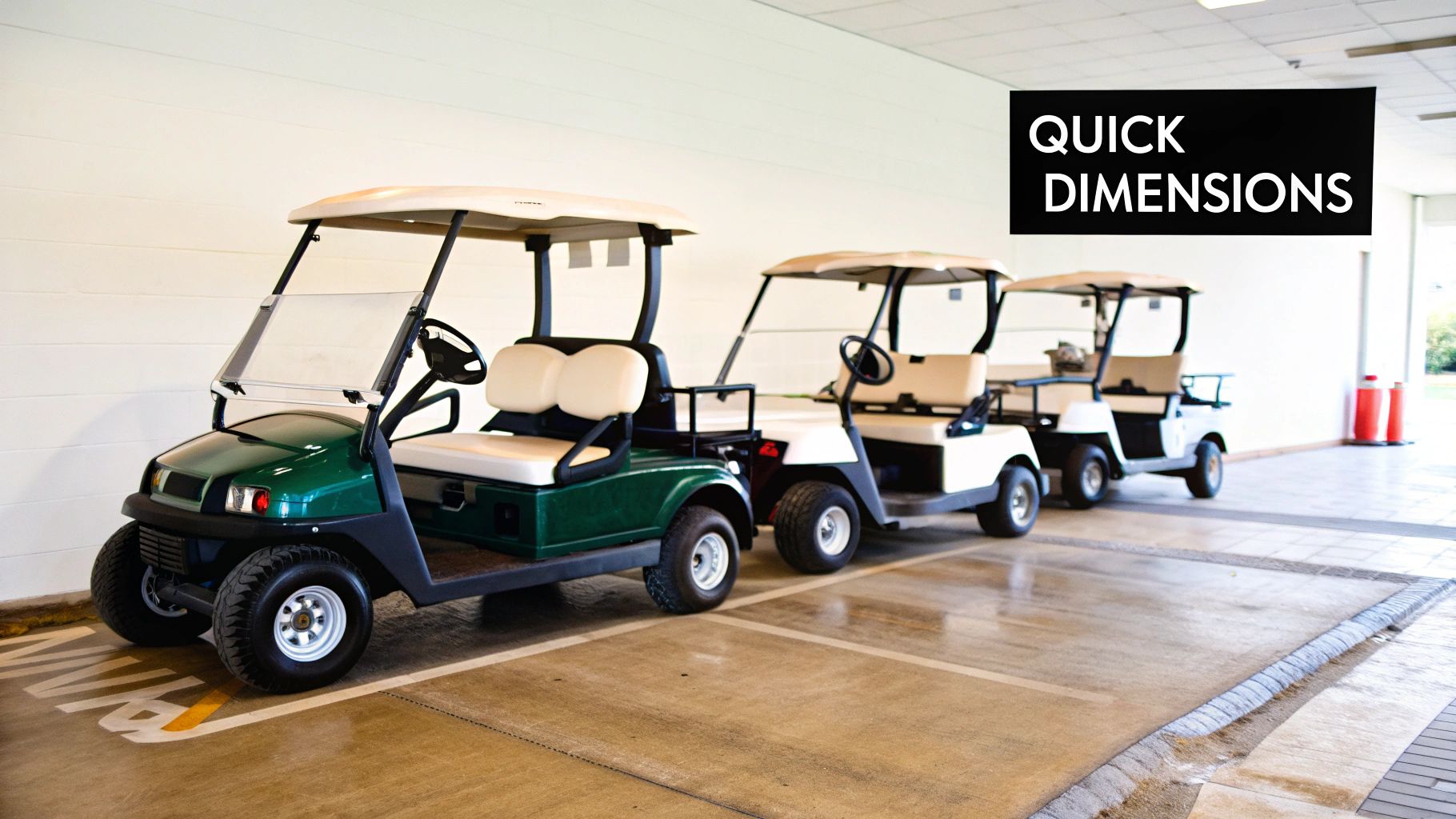
Understanding a golf cart's size is the first step whether you're buying one, making space for storage, or figuring out how to transport it. It doesn't matter if you're a course manager, a homeowner in a golf community, or just using it for fun—getting the length, width, and height right ensures it works in your space.
These measurements aren't just random numbers. They've been fine-tuned since the early days of golf carts in the 20th century to make navigating a course as smooth as possible. Today's two-seater models still stick to those tried-and-true principles, usually measuring between 92-100 inches long, 47-48 inches wide, and 70-75 inches tall. This design also keeps the wheelbase around 65-67 inches, which is what gives them that tight turning radius perfect for those winding cart paths. For some great insights into the broader golf cart market, you can check out reports on fortunebusinessinsights.com.
To give you an immediate idea of what to expect, I've put together a quick-reference table for the most common cart sizes you'll encounter.
Standard Golf Cart Dimensions at a Glance
This table gives you a simple, at-a-glance summary of the typical dimensions you'll find for the most common types of golf carts.
| Cart Type | Average Length (inches) | Average Width (inches) | Average Height (inches) |
|---|---|---|---|
| 2-Seater | 92-100 | 47-48 | 70-75 |
| 4-Seater | 104-110 | 47-48 | 70-75 |
| 6-Seater | 142-145 | 48-51 | 75-77 |
Think of these numbers as a solid baseline. They're perfect for helping you quickly figure out if a certain model will fit your needs before you start digging into the more detailed specs.
Understanding Key Golf Cart Measurements
To really compare golf carts and know what you're getting, you need to speak the language of their specifications. Each number on a spec sheet tells a story about how the vehicle will perform, how stable it feels, and how practical it is for your needs. These figures go far beyond just figuring out if it'll fit in your garage; they directly influence how the cart handles on the course and off.
The core golf cart dimensions you’ll always find listed are length, width, and height.
-
Length (Overall Length): This is the measurement from the absolute front of the cart (like a bumper or brush guard) to its rearmost point (which could be a bag holder or the footrest on a rear seat). This is the single most important number for knowing if a cart will fit in your garage or on a trailer.
-
Width (Overall Width): This is measured at the widest point of the vehicle, which is almost always the outside of the tires or the fenders. Width determines if the cart can navigate narrow paths or squeeze between tight spots without a scratch.
-
Height (Overall Height): Measured from the ground to the very top of the roof. This one's crucial for making sure you have enough clearance to get under a standard garage door or inside an enclosed trailer. No one wants to find out the hard way.
Beyond the Basics: What Other Measurements Matter
While those main three dimensions are vital, a few other measurements give you a much deeper insight into a cart's ride quality and true capabilities. Understanding these will help you pick a model that’s perfectly matched to your property and how you plan to use it.
Wheelbase
The wheelbase is simply the distance between the center of the front wheels and the center of the rear wheels. You'll notice that 4- and 6-seater models have a longer wheelbase, which generally delivers a smoother, more stable ride. The trade-off is a larger turning radius. A cart with a shorter wheelbase, on the other hand, will feel more nimble and agile.
Ground Clearance
Another critical factor is ground clearance—the amount of space between the lowest point of the cart’s frame and the ground. If you're planning to go off-pavement, this number is huge. Higher clearance is essential for tackling uneven terrain, trails, or hilly properties without scraping the undercarriage.
- A standard cart might only have 3-4 inches of clearance.
- Lifted models can easily have 6 inches or more.
Turning Radius
Finally, the turning radius tells you the smallest circle the cart can make when the wheel is turned all the way. A smaller radius means better maneuverability in tight spaces, which is perfect for navigating crowded clubhouses or weaving through complex paths. For most standard carts, you're looking at a turning radius of about 8 to 10 feet.
Detailed Dimensions for 2, 4, and 6 Seater Models
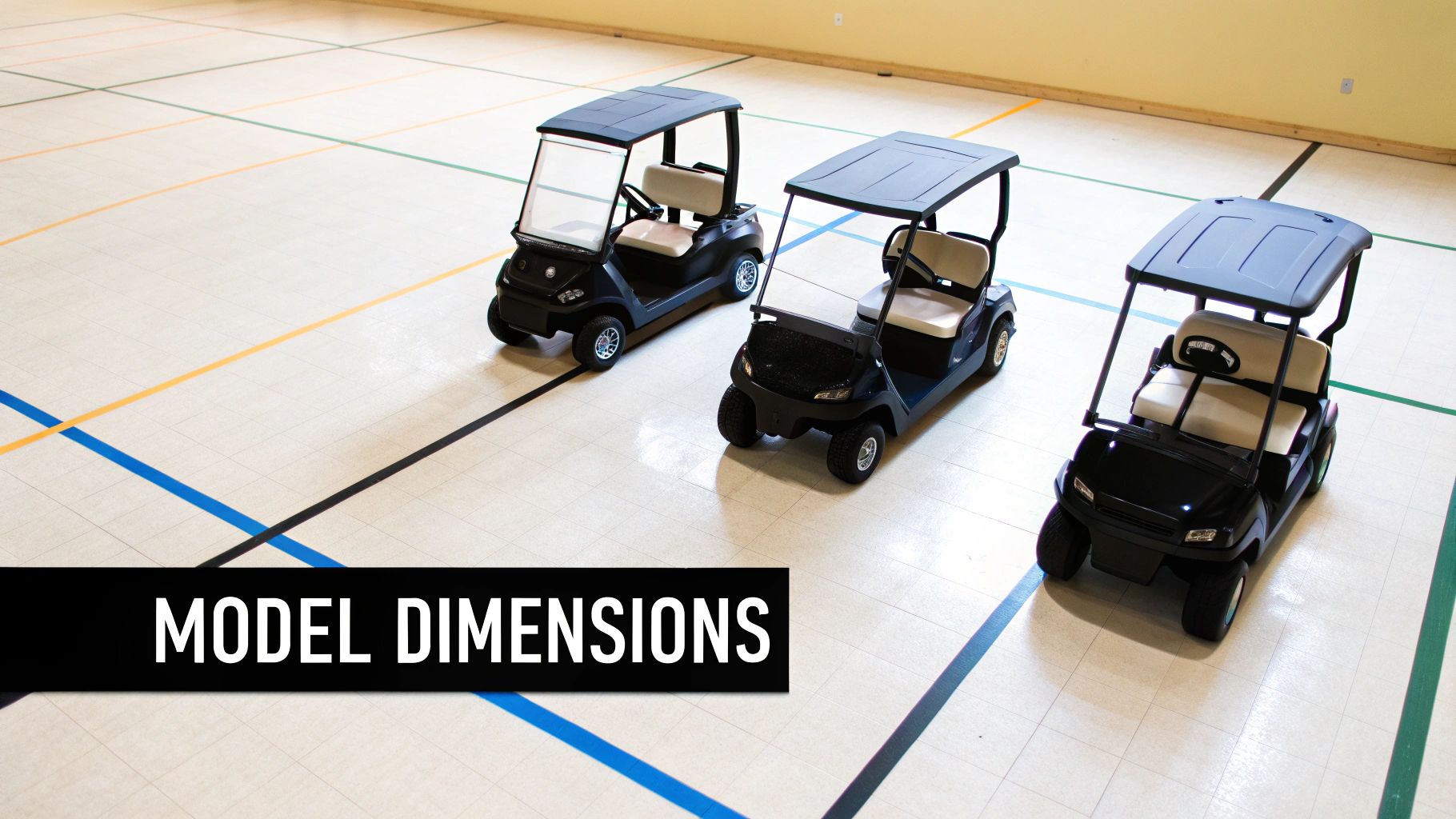
When you start looking at different golf carts, you'll quickly notice that moving from a simple two-seater to a larger model changes the golf cart dimensions in a big way. This isn't just about fitting more people; it affects everything from where you can store it to how it handles on the course. Each extra row of seats stretches out the cart's length and wheelbase, a crucial detail to keep in mind.
The classic 2-passenger golf cart is the most common for a reason—it's compact and incredibly agile. Big names like Club Car, E-Z-GO, and Yamaha have perfected these models to be nimble on tight paths. They typically measure around 91-93 inches long and 48 inches wide, which means they'll slide into a standard garage with no problem.
Standard 2-Seater Golf Cart Dimensions
The 2-seater is the starting point for every other configuration out there. Its small footprint is its biggest advantage, giving it the tightest turning radius and making storage a breeze.
- Club Car Precedent: A very common model, it comes in at 91" L x 48" W x 69" H.
- E-Z-GO TXT/RXV: These are often a bit longer, measuring 93" L x 51" W x 67.5" H.
- Yamaha Drive: Known for being a touch narrower at 91" L x 44" W x 70" H.
These small differences really drive home why you need to check the manufacturer's spec sheet for the exact model you're considering. An inch or two can be the deciding factor when you're trying to fit a cart into a tight spot on your property or onto a trailer.
Dimensions for 4-Seater Golf Carts
The most popular upgrade is adding a rear-facing back seat, which instantly turns a 2-seater into a 4-passenger vehicle. This modification mostly impacts the overall length, adding about a foot to the frame.
A typical 4-seater, like a Club Car Precedent with a flip-seat kit, will grow to around 104 inches in length. In the same way, an E-Z-GO or Yamaha model with a rear seat usually measures close to 108 inches long. The width and height stay the same unless you also decide to add a lift kit.
One thing you'll notice right away is that the longer wheelbase gives you a smoother, more stable ride, especially when you pick up a little speed. The trade-off? A wider turning radius, making the cart feel a little less nimble in tight corners than its 2-seater cousin.
Limo Style 6-Seater Golf Cart Dimensions
If you need to move a crowd, the 6-seater "limo" model is the way to go. These carts are significantly longer to fit three rows of forward-facing seats, and their footprint is dramatically different.
Take the Club Car Precedent 6-Passenger Limo, for example. It measures a whopping 142 inches in length. These stretched-out models also tend to be a bit taller, often around 77 inches, to keep everything proportional and provide enough roof support.
Because they're so long, 6-seaters demand a lot more real estate for storage and transport. Their turning radius is also the largest of any standard cart, which is a major point to consider if your property has narrow paths or sharp turns. Always get out the tape measure and check your available space before you commit to a limo cart.
Comparing Electric vs Gas Golf Cart Dimensions
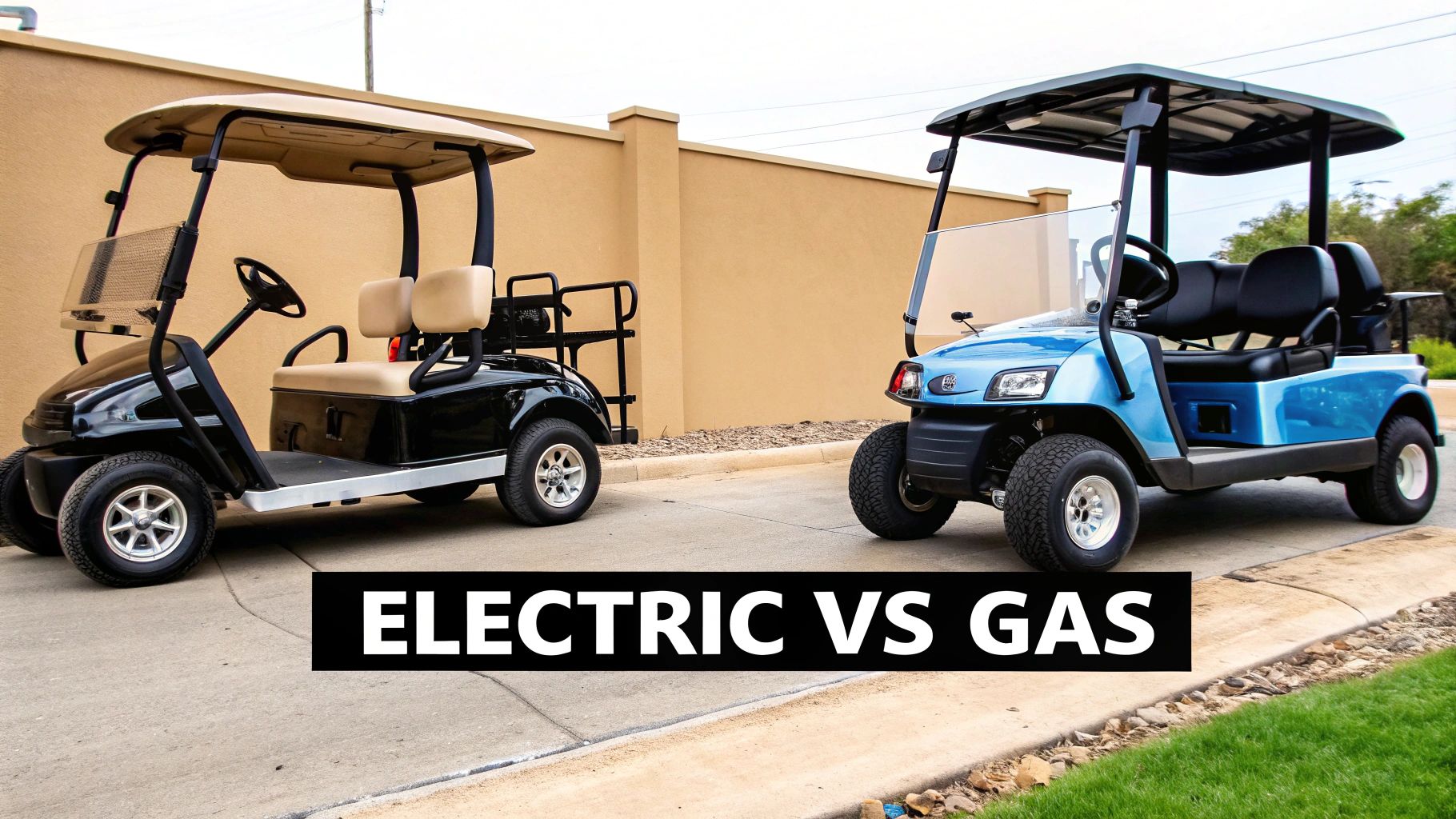
When you're trying to choose between an electric or a gas golf cart, the conversation usually revolves around noise, maintenance, and raw performance. But there's another factor that often gets overlooked: the subtle differences in their golf cart dimensions. These can make a real difference in everything from storage and handling to how the cart feels on the course.
At first glance, you might not notice much of a difference. Manufacturers often use the exact same frame for both versions, but it’s what’s under the hood—or seat—that counts. The powertrain components, whether it’s a heavy battery pack or a gas engine and fuel tank, create some very distinct characteristics.
These differences in the powertrain have a direct impact on weight distribution. An electric cart’s batteries are typically spread out low under the seat, which gives it a balanced, low center of gravity. This translates to a more stable, planted feel, especially when you're making tight turns. On the flip side, a gas cart's engine is usually tucked away in the rear, which can slightly alter its handling, particularly on hills or uneven ground. This is a key point you'll see pop up in many detailed reviews of popular golf carts.
How Powertrains Affect Space and Clearance
The physical space the powertrain takes up matters, too. That large, rectangular battery pack in an electric cart often eats up a good chunk of the under-seat storage. In contrast, a gas model, with its more compact engine, might leave you with a bit more open space for your gear.
It's a practical trade-off you have to consider if you plan on stowing supplies or equipment. Another small but important detail is ground clearance. The engine and exhaust on a gas cart can sometimes hang a bit lower, slightly reducing its clearance compared to an electric model with its clean, flat underbody.
The growing trend toward electric models, with a market projected to hit $3.07 billion by 2029, is fueled in part by this efficient design. Electric carts often keep a compact footprint, typically around 47 inches wide and 92 inches long, which can be up to 10% slimmer than some of their gas-powered cousins. You can find more insights on this move toward lighter, more nimble golf mobility solutions on epiccarts.com.
So, while the overall length, width, and height might look nearly identical on a spec sheet, the internal layout creates real-world differences. An electric cart often gives you that stable ride and a cleaner undercarriage, while a gas cart might offer a bit more room for your stuff. Getting a handle on these subtle dimensional trade-offs is key to picking the right vehicle for your specific needs and the terrain you’ll be tackling.
Finding the Right Dimensions for Golf Push Carts
For golfers who prefer to walk the course, the conversation around dimensions changes entirely. Instead of worrying about garage clearance, the real test is trunk space and whether it’ll fit in a locker. When it comes to golf push carts, the most important numbers are the folded dimensions, which tell you just how compact it gets for storage and transport.
Out on the fairway, a good push cart has a wide, stable footprint to handle uneven turf. But its true value often shines after the last putt drops. A well-designed cart collapses into a surprisingly small package, a critical feature for anyone dealing with limited space.
Folded vs. Unfolded Dimensions
The difference between a cart's size on the course and its size in your car is huge. Most modern push carts are built for convenience, folding down in just a few simple steps.
- Unfolded (In-Use) Dimensions: When it's ready to go, a standard three-wheel push cart might measure around 45-50 inches long, 25-30 inches wide, and 40-45 inches tall. This footprint is what gives it excellent stability, especially for those nimble three-wheel models.
- Folded Dimensions: Once collapsed, these carts shrink dramatically. A really compact model can fold down to as small as 24 inches long, 16 inches wide, and 12 inches tall. That’s small enough to slide into almost any car trunk right next to your golf bag.
If you're thinking about an upgrade, our guide on how to choose a golf push cart takes a much deeper look at picking a model that perfectly balances on-course performance with off-course convenience.
The Impact of Design on Stability and Size
A push cart's design—specifically whether it has three or four wheels—also affects its dimensions and how it behaves on the course. Four-wheel carts often have a slightly larger, more rectangular footprint, which can deliver superior stability on hilly terrain. The trade-off is that they can be a bit bulkier when folded compared to their three-wheeled cousins.
The ultimate goal for push cart manufacturers is to strike that perfect balance between a sturdy, stable frame and a lightweight, compact folded form. This is exactly why knowing both sets of golf cart dimensions is so crucial before you buy.
This focus on standardized design is also what makes aftermarket upgrades so seamless. Products like the Caddie Wheel were created with these common push cart dimensions in mind. Its universal bracket system is made to fit the frames of most standard three- and four-wheel push carts, allowing for a simple, drop-on installation that adds electric power without sacrificing the cart's portability.
How to Measure Your Golf Cart for Storage or Transport
Eyeballing it just won't cut it when you're trying to fit a golf cart into a trailer, garage, or storage unit. Guesswork is a surefire way to end up with a cart that's a few inches too wide or too tall, creating a massive headache you didn't need. Taking a few minutes to get the correct golf cart dimensions is non-negotiable for a perfect fit every time.
To get started, grab a tape measure that's long enough for the job—a 25-foot one is ideal. Make sure you’re measuring on a flat, level surface to keep your numbers accurate. If you can, grab a friend to hold the other end of the tape; it makes getting those longer measurements much easier.
The Essential Measurements Checklist
Follow these steps to get the three critical dimensions of your cart. It’s incredibly important to account for any aftermarket parts you’ve added, as they almost always change the original factory size.
- Overall Length: Measure from the absolute front-most point of the cart to the absolute rearmost point. This might be a brush guard on the front and a grab bar or the footrest of a rear-facing seat on the back. Do not just measure the body itself—you need the full footprint.
- Overall Width: Find the widest point of your cart. For most, this will be the outside edge of the tires. However, if you've added fender flares or custom wheels with a wider offset, measure from the absolute widest point to ensure you'll clear tight doorways or trailer openings.
- Overall Height: With the roof installed, measure from the ground up to the highest point of the canopy. This measurement is especially critical if your cart has a lift kit, as it will determine whether you can clear your garage door.
Remember that accessories change everything. A stock cart might slip into your garage with room to spare, but once you add a rear seat kit, a lift kit, or bigger, beefier tires, its footprint can expand significantly. Always re-measure after making modifications.
With precise numbers in hand, planning becomes a whole lot simpler. You can confidently figure out if your cart will slide into a specific truck bed or fit inside an enclosed trailer. For longer-term storage, these figures are a must-have. Once you have your golf cart dimensions locked down, you can use a reliable Self Storage Size Guide to find the perfect unit for your vehicle without any guesswork.
On a similar note, knowing your wheel measurements is just as important for routine maintenance and upgrades. If you're thinking about new tires or trying to troubleshoot a problem, you need to know your wheel size. For a detailed walkthrough, check out our guide on how to measure wheel diameter accurately.
Golf Cart Measurement Checklist
To make sure you get it right the first time, here's a quick checklist to follow. It breaks down what to measure, how to do it, and what common mistakes to watch out for.
| Measurement | How to Measure | Common Pitfall to Avoid |
|---|---|---|
| Overall Length | From the very front point (e.g., bumper) to the very back point (e.g., rear seat footrest). | Forgetting to include accessories like cargo boxes or grab bars that extend beyond the main body. |
| Overall Width | From the widest point to the widest point, usually the outside of the tires or fender flares. | Measuring only the cart's body and not the wheels, which are almost always the widest part. |
| Overall Height | From the ground to the highest point of the roof. | Not accounting for a lift kit or oversized tires, which significantly increases height. |
| Wheelbase | The distance from the center of the front wheel hub to the center of the rear wheel hub. | Measuring from the edge of the tires instead of the center of the hubs, which will give an inaccurate number. |
| Ground Clearance | The distance from the ground to the lowest point of the cart's undercarriage (often the differential or motor housing). | Measuring from the side frame instead of the true lowest point, giving a false sense of clearance. |
Following this checklist will give you the confidence that your numbers are accurate, saving you from any frustrating surprises down the road.
Ensuring Accessory Compatibility With Your Cart's Dimensions
Knowing your base golf cart dimensions is the secret to getting accessories that fit perfectly the first time. Whether you're looking for a protective cover, a custom enclosure, or performance upgrades like lift kits and new wheels, those core measurements are your starting point. It's what prevents the headache of a costly return or a frustrating installation.
Think about it this way: a cover made for a standard 92-inch cart will leave a 108-inch 4-seater exposed. It just won't work. The same goes for a lift kit—your cart's stock height and wheelbase are the baseline numbers that determine how a new suspension will change its stance and ground clearance. Getting these measurements right is your best tool for a successful customization project.
This flow chart breaks down the simple steps for measuring your cart’s length, width, and height.
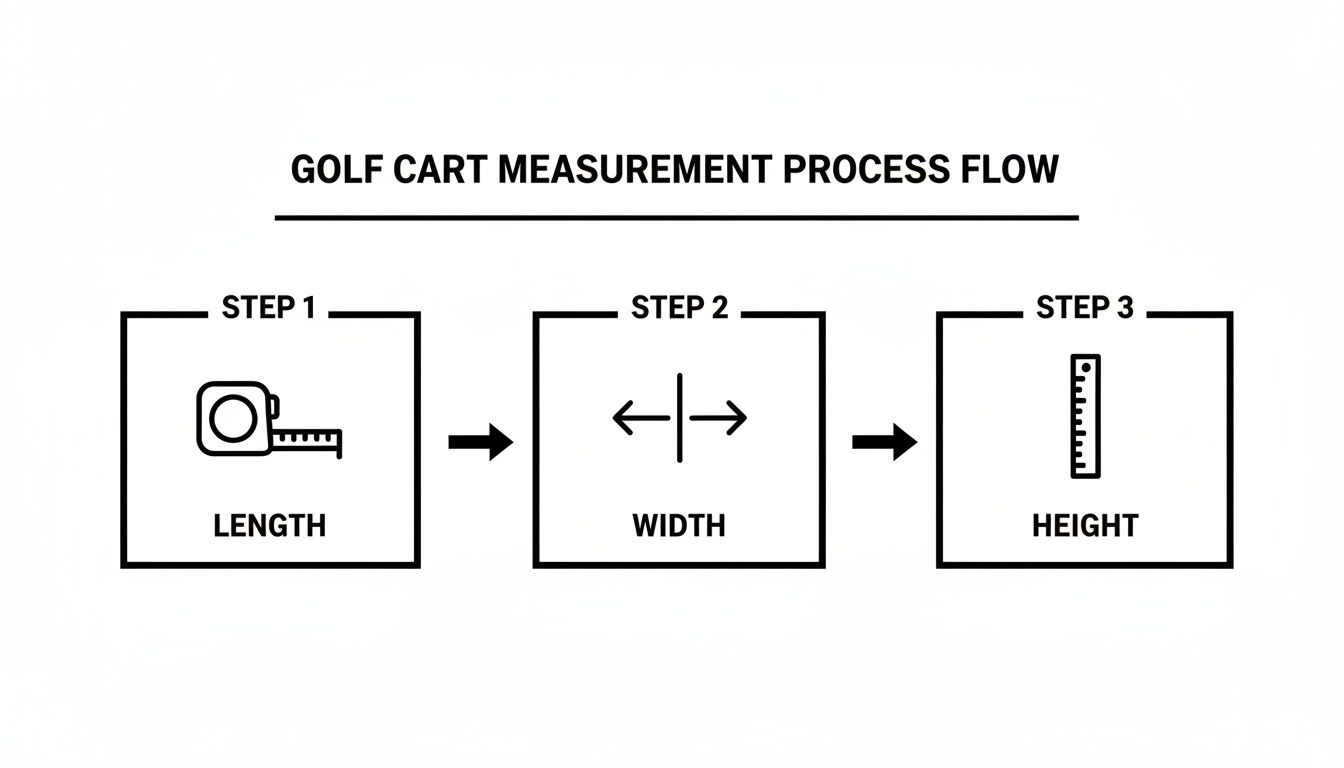
As the visual guide shows, the key is to always measure from the absolute widest, longest, and tallest points to capture the true footprint of your vehicle.
Upgrading Push Carts With Precision
This same rule of "measure twice, buy once" applies to walking golfers looking to upgrade their gear. Most push cart accessories are built to fit within common industry standards, which is great for ensuring broad usability. A perfect example is how the Caddie Wheel’s universal bracket system is designed to accommodate the frame construction of most push carts out there.
This focus on standardized dimensions allows for a simple, drop-on installation that can instantly motorize an existing push cart without any hassle. The global golf cart market is projected to hit $3.5 billion by 2033, a boom driven by customization and the big shift to electric power. You can read more about this market growth on gminsights.com.
For walking golfers, this trend shows up in accessories where compact dimensions allow for seamless integration of products like the Caddie Wheel, echoing the same demand for efficiency we're seeing in the wider market.
The takeaway is clear: whether you're adding a roof rack to a ride-on cart or a motorized wheel to a push cart, understanding your equipment’s core dimensions is the key to a successful upgrade. It bridges the gap between the product you want and the equipment you already own.
Common Questions About Golf Cart Dimensions
When it comes to golf carts, a few inches can make all the difference. Whether you're trying to figure out storage, transport, or how modifications will impact your setup, getting the dimensions right is key. Let's tackle some of the most common questions golfers have.
Will A Standard Golf Cart Fit In My Pickup Truck Bed?
This is a classic question, and the short answer is usually no. A standard two-seater golf cart is typically 92-100 inches long. Your average short-bed pickup truck is only about 78 inches long, so it’s just not going to happen.
You might be able to squeeze it into an 8-foot long bed (which is 96 inches), but it'll be a tight fit and you absolutely must measure both your cart and your truck bed first. The good news? The width, which is usually around 48 inches, almost always fits fine in standard truck beds.
What Is The Minimum Garage Door Height For A Golf Cart?
For a stock golf cart, you're generally in the clear. Most standard carts stand about 70-75 inches tall, which slides comfortably under a standard 7-foot (84-inch) garage door.
But—and this is a big but—if you've added a lift kit or bigger tires, that changes everything. Always measure your cart's total height at its highest point before you even think about driving it into the garage. It's a simple step that can save you from a very expensive mistake.
How Do Lift Kits and Large Tires Affect Golf Cart Dimensions?
Modifications like lift kits and oversized tires are great for performance and looks, but they have a direct impact on your cart's overall size. Don't get caught off guard.
- Height Increase: This is the most obvious change. A 6-inch lift kit can easily add 6 inches or more to the final height of your cart, putting that garage door clearance at risk.
- Width Increase: Don't forget about width. Swapping to larger, aggressive off-road tires can tack on a few extra inches to the cart's overall width, which might matter for tight trails or trailers.
The takeaway here is simple: after any modification, grab the tape measure and get new, accurate dimensions for your cart. You'll need them for storage, trailering, and making sure it still fits where you need it to go.
The Caddie Wheel is designed with a universal snap-in bracket system to be compatible with most standard three- and four-wheel push carts. The mounting mechanism accommodates the typical frame construction found on popular brands, making it a simple, drop-on solution for the vast majority of carts.
Ready to make walking the course effortless? The Caddie Wheel upgrades your existing push cart with powerful, quiet electric assistance. Enjoy your round without the fatigue. Learn more and order yours at https://caddiewheel.com.
Share:
The Ultimate Guide to Four Wheel Golf Push Carts
Golf Pull Carts Electric: The Modern Golfer's Guide