
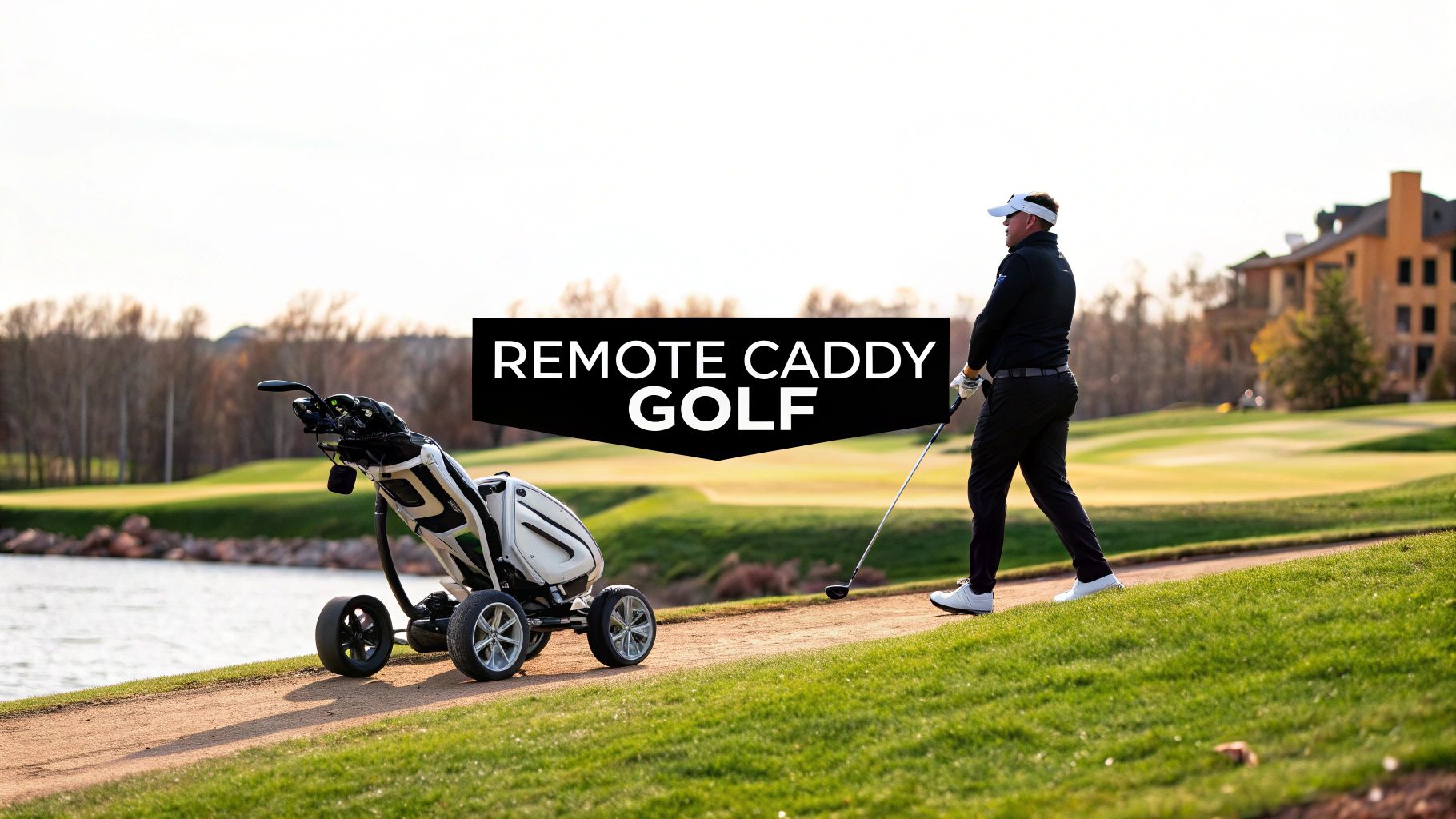
Picture this: you’re strolling down the fairway, your mind completely on your next shot, while your clubs glide silently beside you. That's the real magic of remote caddy golf, a shift in how golfers are experiencing the game. It perfectly blends the health benefits of walking the course with the sheer convenience of a personal caddy, all managed by a small remote you can tuck in your pocket.
What Is Remote Caddy Golf and Why Does It Matter?
Walking 18 holes is one of golf’s purest pleasures, but let's be honest—lugging or pushing a 30-pound bag can quickly turn a relaxing day into a serious workout. Remote caddy golf completely sidesteps this problem by adding power to your push cart, letting you guide it effortlessly from tee to green. This frees up your physical and mental bandwidth, so you can focus on strategy and sinking putts instead of wrestling with your gear.
Think of it this way: a standard push cart is like driving a manual car. It gets the job done, but it demands your constant attention and effort. A remote caddy, on the other hand, is like flipping on cruise control. You just set the pace and point it in the right direction, and it handles the rest, navigating fairways and hills without breaking a sweat. It's a simple change from manual labor to remote supervision, but it's a true game-changer.
The Core Benefits of Going Remote
The perks go way beyond just convenience. When you stop hauling a heavy bag around, you conserve energy, fight off fatigue, and seriously reduce the risk of a tweaked back or shoulder. For many golfers, that extra stamina translates directly into better scores, especially on the back nine when focus usually starts to fade.
The primary goal of a remote caddy is to remove physical distractions, allowing a golfer to maintain focus and conserve energy for what truly matters—the next shot.
This technology really opens up the game, making it more accessible and enjoyable for everyone. Whether you're a senior golfer looking to play for many more years or a fitness enthusiast who wants the walk without the exhaustion, a remote caddy is simply a smarter way to play. The biggest wins include:
- Reduced Physical Strain: Say goodbye to muscling your heavy bag up those steep hills.
- Improved Focus and Concentration: Spend your mental energy on course management, not cart management.
- Effortless Navigation: Guide your clubs over any terrain, from slick fairways to bumpy cart paths, with total ease.
By taking over the heavy lifting, a remote caddy lets you get back to the heart of the game. For a deeper look at what’s out there, check out our in-depth guide to remote golf caddies to explore all the options.
The Technology Powering Your Effortless Walk
Think of a remote caddy as a high-tech, all-terrain RC vehicle, but one built from the ground up for stability and silence on the golf course. It’s a sophisticated marriage of a responsive remote control, powerful yet whisper-quiet motors, and a long-lasting battery working in perfect harmony. This trio is what turns a standard push cart into your personal robotic assistant.
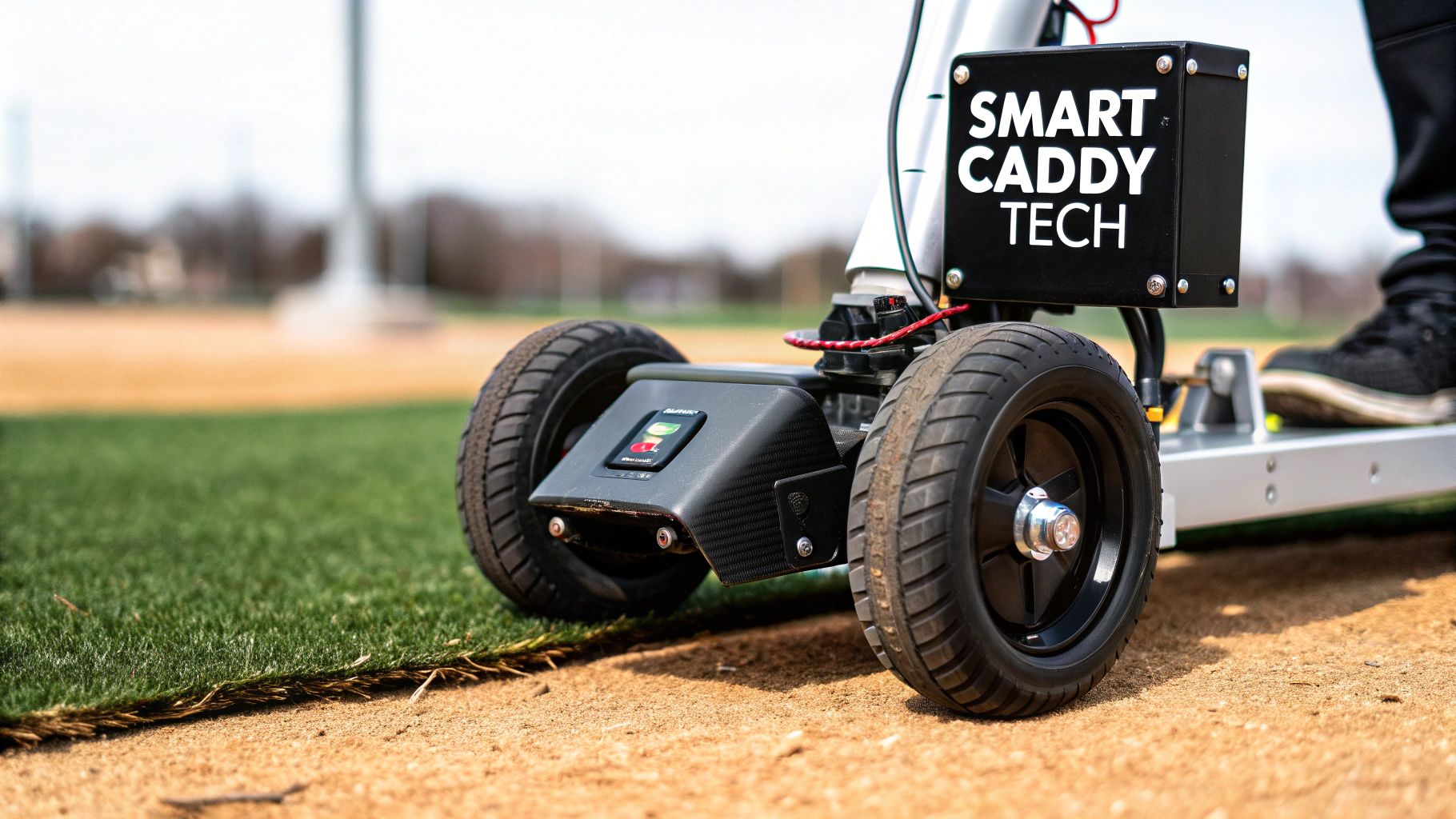
It all starts with the remote. Even the most basic models give you simple directional controls—forward, reverse, left, and right—letting you steer your bag around bunkers and up to the next tee without breaking a sweat. Of course, the more advanced systems are where things get really interesting. Some feature "follow me" technology, using AI and sensors to autonomously trail behind you as you walk, creating a true hands-free experience. If you're curious about the different options out there, you can learn more in our complete guide to remote control electric golf carts.
Motors, Brakes, and Batteries
The real workhorses here are the dual motors. They are typically brushless, which keeps them nearly silent, and they provide the muscle needed to climb steep hills without a hint of hesitation. These motors are also the key to the advanced braking systems you'll find on modern caddies.
A crucial safety feature in any modern remote caddy is Downhill Speed Control (DHC). This technology automatically keeps the caddy at a steady, controlled pace on descents, stopping it from getting away from you on hilly terrain.
This is often paired with an electronic parking brake, which locks the wheels in place so your bag stays put, even when parked on a steep fairway. That kind of stability is vital for navigating the varied landscapes of a golf course.
The final piece of the puzzle is the battery. The industry's move away from bulky lead-acid batteries to lightweight, high-capacity lithium-ion has been a massive leap forward. These newer batteries now deliver up to 36 holes of power on a single charge, all while new features like GPS navigation and smartphone apps provide yardages right on the caddy's display. It's a trend highlighted in recent global remote control electric golf caddy research. This evolution has made the entire remote caddy experience lighter, longer-lasting, and more user-friendly than ever before.
Essential Features of a Modern Remote Caddy
When you start digging into the world of remote caddy golf, you’ll quickly realize they aren't all built the same. Figuring out the key features is the only way to find a caddy that actually fits your game, your home course, and, of course, your wallet. Let's break down the must-have functionalities you should be looking for, plus some of the premium upgrades that can really take your round to the next level.
The heart and soul of any remote caddy is its control system. The remote's range is a huge deal—most will give you a reliable connection up to at least 50 yards, which is more than enough to send your cart ahead to the next tee while you're finishing up on the green. The best remotes are dead simple, with obvious buttons for forward, reverse, and turning that you can master in just a couple of holes.
Battery life is just as critical. These days, modern lithium-ion batteries are the gold standard, packing enough juice for 18 to 36 holes on a single charge. Just make sure the model you choose has a clear battery life indicator. There’s nothing worse than getting stranded without power on the back nine.
Stability and Terrain Management
A remote caddy that can't handle the bumps and slopes of your course is pretty much useless. Stability is a non-negotiable feature, and it comes from a few smart design choices working together.
- Wide Wheelbase: A wider stance is your best defense against tipping over on sidehills and uneven ground.
- Anti-Tip Wheel: This is usually a small, extra wheel at the back that acts as a kickstand, stopping your cart from flipping backward on steep climbs.
- All-Terrain Tires: You want treads designed for real-world conditions. Good tires offer a solid grip on wet grass, cart paths, and rough, making sure your caddy stays where you point it.
When these elements are combined, you can send your clubs off with confidence, no matter what the terrain looks like.
The true test of a remote caddy isn’t on a flat, pristine fairway. It’s on the challenging slopes and uneven lies where stability features like a wide wheelbase and an anti-tip wheel prove their worth, preventing costly and frustrating accidents.
Premium Features for the Serious Golfer
If you're looking for the ultimate hands-free experience, some of the premium features out there can genuinely elevate your game. These go way beyond basic navigation, turning your caddy into a high-tech partner on the course.
Take models like Motocaddy's M7 GPS REMOTE, for example. They set a new standard by using quiet brushless motors and including a rear anti-tip wheel. This kind of thinking is why the market saw a 31% sales surge in remote carts across the UK and Ireland in a single year—golfers are clearly ready for more advanced tech. You can read more about these electric caddy market trends to see where things are headed.
To help you decide what's right for you, here’s a quick breakdown of the features you’ll find on entry-level models versus the more advanced ones.
Essential vs. Advanced Remote Caddy Features
| Feature | Essential (Entry-Level) | Advanced (Premium-Level) |
|---|---|---|
| Control System | Basic remote with forward, reverse, and turn functions. | Multi-directional control, automated distance functions. |
| Battery Life | Enough for 18 holes with a basic indicator. | Extended life for 36+ holes, smart battery monitoring. |
| Stability | Wide wheelbase and basic all-terrain tires. | Anti-tip wheel, gyroscopic stabilization for hills. |
| Display | None or a simple LED indicator for power. | Full-color LCD screen with GPS and smartphone notifications. |
| GPS | Not included; requires a separate device. | Integrated GPS showing yardages and course maps. |
| Connectivity | None. | Bluetooth for app integration and notifications. |
| Motors | Standard brushed motors. | Quieter, more efficient brushless motors. |
Ultimately, what you need comes down to your priorities. If you just want a reliable caddy to carry your bag, the essential features will do the job perfectly. But if you’re looking for a fully integrated course companion that offers GPS, phone alerts, and automated functions, investing in a premium model can be a real game-changer.
The Health and Performance Benefits of Hands-Free Golf
Choosing a remote caddy isn't just about adding a cool gadget to your setup; it's a smart investment in your physical well-being and, ultimately, your scorecard. The most obvious benefit is a huge sigh of relief for your body. By taking away the need to push, pull, or carry a heavy golf bag, you're saving your back, shoulders, and knees from a ton of cumulative strain over 18 holes.
This physical relief pays off big time as your round goes on. We all know golf is as much a mental game as a physical one, and fatigue is the ultimate enemy of focus. When your body isn't worn out from hauling your gear, your mind stays sharp. That means better decision-making from the first tee to the final putt. The energy you save directly translates to better stamina on the back nine, which is exactly where so many good rounds start to fall apart.
Preserving Energy for a Stronger Finish
Think of your physical energy like a battery. Every time you shove a 30-pound cart up a steep fairway, you're draining that battery—fast. A remote caddy basically acts as your personal energy management system, saving your power for what actually matters: executing a smooth, powerful swing.
This huge reduction in physical effort helps golfers maintain much more consistent form throughout the round. When you remove fatigue from the equation, you can concentrate on your technique and support peak athletic performance through precise the analysis of movements in sports. You're no longer trying to compensate for a tired body, a habit that almost always leads to sloppy swing mechanics and costly mistakes.
A remote caddy allows you to get the full cardiovascular benefits of walking the course without the physical penalty. You arrive at each shot feeling fresh and focused, not winded and worn out.
Walking for Health Without the Strain
Lots of us choose to walk the course for the exercise, and for good reason. It’s a fantastic low-impact cardio workout. But the constant strain of pushing a cart can sometimes cancel out those benefits, especially for players who already deal with joint or back pain. A remote caddy golf system strikes the perfect balance.
You still get all the positive health impacts of walking several miles, but you get to skip the exhaustion that can ruin your enjoyment and tank your score. You get your steps in, keep your heart rate up, and still have enough gas in the tank to actually enjoy the 19th hole. To dig deeper into the advantages, you can learn more about how walking golf is good exercise in our detailed guide. It's simply a smarter, healthier way to play the game you love.
How to Choose the Right Remote Caddy for Your Game
Picking the right remote caddy isn't about grabbing the flashiest new model off the shelf. It’s a personal decision, one that boils down to matching the right technology to your game, your course, and your goals as a golfer. When you start with a quick self-assessment, the perfect choice becomes a whole lot clearer.
The first place to start is your home course. Think about the terrain you walk week in and week out. Is it a flat, parkland-style track where you can cruise, or are you constantly tackling dramatic hills and valleys? If you're playing on a hilly course, you’ll absolutely need a model with robust Downhill Speed Control and a powerful dual-motor system. Without it, you'll be chasing a runaway cart down one fairway and struggling to get up the next.
This is where you really see the core benefits of a remote caddy come to life—it’s not just about convenience. It’s about improving your health, focus, and ultimately, your scores.
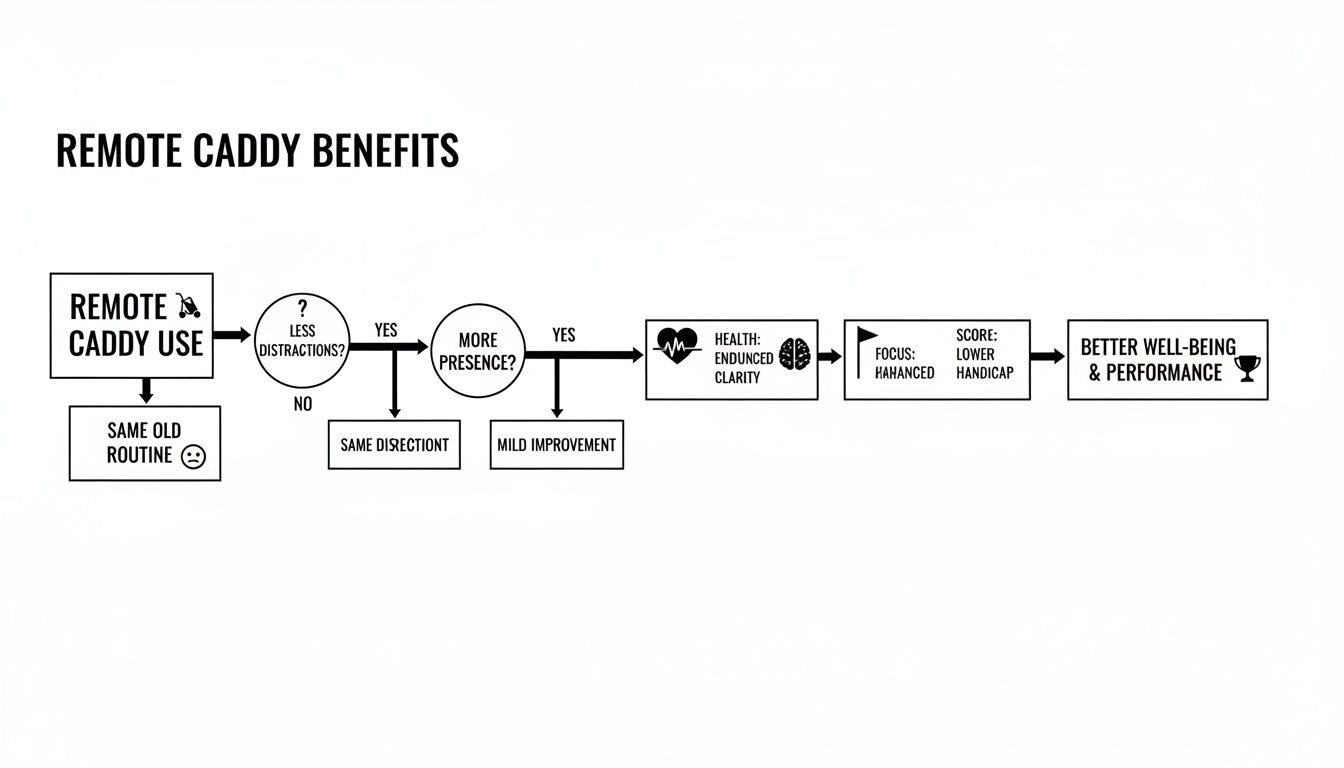
As you can see, taking the physical burden of your clubs off your shoulders has a direct line to better mental clarity on the course. And that almost always leads to lower scores.
Tailoring the Caddy to Your Player Profile
Next up, think honestly about what kind of golfer you are. Everyone has different priorities, and the best remote caddy for you will line up perfectly with what you want to get out of the game.
- The Senior Golfer: Comfort and accessibility are king. The last thing you want is to be fumbling with a complicated remote or wrestling with a heavy frame. Look for intuitive controls, a lightweight design for easy transport, and a reliable electronic parking brake that gives you peace of mind.
- The Fitness Enthusiast: If you're walking the course for the health benefits but are tired of the strain, battery life is your number one priority. You need a caddy that can easily handle 36 holes without a single worry. A lighter design also helps maximize your workout by not adding unnecessary weight.
- The Competitive Player: For anyone hyper-focused on performance, the more advanced features are worth every penny. Things like integrated GPS, automated distance functions, and "follow me" modes are designed to minimize distractions, letting you put 100% of your focus on strategy and hitting the perfect shot.
Practical Considerations and Final Checks
Beyond how it performs on the grass, you need to think about the real-world logistics of owning one. How much room do you have in your car trunk or garage? If space is tight, a compact model that folds down easily is non-negotiable. Don't forget about the caddy's weight—you'll still be lifting it in and out of your car, so be sure to pick a model you can handle without straining.
Of course, budget plays a huge role. But it’s helpful to look past the initial price and see this as an investment. Hands-free tech is clearly where the game is headed. In the world's biggest golf market, with 15,500 courses and 25 million players, remote models accounted for a staggering 85% of one top brand's sales. That tells you something. Golfers are voting with their wallets for better performance and health benefits, as you can learn more about American golfers' embrace of this technology.
Choosing a remote caddy is an investment in your long-term enjoyment of the game. Prioritize a reputable brand with a solid warranty and responsive customer support to protect that investment.
Finally, do your due diligence on the brand itself. Spend some time reading reviews from other golfers. Check the warranty details—a 12-month warranty should be the minimum standard. See what people are saying about their customer support. A great product backed by a solid company ensures your remote caddy will be a reliable partner on the course for years to come.
Your Questions About Remote Caddy Golf Answered
Even with all the benefits laid out, it’s completely normal to have a few questions before you pull the trigger on a remote golf caddy. This is a big step up from a standard push cart, after all, and you want to be sure it’s the right move for your game. We’ve rounded up some of the most common questions we hear to give you clear, practical answers and help you make the call with total confidence.
How Do Remote Caddies Perform in Heavy Rain or on Wet Courses?
This is a great question for anyone who doesn't let a little weather get in the way of a good round. The short answer is that most high-quality remote caddies are built to be water-resistant, with sealed battery compartments and protected motors. They handle damp fairways, morning dew, and even a light drizzle without skipping a beat.
However, "water-resistant" isn't the same as "waterproof." You’ll want to avoid driving your caddy through deep puddles or leaving it out in a torrential downpour for a long time. A good habit to get into is giving it a quick wipe-down with a dry cloth after a wet round. It’s a simple step that goes a long way in preventing corrosion and keeping your caddy in top shape for years.
Is There a Steep Learning Curve to Using the Remote Control?
Not at all. The learning curve for a remote caddy golf system is surprisingly quick. Most remotes are designed to be incredibly intuitive, with simple, clearly marked buttons for forward, reverse, left, and right. The vast majority of golfers feel completely comfortable steering their caddy within just a few holes.
The key is to give yourself a little space to practice when you first start. Head to an open fairway to get a feel for the speed settings and turning radius before you try navigating tight spots around the green or a crowded tee box. It’ll feel like second nature in no time.
What Is the Average Lifespan of a Lithium Battery?
A modern lithium-ion battery is a real workhorse. They are typically rated to last somewhere between 800 and 1,000 charge cycles. For a golfer who plays once a week, that can easily translate to five years or more of reliable performance before you notice any real drop in capacity.
A lithium battery is the heart of your remote caddy. Maximizing its lifespan is simple: avoid leaving it on the charger indefinitely after it's full and store it in a cool, dry place during the off-season.
When the time eventually comes for a new one, replacement costs can range from $250 to $600, depending on the brand and battery capacity. While it's a notable expense, it's an infrequent one that only comes after years of great service.
Will My Current Golf Bag Fit on Any Remote Caddy?
In most cases, yes. Remote caddies are built with adjustable straps and supports designed to hold a wide variety of both cart bags and stand bags. That said, they generally work best with cart bags, which have a flat, solid base that sits perfectly secure in the caddy’s cradle.
Stand bags can sometimes be a little finicky. Their leg-activation mechanism can occasionally get in the way of the lower bracket, causing the bag to twist or shift during the round. To solve this, many bag manufacturers now offer "cart-friendly" stand bags with leg-locking straps. It’s always a good idea to check the caddy’s specifications just to be sure it’s a perfect match for your bag style.
Ready to transform your walk and focus on your game? The Caddie Wheel offers a simple, powerful, and affordable way to upgrade your existing push cart into a fully remote-controlled caddy. Experience the freedom of hands-free golf on your next round. Explore the Caddie Wheel today!
Share:
Your Guide To The Best Motorized Golf Caddies
The Essential Guide to the Sand Bottle Golf Cart