
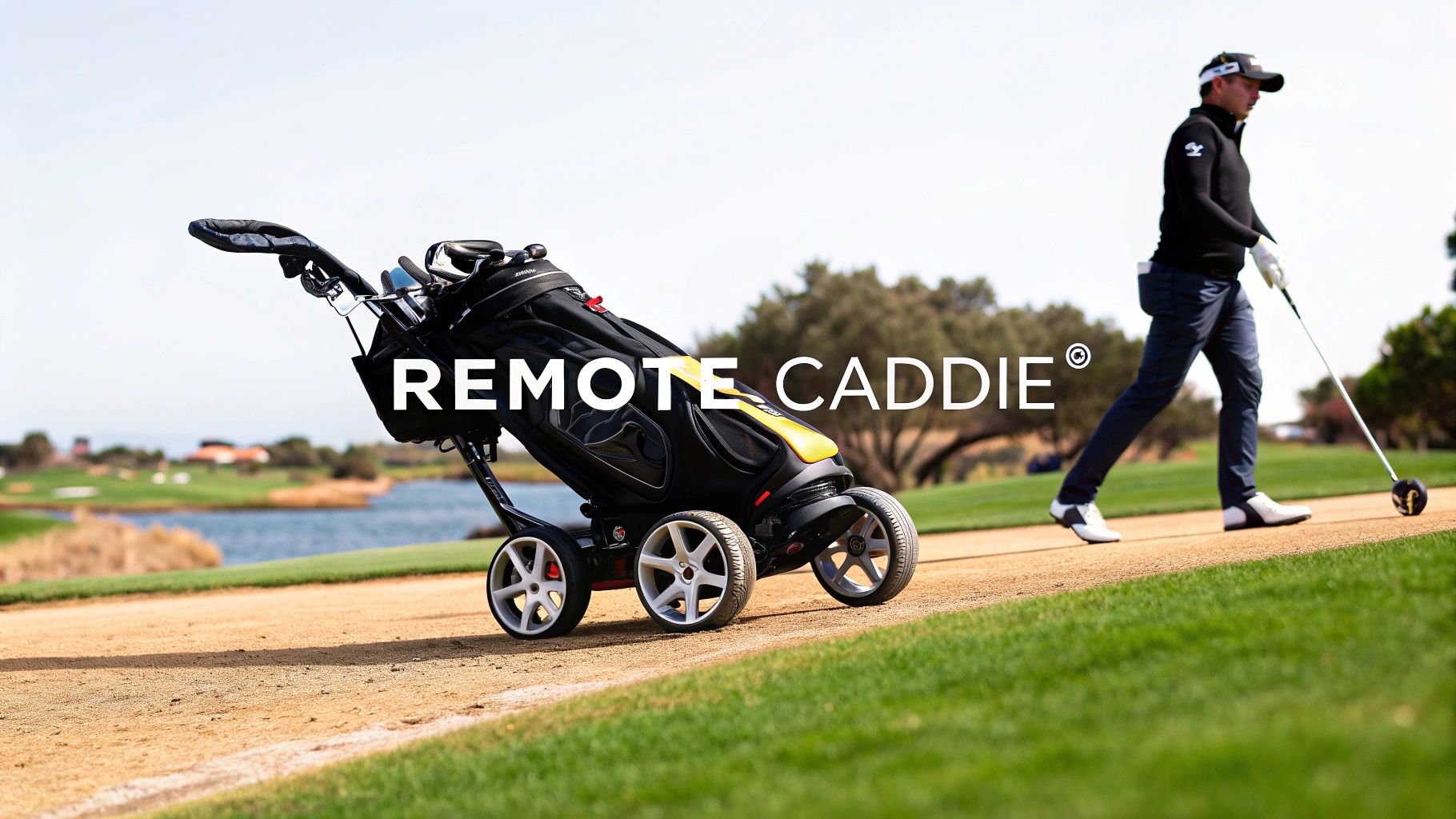
Imagine this: you’re walking the course, completely dialed in on your next shot, and your clubs are gliding along right beside you like a loyal companion. That's the magic of a remote golf caddie. It’s a simple but brilliant piece of tech that turns your everyday push cart into an automated partner, giving you the health benefits of walking without the hassle.
The Hands-Free Revolution on the Fairway

Let’s be honest, nobody enjoys that back-and-shoulder strain from shoving a heavy bag up a steep fairway. Those days are quickly becoming a thing of the past. A remote golf caddie—also known as a remote-controlled golf trolley or electric caddie—is a motorized system that does all the pushing for you. Think of it as a personal robot for your golf bag, all controlled with a simple handheld remote.
This isn't just some niche gadget anymore; it's a mainstream accessory that’s changing how we experience the game. It perfectly bridges the gap between carrying your bag and riding in a cart, offering the best of both worlds. You get a great workout walking the course, but without the exhausting labor of lugging your gear for five miles.
Why This Technology Is Gaining Momentum
The explosion in popularity is no accident. Thanks to huge leaps in battery technology and automation, these devices are more reliable, powerful, and affordable than ever. What was once a novelty is now a serious player in the golf equipment market. In fact, the electric golf trolley industry was valued somewhere between USD 150–176 million in 2023, and it's only expected to keep growing.
This growth points to a clear shift in what golfers want. We want to enjoy the walk, save our energy for the actual swings, and finish 18 holes feeling refreshed, not wiped out. A remote caddie makes that possible by taking care of the most strenuous part of walking the course.
A remote caddie is more than just a convenience—it's a performance tool. By removing the physical burden of pushing a cart, players can maintain focus and stamina from the first tee to the final putt.
The benefits are straightforward and pretty compelling:
- Reduced Physical Strain: Say goodbye to pushing a 30+ pound bag. All that energy you save goes right back into your swing.
- Improved Focus: You can concentrate on your next shot and course strategy instead of wrestling your cart over tricky terrain.
- Enhanced Enjoyment: Walking the course becomes a genuinely pleasant and relaxing experience, especially on those hilly or challenging layouts.
This guide will walk you through everything you need to know, from how the tech works to picking the right model for your game. If you're curious about the absolute cutting edge, you should also check out our guide to a golf cart that follows you.
How Remote Golf Caddie Technology Works
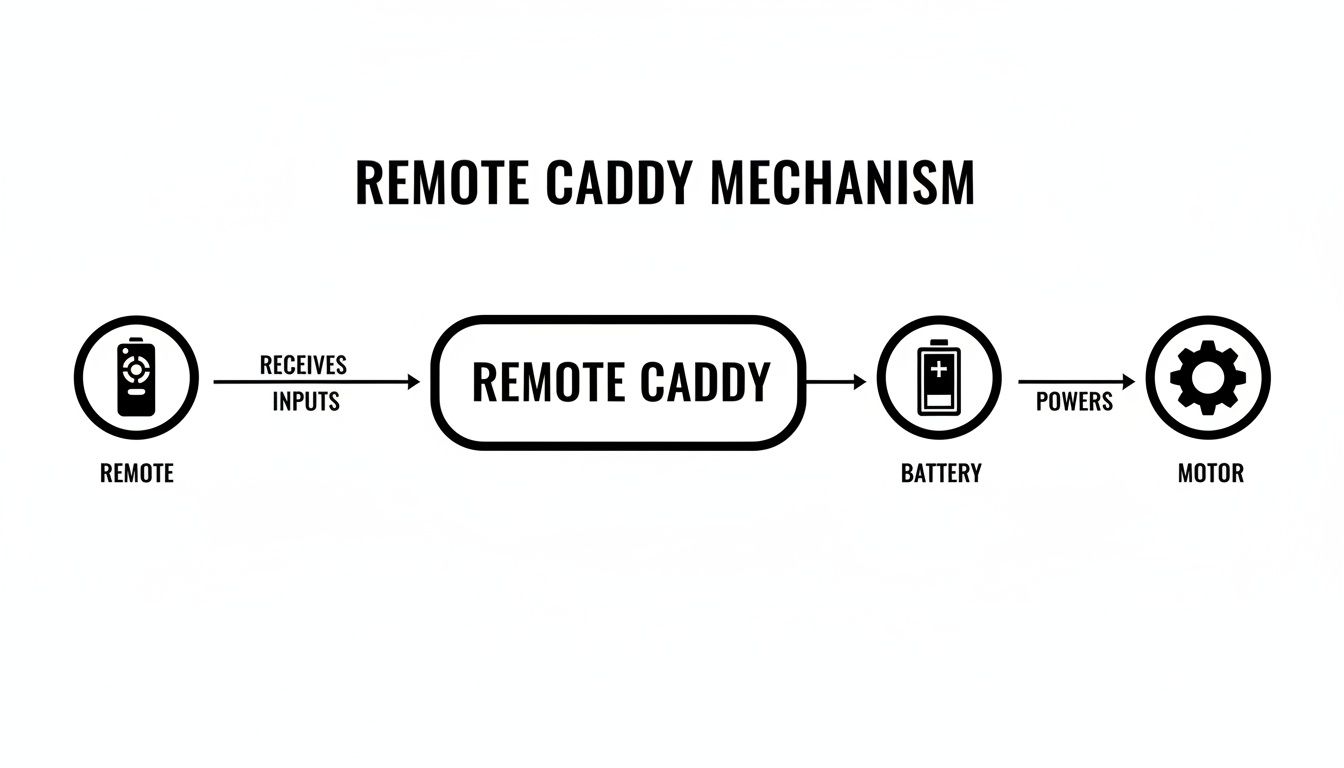
At its heart, a remote golf caddie is built on a simple, brilliant idea. Think of a high-tech, remote-controlled vehicle designed for one specific mission: carrying your golf bag. It’s not some overly complex machine, but a streamlined system of three core parts working in perfect harmony: powerful motorized wheels, a long-lasting battery, and a simple handheld remote.
This trio is the foundation of the whole operation. The remote is your command center, sending signals to a receiver on the cart. That receiver then translates your thumb movements into action, telling the motors which way to go—forward, back, left, or right—and pulling power from the battery to make it happen. It's this instant communication that lets you effortlessly guide your clubs across the fairway.
The Brains and Brawn of the Operation
The real magic is packed inside the motorized wheels. These aren’t just any motors; they're specifically engineered for the unique challenges of a golf course. They need enough muscle to climb steep hills without skipping a beat, but also the finesse to maintain a smooth, steady pace on the flats. The best systems use durable, efficient motors built to handle everything from morning dew to uneven terrain, all while carrying a fully loaded golf bag. For a closer look at the mechanics, you can explore the differences in AC motors for golf carts and similar tech.
Fueling these workhorse motors is usually a high-capacity lithium-ion battery. This is the same modern technology you’ll find in smartphones and laptops, chosen because it packs a huge amount of power into a lightweight and compact form. A solid battery is the key to finishing a full 18 holes—or even 36—without ever worrying about losing power halfway through your round.
From Simple Controls to Smart Automation
While basic remote steering is a fantastic upgrade on its own, many of today's caddies come with more advanced "smart" features that take the experience to a whole new level. These systems use the same core technology but add a layer of sensors and intelligent software.
- Automatic Downhill Braking: This is a must-have safety feature. Using built-in sensors, the cart can detect when it’s on a decline and automatically engage the motors to slow itself down. This prevents your cart from getting away from you on steep hills.
- "Follow Me" Mode: Think of this as your caddie’s autopilot. Using a combination of AI and sensors, the cart can lock onto your position and follow you at a set distance, completely hands-free. It’s like having a loyal sidekick that just so happens to carry your clubs.
- Obstacle Avoidance: Higher-end models now include sensors that can spot obstacles like trees, bunkers, or even other golfers. The cart will then automatically adjust its path to avoid a collision.
The goal of this technology isn't just about moving your bag; it's about removing a mental and physical burden. By automating the transport of your clubs, it frees you up to stay completely focused on your game from the first tee to the final putt.
Evaluating the Most Important Caddie Features
Choosing the right remote golf caddie isn't about finding some mythical "best" one. It’s about finding the one that perfectly suits your game, your home course, and your budget.
With so many options out there, it’s easy to get lost in the specs. The trick is to focus on a few core features that really define how it will perform for you out on the fairway. Let's cut through the noise.
Battery Life: The Heart of Your Caddie
First things first: the battery. Think of it as the heart of your caddie; if it gives out mid-round, your easy walk suddenly becomes a real workout. The key metric here is how many holes it can last on a single charge. A standard 18-hole battery is fine for most golfers, but be honest with yourself.
Do you love squeezing in 36 holes on a long summer day? Are you the type who sometimes forgets to charge your gear? If so, investing in an extended-life battery from the get-go is one of the smartest moves you can make.
This diagram breaks down the basic flow of how a remote caddie works. It’s pretty straightforward—your command from the remote tells the battery to power the motor, which turns the wheels.
It’s this simple system that takes the weight off your shoulders.
Power and Stability on Any Terrain
Next up are the motor and the wheels. This combo determines how well your caddie handles the real-world challenges of a golf course—because no course is perfectly flat. A powerful motor isn't just for racing down the fairway; it's about torque. That's the raw strength needed to climb steep, grassy hills without grinding to a halt. A weak motor on a hilly course will leave you frustrated and, worse, pushing the thing yourself.
Stability is just as critical. You need a caddie that stays upright, even when the ground isn’t cooperating. Here’s what to look for:
- Wide Wheelbase: A wider stance is like having better balance. It’s crucial for preventing tips on sidehill lies.
- Anti-Tip Wheel: Many great models include a small fourth wheel at the back. Its only job is to stop the caddie from flipping over backward on steep climbs.
- Downhill Braking: This is a must-have safety feature. It automatically slows the cart on descents, preventing it from getting away from you and taking a dive into a bunker.
A great remote caddie shouldn't just carry your clubs; it should give you the confidence to walk any part of the course without a second thought. Stability and power are the foundation of that confidence.
Controls and Everyday Convenience
Finally, think about the little things that make a big difference in your day-to-day use. The remote control should feel good in your hand and be totally intuitive. You don't want to be fumbling with buttons when you should be focused on your next shot. A strong signal range is also important so you don't have to stay tethered to your cart.
Also, consider how the unit folds down. A caddie with a quick, one-touch folding mechanism will save you a ton of time and hassle in the parking lot after a long round.
The market is clearly moving toward smarter, more user-friendly tech. You see it everywhere—the industry has largely shifted to lithium-ion batteries that cut pack weight by 30–50% while lasting longer. As features improve, prices naturally vary. Top-tier remote caddies often run between $700 and $1,100, while more basic electric models can be found in the $300–$500 range. For more comparisons, it’s worth checking out guides on 2025's best-selling electric caddies.
By carefully weighing these key areas—battery life, power, stability, and ease of use—you can make a decision you'll be happy with for years to come. For more detailed breakdowns, check out our guide to the best remote control golf trolley models and tips.
Discovering if a Remote Caddie Is Right for You

A remote golf caddie isn't just another flashy gadget; it’s a game-changer that solves real problems for specific kinds of players. While anyone can appreciate the convenience, certain golfers will find it completely transforms their day on the course. By looking at a few common scenarios, you can figure out if this is the upgrade your game has been waiting for.
Do you find yourself running out of steam on the back nine? Do you love the idea of walking the course but dread the toll it takes on your back and shoulders? These are the exact pain points a remote-controlled system is built to fix. Let's meet a few golfers who are the perfect fit for this technology.
The Fitness-Focused Golfer
Meet Sarah. For her, a huge part of the game is the health benefit of walking—getting her steps in and enjoying the fresh air. But wrestling a 30-pound bag up a steep fairway zaps the energy she’d much rather put into her swing.
A remote caddie is the perfect solution. It lets her get in a fantastic low-impact workout by walking several miles, but without all the upper-body strain. She can focus on her posture and pace, arriving at each shot feeling strong and ready, not winded from pushing a heavy cart.
The real win for the fitness-minded player is energy conservation. By offloading the push/pull effort, you can walk 18 or even 36 holes and still feel fresh, maximizing the cardio benefits without risking injury or exhaustion.
The Senior Golfer
Now let’s think about Bob, a lifelong golfer in his late sixties. He wants to keep walking the course for as long as he possibly can, but a nagging bad back and less stamina make it a real challenge. For him, a remote golf caddie is much more than a convenience—it’s an accessibility tool.
It empowers him to keep enjoying the game he loves on his own terms. Instead of giving in and taking a riding cart (and missing out on the walk), he can stroll the fairways comfortably. This kind of tech can literally add years to his golfing life, making the sport more sustainable and, most importantly, more fun.
The Tech-Savvy Player and Players with Limitations
Finally, you've got the golfer who just loves integrating cool, genuinely useful tech into their hobbies. They appreciate smart design and anything that makes life more efficient. A remote caddie with slick features like automatic follow modes and obstacle avoidance speaks directly to their love for modern equipment that truly enhances an experience.
On top of that, players with physical limitations—whether from an old injury or a chronic condition—find these devices liberating. They completely remove a significant physical barrier, opening the game up to a much wider range of people. If any of these stories hit close to home, a remote golf caddie could fundamentally improve your time on the course.
The Future of On-Course Automation
If you think a remote golf caddie is just a fancy toy, you're missing the bigger picture. This isn't just about convenience; it's a sneak peek into where the game is headed. We're seeing a clear shift toward smart, on-course automation that handles the grunt work, letting you focus completely on your next shot.
This movement isn't about ditching tradition. It's about enhancing the experience we already love with some seriously intelligent design. Manufacturers aren't just slapping motors on wheels anymore—they're creating sophisticated partners for your round.
Smarter Caddies for a Smarter Game
The technology is evolving at a breakneck pace, moving way beyond simple remote controls. Today's top-tier models are loaded with tech that makes them feel less like equipment and more like a true on-course ally. What we're seeing is a blend of smart hardware and software that creates a more connected, data-driven round of golf.
Here are a few of the game-changing advancements shaping this future:
- Integrated GPS Course Mapping: Imagine your caddie knowing the exact layout of the course you're on. It can feed you perfect distances to the green, hazards, and ideal landing spots, either on a built-in screen or right to your phone.
- Seamless Smartphone App Control: Forget about juggling another dedicated remote. The best new models are leaning into intuitive smartphone apps that not only steer the cart but also track your stats, log scores, and manage all the settings.
- AI-Powered Yardage Suggestions: This is where it gets really interesting. By learning your actual club distances over time, the smartest caddies will start suggesting the right club for your next shot based on your lie, the wind, and your own performance data.
This shift turns a remote caddie from a simple club-hauler into an active strategic tool. It's an investment in playing a smarter, more efficient, and—let's be honest—more fun game of golf.
A Growing Global Trend
This push for automation isn't just happening here; it's a global phenomenon. Market reports show North America is currently the biggest market, which makes sense given our established golf culture and willingness to invest in gear.
But the real story is how fast this is catching on everywhere else, with the Asia-Pacific region showing the most explosive growth. This worldwide demand is pushing manufacturers to innovate even faster. As a result, remote-control models packed with features like GPS and follow-modes now command prices 20–60% higher than their more basic counterparts. If you're curious about the numbers behind the trend, you can dig into more details about the global remote control golf caddie industry.
Your Essential Remote Golf Caddie Checklist
Alright, let's get you ready to choose the perfect remote caddie. This final checklist cuts through the noise and boils everything down to a few key questions. Answering them honestly is the best way to make sure you walk away with a caddie that actually fits your game, your home course, and how you play.
Think of this less as a list of features and more as a smart investment in your enjoyment on the course for years to come. A little thought now saves a lot of headaches later.
Your Course and Your Game
- What's my home course like? Is it a flat, easy walk, or are you constantly climbing hills? A hilly track demands a caddie with a beefy motor and, just as importantly, solid downhill braking.
- How many holes do I really play? Be honest. If you're the type to squeeze in 36 holes on a long summer day, a standard battery won't cut it. Investing in an extended-life battery is a no-brainer here.
- What's my budget? Set a realistic price range before you start shopping. These things can run anywhere from a few hundred bucks to over a thousand, so knowing your limit keeps you focused.
The best remote caddie for you is the one that solves your biggest annoyances on the course. Don't get upsold on fancy "Follow Mode" if all you really need is simple remote steering to take the load off.
Finally, think about your own physical needs. If you've got a bad back or shoulder, things like stability and ease of use become top priorities. A lighter model that's a breeze to fold can make a world of difference getting from the parking lot to the first tee.
Your Questions Answered: Getting to Know Remote Caddies
Stepping into new golf tech always brings up a few questions. When it comes to something like a remote-controlled caddie, most golfers are thinking about the same things: how hard is it to set up, what happens if it fails, and will the course even allow it? Let's clear the air so you can feel confident before making the switch.
How Tough Is the Setup?
Honestly, it's surprisingly simple. Most modern remote conversion kits are designed for the everyday golfer, not a mechanic. The whole process usually just involves swapping your push cart's back wheels for the new motorized ones and clipping on the battery mount.
Most brands have great video guides to walk you through it, and you can get it done in under an hour with basic tools you already have in the garage. The most important step? Just double-check that the kit you're buying is made for your specific push cart model to guarantee a perfect fit.
What Happens If the Remote Battery Dies Mid-Round?
This is probably the number one worry we hear, but it's one you can put to rest. Every quality remote caddie is built with a simple backup plan. If your remote ever dies or loses signal, you just disengage the motors on the wheels.
Instantly, they spin freely, and your cart is back to being a normal, everyday push cart. You can finish your round without missing a beat.
You’ll never be stranded out on the fairway. The main battery for the caddie itself is a totally separate beast, built to last a full 18 holes—often even 36—so running out of juice there is rarely an issue.
Are These Remote Caddies Allowed Everywhere?
For the most part, yes. The vast majority of golf courses that allow walkers have no problem with electric or remote caddies. They treat them just like a standard push cart. In fact, they're much gentler on the turf than a heavy, full-sized golf cart.
That said, some exclusive private clubs or courses with unique local rules might have their own policies. If you're ever unsure, the easiest thing to do is make a quick call to the pro shop before your tee time. They'll give you the final word.
Ready to stop pushing and start playing? The Caddie Wheel gives you a powerful, easy-to-install remote caddie solution that lets you focus on your shot, not your gear. See what it feels like to walk the course with total freedom on your next round. Explore the Caddie Wheel today.
Share:
A Golfer’s Guide to Using a Phone Holder Golf Cart Mount
The Best Lithium Batteries For Golf Carts Power And Performance