
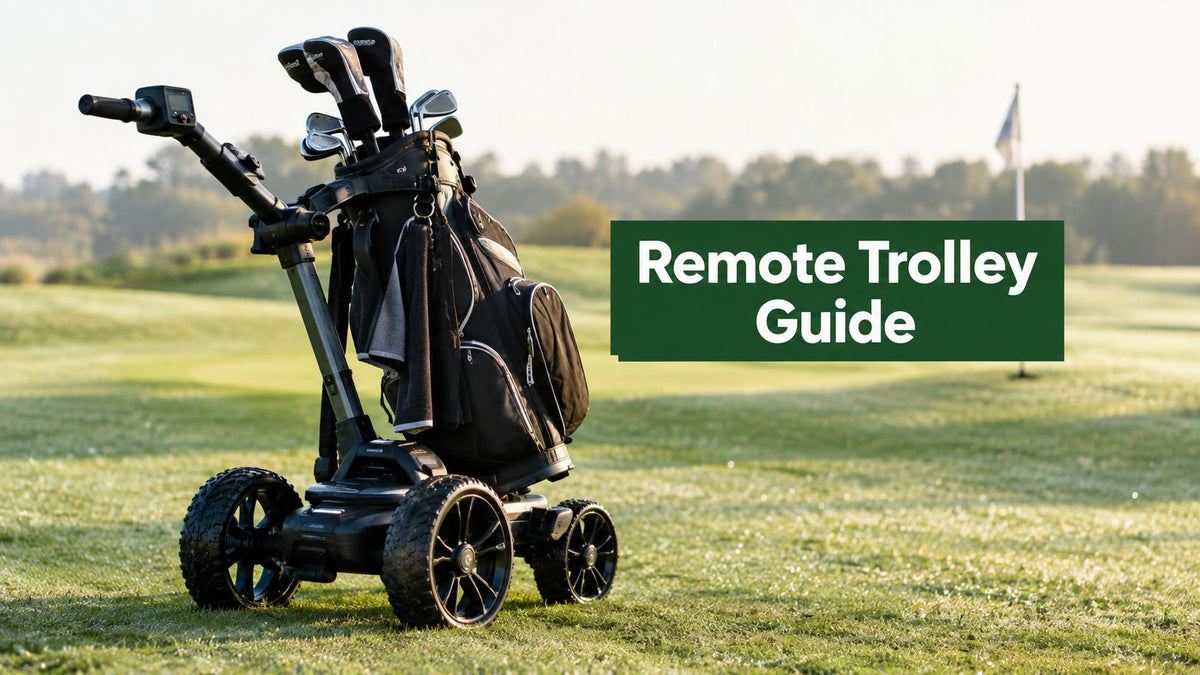
You're walking the 14th hole, your hands are tired, and the push cart feels heavier than it did on the first tee. Your remote is sitting in your pocket, but you're still thinking about the next shot, the slope ahead, and whether your shoulders will be sore before the round is over. That's the point where most golfers start reading remote golf trolley reviews and quickly get buried in motor wattage, GPS screens, app features, and glossy claims.
The decision is simpler. You can buy a full electric trolley, with its own frame, motor, battery, wheels, and remote. Or you can keep the push cart that already fits your bag and add a retrofit power-assist wheel that motorizes the setup. Both can make walking easier, but they suit different golfers, courses, storage situations, and budgets.
| Buying path | Best suited to | Main advantage | Main compromise |
|---|---|---|---|
| Full remote electric trolley | Hilly courses, heavy bags, golfers who want maximum assistance | Stronger integrated power, braking, and stability | More weight, bulk, and ownership cost |
| Retrofit power-assist wheel | Existing push-cart owners, flatter courses, buyers focused on value | Keeps familiar equipment and simplifies storage | Requires axle compatibility and more hands-on steering |
| Premium remote trolley | Frequent walkers demanding advanced terrain control | Better control systems, stability, and feature integration | Higher purchase price and more expensive upgrades |
| Mid-tier remote trolley | Most regular walkers on mixed but manageable terrain | Good remote convenience without every premium extra | May compromise on hill power or refinement |
This guide focuses on what affects a real round: terrain handling, braking, range, weight, folded size, ownership cost, and compatibility. A trolley isn't just another piece of equipment. It changes how much attention you spend pushing, steering, and recovering between shots.
The Round That Made You Start Looking
The 14th is where the decision becomes obvious. You've already walked a long way, your glove is damp, and the fairway rises toward the green. You pull the remote from your pocket, press forward, and watch the trolley move ahead while you walk beside it. For the first time that day, your hands are free and your shoulders aren't working to keep a loaded bag on line.
Then the question arrives. Should you replace the entire push-cart setup with a full remote electric trolley, or add a motorized wheel to the cart you already own?

A full electric trolley gives you an integrated system. The frame, wheels, drive motors, battery, remote, braking controls, and bag supports are designed to work together. That matters on steep ground, wet grass, and awkward side slopes, where a badly balanced setup can drift, roll back, or become difficult to stop.
A retrofit power-assist wheel takes a different approach. It adds propulsion to an existing push cart rather than replacing it. You keep the folding mechanism, bag position, storage routine, and steering feel you already know. The attraction is obvious for golfers who like their current cart but no longer want to push it for an entire round.
The choice isn't about the biggest specification sheet
Many reviews treat the purchase as a contest between premium features. That misses the practical question. A remote trolley only earns its place if it makes your usual rounds easier without creating a new problem in the car, garage, apartment, or battery cupboard.
A golfer on a steep parkland course may need controlled downhill braking and enough torque to keep moving uphill. Someone on flat links terrain may care more about low lifting weight and a compact folded footprint. A golfer with a good three-wheel push cart may have no reason to replace a frame that already carries the bag perfectly.
Practical rule: Buy the power system that solves your biggest problem. Don't pay for a complete new cart if your existing frame is still doing its job.
The best setup changes the feel of the round. You stop arriving at the ball with tense shoulders, you can prepare for the shot while walking, and you spend less time managing equipment. That's a meaningful performance benefit, even if it never appears in a product specification.
Why Electric Trolleys Took Over the Market
Electric products already dominate the global golf trolley category. They held 69.4% of the market in 2023, while the overall golf trolley market was valued at USD 175.8 million that year and is projected to reach USD 259.0 million by 2030, with a projected compound annual growth rate of 5.8%, according to market coverage of electric golf trolley sales performance.

That shift makes sense on the course. A powered trolley takes the bag load away from your arms, maintains a steady walking pace, and makes hills less punishing. Add remote steering, and you can walk toward your ball while the trolley follows or waits nearby instead of forcing you to push and reposition it after every shot.
Market growth also changes what buyers can expect. More electric products encourage wider accessory support, more competition between brands, and greater availability of remote controls outside the most expensive range. The result is a market where remote operation, lithium batteries, compact folding systems, and electronic braking appear across several price levels.
A useful overview of the latest electric caddies for golfers can help you see how quickly manufacturers are adding GPS, app connectivity, and other integrated features. Those extras may be useful, but they shouldn't distract you from the fundamentals.
The headline market leaves out the retrofit buyer
The market figures describe electric trolleys as a broad category. They don't tell you how many golfers want motor assistance without buying an entirely new cart. Retrofit power-assist wheels operate from a smaller and less visible part of the market, yet they address three common objections directly: weight, storage, and price.
That matters because a full trolley can be the wrong answer for someone who already owns a sturdy push cart. The existing frame may fold well, fit the car, and hold the golf bag securely. Adding propulsion can preserve those advantages while removing the tiring part of the round.
The buying decision, then, isn't electric versus manual. It's integrated electric versus modular electric. Full carts tend to win on hill control, stability, and system integration. Retrofit units can win when simplicity, portability, and reuse of existing equipment matter more.
What Actually Matters in a Remote Golf Trolley
Ignore the feature list until you've answered five practical questions. How does the trolley climb, how long does the battery last on your course, how far can you control it around trees and slopes, how safely does it stop, and can you lift the folded unit into your car?
| Category | Motor Power | Battery Life | Remote Range | Braking | Fold Size |
|---|---|---|---|---|---|
| Value remote trolley | Adequate for gentle slopes, often single-motor | Usually suitable for a normal round when fully charged | Generally sufficient on open fairways | Basic electronic or mechanical stopping | Often lighter, but check wheel and handle footprint |
| Mid-tier remote trolley | Better hill response and steadier pace | Lithium systems commonly target a full round | Commonly practical for normal walking distances | Look for controlled downhill stopping and parking hold | Usually a useful balance of portability and stability |
| Premium remote trolley | Stronger torque, dual motors, and advanced terrain assistance | Higher-capacity options can support extended play | More refined signal response, sometimes with longer published range | This is where premium systems should justify their cost | Heavier frames often fold well but still demand lifting space |
| Retrofit power-assist wheel | Useful assistance, with less integrated hill power than a full cart | Depends on battery capacity, terrain, and the host cart | Depends on the remote and unobstructed course conditions | Must control speed and braking through the added drive unit | Retains the existing cart's fold size, plus the wheel and battery |
Motor and hill control
Motor wattage alone doesn't tell you how a trolley behaves. Torque, wheel traction, weight distribution, and control software matter more when the fairway rises or the ground becomes slick. Dual motors can provide a real advantage because each driven wheel can contribute to forward movement and stability rather than relying on one power source.
A 2026 independent evaluation gave signal stability a 30% weighting, battery cycle life and range 25%, and downhill braking 20%, showing how heavily serious comparisons should value control rather than decorative features. The same review assessed a model with a 250 W brushless motor, 45 Nm peak torque, a top speed of 5.2 mph, and a 2.4 GHz remote with up to 80 ft of range, as detailed in this independent remote trolley evaluation.
Battery, signal, braking, and storage
Battery performance depends on more than the advertised capacity. Independent review data places typical 20 Ah to 30 Ah lithium-ion packs at about 18 to 36 holes per charge, but hills, higher assist settings, and cold weather reduce usable range. A reviewed 36 V 10 Ah pack covered roughly 18 to 22 miles on moderate hills, while hilly terrain reduced range by 20% to 40% and cold conditions by 10% to 15%, according to independent electric trolley range testing.
Remote range should be tested with the course in mind, not just in an open field. Handsets commonly provide up to 50 meters, while atmospheric conditions, interference, hills, and tree cover can reduce that distance, as noted in remote trolley operating guidance. Higher-end systems may publish ranges of 100 meters or more, but line of sight still matters, according to current remote trolley descriptions.
Braking is critical on slopes. Look for gradual downhill control, an emergency stop, parking resistance, and protection against rollback. Finally, measure the folded trolley and weigh the complete lifting load, not just the frame. A trolley that performs brilliantly but stays in the garage because it's awkward to transport is a bad purchase.
Matching a Trolley to Your Game and Course
Start with your course, not your handicap. Walk the route you play most often and identify the section that makes the current cart difficult. Is it a sustained climb, a wet descent, a side slope, or the repeated lifting in and out of the car?
Match power to the ground
Hilly parkland demands torque and dependable downhill control. A lighter single-motor unit may manage a gentle incline but struggle when the bag is heavy, the grass is wet, or the trolley has to hold a line across a cambered fairway. Choose the full electric route when the course itself is the source of fatigue.
Flat seaside links create a different priority. Lower weight, compact storage, and efficient battery use can matter more than maximum climbing strength. A mid-tier remote trolley or a retrofit wheel may give you the assistance you need without carrying a large, heavy chassis.
Match assistance to your body
If your knees, hips, back, or shoulders hurt after walking, a full electric trolley makes the stronger case because it carries the bag as a complete system. You won't need to lean into the handle or repeatedly correct the cart's direction by hand.
Stronger walkers may prefer a simpler setup. If you only need help on selected climbs, a power-assist wheel lets you retain more of the familiar push-cart experience while reducing the effort that causes fatigue.
Use this quick scoring check:
- Course profile: Steep and wet points toward an integrated trolley. Flat and firm keeps the retrofit option open.
- Physical demand: Persistent joint or back strain favours full electric assistance. Occasional fatigue favours modular help.
- Transport: A small boot rewards a compact frame or existing push-cart conversion. A large vehicle gives premium carts more room.
- Walking style: Golfers who want the trolley to move independently should prioritise stable remote control. Golfers who mostly push by hand can save by avoiding unnecessary automation.
- Bag load: A heavy cart bag increases the value of motor torque, braking, and chassis stability.
The practical target is simple. You need enough battery for your normal round, enough remote reach to keep the trolley where you can see it, and a folded package you'll carry. Independent golf-equipment coverage treats a full round as the standard battery expectation and 36 holes as a common benchmark for extended packs, as explained in this remote-control trolley guide.
The Real Cost Beyond the Price Tag
The purchase price is only the beginning. Remote models currently span roughly $800 to around $2,500, and recent launches increasingly bundle GPS, app functions, and premium add-ons, according to coverage of the 2026 electric trolley market. That range is wide enough to hide major differences in battery replacement, accessories, storage, and warranty support.
| Cost Component | Budget Tier | Mid-Range Tier | Premium Tier |
|---|---|---|---|
| Initial purchase | Lower entry cost, but inspect included battery and remote | Balanced price for core remote functions | Highest outlay, often with integrated electronics |
| Battery ownership | Replacement terms matter more than headline price | Lithium support can improve convenience and weight | Replacement battery and proprietary parts can be costly |
| Add-ons | May require separate holders or covers | Common accessories add to the final bill | GPS, app features, and premium modules may be bundled or optional |
| Storage | Usually easier to fit into limited space | Requires careful folded-size checking | Heavier chassis can demand more garage or vehicle room |
| Warranty | Read exclusions closely | Look for battery and electronics coverage | Strong support matters because more components can fail |
What the price doesn't reveal
A lower-priced trolley can become expensive if its battery is difficult to replace or if the remote and charger use proprietary parts. A premium trolley can offer excellent stability, but the extra weight may force you to change how you transport and store it.
The NAVEE Birdie 3 has been described as a strong remote option, while coverage of the Cybercart highlights its heavier build, excellent remote control, and low-centre-of-gravity stability. Those are useful contrasts, but the missing ownership question remains: what does the battery cost later, which modules are optional, and can you still get parts when the model changes?
Ownership test: Before buying, price the replacement battery, charger, remote, and essential accessories. If the seller won't make those costs clear, treat the advertised price as incomplete.
A five-year view doesn't need false precision. Compare each tier by the costs you can verify: purchase price, likely battery replacement, required accessories, storage demands, and warranty exclusions. Value models often win when your course is manageable and your existing equipment already works. Premium carts earn their money when stronger hill control, better braking, and more stable remote handling prevent you from compromising on every round.
For a broader breakdown of purchase and running expenses, use this guide to the cost of electric golf carts. Pay particular attention to battery coverage, because a warranty that protects the frame but excludes battery capacity may not protect the part you'll rely on most.
The Retrofit Alternative Worth a Hard Look
A retrofit power-assist wheel makes sense when your push cart is already the right cart. You know how it folds, your bag sits securely, and the frame fits your car. Replacing all of that just to add propulsion can feel wasteful.
The mechanical idea is straightforward. A motorized wheel drops onto the axle of a compatible three-wheel push cart, adding drive power while leaving the main frame and steering arrangement in place. The Caddie Wheel system is designed to attach with a drop-on setup and snap-in bracket, adding roughly 15 pounds to the existing arrangement according to the provided product information.
Where the retrofit wins
The strongest case is practical rather than technical:
- Reuse your cart: Keep the bag position, folding process, and steering feel you already trust.
- Reduce storage pressure: A modular drive unit can be stored with the push cart instead of adding another full chassis.
- Avoid a full replacement: You're paying to add assistance, not to replace every component that already works.
- Keep remote control: A variable-speed handset can provide forward, reverse, and braking control without requiring you to push continuously.
- Preserve walking involvement: You still guide the cart manually, but the motor removes much of the tiring propulsion work.
The supplied product information states that Caddie Wheel supports up to 36 holes per charge, while the section brief identifies real-world retrofit range of 18 to 27 holes depending on terrain. Treat those figures as usage targets rather than guarantees. Hills, grass conditions, bag weight, and driving style all affect how far any battery will carry you.
Where it falls short
A retrofit wheel doesn't automatically turn every push cart into a premium remote trolley. Steep slopes may expose its lower torque compared with a dedicated dual-motor chassis. You also won't get integrated GPS, built-in bag supports, or a factory-matched frame unless your original cart already provides those features.
Compatibility comes first. Confirm the axle shape, mounting space, wheel arrangement, and clearance before ordering. A unit that fits most three- and four-wheel push carts still needs to fit your specific model securely.
The provided product information identifies a 12-month warranty, while the section brief describes a two-year warranty for the reviewed retrofit unit. Check the current seller's written warranty before payment and confirm whether the battery, motor, bracket, and remote are covered separately.
For installation details and compatibility guidance, consult this electric golf push-cart conversion kit guide. The retrofit path is the smart compromise when your current cart is sound and your biggest complaint is pushing fatigue, not poor frame stability.
Which Remote Golf Trolley Should You Buy
The deciding question is this: Do you need a new cart, or do you only need powered assistance?
Buy a full remote trolley when the course, bag, or your body demands an integrated system. Choose a retrofit when your existing push cart already solves the carrying, folding, and storage problems.
| Golfer Profile | Best Pick | Key Reason |
|---|---|---|
| Hilly-course walker | Full remote electric trolley | Stronger integrated power, stability, and downhill control |
| Casual flat-course player | Lightweight remote trolley or retrofit | Less equipment burden and simpler transport |
| Budget-focused push-cart owner | Retrofit power-assist wheel | Adds propulsion without replacing a usable frame |
| Golfer with recurring joint or back strain | Full electric trolley | Removes more steering and pushing effort from the round |
| Feature-focused golfer | Premium remote trolley | Better chance of integrated GPS, apps, and advanced control |
Three clear buying decisions
Choose the full trolley if you regularly face steep climbs, wet descents, heavy bags, or difficult side slopes. Premium systems earn their price through control and stability, not because a built-in GPS screen looks impressive.
Choose a lighter mid-tier model if you want remote convenience but don't need extreme terrain performance. Check the folded dimensions, remote response, and braking behaviour before paying for extra apps or modules.
Choose the retrofit if your push cart is comfortable, reliable, and easy to store. It's especially sensible when your course is manageable and your main problem is the effort required to push a loaded bag.
Before you pay, verify these points with the seller:
- Warranty scope: Confirm coverage for the battery, motor, electronics, remote, and mounting hardware.
- Real-course range: Ask how the remote behaves around trees, slopes, interference, and broken line of sight.
- Battery expectations: Check the stated hole range for your terrain, not just the best-case capacity.
- Braking: Look for controlled downhill stopping, parking resistance, and an emergency stop.
- Folded fit: Measure your vehicle boot or storage cupboard and compare it with the complete folded trolley.
- Compatibility: For a retrofit, confirm the axle and wheel arrangement before placing the order.
For additional model-selection guidance, use these remote-control golf trolley guides and buying tips. Don't choose the most expensive trolley by default. Choose the setup that removes the exact strain you feel on the back nine.
Caddie Wheel offers a motorized power-assist wheel for compatible push carts, with remote forward, reverse, speed, and braking control, plus a battery designed to support up to 36 holes per charge. If you want electric help without replacing a push cart that already fits your game, visit Caddie Wheel and check whether your current cart is compatible.
Share:
Portable Charger Quick Charge Explained for Faster Power
Quick Charge Battery Life Explained for Golfers