
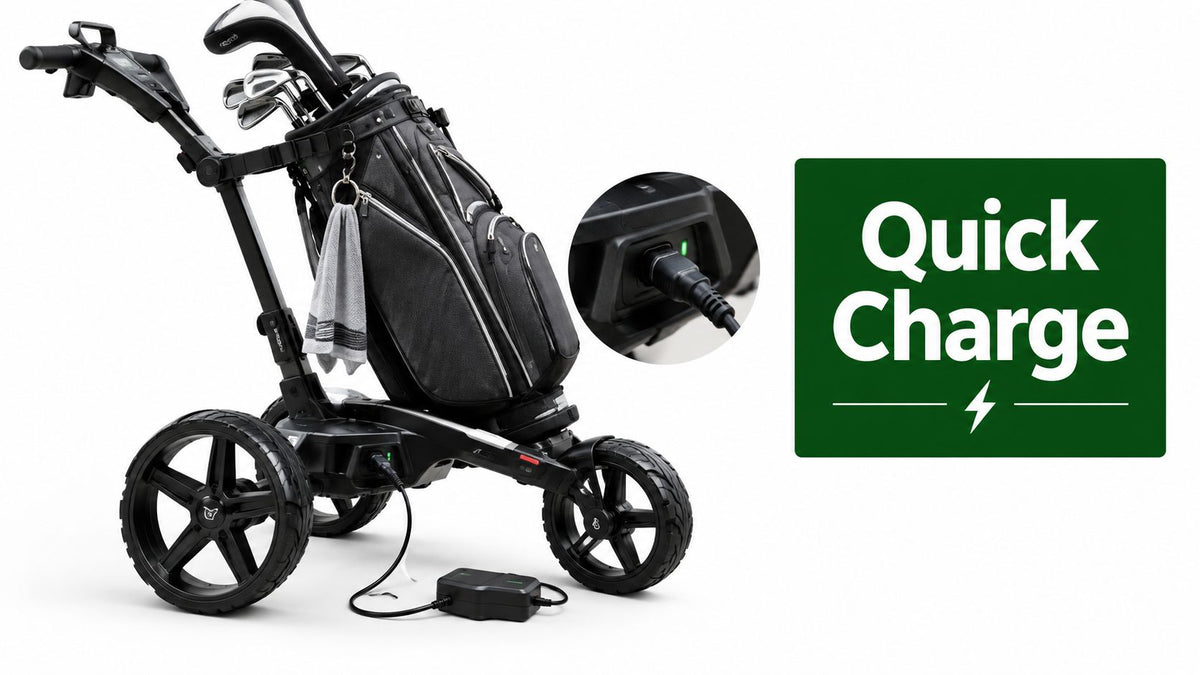
You're on the first tee, the battery gauge looks decent, and then someone says there's a hilly back nine ahead. If you've ever wondered whether a quick top-up before the round is smart or whether it shortens quick charge battery life, you're asking the right question. The answer isn't a simple yes or no. It depends on the battery chemistry, the heat around the pack, and the way you charge between rounds.
For walking golfers, that nuance matters because portable golf-cart batteries rarely live a neat, laboratory life. They get partial charges, sit in hot trunks, cool off overnight, and sometimes get plugged in again just to finish one more round. Those habits don't punish every battery in the same way, which is why the core issue is system-level performance, not charging speed alone.

Introduction to Quick Charge Battery Life on the Course
A lot of golfers face charging decisions at the worst possible time. The battery is low after nine holes, the group behind you is ready to go, and you're deciding whether to plug in for a short break or save the pack for later. That is where quick charge battery life stops being an abstract battery topic and starts being a practical golf problem.
The common mistake is treating charging speed and battery wear as the same thing. A fast plug-in does not automatically mean damage, and a slow charge does not automatically mean protection. Real-world EV data found no statistically significant difference in range degradation between Teslas that fast charged more than 70% of the time and those that fast charged less than 30% of the time, which points to chemistry, thermal control, and charging pattern instead of speed alone (Recurrent analysis). That same system-level logic applies to golf batteries too, especially when charging happens in bursts between rounds.

A golf battery also does a very different job from a home appliance. It has to deliver dependable power, recover quickly when you need it, and handle the stop-start pattern of a walking round. Portable golf-cart batteries face partial charges, warm trunks, cool nights, and occasional top-offs before the next round. Those conditions do not affect every battery the same way, so the question is how the whole charging system behaves under heat and repeated short cycles.
Practical rule: treat quick charging as a tool for convenience, not a habit to use automatically after every round.
For golfers who want a deeper overview of charger behavior, this guide on charger fast charging fits naturally with the basics here. The short version is simple: the charger matters, and the battery's chemistry and temperature matter just as much.
How Quick Charging Actually Works
Think of a battery like a water tank. Current is the flow of water into the tank, voltage is the pressure pushing it, and state of charge is how full the tank already is. When the tank is mostly empty, filling is easier. As it gets closer to full, the same flow has to work harder, and the process slows down.
The main pieces that control charging speed
A quick charge session isn't just “more power.” The charger, the battery management system, and the battery cells all negotiate how much energy can safely move at once. In simple terms, the charger wants to move energy fast, while the battery system tries to keep temperature and voltage in a safe zone.
That's why people often notice charging feels fastest in the middle of the battery range. The last stretch toward full charge is slower because the system protects the cells from stress at high state of charge. This isn't a bug. It's built-in caution.
What C-rate means in plain language
Battery people use C-rate to describe how quickly a battery charges or discharges relative to its size. A higher C-rate means more aggressive charging. Research cited in the brief notes that fast charging at 2C or higher can reduce lithium-ion cycle life by 20 to 40 percent versus 1C charging, depending on temperature control and cell design (Better Tech).
The useful question isn't “Is fast charging bad?” It's “How hard am I asking this battery to work, and under what conditions?”
The cell design matters too. In the comparative aging study in the brief, high-energy cells had much lower cycle life under fast-charge conditions, while a high-power cell lasted far longer. That's the same reason one portable battery can handle quick top-offs with little drama, while another gets hot, slows down, and ages faster under the same charger.
Why Quick Charging Can Shorten Battery Life
A quick charge looks simple at the outlet, but inside the battery it is a juggling act. The charger is pushing energy in fast, while the cells have to manage heat, voltage, and chemistry at the same time. For portable golf-cart batteries that often see partial charges, then sit through temperature swings, that mix matters just as much as the charger's wattage.
Fast charging stresses a battery in a few specific ways, and the terms are less mysterious than they sound. Lithium plating means lithium deposits form where they should not. Loss of active material means parts of the cell stop contributing as well as before. Impedance growth means internal resistance rises, so the battery has a harder time delivering power smoothly.
Heat and high current do the damage together
High current pushes ions through the cell more aggressively, and high voltage adds another layer of stress. If the battery is already hot or very cold, the risk rises. That is why battery engineers care about temperature windows and charge limits, not just charger speed.
The chemistry matters as much as the charging hardware. In the brief's comparative aging study, high-energy cells showed cycle life ranging from about 100 to 900 cycles under fast-charge conditions, while a high-power cell exceeded 1,700 cycles. The same study found degradation rose sharply as charge current and voltage increased, though one cell type was much less sensitive than the others (MIT Braatz Group study).

Why the top end of charge is different
Near full charge, the battery has less room to absorb stress. The chemistry becomes less forgiving, so a well-designed pack slows the process down to protect the cells. To the person waiting by the cart, that slowdown can feel frustrating. Inside the pack, it is a safety cushion.
Fast charging is least forgiving when high current, high voltage, and weak thermal control show up together.
Two batteries can see the same charger and age differently if their chemistry and cooling are not the same. That is why quick charge battery life is better understood as a chemistry, heat, and charge-habit problem than as a simple speed question.
What Real World Data Shows About Fast Charging and Degradation
Real-world fleet data gives a calmer view than lab results alone. Some batteries hold up well with frequent fast charging. Others age faster once high-power charging becomes the habit. The pattern matters, but it is tied to chemistry, heat, and charging routine, not speed by itself.
Different fleets, different outcomes
Analysts at Recurrent looked at more than 13,000 U.S. Teslas from model years 2012 to 2023, using over 160,000 data points. They found no statistically significant difference in range degradation between vehicles that fast charged more than 70 percent of the time and those that fast charged less than 30 percent of the time. That finding matters because it shows charging behavior only explains part of battery aging.
Geotab's 2026 study of more than 22,700 EVs across 21 vehicle models found a clearer split. Vehicles using DC fast charging above 100 kW had annual battery degradation of up to 3.0 percent, compared with around 1.5 percent for vehicles that mainly used AC or lower-power charging (Geotab study). The same dataset also reported 1.5 percent annual degradation for vehicles where DC fast charging made up less than 12 percent of charging sessions, and 2.5 percent for those above that mark.
Why those numbers don't tell the whole story
The two results fit together. They show that frequency, power, chemistry, and thermal design all shape battery wear. A pack that gets quick charges now and then may age differently from one that depends on them every day. Cooling matters too. A battery that stays cooler under load usually has an easier time than one that keeps running hot.
A related point from the brief helps fill in the picture. NREL research summarized there found that the average driver used fast charging about 10 times in the first year, with extreme cases around eight times per month, and DC fast charging typically made up less than 10 percent of total BEV electricity. That suggests quick charging was never the only charging style for most drivers.
| Charging pattern | What the data suggests |
|---|---|
| Mostly lower-power charging | Lower annual degradation in fleet data |
| Frequent high-power DC charging | Higher annual degradation in some fleets |
| Occasional quick charging | Often manageable, especially with good thermal control |
For golfers, the lesson is straightforward. A short recharge before the next round is usually manageable. Making quick charging the default, especially with portable golf-cart batteries that see partial charges and temperature swings, can add wear over time.
Best Practices to Maximize Quick Charge Battery Life
A quick charge helps most when it solves a real need, not when it becomes the default habit. The battery behaves better when you manage chemistry, heat, and charge level together, the way a golfer keeps an eye on weather, pace of play, and club choice at the same time. Charge enough for the round, let the pack cool when it has been working hard, and avoid leaving it parked at the extremes longer than necessary.
Use the 20 to 80 idea as a practical habit
The 20 percent to 80 percent range is useful because the middle of the charge window is usually easier on the cells. Geotab's battery-health data showed that degradation sped up when vehicles spent over 80 percent of their total time at or near-full or nearly empty charge levels, while moderate exposure was much less of a problem (Geotab study). For golf use, that means you do not need to chase a perfect number every time. You do want to avoid keeping the battery near full for long stretches when you do not need the extra range.
If you want a practical follow-up, golf cart battery charging tips for max longevity breaks down the same idea for everyday cart use. The basic pattern is simple. A battery usually handles steady, moderate use better than repeated extremes.
Temperature should change your decision
Heat and cold change the result. Research in the brief shows repeated fast charging at 10°C and below led to significant degradation from the start, while charging at 23°C showed no noticeable performance loss in one study (IOPscience study). Another study cited there reported around 41 percent capacity loss after 100 cycles at about 70°C, compared with minimal fading at room temperature under similar fast-charging conditions (ScienceDirect study).
That is why timing matters. If the battery feels hot after the round, let it cool before topping off. If the morning air is cold, expect the charging process to be more conservative.
Single most useful habit: charge when the battery is warm enough to work comfortably, not when it is hot from use or cold from storage.
For golfers who are also upgrading their practice setup, the team at Dialed Golf published a guide where you can review top launch monitors with Dialed Golf before your next range session.
Real World Guidance for Portable Golf Cart Batteries
Portable golf-cart batteries live in a practical middle ground. They're not sitting on a bench all week, and they're not running a huge road trip load either. They get short bursts of use, partial recharges, and regular handling in outdoor conditions, which makes their charging pattern more like a working tool than a stored appliance.
Match the charge to the round
For a normal 18-hole outing, the smartest move is often to start with enough charge for the day and recharge after you're done. If you know the next outing is another 18 or a hilly course, a quick top-up makes sense. If you're only using the cart lightly, there's no reason to push the battery to full every time just because the charger is there.
That mindset matters for quick charge battery life because convenience and longevity pull in opposite directions when they become automatic habits. A portable battery that's always topped off may be ready on demand, but it also spends more time at the high end of charge, which is the part of the range that usually deserves the most respect.
Think in seasons, not just today
A battery that feels fine after one quick recharge might still be accumulating wear in the background. Over a season, the key question isn't whether one top-up worked. It's whether your routine keeps the battery usable and dependable for the next round, the next trip, and the next warm weekend.
If your setup uses a portable charger, the guide on how to use portable charger gives a clean reference point for normal charging behavior. The useful habit is to treat quick charging as a response to actual need, not a reflex.
Here's the cleanest way to understand it:
- Morning round: start with enough charge for the day, then recharge after use.
- Afternoon replay: use a quick top-up only if the battery won't comfortably finish the full plan.
- Hilly course: prioritize range buffer, because extra load matters more than you think.
Caddie Wheel's portable golf-cart setup fits this use case well because it's built around the kind of partial-charge, quick-turnaround routine walkers live with. That doesn't remove battery care from the picture, it just makes the charging pattern easier to manage.
Making Smart Charging Choices for Longer Battery Life
The best charging choice is usually the one that matches the day, not the one that sounds fastest. If you remember only three levers, make them chemistry, heat management, and charge habits. Those are the factors that turn quick charging from a vague worry into a manageable routine.
For practical decision-making, use this simple check before you plug in. Is the battery hot, cold, or comfortable? Do you really need a full charge, or just enough for the next round? Will the pack sit at a high state of charge for a long time afterward? If the answers point toward unnecessary stress, delay the charge or shorten the session.
The evidence behind quick charge battery life is more nuanced than expected. Recurrent's large Tesla analysis showed no clear degradation penalty from frequent fast charging in that dataset, while Geotab's fleet work found higher annual degradation when high-power DC charging dominated. The difference is the system around the battery, not the word “fast” by itself.
For golfers, that leads to a straightforward rule. Use speed when the round calls for it, then let the battery spend more of its life in the middle of the range, at reasonable temperatures, with fewer extreme habits. That's how you keep convenience without turning every recharge into a long-term penalty.
If you want a golf battery setup that's built for real walking routines, visit Caddie Wheel and look at how its portable electric assist fits into everyday charging habits. You'll see how the right hardware can make quick top-ups easier to manage while still giving you a simple path to longer battery life and more comfortable rounds.
Share:
Remote Golf Trolley Reviews You Can Trust in 2026
36 Holes of Golf How Long It Takes and How to Walk It